In this post I have explained how to design an intriguing LED light effect that generates a collapsing metor shower like appearance. The idea was requetsed by Mr.Pinto Mondal.
Technical Specifications
I am very grateful of your work. Sir I want to make a circuit,which available in the market like 1 or 1.5ft long led light stick and the led flow's from up to down ,like water flow's slowly down from up.
so please sir help me out the circuit, the name is "rain tube led string" size 50cm on Internet I found another name hot meteor shower
Thanks
Pinto Mondal
What is LED Meteor Shower
As the name suggests, the proposed meteor shower or rain tube LED light circuit imitates a falling meteorite, collapsing in the sky.
Some of the other names for this project can be as given below:
- Falling LED light circuit
- Dropping LED Light circuit
- Slow Fade Running LED circuit
- Shooting Star LED Effect Circuit
The effect begins with a sequentially incrementing bar graph type of illumination which suddenly begins collapsing from the rear until its completely OFF, the effect keeps on repeating, quite resembling a chasing and collapsing meteorite in the sky.
When connected in groups, the visual experience can be quite a mesmerizing.
UPDATE
While practically verifying the circuit I found that the meteor shower effect could be improved and made more powerful by introducing the LEDs at the collector side of the transistor.
The revised circuit diagram can be seen below:
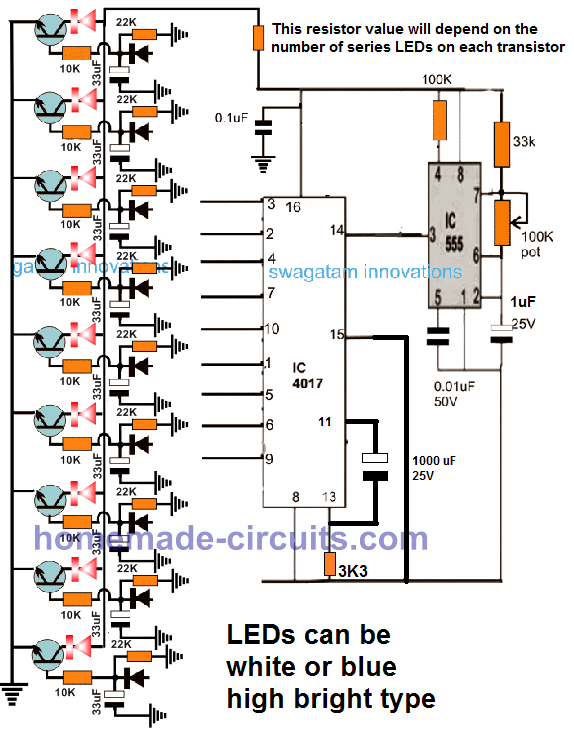
Parts List
All resistors are 1/4 watt 5%
- 10K - 9
- 22k - 9
- 33k - 1
- 100k pot - 1
- 3k3 - 1
- 1N4148 - 9
- IC 4017 - 1
- IC 555 - 1
- BC547 - 9
- LEDs Blue/RED - 9 to 36 (1 to 4 in series on each channel)
- 33uF/25 - 9
- 1uF/25V - 1
- 1000uF/25 - 1
- 0.1uF - 1
Note: The 100K on IC 555 pin#4 can be removed and pin#4 connected directly to the positive line.
The 1000uF can be reduced, if the 3k3 is increased proportionately.
Video Demonstration
PLEASE IGNORE THE DESIGN DISCUSSED IN THE FOLLOWING SECTIONS BECAUSE IT IS AN OLDER DESIGN AND HAS NOT BEEN VERIFIED THROUGH PRACTICAL TESTING.
Circuit Diagram
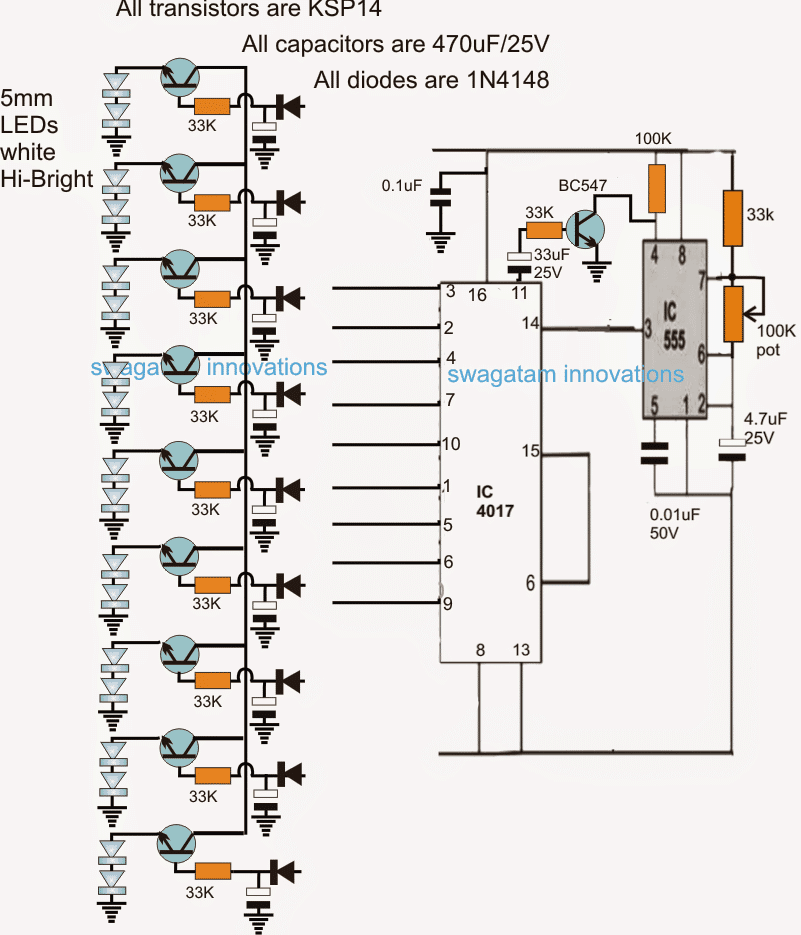
The idea could be achieved through the circuit represented above, using a Johnson's decade counter and a 555 astable clock generator circuit.
How it Works
It's basically a LED chaser circuit with a delay effect that's introduced at the base of each LED driver transistor. The charge stored in the capacitors hold the LED illumination for some moment until shutting them off gradually at the same sequencing rate as these were earlier illuminated....creating the fading collapsing effect of a meteor shower.
The IC 4017 outputs produce a jumping high or shifting logic high across its pin#3 to pin#9 in response to the clock signals fed at its pin#14 by the IC 555. The speed of this sequencing can be adjusted and tailored as per preference with the help of the 100k pot associated with pin#7 of the IC 555
The sequencing begins from pin#3 of the IC 4017 and proceeds until the sequence reaches pin#9 of the IC, during this course of travel, the LEDs illuminate in a bar graph form, due to the holding charge within the base capacitors of the transistors.
By the time the sequence reaches pin#9, the capacitor across that bases of the transistors begin losing there holding power as these are discharged sequentially, such that the LEDs too begin shutting from pin#3 towards pin#9, until all the LED are shut off.
However until this process is completed successfully, the IC 555 must somehow be disabled otherwise the sequence will reset back to pin#3 of the IC 4017 before the LED are able to shut off for evolving the desired meteor shower effect...and the whole purpose of the design might be nullified.
In order to ensure this, as soon as the sequence reaches pin#9, and subsequently to pin#11, the pin#11 holds pin#4 of the 555 to ground disabling the IC for some moment until the fading or the collapsing effect of the sequence is implemented across the LEDs. The time delay responsible for this must be precisely set by adjusting the base resistor of BC547 transistor at pin#11 of IC 4017.
If you are not interested to include the above explained pin#11 stage, the other alternative is to use the LEDs driver stages only up to pin#5, and allow the remaining pinouts to be blank, such that the sequencing logic while crossing these blank pins provide the required time delay for the collapsing effect to complete.
The idea can also be implemented using 1 watt LeDs for enabling brighter and more robust meteor shower LED effect....the only change required for this would be to replace all the transistors with TIP122,and make sure the LEDs are mounted on adequately large heatsinks.
R/C Delay Components Selection is Important
In this circuit the timing resistors and capacitors across the transistor bases play an important role for enhancing or degrading the desired meteor shower light effect...therefore the values must be selected carefully and tweaked through experimentation until the most impressive outcome is achieved.
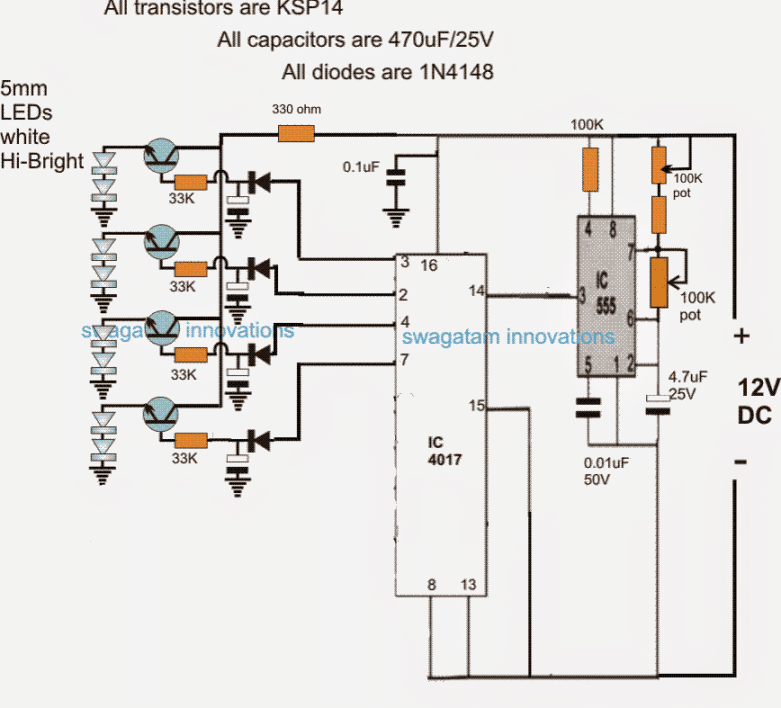
The above circuit can be simplified to an extent by implementing the modifications as shown in the following image, although the effect will not be as interesting compared to the original design, the LED meteor shower effect will be still effectively displayed.
Simplified Schematic



Questions & Answers
I used a 741HC164 IC, a BJT547 (1 unit), 555 timer and a 10k trimpot. I achieved the output in simulation, but I’m unable to replicate it on the breadboard.
I would suggest you to build it on a perfboard by soldering, by referring to the first schematic, it will surely work.
I have a project where I would like to cascade six 4017s together to drive a total of 48 LEDS. Would the set of LEDS from the first 4017 fade off before the second set began to come on? Do you have any schematics where you have cascaded a number of 4017s? Power requirements wouldn’t change if only one 4017 is functioning at a time? Thanks for your thoughts? You have inspired me to re start a hobby that I enjoy.
The fading effect can be created by adding capacitors at the bases of the LED transistor drivers.
Yes I have an article where I have discussed how to cascade a few 4017 ICs. You can find the details in the following article:
https://www.homemade-circuits.com/how-to-understand-ic-4017-pin-outs/
Is there a breadboard layout available? I am attempting but making the connections to and from the 555 are somewhat throwing me off. My standard size breadboard may not be big enough to see and get clarity.
You must use an 830 points breadboard.
It can be done.
I have made with some modifications, to only light 6 LED’s under 3.7V lithium battery, using CMOS IC.
And instead of 1N4148 I have use 1N5819 Schottky diodes, since the drop-down voltage is arround 0.1V instead of the 0.5V of the 1N4148.
I won’t recommend a breadboard construction for this project. I would recommend building it over a strip-board by soldering the components. The circuit is tested so you can afford to build it by soldering.
Sir, first of all thank you for publishing these circuits. I am a neophyte and am trying to build it.
First question: in the third picture, the one called “Simplified Schematic” which includes only 4 LEDs in the circuit, I can’t understand the type of resistor in the upper right corner, the one that is between the two potentiometers.
Second question: I would like to make the meteor effect of 3 led width (instead of 1 only as shown in the picture); what changes should i make?
Thanks again.
Gabriele
Thank you Gabriele,
Please use only the first circuit.
For 4 stages connect the LED stages to pin3,2,4,7.
Disconnect pin15 from ground and connect it with pin1
Disconnect capacitor positive from pin11 and connect it to pin10
Sir, thanks again for your valuable advice. I ask you one last thing: in the picture you wrote, about the resistor at the top, “This resistor value will depend on the number of series LEDs on each transistor”; here I would like to insert 3 LEDs on each transistor (for a total of 3 x 4 = 12 LEDs); what type of resistor do you recommend to apply?
Thank you so much.
Gabriele
Gabriel, for 3 LEDs in series with 20 ma current and 12 V supply you can use a 120 ohm resistor 1/4 watt
Thank you very much sir!
You ate welcome!
Sir can I use BD140 and BC547 transistors to make BC517 transistor?
Sir, I like your rain drop design. To design it myself, I cannot find bc517 or ksp14 transistors in my area? What is the option for it???????????????????????
Gayan,
please see the updated design, there’s no BC517…all are BC547
sir can i use bc transistors…. i cant fine the listed
you can try, but preferably it should be Darlington
Sir my circuit is working very well. The only thing i want is to discharge the capacitor at the base of a transistor a little faster. Because the fading effect is very slow. I used 1 uf cap. but still the discharging is very slow. Is there a possible solution with this problem of mine.
Thank u very much and more power to you.
May God bless u always.
Celio
I am glad you could make it successfully Celio, to further reduce the delay effect, you can try lower values for the 33k base resistor, initially you can try 22K and check the results, or try other lower value to make it even faster…
Thank you very much sir for your quick reply to my question. It is working very nice and very attractive. I used the 18 output of 2 ic 4017. The result is continuous moving chain of lights with fading effect
Thanks again & God bless you always.
Thank you Celio, I am glad it is working, keep up the good work!
hi hello sir my name is johnny. sir i follow all your diagram of meteor shower led but only no.3 will light but no running. only no.3 steady
johnny, it means your IC 555 is not generating the required pulses for the IC 4017 at its pin#14…make sure the IC 555 is oscillating and generating the required pulses
Sir , how to make npn Darlington pair using bc547 transistor
Mahadeb, connect the collectors of the two BJTs together, then connect the base of one with the emitter of the other…that's all..
you will find one base and one emitter pins free…connect the base with the input signal, and emitter with the load
Sir have made many attempt but got no success, I have made circuits in a beard board and I have used 33uf 50v capacitor. Initially pin is shifting from 3 to 9 and remain steady. Sir if possible please upload a fresh diagram so that me as a new in this can understand what mistake I have made in circuits.
Rajesh, if you try making random changes you will never get any success, you must know what exactly you are doing and how it is supposed to effect the results. All the components have their specific role and needs to be correctly set up.
the diagram is perfect except the 33uF polarity which needs to be reversed.
if you do not wish to include the pin#11 modification, you can try the last circuit but the number of channel will be reduced.
Sir I have made a circuit using bc517 while giving power through pc smps intially LED is shifting from one pin to another and after that light start to began dim and LED then not lit up. I have removed pin 11 then led is working but not working like a meteor. Please give me some suggestion in ordwe to rectify the problem. I have also tried to change the ic 555 and 4017 but the problem still exists.
Rajesh, you will need to adjust and experiment with the capacitor value or the 33K resistor at the transistor base to get the correct effect, the 555 speed will also need some tweaking
I hope you know the function of pin11…it is introduced to add some delay between the cycles.
please read the previous comments for getting a proper idea regarding the adjustments.
Sir can I use bc517 Instead of ksp14. As ksp14 is not available in market.
Hi Rajesh, yes you can use BC517 transistor instead of ksp14
hi swagatam can the meteor circuit be used on 110 volts with triacs?
Hi William, it is possible by replacing the transistors with triacs, but the fading effect may disappear..
TIP 122 transistor noting in my area… please
Thank’s a lot Swagatam,
You are the best.
I changed the capacitor to another brand and changed the polarity as you described.
Now it works as expected and the LED on pin 3 is also working.
Again thank you,
Henrik
You are most welcome Henrik, wish you all the best!!
Dear Swagatam,
Thank you for your fast reply and effort always to help.
As you guessed my 555 was oscillating to fast. I had accidently used a 4,7 nF capacitor instead of the 4,7 uF. Changing the capacitor to the correct one fixed the problem with the too fast oscillating.
Now I have another problem. The LED’s illuminates once only. By switching the power off/on the LED’s illuminates once again.
I though the problem was my transistor not resetting the 555 and changed it but without success.
I don’t have a 33uF in stock (pin 11) so I used a 47uF instead. Could that be a problem?
The LED at pin 3 of the 4017 (first output) does not illuminate. Does that have anything to do with the above fault? The LED is OK
Thanks Henrik,
The idea is simple, as soon as the logic reaches pin#11 of the IC 4017, the 33uF initially triggers BC547 into conduction which jams the 555 IC oscillations and therefore the IC4017 sequence stops for a moment.
However as the 33uF charges up may be within 3 or 4 seconds and gets full charged, the BC547 is no longer able to hold the conduction and it releases the IC 555 which again starts oscillating and allows the IC 4017 to start a fresh cycle.
If your IC is permanently getting jammed then perhaps the 33uF cap or your 47uF cap could be leaking current which might be keeping the BC547 permanently ON.
Please note that the polarity of the 33uF is incorrectly shown, it should be the other way round, meaning its positive should be towards pin#11.
Coming back to the issue, you can try connecting a diode in series with the 33uF or 47uF to prevent the leakage current, and see if that helps….
pin#3 should illuminate in any case….connect a capacitor very close to the (+)/(-) pins of the IC4017 and see if that corrects the issue.
Dear Swagatam,
I am having trouble with this circuit. When I connect 12V to the circuit nothing happends.
I hope I have understood your answer to Pintu (November 20 2015) correct with only 1 LED at each output of the 4017.
The current usage is only 10 mA.
In order to try to find the error I removed the BC547 transistor to make sure I got a clock from the 555.
With the transistor removed all LED’s lights up.
Connecting an LED to pin 3 of the 555 gives light, but not a pulse (blink).
Please take a look at my PCB layout and tell me if I have made an error.
https://1drv.ms/f/s!AuZaLQUHZG7QZ-olZded8OnaDgs
Best regards,
Henrik
….I guess your IC 555 might be oscillating too fast and that's the reason it's pin#3 is showing a constant glow and the 4017 outputs are all lit up….try increasing the 555 capacitor value to some higher level, until the blinking comes to a slower distinguishable level…
Dear Henrik, even if the 555 does not oscillate, still all LEDs across the 4017 output cannot light up, because the 4017 is designed to illuminate only one LED at a time…so this is something which you may have to check additionally.
As far as the 555 IC is concerned, the circuit is correct and it should show an oscillating output at its pin#3.
I think you should have first finalized the design over a general purpose board and then designed a PCB, because unless a circuit is confirmed practically you could have multiple problems in the PCB layout.
Sorry I having difficulty in viewing your PCB, the zoom-in is not responding properly due to some reason….you can take help of the second design in the following article and use fixed parts for acquiring the 2Hz frequency at the pin#3 of your 555 circuit:
https://www.homemade-circuits.com/p/ic-555-calculator.html
if still it does not respond then your IC could be faulty.
Sir I live in kolkata, naihati. Here ksp14 Darlington non transistors not available .so pls refer ksp14 equivalent transistors.
..for the other set up simply connect the collector of BC547 with base of BC557 via a resistor.
emitter of BC547 to ground, base to trigger, and load across negative supply (ground) and collector of BC557
Mahadeb, it is not difficult at all, connect the collectors of BC547/2N2222 together, connect the base of 2N2222 with emitter of BC547…that's all.
Now you can use this set up by connecting negative supply to the emitter of 2N2222, trigger to base of BC547 via a resistor and load across positive supply and collector of BC547/2N2222
Sir can I use two bc547 together to form a Darlington pair.
Ksp14 transistor is not available in my area.only BC328 is available in my area can I use it instead of ksp14.
BC328 is PNP, it won’t work here.
Thanks for your prompt reply sir. I’m so impressed in your projects keep going sir.wish you all the best…
You are welcome Deepu!
Hi Deepu, yes you can if the LEDs are 20mA rated
Sir pls send me the circuit diagram of Darlington pair using bc547 and 2n222.
Sir can use bc557 and bc547 for making Darlington pair
mahadeb, you can use TIP122, or make Darlington pairs using BC547 and 2N2222 together for each channel.
Hi again,
Thank you very much
Hi Swagatam,
I would like to try this circuit because of the great effect.
I am having trouble to find the KSP14 transistor. Could a replacement be the MPSA13? Also a Darlington NPN transistor. Or another Darlington transistor? Maybe a 547 and 558 coupled as Darlington?
cdn-reichelt.de/documents/datenblatt/A100/MPSA13_CDIL.pdf
Best regards,
Henrik
Hi Henrik, you can use any form of Darlington NPN transistor for the purpose, but make sure the current of the transistor is rated much higher than the LED current
Hai sir, how can I possibly increase the no. Outputs from 9 to say 15 or so in?
Hi Jacob, you will need to cascade two ICs, and get 18 outputs
dear sir ,
great job by u,thanks.
i want to know how can i run 5w/500ml.amp.led run on 12v/7.5ah lead acid battery.
i connect it with 15ohms/10watt resister but light is very low.can i run this led without any heat sink and resister.
Dear Bashir, please specify the voltage rating of the LED, or you can use the following formula to get the resistor value;
R = Battery voltage – LED voltage rating / LED amp rating
Hi Swagatam,
I read the text again and noticed that pin 8 of 4017 connects to – … this means ground, as pin 15?
Best Regards,
Nélio.
Thanks Nelio, yes you are right.
the diagram was lifted from one of my other articles, and I forgot to correct pin15 connection as per the present requirement.
Pin8 and pin13 are already connected to ground and is shown in the diagram, therefore I only pointed towards pin15 because this pin which is incorrectly shown connected with pin6 needed the correction.
Hi Swagatam,
Me again… you say in the text that pin 15 of 4017 should be connected to the ground…. what about pins 8 and 13?
Best Regards,
Nélio.
Hi Swagatam,
There's an error in your schematic…. There are 2 pins 6 in the 4017….
Please check it.
Best Regards.
Nélio
P.S. Keep up the good projects.
Sir, the led wattage divided by led forward voltage = led amp, is it universal formula?
yes it is an universal formula…
Sir,Sorry for the comments, one thing I am asking you can I use two 10w smd led or one 20w led on12v 2amp smps if yes do I need any limiter circuit or resistor
Pintu, yes you may use it, but you will need a current limiter in the middle as described in the following article:
https://www.homemade-circuits.com/2013/06/universal-high-watt-led-current-limiter.html
Sir, I am waiting
Pintu, it was updated on the same day, please see the last diagram….
Thank you,sir
Sir, I am new in electronic and the meteor shower circuit you gave me its more big then I thought specially the led portion and I think my bread board not enough to hold the full circuit so I am buying some time to think and doing some small ic circuit to make some confident, can I make one led at the end instead of two
Pintu, I'll try to make it little short for you…then you can try.
I'll make it 4 LEDs….2 LEDs will not produce the required effect.
Sir, this is not the meteor shower led light it's blinking led light please see the video
yes it's not LED meteor shower because you have just anything as per your own wish and will….it's not my circuit….it's your modified circuit.
Sir, I want make more faster blink ,not the two led I need, I want 1 led the blue one blink and little faster what's the change I have to made ,in this video https://drive.google.com/file/d/0B_REIZgLatu2eFc1eFBCX0hWdm8/view?usp=docslist_api
….reducing the 33k resistor or the 4.7uF cap will make the blinking rate faster
Sir, can pot resistor get damage by heat of soldering iron
no pots will not get affected with soldering heat…unless it's held for too long
Yes sir, l made many mistakes in this circuit so my circuit not working now I am doing it on bread board and asking you two parts value, can I use Ecap 4.7uf/63v instead of 4.7uf/25v and 2A103k instead of 0.01uf/50v
yes, both the mentioned capacitors will work….
and you will need to include the transistors also….initially you can try BC547 with 5mm LEDs
Sir, the circuit is not working.i am powering the circuit with the mobile charger and nothing happen. sir,the cap before led is it 470 uf, because they are big.what what would be the possible problem.
Pintu, the circuit may not be working because there might be faults in your connections or parts.
Are the LEDs running from pin3 to pin11?
first make sure the LEds at least shift from one pin to the other…after that we can fix the delay time factor…
initially keep the pin11 circuit disconnected or simply remove this stage.
Dan – Abuja Nigeria
Sir I am a regular visitor to your blog and I find it very interesting I have a request for your assistance. I have a 2KVA rated Liebert UPS running on an internal battery consisting of 8 pieces 12v 7amps rating all connected in series. Now I have an external battery bank of 8 pieces 12v 18amps also connected in series I have not yet attached it to the ups until I can find a circuit that can independently charge the external bank. please assist me in this regard, with a cct. that can charge the 8 batteries in series Thank you
Daniel, If you wish, you can charge the batts in series, but it's never recommended.
the link is opening here in my computer, you might have not copied it correctly…please check it again by copying the entire link and opening it in a new tab.
Sir
Thanks for your prompt response, going by your explanation it looks a bit cumbersome to build several circuits to recharge these batteries individually. however, as I earlier mentioned the internal batteries are all connected in series and are charged simultaneously by the UPS that being the case I thought I could have a circuit that can charge the external Bank.
If that is not possible how about grouping them into 4 making 48Volts into 2 for the purpose of charging them. meaning connecting 4 of them in series and charging them.The link you referred me to is not opening thanks for your advice
thanks Dan! you can simply use a 0-12V/ 2amp transformer, connect a bridge rectifier to it using 1N5408 diodes and connect the output to each battery individually through a 5amp FSD ammeter….when the ammeter needle falls to zero you can assume the batt to be fully charged, you an do this to all the battey one by one
or make 8 such units and connect to the 8 batteries for charging all of them simultaneously.
if you are interested to include an automatic cut off, in that case you can include the second circuit from the following article in between the battery and the 12V/2amp power supply:
https://www.homemade-circuits.com/2011/12/how-to-make-simple-low-battery-voltage.html
Sir, in ic- 4017 pin 6 connect with pin15, is it pin 6 or pin12 and you told that pin 15 not connect with pin 6 or 12 connect with ground, then pin 6 or 12 remain open or what?
pin6 is one of the outputs…please see and do it carefully…
pin12 is unused
pin15 is connected directly with ground
Pintu, don't use the transistors initially….do it in this way:
first chnage the resistor after the diode to 1K…and then connect the LEDs directly across the end of this resistor and ground….do this for all the outputs…and check the response.
Sir, in our area there are no ksp 14 transistor so, can we have any similar transistor
Thank you very much sir, for making the circuit so fast.now I have two questions & a request ,the question is 0.1uf cap is it Polly cap & volt value is?and the circuit is it powerd by 12v DC & the connection(- +)is ,need any current limiter circuit. Now the request can you please tell me what's the change I have to made for making this kind of effect. https://drive.google.com/file/d/0B_REIZgLatu2UWtzVjlSMlhaNXM/view?usp=docslist_api
0.1uF cap can be a disc ceramic capacitor,
please read the section shown in bold letters for other info
Pintu, yes, the show circuit can be expected to give approximately the same results as shown in your video….