In this article I have explained how to make a very simple circuit for buzzer using piezo electric transducer, two resistors, a small coil and a BC547 transistor.
A buzzer is a high frequency oscillator circuit used for generating a buzzing sound through a transducer or speaker output.
Simple Buzzer using a Single Transistor
Just a single transistor, a ferrite inductor, and a piezo transducer, that's all you will need to make this circuit “buzz” or rather “twit” for you, with an output that may be quite loud and ear piercing.
The simple piezo buzzer circuit described here actually works in a quite unique way. Instead of the normal working concept employed by other forms of oscillators which require resistor and capacitor networks for generating the oscillations, this circuit use inductive feedback for the required operations.
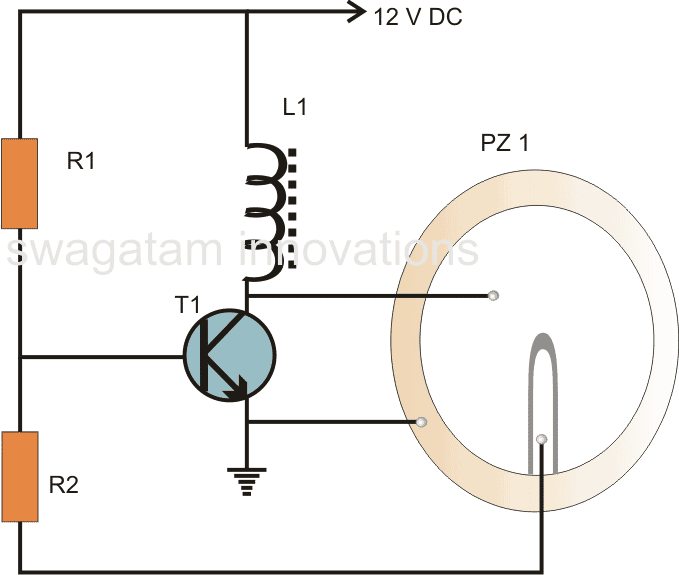
Circuit Description
Referring to the above buzzer circuit diagram we find that the transistor T1 along with the inductor forms the heart of the circuit.
Basically the coil which is specifically called the buzzer coil, is in fact positioned for amplifying the created oscillations while the actual feed back is provided by the center tap of the three terminal piezo element used for the present application.
When a voltage is introduced in the circuit, the transistor conducts, operating the piezo element across the buzzer coil.
However this also leads to the grounding of the base of the transistor through the center tap of the piezo element, this instantly switches off the transistor and in turn the piezo also switches off, releasing the base of the transistor.
The transistor reverts to its original state and the cycle repeats, generating oscillations or the required “buzzing” frequency.
The center tap from the piezo transducer plays an important role in sustaining the oscillations and therefore in this particular design we need a three terminal piezo rather than a two terminal one.
The oscillations produced at the collector of the transistor is dumped into the coil, saturating the coil with magnetic inductions.
The coil kicks back the stored energy during the oscillations, magnifying the generated AC across it.
This stepped up AC is applied across the anode and the cathode of the piezo element, which starts vibrating sharply according the pitch of the frequency, generating a shrill, ear piercing sound in the air.
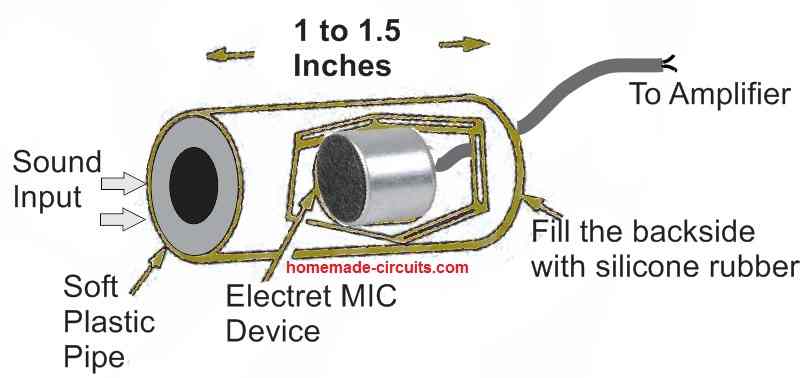
However to make the sound audible at maximum intensity, the piezo transducer needs to be glued or installed in a special way inside its housing.
Video Clip
How to Stick Piezo
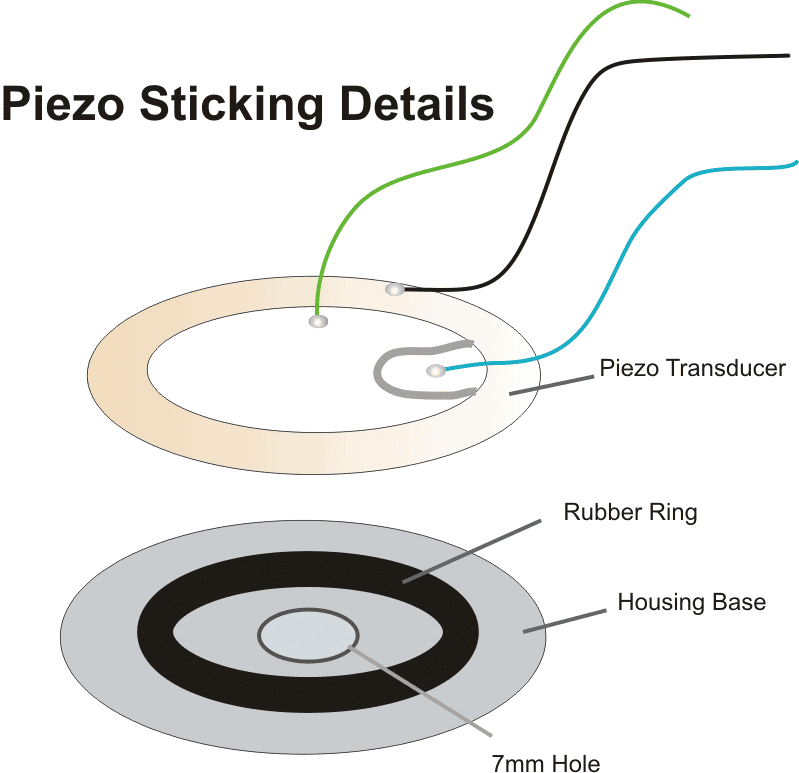
Video Clip showing the various procedures required for sticking a piezo transducer correctly:
For this particular application the piezo element needs to be stuck at the base of its housing which must consist of a hole having a diameter of about 7 mm.
The piezo element cannot be stuck directly over the base of the housing, rather it must stuck and positioned over a soft, pure rubber ring, having diameter 30 % less than that of the piezo transducer.
Only if the above fixing procedure is followed, the buzzer will sound, otherwise the sound may get choked and fail to reproduce.
Parts List
- R1 = 100K,
- R2 = 4k7,
- T1 = BC547,
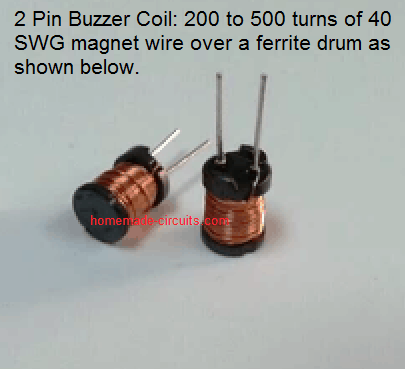
- L1 = Buzzer inductor,
- PZ1 = Piezo element, 27mm, three terminal
- Rubber ring = 22mm
Formulas and Calculations
Transistor Operating Conditions
Base Current (IB):
IB = (Vin - VBE) / RB
Where:
- Vin = Input supply voltage
- VBE = Base-emitter voltage of the transistor (typically ~0.7V for BC547)
- RB = Base resistor value
Collector Current (IC):
IC = β * IB
Where:
- IC = Collector current
- β = Current gain of the transistor (typically ~100–200 for BC547)
Saturation Condition:
IB > IC / β
Inductive Reactance
Inductive Reactance (XL):
XL = 2 * π * f * L
Where:
- XL = Inductive reactance (in ohms)
- f = Oscillator frequency (in Hz)
- L = Inductance of the coil (in henries)
Piezo Capacitance and Impedance
Capacitive Reactance (XC):
XC = 1 / (2 * π * f * Cs)
Where:
- XC = Capacitive reactance (in ohms)
- f = Oscillator frequency (in Hz)
- Cs = Capacitance of the piezo (in farads)
Combined Impedance (Z):
Z = √((XL - XC)2 + R2)
Where:
- Z = Total impedance (in ohms)
- R = Equivalent resistance of the circuit (in ohms)
Power Delivered to the Piezo
Power (P):
P = VAC2 / Z
Where:
- P = Power delivered to the piezo (in watts)
- VAC = AC voltage across the piezo (in volts)
- Z = Impedance of the piezo (in ohms)
Energy in the Inductor
Energy (E):
E = 0.5 * L * I2
Where:
- E = Energy stored in the inductor (in joules)
- L = Inductance of the coil (in henries)
- I = Current through the inductor (in amperes)
Oscillation Frequency
Frequency (f):
f = 1 / (2 * π * √(Ltotal * Ctotal))
Where:
- f = Oscillation frequency (in Hz)
- Ltotal = Total inductance (internal + external) (in henries)
- Ctotal = Total capacitance (internal + external) (in farads)
Voltage Gain of the Oscillator
Voltage Gain (Av):
Av = XL / Z
Where:
- Av = Voltage gain (unitless)
- XL = Inductive reactance (in ohms)
- Z = Total impedance (in ohms)
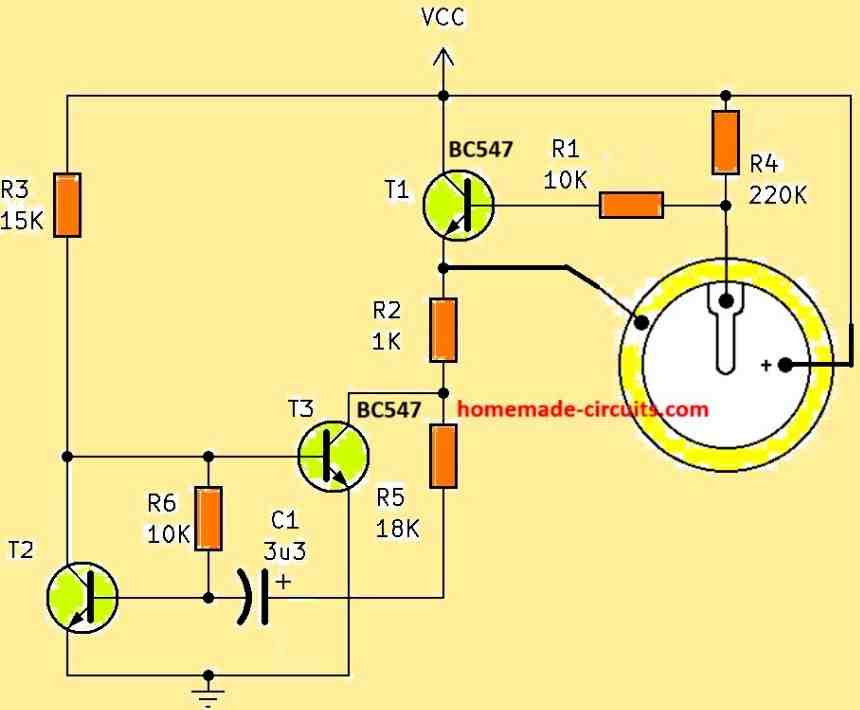
Intermittent Piezo Buzzer Circuit using Transistors
If you are looking for an intermittent piezo buzzer circuit that will produce a beep, beep, beep... kind of intermittent beeping sound, you can modify the above design in the following manner, to get this intermittent output.
Simple Buzzer using 8 Ohm Speaker
The circuit illustrated below generates sounds similar to a genuine buzzer. It simply works with two integrated circuits and very few parts.
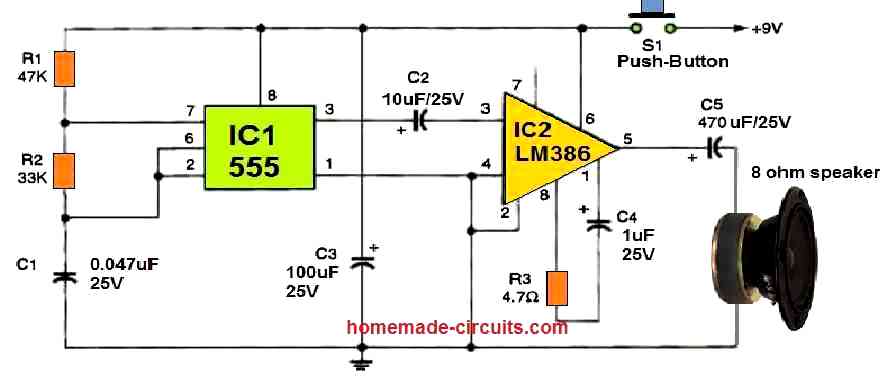
When S1 is temporarily pushed, C1 begins to charge via resistors R1 and R2. Pin 2 of the 555 oscillator/timer, IC1, is finally triggered. By driving pin#7 low, the IC begins to drain the capacitor via R2. This cycle will continue as long as S1 remains pushed.
The output of IC1 (pin 3) alternates in rhythm with the capacitor's charging and discharging, generating a sound frequency for IC2. IC2 is an LM386 low voltage audio power amplifier which amplifies the audio frequency's volume.
The speaker is employed to replicate IC1's tone frequency, that feels like a genuine buzzer sound. To get a low-frequency buzzing, you may want to increase the value of C1 to 0.1 uF.
For added stability, you can connect pin 7 of IC2 to ground through a 47 uF capacitor.



Questions & Answers
здравствуйте.хочу добавить световую прозвонку в dt832. не могу найти схему, по которой я смогу произвести распайку в dt832. cпасибо.
what is dt832?
Sorry in advance for my inexperience.
Do you know why my LT spice model of the intermitant (beeping) version that uses a piezo crystal is only ringing once at the start and does not repeat? Wish I could share a screenshot. However, I was pretty careful about wiring it as you show in the figure labeled “Intermittent Piezo Buzzer Circuit using Transistors”. Thank you in advance.
Sorry for the trouble, actually the intermittent buzzer circuit was taken from an eternal source so i am not sure about its working. The diagram looks problematic to me, because the buzzer ground must go to ground directly, not through resistor.
You can do one thing, please build and test the following circuit, and check whether the bulb flashes or not….if it does then we can replace the bulb with the top buzzer circuit, and make it intermittent:
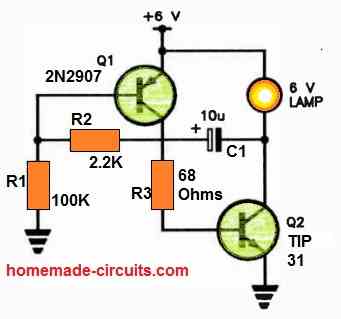
….You can replace the TIP31 with 2N2222…
Looking for a circuit schematic using hi frequency tweeters or piezo speakers for and LRAD application used against neighbors barking dogs??
You can easily build it using an 555 IC astable circuit.
A related concept is posted in the following article, you can checkout the last circuit from this article:
How to Make Dog Barking Preventer Circuit using High Frequency Deterance
Hi, I am looking for 1500 kHz frequency circuit’s for my son collage project, for metal Detector working on 12 Volts battery. As he have had gone throw bike Accident. 4 months total on bed as multiple fractures. We both are choked. Can u please help
You can easily make the oscillator using a 555 IC as I have explained below:
https://www.homemade-circuits.com/ic-555-astable-multivibrator-circuits/
Can you please help me with a driver circuit for a two terminal piezo buzzer.
Sure, you can try the following circuit using IC 555:
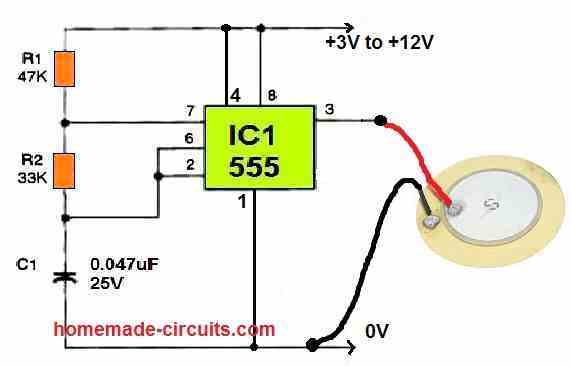
If you want to increase the volume drastically just add a buzzer coil parallel to the piezo wires.
Hi swagatam
I am using this buzzer in 24v system .this buzzer starts operate from low voltages ex:3V , how to block voltage below 22V , it should operate only above 22v to 28V.
Hi Mehboob, you can add a 22 V zener diode in series with the buzzer positive wire.
HI Swagatam , Thanks for the circuit . If I want it 0.5 secs on and 0.5 secs off(intermittent) what circuit I will have to use ?
Hi Nikhil, unfortunately you can’t change anything in the above diagram for getting intermittent sound. You may have to use another oscillator for this.
Hello Sir,
I would like to know the resistance value of the inductor of 40 milli Henry you have showed in your circuit is it below115 ohms or above that.As you said the resistance increases with the Henry value such that I will be able to select a suitable Henry value for my circuit. With 115 ohms a iam getting a very good sound and the current is also less.
Regards
Regards.
Hello V. Sambath, I did not measure the inductor resistance so I am not sure about it. If 115 ohm inductor is working for you then you can continue using it without any doubts.
Hello Sir,
My problem is that I don’t know the inductance value i only know the resistance of the inductance 115 ohms , that is why i asked about the resistance of the 40 Henry coil.I tried with the suppliers they are asking to mention the Henry value .
Hello V.Sambath, you can buy a multimeter which has an inductance measuring facility, then you can easily determine the value of your inductor.
Thank you Sir.
Regards.
Hi, Sir
Thank you very much for your fast response.
Sir I have designed afire alarm hooter which can be used along with the present digital, programmable fire alarm panel working on 24v DC. The circuit is 100% OK and draws around 52 ma at 24v actually during a fire the hooter voltage goes down to 19 to 20v in that condition the current again will go below 40 ma, tone is also easily variable as per our requirement I got the ferrite coil from my junk box i don’t know the value of it ,the voltage from the + of the coil to Gnd is 20.5v the buzzer is driven by a transistor so the voltage across the buzzer is 5.8v it is a 27 mm 12v buzzer so I hope 40 mill Henry may match for my circuit transistor is driven by a 555 ic. 100 milli Henry or 40 milli Henry which will have more resistance .my coil shows 115 ohms.the coil is 32 SWG.
Regards ,V.Sambath Kumar.
Thank you V. Sambath, for the detailed explanation.
As the inductance value increases the resistance also increases, therefore the 100mH will have higher resistance than the 40mH coil.
Sir,
Thank you so much for your valuable information. If you add a provision for uploading the circuits from our end it will be more usefull .
Regards .
You are welcome V.Sambath, I agree with you however we do not have an easy facility for image uploads, therefore presently this may not be possible, hopefully in future we may see this facility implemented in all WordPress blogs.
Sir,
What will the ohmic value of the coil that you have mentioned in the circuit. Is it necessary to use only ferrite core type coil if the inductance 40 milli Henry match will it work. One looks like a resistor can I use this if the Henry value is same, will a 100 milli Henry resistor type work here these are easily available in the market.
Regards. V.Sambath kumar
Hello Sambath, the recommended inductor is shown in the figure, for maximum sound output. If you are using an air core coil then an equivalent coil wold be much bigger in size, but it will work. I am not sure about the exact mH value of the coil
Sir,
Can I use a resistor type inductor of 40 milli henery. It is a tubular type Air Core type.
Regards V.Sambath kumar
Sir, first of all thanks a lot for sharing the circuit details of almost all simple to somewhat complex circuit concepts in details here. I hv a question which is not related to this post of urs but definitely related to mini buzzer. I have a circuit wherein when a transistor turns on it activates a DC pump and also a audio indication using a buzzer. But the sound of the buzz is not so pleasing when the pump is connected. Otherwise(without pump) it gvs nice sound. Is there any way to rectify this sound issue when inductive loads are connected .Thanking you so much
Thank you Binoj, the disturbance in the buzzer sound could be due to the motor reverse spikes. You can try connecting a high value capacitor between 100uF and 1000uF right across the buzzer terminals and check if that helps or not
Hi. I have just discovered your site; it is very interesting and useful to complete electronic newbies like me. I have made the basic buzzer circuit (https://www.homemade-circuits.com/how-to-make-simple-piezo-buzzer-circuit/) and fiddled with it, trying to change the pitch of the output. Nothing changes it. I have thought about this and wonder if it is because the feedback part of the piezo ‘speaker’ fixes the output frequency. Is that the case or is there something else going on? Do you have any circuits on the site that I haven’t found that show how the pitch of a piezo ‘speaker’ can be changed?
Thank you; I will certainly try that (with a 2-terminal transducer…)
Hi, thanks for liking this site! you cannot adjust the tone frequency of the sound in this circuit. yes it is due to the feedback element determining the frequency
you can try the following concept instead for a variable feature:
Simplest Piezo Driver Circuit Explained
Hi, I have a simple piezo transducer with only 2 leads . How can I substitute as a 3 lead?
Hi, you can try this circuit:
replace the speaker with your piezo, and also add a suitable inductor across the piezo wires
Hi Swagatam,
I understood, it will arouse curiosity among all kids making them willing to learn. 🙂
Thank you so much, I have to travel to work, but after returning I will show what we have done as we recycling parts instead buying, and this makes a bit more difficult but will work, I hope.
Thank you again
No problem Henrique! wish you all the best!
Hi Swagatam,
thank you for sharing your ideas and inventions for us, like me, that is just a hobbyist interested only in understanding new things.
Please, could you explain to us… Is this circuit the same used to prank with small shocks when touched by removing the piezo part?
Tnx a million!
You are welcome Henrique, The coil can be used for generating high voltages enough to jolt anybody with a tiny shock, but the above circuit cannot be used for that purpose without the piezo transducer. Because without the piezo the circuit will not oscillate. If you use any other form of oscillator with this inductor then probably it can be used for the mentioned application
Thank you so much again for your very kind and quick reply 🙂
I am learning w/ you because I am teaching few kids helping them to forget TV, video games learning something useful… but I know nothing!
I am just transferring/translating what you teach.
Is it possible to create a wireless control that could send signals to the buzzer making it to beep like telegraph helping kids learn Morse code with fun?
If so, would you mind teaching us how to do it?
Thank you so much again !!!
No problem, I am glad to help!
To make a wireless morse code circuit, there are 3 things you will have to learn to build. 1) the code oscillator circuit, 2) the Transmitter circuit, 3) the receiver circuit, which can be a small FM radio.
You can start with the oscillator circuit first, as given below, if you succeed then we can move to the transmitter circuit:
The crystal earphone can be replaced with any normal head phone
Thank you Swagatan,
We will do Telegraph next weekend, the kids are getting mad…
all of them asked to make the shock first.
But I am learning to teach… and I didn`t understand well..
What should we connect after Piezo part to create shock w/ small batteries AAA or Lr44 ones? I am scared to use 9Volts batteries.
Thank you again
No problem Henrique.
After making the buzzer circuit successfully, try touching the two ends of the coil, you should find some shock like vibration.
The mosquito bat circuit is one good source of converting 3V to 1000 V shock
Design a variable frequency oscillator using Electric Bridge network to employed as actuating signal for a buzzer circuit indicating over-current in the system. Assume suitable frequency range for buzzer and electrical load. Justify the selection of the components.
Hello Sir,
What should I have for the value of R1, R2, L1 if I have access a dc voltage of 5.5VDC? Thanks!
Hello Sir,
I have a current limit of max 1 mA. Wondering if you have any suggestions? Is it possible to decrease the period of the tone with a simple modification on your Simple Buzzer circuit? Thanks!
Alex, the above circuit cannot be customized for frequency, you can try the following instead:
https://www.homemade-circuits.com/simplest-piezo-driver-circuit-explained/
Hello Alex, you can use the same set up for 5V operation also…
I want to design buzzer but i have to create time delay for ON/OFF of 2 sec using passive component and using one DC supply of 12V DC no addition switching supply can not be used.
You can connect the above buzer across the output of the following circit:
Make sure to increase the C1 value to 1uF
HI Swagatam!
Just curious… can the BJT be replaced with an AO3400? What effect will it have on the circuit? I was hacking a 3-24V piezo and I think I blew the L6 transistor. The L6 is a 200-400 hfe SMD NPN transistor. I don’t have anything like that, but I do have the AO3400. Its really not a big deal as I have plenty more of the same piezo buzzers. I was just curious. Thanks!
Hi Norman, yes it might work, if the supply is above 6V
Hi All,
Perhaps it not the right post to ask my question but if you can help me it would be great. I am trying to generate small voltage (~5mV) from sound of high frequency (~20 Khz). Also I need a cheap option to make it (~ INR 5) as I would require to mass produce the circuit. I was thinking of using a piezoelectric in place electromagnetic inducers for the same. Do you think it is possible
please specify the volume level of the source, and at how much distance the sensor would be allowed to be positioned….
Can you help with the circuit. I cant seem to generate a sustainable voltage.
Hi, a piezo can be tried, but only if the sound pressure (volume) is reasonably good.
Hi sir ,i have a piezo (black) which gives beep when applied to 3v…i want to make sparrow sound through it using 220v capacitive power supply
Hello dear, your work is amazing
I need help using piezoelectric flag with LTC3588 circuit, can u help in this regard?
Thank you and glad you liked this site! Please explain your problem in details, if it possible I will try to solve it for you!
I used ltc 3588 circuit and as input ac source i used piezoelectric flag which upon flapping produce ac current but it doesn’t light up the led , instead i used function generator to provide ac and it worked perfectly fine, there may be possible my ac sources are causing destructive interference, can u help me to get constructive interference while using multiple sources
I guess you have used the concept explained in the following article. The AC from the piezo may be too low to detect. How did you connect the piezos, in series or in parallel? You must connect it in parallel, according to me, and verify the output through an AC voltmeter
https://www.analog.com/media/en/technical-documentation/data-sheets/35881fc.pdf
sorry, I am not sure about this circuit idea
hi sir,
good afternoon
please watch video (https://www.youtube.com/watch?v=FgcB7Lkvp44)
i want to generate same sound effect using electronic circuit ,
do you have any idea,
i have single pulse by which i want to generate the same sound effect.
Thanks
Nikhil
Hi Nikhil, It's a TINGGGGG sound…sorry I don't have it… it needs to be programmed or designed and tested with a lot of trial and error
How can I change the buzzer inductor. By mistake my younger brother used it with main current electricity.
WE CAN DETERMINE CONDUCTANCE WITH RESPECT TO FREQUENCY AND HEREBY DETERMINE THE DENSITY
resonant frequency:500khz,Electrical-mechanical Coupling coefficient:0.75±8%,Mechanical Quality Factor:60±15%, these are the specifications of my piezodisc
i am suppose to measure bone density using piezo disc P-52,i want to make piezo to work as an actuator at one end(exciting it usinf electric field so that it produces at stress at one side) which is attachted to a bone.the waves will travel through the bone and are picked up by other piezo patch at other end.and correspondingly define conductance and thus bone density
you mean to say the bone density will causing variations in the frequency level from one to the other end? I don't think do this concept will help to measure bone?
I can design but that won't help the purpose…
sorry a lot of typos in the above comment, here's the corrected version:
"you mean to say the bone density will cause variations in the frequency level from one end to the other end of the bone? I don't think this concept will help to measure bone density?
I can design it but that won't help the purpose…"
HI.I AM WORKING ON PROJECT FOR BONE DENSITY MEASUREMENT USING PIEZO.I HAVE PIEZOELECTRIC DISC(500KHZ),PZT-52.CAN YO HELP ME IN DESIGNING THE ACTUATOR AND SENSOR PART
Hi, if you can provide more details regarding the concept then may be I can try.
Inductor coil & 27mm nickel buzzer plate How much cost in bulk for each peace
I don't know about the latest rates, you can inquire it in Lamington Road (Mumbai).
…by the way manufacturing the above explained buzzer won't be easy because plenty of small and big companies are already manufacturing these at extremely competitive rates……
"L1 = Buzzer inductor" in india where it i can get them in bulk please give the contact.
sorry, I don't provide telephonic assistance, if you have any questions you can put them here.
the inductance value is around 40mH (milliHenry)
image can be seen here:
2.bp.blogspot.com/-8dkdn6B6OUc/VVBH_3imhcI/AAAAAAAAKLQ/3fKYTil2Fi4/s1600/buzzer%2Bcoil.png
Sir please give me your contact number I want talk to u for i am stating new business to manufacture piezo buzzer.i want need your help sir.
Please tell 12v piezo continues buzzer inductor coil full specifications
you can get it from Lamington Road, Mumbai
Hello, i wiuld like to buy a certain quantity of those pzt elements for a project i'm having.
The only problem is, i need to know much power output one piece can provide per pulse, and i don't know how to calculate it with the data dosplayed on the datasheets… can someone help me?
The datasheet reveals that it has a resonant impedance of 300 ohms approximately, so you can use is this with reference to the supply voltage and use Ohms law for calculating the current intake
Once you find the current you can multiply it back with the supply voltage.
Thank you Chinmoy for your curiosity,
However I would repeat the same thing again…"why do you need it? it's not necessary for such a simple design"
I am afraid just like your other previous comments you once again failed to understand the core of the advise 🙂
I meant to say that we measure voltage and current parameters only for those circuits for which these matter, so that it helps the user to tweak and optimize the results from the circuit, and here it wasn't relevant at all since the circuit is heavily dependant on readymade components such as the piezo, transistor and the inductor, so it wasn't so important, it's just about using good quality components and witness perfect results.
And as far as a new learner is concerned it becomes even more meaningless and irrelevant for him to know these parameters, because a new learner must first learn the basics regarding transistors, piezos, inductors etc, and then learn how these need to be configured for achieving the intended results, there's no point in jumping to an oscillator and start measuring the voltages and current, what would the new learner understand from these data?
And by the way, piezos vary a lot for different makes and brands, and so does the hfe of the transistors and so does the mH of the inductors, which are procured readymade….so IMO these can definitely cause variations in the discussed parameters and there’s no way to change these until the components were itself changed,…and again it's not important to change these variations because it wouldn't yield anything substantial in terms of the sound intensity.
Sound intensity for the above design is hugely dependent on how it's stuck on the base, the quality of the rubber ring and the size of the hole of the front lid.
the inductor value is 40mH wound over a ferrite drum
why do you need it? it's not necessary for such a simple design
Very hulp full design ,can use it for 24V system?
Thank you, yes you can try 24V, by increasing the base resistor to 100k
U mean R1 to 200k or R2 to 4k7 to 100k?
Actually R1 is already 100K, so make it higher upto may be 220K, R2 can be as it is, that is 4k7. The coil winding might also need to be increased, but let’s hope it is not required.