An LED tube-light is lighting device built using high efficiency LEDs for illuminating a premise where it is installed, through the available AC mains supply.
In this post I have explained the complete construction details of a simple LED light tube light circuit using 20 mA, 5 mm high bright white LEDs.
The circuit can be operated directly from the 230V AC mains of your domestic supply. This will not only save electric power but also help curb the global warming issue.
WARNING: SINCE ALL THE CIRCUITS EXPLAINED BELOW INVOLVE LETHAL HIGH MAINS AC VOLTAGES, WE STRICTLY ADVISE YOU NOT TO BUILD THESE CIRCUITS UNLESS YOU ARE TOTALLY AWARE OF THE DANGERS OF AC MAINS VOLTAGES AND EXACTLY KNOW HOW TO SAFEGUARD YOURSELF BY EXERCISING PROPER SAFETY MEASURES, WHILE BUILDING THESE CIRCUITS.
LED Tube light using a Transformer or Battery
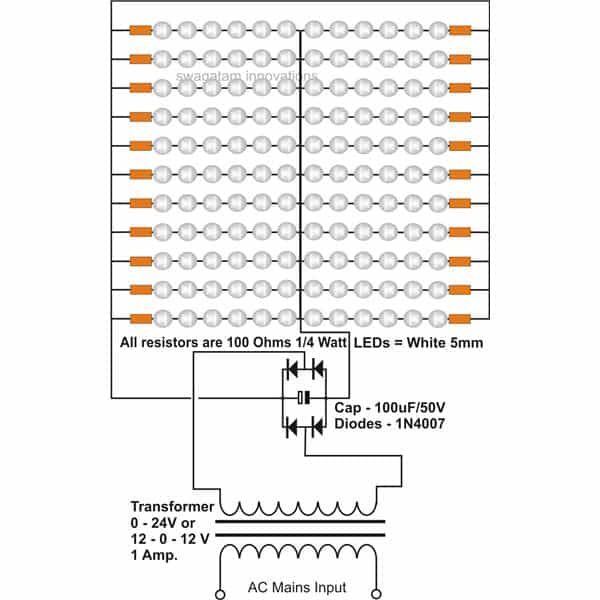
In the following first design we will see how to make a simple lED tubelight using a transformer based power supply, and by connecting the desired number of LEDs in series parallel connection.
Using white LEDs for illuminating our homes is becoming popular nowadays, due to the high power efficiency involved with these devices.
The diagram shows a straightforward configuration involving many LEDs, arranged in series and parallel.
Circuits Description
Referring to the shown LED tube light circuit using transformer we see the LEDs are driven by a general purpose 24 V power supply for illuminating the LED bank very brightly.
The power supply incorporates standard bridge and capacitor network for the required rectification and filtration of the supply voltage to the LEDs.
The arrangement of the LEDs is done in the following way:
The supply voltage being 24, dividing it by the forward voltage of a white LED which is around 3 volts gives 24/3 = 6, meaning the supply voltage will be able to support at the most 6 LEDs in series.
However since we are interested to include many LEDs (132 here), we need to connect many of these series connected strings of LED through parallel connections.
That's exactly what we do here.
Total 22 strings of LEDs having 6 in each are connected in parallel, as shown in the figure.
Since current limiting becomes an important issue with the white LEDs, a limiting resistor is added in series with each of the strings.
The value of the resistor may be optimized by the user for adjusting the overall illumination of the LED tube light.
The proposed design will provide enough light for illuminating a small 10 by 10 room brightly, and will consume not more than 0.02 * 22 = 0.44 Amps or 0.44 * 24 = 10.56 watts of power.
24 Volt, LED Tube Light Circuit Using Transformer, Circuit Diagram
In the above designs we have learned how to make LED tube light without any current control which may be OK if the LEDs are not power LEDs and do not have the property of getting too hot due the extremely high bright illumination.
However for power LEDs which are designed to emit extremely high bright lights and which have the tendency to become too warm quickly, a heatsink and a current control feature become very important.
Transformerless LED Tube light Circuit with Constant Current for Power Saving
Current control in an LED tube light becomes crucial because LEDs are current sensitive devices and can quickly get into a thermal runaway situation, ultimately damaging it permanently.
In an LED thermal runaway situation the LED starts drawing more current, and begins getting warmer due to the absence of a current control limit.
The rising heat inside the LED forces the LED to draw even more current, which in turn cause more heat, this goes on until the LED is completely burnt and destroyed. This phenomenon is known as thermal runaway situation in an LED.
To avoid this current control becomes too crucial for any LED driver circuit.
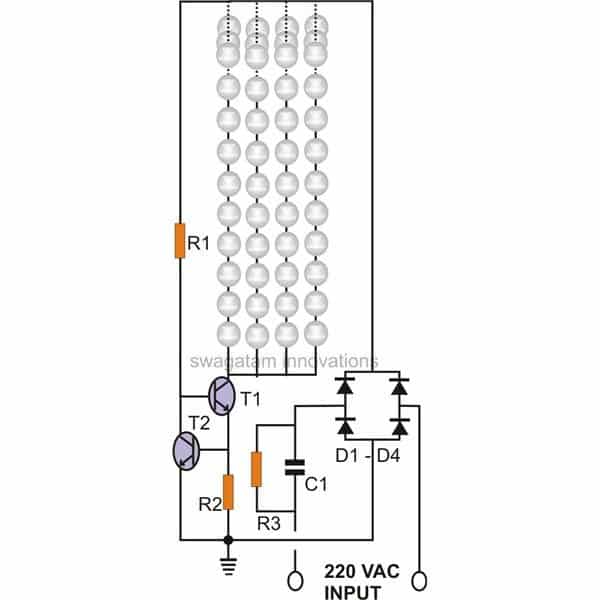
In this circuit resistor R2 is placed for converting the rising current to voltage across itself.
This voltage is sensed by R2 which immediately conducts and grounds T1's base rendering it inactive, the instantaneous process initiates a switching effect, producing the desired current control and safeguarding of the LEDs.
Each channel consists of 50 white LEDs in series. R2 is calculated with the following formula: R = 0.7 / I, where I = Total safe current consumed by the LEDs.
The whole circuit of the current controlled LED tube light may be understood in this manner:
Circuit Operation
When input AC is applied to the circuit, C1 drops the input current down to a lower level which can be considered to be safe for operating the involved electronic circuit.
The diodes rectify the low current AC and feeds to the next current sensing stage consisting of T1 and T2.
Initially T1 is biased through R1 and conducts fully illuminating the entire array of LEDs.
As long as the current delivered by T1 or rather current drawn by the LEDs is within the specified safe limit, T2 remains in a non-conducting state, however of the current drawn by the LEDs begins to cross the safe limit, the voltage across the limiting resistor R2 begins to develop a small voltage across it.
When this voltage exceeds 0.6, T2 begins to leak through its collector emitter pin outs.
Since the collector of T2 is connected to the base of T1, the biasing current to T1 now starts leaking to ground.
This inhibits T1 from conducting fully and its collector current stops rising any further. Since the LEDs form the collector load of T1, the current through the LEDs also gets restricted and the devices are safeguarded from the rising current intake.
Ths above rise in the current takes place when the input AC rises, producing an equivalent increase in the LED current consumption, but the inclusion of T1 and T2, ensures that anything that's dangerous to the LEDs is effectively controlled and curbed.
Parts List
Parts List for the proposed current controlled LED tube light circuit
| Component | Specification |
|---|---|
| T1 | MJE13003 |
| T2 | MJE304 |
| R1, R2 | To be calculated |
| R3 | 1 M, 1/4 W |
| Diodes | 1N4007 |
| C1 | 2 µF / 400 V |
Important Calculations
Capacitive Reactance of C1
The input capacitor (C1) is used to drop the 220V AC mains voltage and current to a lower level suitable for the LED array. The current through the LEDs depends on the capacitive reactance of C1.
Formula for capacitive reactance:
Xc = 1 / (2 * π * f * C)
Where:
Xc = Capacitive reactance (in ohms)
f = Frequency of AC mains (50 Hz or 60 Hz)
C = Capacitance of C1 (in Farads)
Example:
For C1 = 2 µF (2 × 10⁻⁶ F) and f = 50 Hz:
Xc = 1 / (2 * π * 50 * 2 × 10-6)
Xc ≈ 1591.55 Ω
Current Through the LED String
The current is determined by the voltage across the capacitor and the reactance.
Formula for current:
I = V / Xc
Where:
I = Current through the LEDs (in Amps)
V = RMS mains voltage (e.g., 220V AC)
Xc = Capacitive reactance (calculated above)
Example:
For V = 220V and Xc ≈ 1591.55 Ω:
I = 220 / 1591.55
I ≈ 0.138 A or 138 mA
This current value will flow through the LED array and should match the LEDs maximum current rating.
Power Dissipation in LEDs
The power dissipation in the LED string can be calculated as:
P = I × VLED
Where:
P = Power dissipation (in Watts)
I = Current through the LEDs (calculated above)
VLED = Total forward voltage of the LED string
Example:
For 20 LEDs in series with each having a forward voltage of 3V, VLED = 20 × 3 = 60V.
If I = 138 mA (from the previous calculation):
P = 0.138 × 60
P ≈ 8.28 W
Resistor Calculations (R1, R2, and R3)
R1: Limits the base current for T1. Its value depends on the LED string specifications.
Formula for Base Current (IB):
IB = ILED / hFE
Where:
ILED = 120 mA = 0.12 A (desired LED current)
hFE: Current gain of T1 (from the MJE13003 datasheet, hFE ≈ 20 at this current level)
Calculation for IB:
IB = 0.12 / 20 = 0.006 A = 6 mA
Formula for R1:
R1 = VB / IB
Where:
VB = 0.7 V (typical base-emitter voltage drop of T1)
IB = 6 mA
Calculation for R1:
R1 = 0.7 / 0.006 = 116.67 Ω
Choose the nearest standard resistor value:
R1 ≈ 120 Ω
R2: Act as current sensing resistors for T2 to ensure constant current for the LED.
Formula for R2:
R2 = Vsense / ILED
Where:
Vsense = 0.7 V (voltage required to trigger T2)
ILED = 120 mA = 0.12 A
Calculation for R2:
R2 = 0.7 / 0.12 = 5.83 Ω
Choose the nearest standard resistor value:
R2 ≈ 5.6 Ω
R3: Ensures that the high voltage capacitor is able to discharge, preventing painful shock to the user after the circuit is unplugged from the AC mains.
Formula for R3:
The discharge time constant is:
τ = R3 × C1
For a capacitor C1 = 2 μF and rectified voltage Vrectified = 311 V:
To ensure safe discharge within 1 second:
τ ≈ 1 s
Calculation for R3:
R3 = τ / C1 = 1 / (2 × 10⁻⁶) = 500,000 Ω
Choose the nearest standard resistor value:
R3 ≈ 470 kΩ
Bridge Rectifier (D1-D4)
The diodes (D1 to D4) form a bridge rectifier to convert the AC input to DC.
Each diode must handle:
Reverse voltage: At least the peak mains voltage, Vpeak = √2 × Vrms. For 220V AC, Vpeak ≈ 311V.
Forward current: Equal to the LED current, e.g., 138 mA.
Diodes like 1N4007 are suitable since they support 1000V reverse voltage and 1A forward current.
LED String Voltage and Current
Total forward voltage of the LED string: VLED = Number of LEDs × Forward voltage of a single LED.
Yo must ensure that the total forward voltage is less than the rectified DC voltage (approximately 311V for 220V AC input).
LED Specifications and Datasheet
| Parameter | Symbol | Value |
|---|---|---|
| Continuous Forward Current | IF | 120 mA assumed here, can be customized as required. |
| Peak Forward Current (Duty /10 @ 1KHZ) | IFP | 100 mA |
| Reverse Voltage | VR | 5 V |
| Operating Temperature | Topr | -40 ~ +85 ℃ |
| Storage Temperature | Tstg | -40 ~ +100 ℃ |
| Soldering Temperature (T=5 sec) | Tsol | 260 ± 5 ℃ |
| Power Dissipation | Pd | 100 mW |
| Zener Reverse Current | Iz | 100 mA |
| Electrostatic Discharge | ESD | 4 KV |
150 LED Transformerless LED Tubelight Circuit
The simple construction of an LED light tube light discussed here will not only save electric power but also if used in every house will help reduce the ever increasing global warming effects.
Today we are all aware regarding the bad effects of global warming and how it’s gripping our only planet day after day. But for this we ourselves are to be blamed.
You may be thinking how a common person can contribute to help solve the problem. Well look around you, yeah, it’s the lights that we are using presently generate quite an appreciable amount of heat to add to the global warming effect.
CFLs are considered to be quite efficient, but they too release quite a bit of heat. The issue can be very easily solved simply by transforming our heat producing lights into the "cool" white LED lights.
We will learn in this article how simple it is to build a LED light tube that can easily replace your existing "hot" fluorescent tube lights!
Parts List
You will require the following Parts for the construction:
One 36 inches long, 2 inches in diameter white PVC pipe,
150 Nos. White LEDs (5mm),
4 nos. 1N4007 diodes,
3 nos. 100 Ohms resistors,
1no. 1M resistor, 1/4 W CR 5%,
1no. Capacitor 105/400V, Polyester,
14/36 Wire for connections,
Soldering iron, solder wire etc.
Construction Clues
The construction of this circuit is carried out through the following simple procedures:
Cut the PVC pipe lengthwise into half.
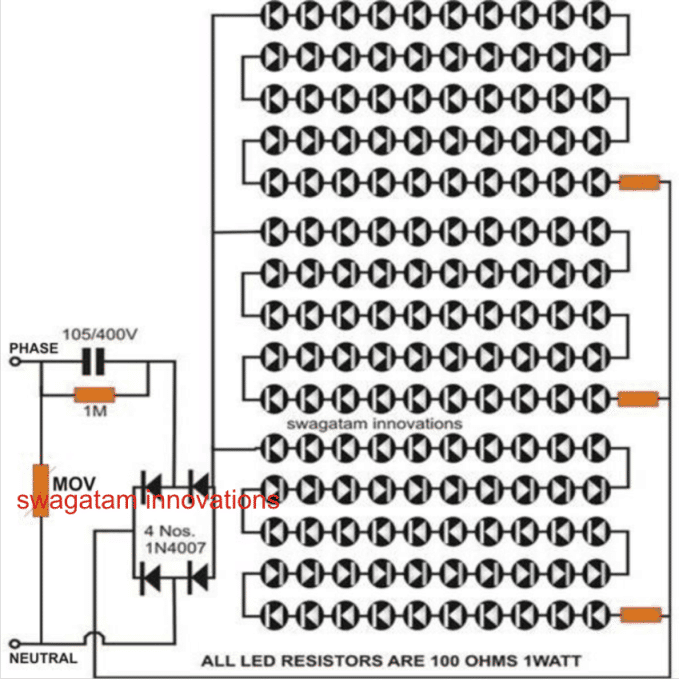
Drill equally distributed LED size holes over the entire area of the two halves of PVC pipes. As shown in the diagrams just fix all the LEDS throughout the pipe.
Be sure to keep the position of the polarity of all the LEDs in the same orientation, Cut and bend the LED leads so that the leads touch each other side by side.
Make 3 series of 50 LEDS each by soldering the joints.
Make sure that each series comprises the given resistor of 470 Ohms.
Connect the 3 series LEDs groups in parallel by joining their positive and negative leads together through flexible wires.
Make a bridge configuration rectifier by joining the 4 diodes together, and connect the relevant points to the LEDs and to a 2 pin mains cord, as shown in the figure.
How to Test it?
Testing this LED tube light circuit is probably the simplest part of the whole operation; it is done through the following simple steps:
After finishing the construction procedure as described above, just plug in the 2 pin plug into the mains socket (be extremely careful as the whole circuit may contain leakage currents).
Instantly all the LEDS should come ON giving a dazzling effect. If any of the series is dead or not glowing, switch OFF the power and check for the LEDs connected with wrong polarity.
Glue all the LEDs so that they may not come out of the holes I which they are inserted. Finally join the two halves of the PVC pipes with the LEDS, either by tying them or gluing them together with cynoacralite bond. Close the two open ends of the tube appropriately.
This concludes the construction of the LED light tube circuit. For optimum performance it would better to hang the unit from the ceiling so that the light is distributed equally.
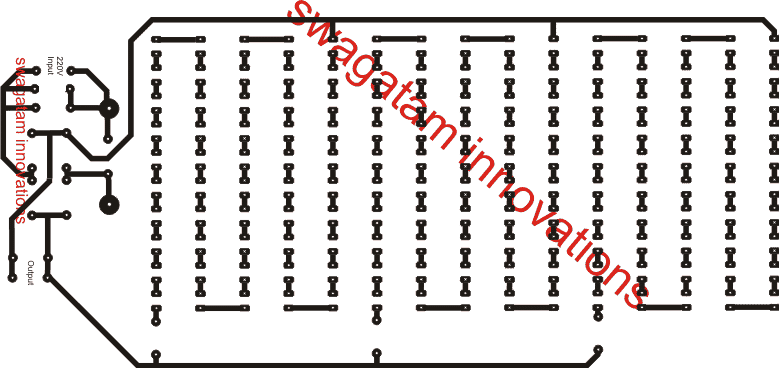
The PCB Design Layout for the above LED tube-light circuit can be seen in the following image.
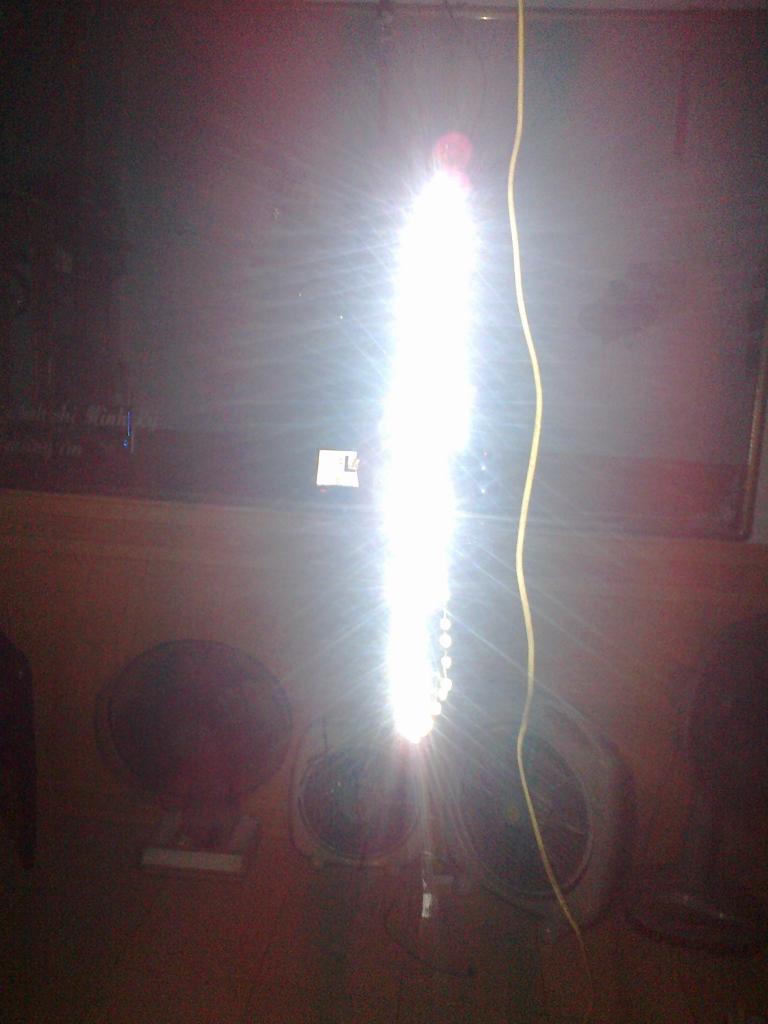
Video Clip showing the testing of a similar LED tubelight using 108 LED in series parallel combination
Below is a 50 LED Tube Light made by Merley, for your viewing pleasure:
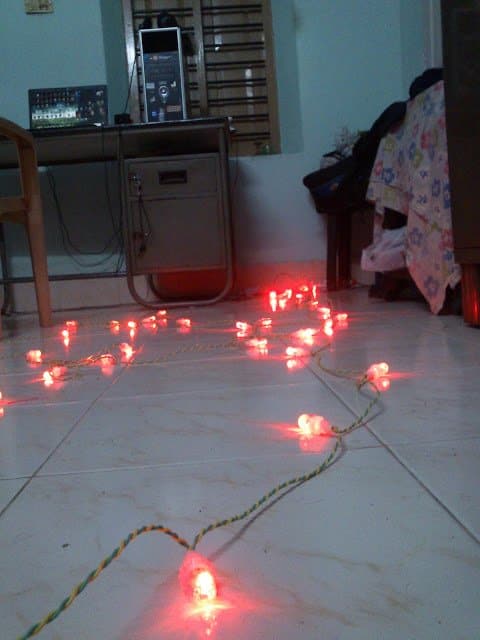
LED string light made by Mr.Bibin Edmond using the explained capacitive power supply.
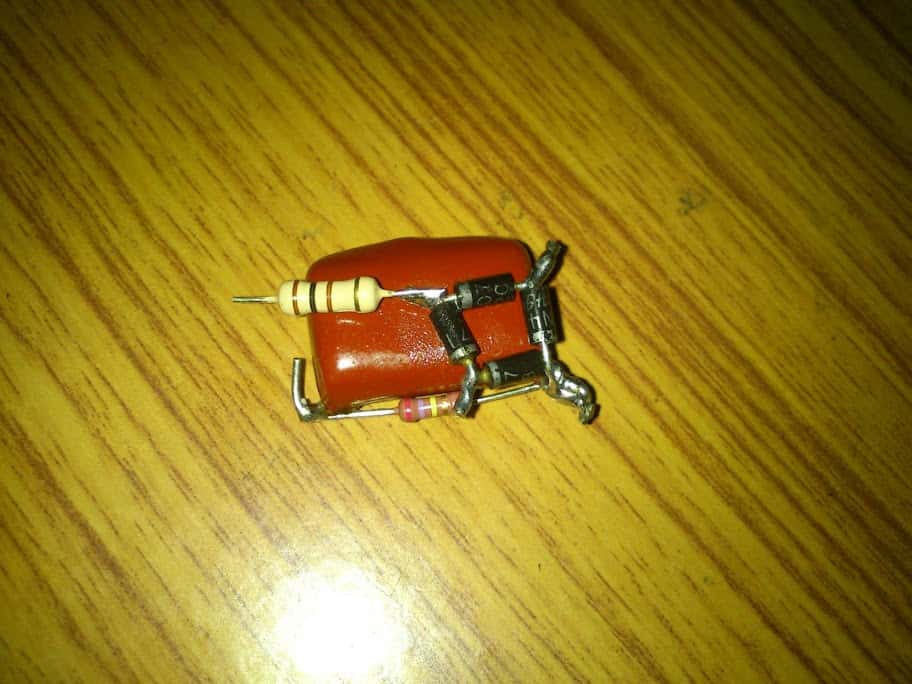
Here's the image of the simple capacitive PS circuit used for lighting the above string LED light.....
courtesy: Bibin Edmond
In case you think that a transformerless based LED tubelight may not be reliable or not powerful enough, you can opt for a transformer based power supply design for accomplishing the same, as described below.


Comments
घर पर ट्यूबलाइट कैसे बनाएं एलइडी ट्यूब लाइट घर पर ही कैसे बनाएं और पूरा सामान कहां से लें
This one is the best circuit you can build for a safe LED tube-light. You can get all the parts from any local electronic spare part dealer in your area or any online store like Robu, electronics spices etc…
https://www.homemade-circuits.com/wp-content/uploads/2011/12/CurrentControlledLEDTubeLightCircuitDiagram252CImage.jpg
Hello Mr Swagatam
Sorry my english is bad
I want ask you to give me a schematics for led driver ac 220 v and 50 watt
I was make a driver and its not good
Thanks
Hello Hendra, making an SMPS for driving LEDs can be quite difficult. It is better to buy a readymade SMPS and then configure the required LEDs to it through a current controller stage. I have discussed the full procedures in the following article:
How to Design Simple LED Driver Circuits
Hi dear Sir Swagatam. Would you please describe the role of 100R resistors? Thanks in advance
Best regards
Mike
Hi Mike, 100 ohm resistors are for limiting current to the LEDs
Hi swagatam, thanks for your ideas and guidance.
I wish to know, what difference in that 150 5mm led circuit is needed to replace those 5mm with 8mm high bright leds.
furthermore, if there’s a need of capacitors to add to stop flickering of leds, if any, pls suggest sir.
Hi Subhajit,
In that circuit, the 105/400V allows a maximum current of 60mA, so this capacitor decides how much current the LEDs can get.
So to change the LED specifications, you may have to change the capacitor value accordingly.
The filter capacitor for the LED light stabilization can be a 470uF/400V capacitor.
Hello dear Swagatam. Thanks a lot for your feedback.
Respectfully yours
Mike
You are welcome Mike!
Dear Mr. Swagatam
Hello and thank you so much for your interesting150 LEDs tube-light. I have an Oxalis flower at home which is very lovely it is also called butterfly flower. Do you think I can assemble this tube-light LEDs in order to supply sufficient light needed for it’s growing instead of indirect sun light?
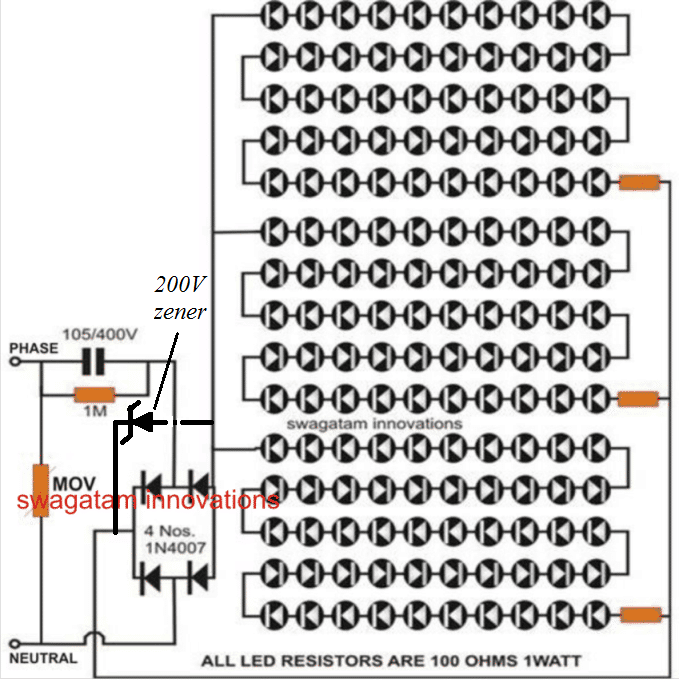
You are kindly requested to tell me how and what kind of Zener diods I can use instead of MOV since this is not accessible for me.
Thank you in advance for your reply
Best regards
Najieh
Dear Najieh, you can try a 200 V 5 watt zener diode such as 1N5388B
More info is given below:
https://www.mouser.in/datasheet/2/308/1N5333B_D-1801430.pdf
https://www.digikey.com/en/products/detail/on-semiconductor/1N5388B/1485521
Glad you liked it. The above circuit is the cheaper version, although still reliable.
The commercial types use SMPS concept, such as this one:
https://www.homemade-circuits.com/ceiling-led-lamp-driver-circuit/
Hello Sir,
I want to turn on 88 leds in two modes DIM and BRIGHT.
The mode DIM is specified by low voltage (25VAC to 35VAC) and the current consumption must be between 5mA and 15 mA.
the mode Bright is specified by hight voltage (98VAC to 132VAC) and the current consumption must be between 5mA and 50 mA.
I should use passive components so I try to calculate the adequate current limiting resistor but it does’nt work when the voltage increases the current also increases and becomes out of specification.
can you help me please
Hello Amel, using Ohms law at 35V and 10mA the resistor required for your LEDs will be:
R = V/I = 35 / 0.01 = 3500 ohms
at 110V using the same resistor will give
I = V/R = 110 / 3500 = 0.031 amps = 31 mA.
So your circuit is possible by using a zener diode control for the two modes.
thank you sir for your response.
I did’nt understand you, how many leds in evry chain I should use?
NB: the leds are white and the forward voltage 3.2V
how the zener diode control the two modes?
Each chain will have 11 LEDs. You will make 8 such chains and join their common +/- ends together so that all the chains become in parallel
make 8 strings of 11 LEDs, and connect them in parallel.
connect them to a transformerless power supply through the desired resistor as calculated in the previous comment.
A pair of zener diodes can be toggled with a switch between a 35V zener diode and a 110V zener diode, in this diagram
https://www.homemade-circuits.com/cheap-yet-useful-transformerless-power/
Thank you one more time for you reply. I understand the schematic of the transformless power supply and the use of zener diode. but I did’nt understand how can I switch between the two zener diode?
Instead of the single 12V zener, replace it with two separate zeners, 110V, and 35V. Connect the anodes of the zeners with the negative line but keep the cathodes unconnected. Use a SPDT switch to toggle these two zener cathodes so that they alternately connect with the positive of the LED chain (after the 3.5K resistor).
thank you so much for your help.
Another question, if I have the frequency between 350 HZ and 650 Hz which capacitor I should use in the transformless power supply to fix the current to 50 mA?
You are welcome….you can calculate it using the information presented in the following article:
https://www.homemade-circuits.com/how-to-calculate-and-deduce-current-and/
Hello sir
I am using 200k variable resistance in the strings. Is it right?.
Thanks
200k will not work
Hello sir
Can i use the same circuit for 60 LEDS in each string and all the three strings with different colored leds i.e. one string of entirely of blue other of red and another green
Thanks
can I use two zener diodes of 120v 1watt rating joined in series across bridge as 200v is not available
yes that will do!
Thanks sir for your valuable response… but I am not able to find a zener diode of 200v. But 150v 1watt and 24v 1watt diodes are available. Also from the various comments I came to know about use of NTC MF75-5D9 instead of zener diode. But NTC 10D9 is the only avaliable option in my city. Is there any other method? Sir, can I use a variable resistance across the strings instead of 100 ohm resistors. Help me sir.
Thank you
Sir,
Can I put one150V 1watt zener and two 24V 1watt zeners in series to get the required value.
Also 100 ohms 1 watt resistor is not available so can I use 1/2 watt resistors
100 1/2 watt will do, please refer to my previous replies…
Hi Mandeep, you can put the two zeners in series and achieve the required results…an NTC can be also used simultaneously but the zener should not be avoided because without zener the LeDs can become prone to fluctuations and burn in the process.
an NTC 10D9 will also work, you can use it.
you can use a 100 ohm pot with a series 100 ohm fixed resistor, that will ensure that the current is never exceeded over the unsafe level.
Hello Mandeep, yes you can do it, just make sure to add a zener diode across the bridge having a voltage rating slightly higher than the total forward drop value of the LEDs
sir i wanted to run 40 led of 5 mm to 230 v in what should be the changes done to the circuit
Abdul, you can use the same circuit, just lower the input capacitor to 474/400V.
I want to use more led in a single string what is the maximum number of led can I connect. Also share the circuit diagram
you can connect 93 LEDs max on each string….the series resistor will not be required in that case….
Simple LED Tubelight Circuit You say : 150 Nos. White LEDs 5mm .
In dont no what 150 nos. means, is it like this:
1) Coolwhite, Viewing Angle: 15°, Liminous Intensity 17000mCd, Forward Current 20mA,Forward Voltage 3,3V
or
2) Coolwhite, Viewing Angle: 20°, Liminous Intensity 9000mCd, Forward Current 20mA, Forward Voltage 3,5
the LEDs must be rated at 3.3V/20mA, that's all..
Hi Swagatam Majumdar
Thank you .
In this circuit we have not 470 ohms resistor but you say (Make 3 series of 50 LEDS each by soldering the joints. Make sure that each series comprises the given resistor of 470 Ohms.) where is this resistor in this circuit .
Hi Shayan, it's a typing mistake, it should be 100 ohms, not 470 ohms
ok thanks for detailed advise….. yes I meant 10% increased resistance that will decrease current.
Pl also advise, I read somewhere that using resistance of 10% less value (to use 90 ohm instead of 100 ohm resistance) is good to increase life of LEDs. is it right ? is it makes any difference if I use 4 watt or 2 watt resistance instead of 3 watt.
Sudhir, you mean to say it should be 10% more?? less will increase current for the LEDs and cause damage so it can be 10% more not less.
Dear Swagatam,
greetings of the day….
I have calculated 2000 ohm 3 watt resistance for series of 50 LEDs to replace 100 ohm 1 watt resistance for 8 mm LEDs in above circuit. The details are :
Mains – 230 v
Forward Voltage – 3.4 v
Forward Current – 30 mA
No. of LEDs – 50
Using 2000 ohm 3 watt resistance is correct in series of 50 LEDs? pl advise.
Have a nice day….
Sudhir
Dear Sudhir,
actually resistor can be eliminated in a capacitive power supply if the input capacitor is calculated correctly as per the LED specs…
for 30mA, you can use a 0.68uF/400V input capacitor and connect all the LEDs without any resistor….but make sure to use a NTC in series with the input supply, MOV can be removed
Hi Rajesh, 150 LEDs will naturally require more current than 50 LEDs, therefore you must upgrade the input capacitor accordingly to get brighter illumination from them…try adding more capacitor in parallel to it until the illumination is satisfactory.
ok, thanks…..
No problem Awal, you can ask questions, I will try to answer.
Hi sir, i ve come accross your wonderful experiment wish to learn more from you. Ok
sudhir, there's no method or formula for identifying the current of an unknown LED, try to find the datasheet of the LED, or inquire with your local parts dealer in your area