In this post I have explained a 48V solar battery charger circuit with high, low cut-off feature. The thresholds are adjustable through individual presets. The idea was requested by Mr. Deepak.
Technical Specifications
Hi Swagatam,
Thank you for UPS relay circuit.
I am trying to build it very soon. I will update you the result once i am done with that.
Next, i am very keen to build a Solar charge controller circuit for following requirement.
1. Battery shall be of 48 V (lead acid or maintenance free) with capacity go up to 48V X 600 AH.
2. Load to battery may be up to 1500 W (30 Amp at 48V)
3. Solar PV cell in series/parallel configuration producing voltage up to 60V and 40 Amps
The controller circuit is expected to perform as follows.
1. Cut off solar supply to battery when its voltage reaches approx 56V and maintain appropriate hysteresis to avoid frequent switching of power MOSFET. So the solar supply to battery would resume again only when the battery voltage reaches approx 48 V.
2. Low voltage disconnect of load from batter supply when battery reaches around 45 V and maintain appropriate hysteresis to avoid frequent power ON/OFF of load.
I will be grateful if you could help me building this circuit.
Thanking you.
Best regards,
Deepak
Circuit Operation
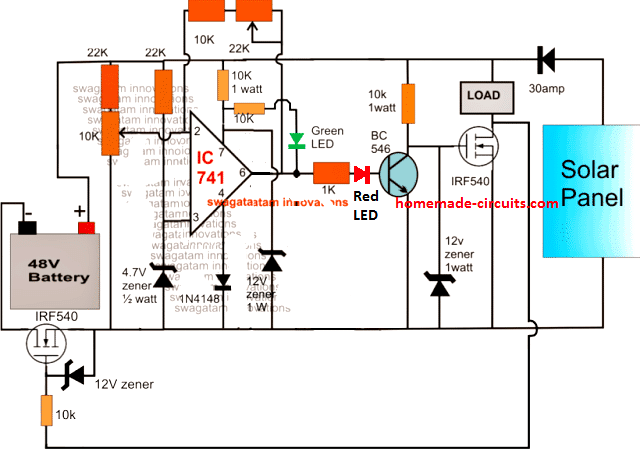
The proposed 48V solar battery charger circuit with high/low cut off feature can be witnessed in the following diagram.
The functioning of the circuit may be understood with the following points:
The IC 741 is configured as a comparator and is appropriately stabilized from the high 48V input using zener diodes and potential divider networks across its supply and input pins.
As requested, the input voltage which may be in excess of 50v is acquired from a solar panel and applied to the circuit.
The 10k preset is adjusted such that the power mosfet cuts off when the connected battery reaches the full charge level.
The 22k preset is the hysteresis control for the circuit and also serves as the lower threshold adjustment preset.
It should adjusted such the the MOSFET just initiates and switches ON at the preferred low battery voltage threshold.
Once the discussed set up is implemented and power switched ON, the discharge level of the battery drags the supply to around 48V forcing pin2 of the IC to go below pin3 potential.
This prompts the IC output pin6 to go high initiating the MOSFET connected in series with the ground rail so that the battery becomes integrated with the solar panel supply.
The above also switches ON the BJT BC546 which in turn makes sure that the associated MOSFET and the load remains switched OFF.
As soon as the battery attains the full charge level, pin2 is pulled higher than pin3 rendering the output to a logic low.
This instantly switches OFF the ground rail MOSFET and the BJT enforcing two things: cutting off supply to the battery and switching ON the load MOSFET such that the load now gets access to the supply voltages from the panel as well as the battery.
The feedback hysteresis network formed by the 22k preset and the series 10k resistors ensures that the above action locks ON until the battery voltage reaches below the predetermined lower threshold.
Circuit Diagram
Diagram
Feedback from Mr. Deepak
Hi Swagatam,
Thanks for Solar charge controller circuit.
The circuit appears to be little different than what i had requested. Let me reiterate the requirement again.
1. Solar panel should continue charging battery not beyond 56 V.
2. In the event of battery discharge, the charging process should resume again only when it reaches 48V. In other words hysteresis should be maintained.
3. Battery should continue supplying power to load when battery voltage remains in between 42 - 56V.
When battery voltage reaches 42V (due to battery discharge) the load should be disconnected from battery supply.
Once the load is disconnected, it should remain disconnected till the battery voltage reaches minimum 48 V during charging process.
Please confirm if the circuit works as above.
Implementing Window Comparator
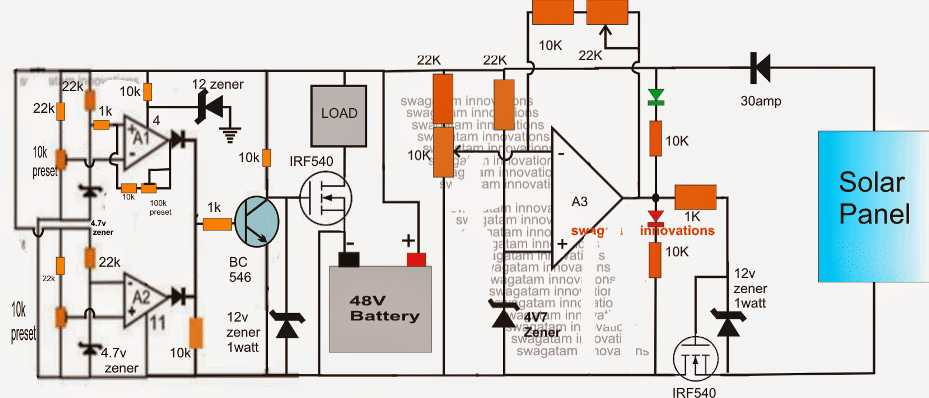
The above 48V solar battery charger circuit with high, low cut-off may be modified with these specifications by introducing a window comparator stage, as shown at the extreme left of the circuit below.
Here the opamps are replaced by three op amps from the IC LM324.
The window comparator is made by two of the 4 opamps inside the LM324.
A1 preset is set such that its output becomes high at the lower threshold level of 42V.
The 100k preset is for adjusting the hysteresis level so that the situation gets latched until 48V is reached.
Similarly A2 preset is set to make the relevant output go high at the higher threshold of 56V.
At voltages between these "windows", the BC546 remains shut off allowing the associated mosfet to conduct and feed the load with the required supply from the battery.
Once the thresholds are crossed, the BC546 is forced to conduct by the relevant opamp shutting down the mosfet and the load.
The A3 stage could also be replaced with an identical window comparator as discussed above for controlling the charging of the battery by setting up the presets appropriately, this would allow using all the four opamps from the IC LM324 and also make the operations much accurate and sophisticated.
Adding a Buzzer Indicator Stage
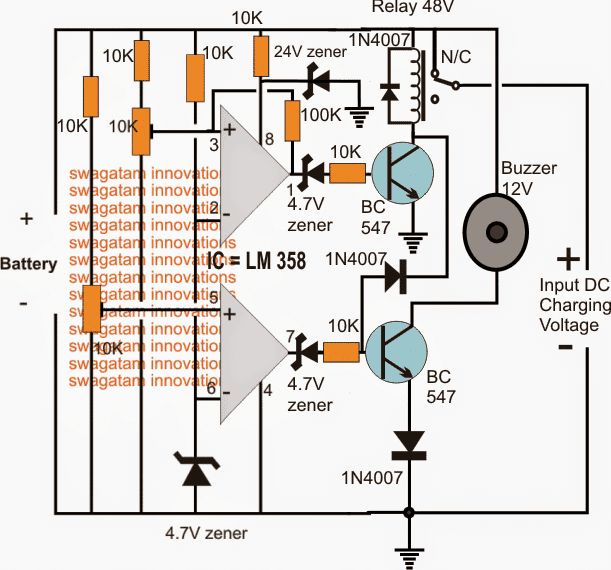
Another version of a 48V automatic battery charger cricuit using a buzzer indicator can be studied below:
The idea was requested by Nadia, please refer to the discussion between Nadia and me in the comment section for more info regarding the design
The transistor are incorrectly shown as BC547, which must be replaced with BC546 for preventing circuit malfunction and damage
How to Set up the above 48V Battery charger circuit with buzzer
Do not connect the charging voltage from the right side.
Keep the 10k preset slider arm towards ground initially.
Connect a DC input using a DC variable power supply from the Battery side on the LEFT of the circuit.
Adjust this voltage to the required potential at which the buzzer needs to get activated....as per the request it should be at around 46V
Now adjust the lower 10k preset very slowly and carefully until the buzzer just activates and starts buzzing.
Seal this preset with glue.
Now increase the input voltage to the desired high cut off level.... which is 48V as per the request here.
Next, adjust the upper 10k preset very slowly and carefully until the relay just clicks. When this happens the buzzer should shut off.
The 48V solar battery charger circuit with high, low cut-off is now set, however the value of the 100k resistor which can be seen connected between the input/output pins of the upper opamp actually decides at what lower threshold the relay must deactivate again, and switch ON the buzzer.
It's been arbitrarily fixed, you may have to adjust the 100k value so that the relay toggles only at around 46V...it may be confirmed with some trial and error
48V automatic solar battery charger using relay
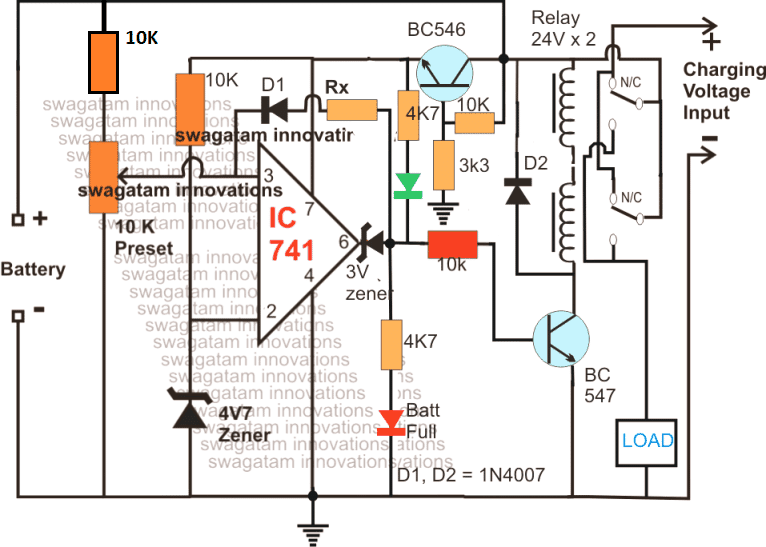
The operations involved with the first diagram above gets much simplified if a relay stage used instead of BJTs, and mosfets.
As can be seen in the above updated diagram, the relay stage is in the form of two 24V relays in series, wherein the coils are joined in series while the contacts are joined in parallel.
The sensing circuit is applied with a proportionately scaled down voltage through an emitter follower voltage divider circuit using the indicated BC546 stage for the intended battery level detection and cut-offs
The following diagram shows an extremely simple 48 V solar charger system which allows the load to access the solar panel power during day time when there's optimal sunshine, and features an automatic switch over to battery mode during night when the solar voltage is unavailable:
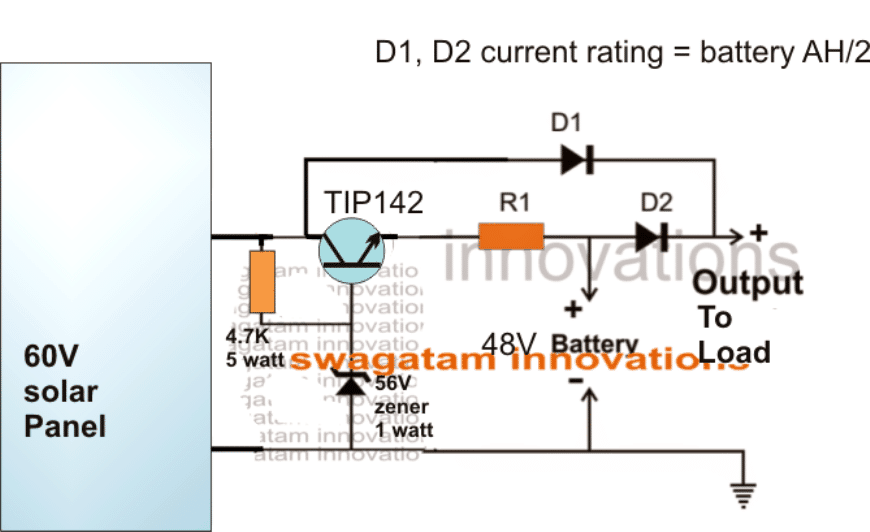
The emitter follower TIP142 ensures that the battery is never allowed to get overcharged above 55V.


Questions & Answers
Thanks for your reply regarding R1, can u mention the resistance power( 1W or !/2 W)
R1 Wattage = (55 – 48) * Max charging current limit
What is the value of R1 resistance?
R1 in the last circuit is approximately:
R1 = 55 – 48 / Max charging current limit
hi.
I would like to know if you can adapt the first design to accommodate a 36v battery bank. with high cutoff at 41vdc and charge at 36vdc the same 50vdc to 55vdc solar input
Hey, I would rather recommend you to try the LAST circuit from the following article. This will allow you to charge your 36V battery perfectly from solar panel:
https://www.homemade-circuits.com/make-this-48v-automatic-battery-charger/
https://www.homemade-circuits.com/wp-content/uploads/2023/01/48V-current-controlled-battery-charger-circuit-with-auto-cut-off.jpg
Thank you. i will give it a test as soon as the part arrive
Sure, no problem, let me know if you have any issues with the circuit…
I have made a 72v dc transformer which I want to fully make automatic to charge my 72v motorcycle battery from home using 240v ac.
Secondly I’m also connecting 3 24v solar panels each with open circuit voltage of 44.44v in series to also charge in the rural areas of my travels. In both cases I need an automatic cutoff once the battery is fully charged.
You can try the last circuit from the following article:
https://www.homemade-circuits.com/make-this-48v-automatic-battery-charger/
Let me know if you have any further questions…
Sir Naveen again! Sir Now I have a 1.2v battery with 1100mAh is it ok now sir, and I have replaced 3v zener with 1N4148 diode, should I have make any further changes sir! also how long it will take to charge sir ?
thanking you!
Naveen, I just forgot that 1.2V or 1.5V cannot be used to operate the op-amp, so it won’t work.
Instead you can try the following concepts for your battery:
https://www.homemade-circuits.com/simple-ni-cd-battery-charger-circuit/
Sir can i Give a 1.5v rechargable battery in the place of 3.7v, so that it charges faster?
With reference to the following circuit, you can use a 1.5V cell, but then make sure to replace the 3V zener diode with a 1N4148 diode, cathode being towards the ground side.:
https://www.homemade-circuits.com/wp-content/uploads/2024/11/3.7V-auto-cut-off-battery-charger-circuit.jpg
Sir Naveen Again! Sir my solar panel has 0.48A as output current is it ok to charge a 2000mAh 3.7v battery and sir if I want to demonstrate the circuit how do I do it by charging and discharging the battery like what load can i use and how? thanking you sir
Hi Naveen, you can use 0.48A to charge a 2000mAh Li-ion battery but it might take 4 to 5 hours to charge it fully…
You can connect a volt meter across the battery to check its voltage, once it reaches 4.1V then you can assume it to be fully charged.
You can connect a 1 watt LED across it to discharge it.
Make sure to use a heatsink for the LED and connect a 3 ohm 1 watt resistor in series with the LED..
Naveen again sir! Thankyou swagatam sir really thankyou! I will notify you once I finish the circuit
No problem Naveen,
For the following circuit, you must set it up in the following manner:
https://www.homemade-circuits.com/wp-content/uploads/2024/11/3.7V-auto-cut-off-battery-charger-circuit.jpg
1) Do not connect any battery initially.
2) Keep the 10k preset wiper towards fully ground.
3) Connect a precise 4.1V DC input from the Battery points of the circuit.
4) You will find the LED lighting up.
5) Now, slowly adjust the 10k preset until the LED just shuts off.
That’s all….you circuit is all set…
Sir Naveen Again! 18v solar panel seems to be too much expensive instead can i use 3.7v battery with 2000mah Li-ion cell. and I have 6v solar panel in hands! can i contact you personally Sir?. Thanking you
Thanks Naveen,
For charging a 3.7V 2000 mAh cell, the 6V panel must be rated at at least 1 amp current, then you can use the following circuit:
https://www.homemade-circuits.com/wp-content/uploads/2024/11/3.7V-auto-cut-off-battery-charger-circuit.jpg
I think discussing through comments is good because it helps other users also to learn from our discussions…
Hello Sir!
https://www.homemade-circuits.com/wp-content/uploads/2023/01/48V-current-controlled-battery-charger-circuit-with-auto-cut-off.jpg
in this circuit What modifications I have to make if I use 12v battery and 6v solar panel and please update me with a modified circuit kindly. I request you to please explain me about the Procedure to connect and working it would be grateful If I am being helped thanking You sir!
Hello Naveen,
A 6V solar panel cannot be used directly to charge a 12V battery, so please change the solar panel to 18V solar panel, and then I will tell you how to modify the previous circuit…
Hello I Have Choosed THis as an mini project in my college. PLease tell me which ciruitit works and help me in what to do!
All the above circuits will work if built correctly, however the following one is the easiest one to build and implement:
https://www.homemade-circuits.com/wp-content/uploads/2023/01/48V-current-controlled-battery-charger-circuit-with-auto-cut-off.jpg
Just make sure to reduce the resistor between the collector of the BC546 and the base of TIP36 appropriately in accordance with the current requirement of the battery.
Hi Swagatam, thank you for the above. Is the above also compatible with Lithium battery packs? Can you suggest what changes to be made to the above for 60 V and 72 V battery packs (Lead Acid and Lithium)?
Hi Rajan,
Yes the above designs can be used for charging Li-ion battery after appropriate settings, however i would recommend you the LAST circuit from the following article:
https://www.homemade-circuits.com/make-this-48v-automatic-battery-charger/
This circuit is easy to configure and very safe for charging all types of batteries.
Thank you for the reply. I will check it out. Just wanted to know what modifications to be made to charge 60 and 72 v battery packs?
You can use the same design which was suggested by me in the previous comment, with the following modifications:
Replace BC546 with TIP122
Adjust the TIP36 base resistor and Rx current limiting resistor as per the required charging rate for your battery.
Just curious to know, in your introduction you say you area manufacturer. So do you manufacture PCBs? If yes, I would like to discuss some business opportunities with you. If no, can you share info about some PCB manufacturer who can print boards in a small quantities?
No, I don’t manufacture PCBs, I had the contact numbers of a few PCB manufacturer in Mumbai long back about 10 years ago, but I seem to have lost them, and don’t have them now.
Nevertheless you can easily search online and you should be able to find plenty of PCB manufacturers who will do the job for you.
Sir I have brought Some of its Component, I have put 12v Battery instead of 48 and 6v solar ponal instead of 56v and please tell what are the modifications that i have to make in order to make the circuit working properly and as a kind request can i Contact you personaly !
Thanks, I found one.
Very many thanks, I will try it out.
Thank you, Sir. If I want to build it with a 20V solar panel and a 12V battery, what should I change in the circuit?
Hi Aulia, you can try the last circuit, with the following modifications:
Remove R1, replace the zener with a 15V zener.
Hi Mr.Swagatam, If I want to create a cut-off system for a 12V lead-acid battery with a PV output voltage of 13-20V, which circuit should I use?
Hi Aulia, I would suggest you to try the LAST circuit from the following article.
https://www.homemade-circuits.com/opamp-low-high-battery-charger/
Thank you, Sir. Is the 54V zener diode replaced with a lower voltage zener diode?
No problem Aulia,
That’s correct, you will have to replace the 56V zener diode with a 15V zener for your 12V battery. Also, the 4k7 or the 4.7K resistor does not need to be a 5 watt resistor, it can be a 1/4 watt resistor.
Oke Thank you Mr. Swagatam
No problem Aulia!
thank you very much for your help and see you next schematic
thank you for answering me.if I use a battery 12 volts will be the same
For a 12V battery the circuit can be exactly as shown in the previous link. However, the 270R must be replaced with a 1N4007 diode.
this schematic what part changes for solar panel 50volt
makingcircuits.com/wp-content/uploads/2017/04/SolarBatteryCharger.gif
Use transistor BD139, relay = 48V relay, battery = 48V, replace 270R with a 1N4007 diode.
Hi,
I want a 48 volt battery low voltage alarm circuit which output operate a 12 voltage relay when battery gets below 42 voltage.
Can you suggest me a circuit diagram like this comparator circuit.
Hi,
you can try the following design:
https://www.homemade-circuits.com/wp-content/uploads/2022/11/low-voltage-alarm-for-48V-battrey-charger.jpg
That’s great Sanjaya, glad it is working good.
The maximum input DC to a 48V battery should not be more than 58 V. So you can adjust the solar panel output to 58V DC.