Mosquitoes are a big menace to humankind and these are present in every corner of the world. A cool way of avenging yourself could by eliminating these "devils" through electrocution. A mosquito swatter bat is designed just for this. I have explained how to build its electronic circuitry. The idea was requested by Mr. kathiravan d.
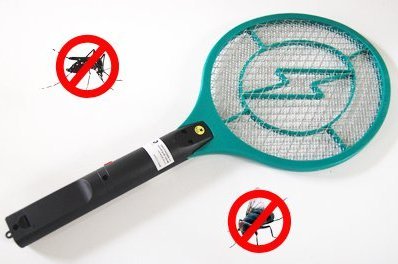
Mosquitoes can be Hard to Eliminate
Mosquitoes are tiny in size but they come in big numbers, and no matter how much we try to eliminate them, these micro pests keep growing with their population.
Today you will find plenty of techniques available in the market that provide us with the options of getting rid of these insects, some are in the form of sprays, some are in the form of coils and mats that need to be burned. Most of these variants are chemical based which either drive away or kill pests due to their toxic nature.
Needless to say if these chemicals have the potentials of harming the pests they would do the same to us in a smaller scale, but nevertheless in the long run they could cause significant health hazards.
Update: Want to know how to build a simple mosquito killer bat without any circuit or battery? Learn More
Audio/Video Representation
Using Swatter Bat for Killing Mosquitoes
However there's an innovative method of killing mosquitoes by electrocution which doesn't involve chemicals and also the procedures are clean, without any mess.
Moreover the electrocuting equipment being in the form of a tennis racket makes the swatting playful and provides an opportunity to avenge ourselves from these pests.
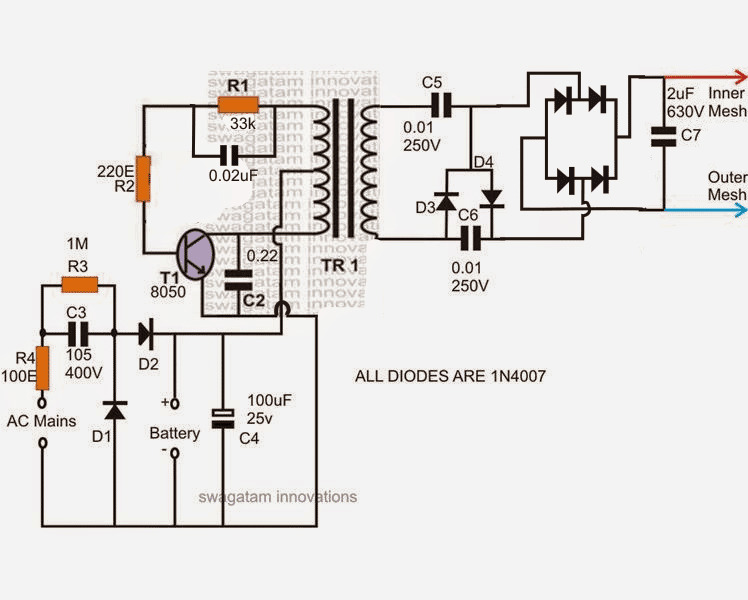
The proposed mosquito swatter bat or mosquito zapper circuit can be seen in the diagram given below, the functioning may be understood with the following points:
The shown configuration employs a blocking oscillator concept as used in joule thief circuits, wherein only a single transistor and a center tapped transformer execute sustainable oscillation across the two winding of the transformer.
How the Circuit Functions
R1 along with the preset and the C1 determine the frequency of oscillation. R1 ensures that the transistor never comes within an unsafe zone while adjusting the preset.
TR1 here is a small ferrite core transformer built using the smallest EE type of ferrite core.
The winding inside the coil is calculated for working with 3V DC supply, meaning the circuit becomes compatible with a 3V battery pack made by putting a couple of AAA cells in series.
When power is applied to the circuit, the transistor and the center tapped transformer instantly start oscillating at the specified high frequency. This forces the battery current to pass across the TR1 winding in a push pull manner.
The above switching generates a proportional induced high voltage across the secondary winding of TR1.
As per the winding data, this voltage could be somewhere around 200V.
To further enhance and lift this voltage to a level which may become suitable for generating a flying spark, a charge pump circuit involving a Crockcroft-Walten ladder network is used at the output of TR1.
This network pulls the 200V from the transformer to about 600V.
This high voltage is rectified and applied across a bridge rectifier where the voltage is appropriately rectified and stepped up by the 2uF/1KV capacitor.
As long as the output terminals across the 2uF capacitor are held at some specified distance, the stored high voltage energy inside the capacitor is unable to discharge, and stays in a standby condition.
If the terminals are bought at a relatively closer distance (about a couple of mm) the potential energy across the 2uF capacitor becomes capable enough to break the air barrier and arc across the terminal gap in the form of a flying spark.
Once this happens, the arcing momentarily stops, until the capacitor charges fully to execute another spark, and the cycle keeps repeating as long as the gap distance is kept within the saturable distance of the high voltage.
When this circuit is applied as a mosquito swatter, the end terminals of the 2uF capacitor are appropriately tied or connected across the internal and the external bat mesh layers.
These metal mesh layers are woven and positioned tightly over a sturdy plastic frame in such away that these are held apart at some distance. This distance prevents the high voltage spark from arcing across the meshes while the bat is in a stand by condition.
The moment the bat is swatted over a fly or a mosquito, the insect gets bridged itself between the bat meshes and allows the high voltage to find and easy conducting path through it.
This results in a crackling sound and a spark through the insect, killing it instantly.
Making the Ferrite Core Transformer
The circuit of the mosquito zapper explained here also includes an small transformerless charger circuit which may be connected to mains for charging the 3V rechargeable battery when the bat stops generating sufficient arcing voltage while swatting the mosquitoes.
TR1 winding details can be found in the following image:
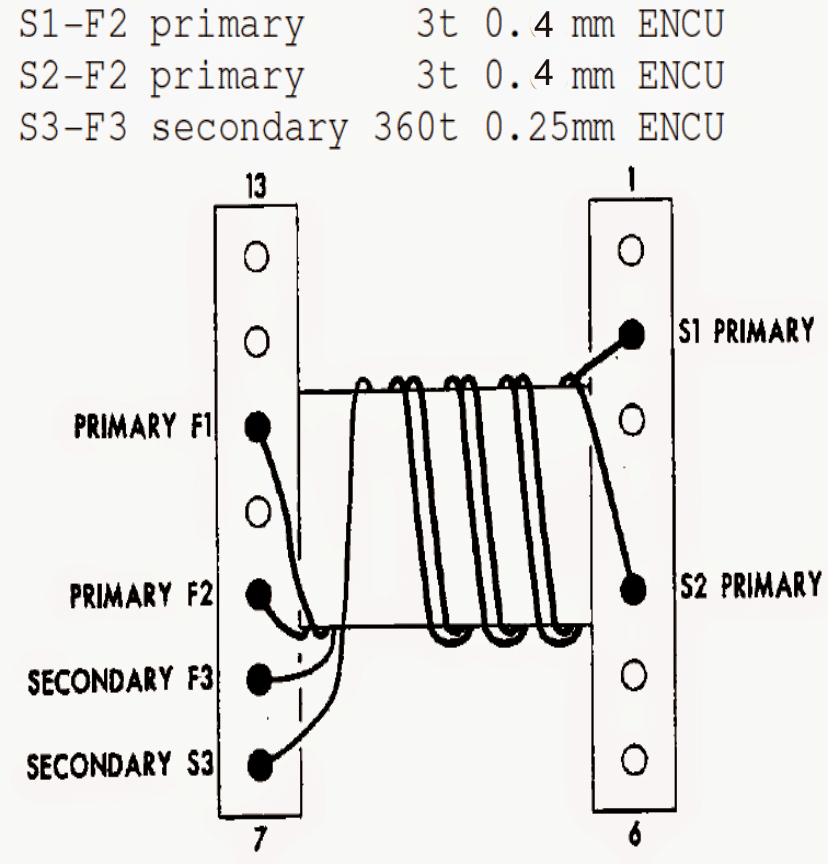
Core: EE19/8/5
Interested to know how to Repair Mosquito Rackets?
Commercial Mosquito Zapper Circuit
The following section discusses the construction details of a high voltage generator circuit which are normally used inside all Chinese or commercial mosquito zapper or mosquito racket units.
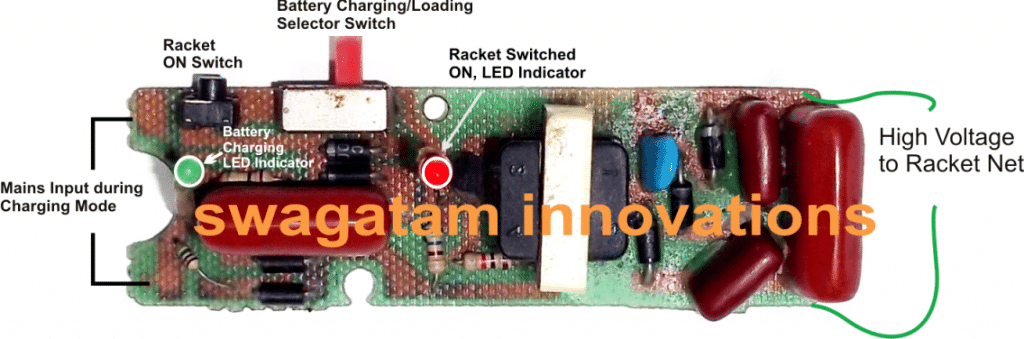
In one of my earlier posts I discussed a simple mosquito zapper circuit, in this article we study a similar design which is commercially used in all mosquito rackets, or mosquito bat units.
How this electronic mosquito racket circuit works
The article was originally posted in one of the Chinese electronic sites and I found it quite interesting and an easy design, and therefore decided to share it here.
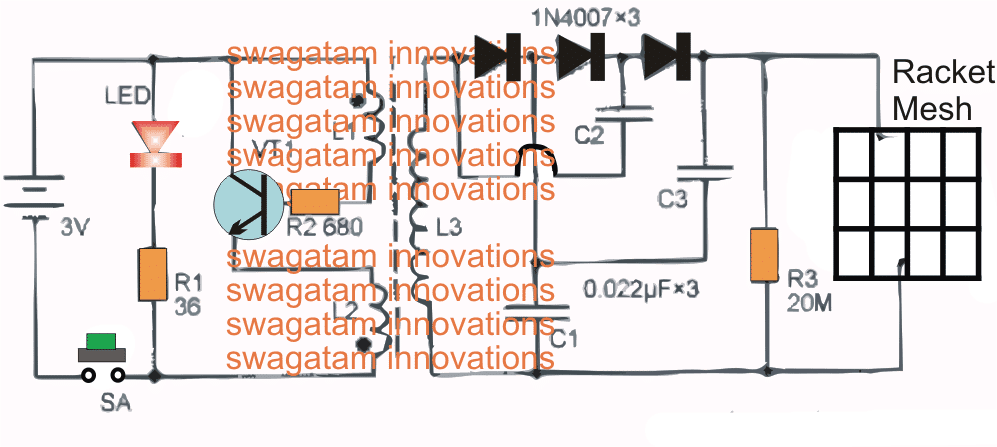
Parts List
- All resistors are 1/4 watt unless specified
- R1 = 36 Ohms
- R2 = 680 Ohms
- R3 = 20 Meg Ohms
- All Capacitors are PPC Type 630V
- C1, C2, C3 = 0.022uF
- Semiconductors
- VT1 = 2N2222 or 8050 Transistor
- D1, D2, D3 = 1N4007 Diodes
- LED = RED LED 20 mA 3mm
- Miscellaneous
- Push Button switch, micro-switch
- 3V or 4V rechargeable Battery
When the power switch SA is pressed, the high-frequency oscillator composed of the transistor VT1 and the step-up transformer T is energized using the 3V DC supply generating a high-frequency alternating current of about 18kHz, boosted by T to about 500V.
This high voltage ranging at 500V is then further stepped up using a ladder network, which is made up of three 1N4007 Diodes, capacitors C1- C3.
This network steps the T output to approximately three times its original value and we get around 1500V which gets stored inside a high voltage PPC capacitor positioned at the extreme end of the ladder network.
This stepped up 1500V is then terminated to the mosquito racket net, which now becomes armed with this high voltage and when ever a mosquito tries to get past the racket net, it instantly gets electrocuted through this high voltage discharge from the PPC capacitor.
An Led can be seen included in the design, it is used for indicating the ON/OFF states of the circuits and also the how much power is left inside the battery. The series resistor R1 decides the intensity of the LED which can be tweaked as per preference to maximize battery life
Component selection
The oscillator transistor used in this Chinese mosquito zapper circuit is a 2N5609, which is an NPN BJT, having a current handling capacity of around 1 amp, however other similar variants such as 8050, 2N2222, D880 etc can also be tried instead of the original number in the design.
The LED can be any 3mm tiny 20mA type of LED, the diodes can be 1N4007 type although fast recovery would work much better, therefore you can also try replacing them with BA159 or FR107 type of fast diodes. The resistors could be 1/8 watt rated or even ¼ watt can be used without issues.
The capacitors must be strictly PPC types rated not less than 630V.
How to Build the High Voltage Transformer
- This is ideally constructed using a 2E19 type ferrite cores and the respective matching plastic bobbin.
- L1 consists of φ0.22mm enameled copper wire or magnet wire with around 22 turns
- L2 is identically wound using φ0.22mm enameled copper wire or magnet wire with around 8 turns
- Finally, L3 which constitutes the secondary winding uses φ0.08mm enameled copper wire and has around 1400 turns.
The above discussed mosquito bat circuit can be also used for killing various kinds of bugs through electrucution using some other suitable format. For example this design could be integrated with a mesh over a dish having a mosquito/bug bait, which might attract the mosquito/bugs and eventually electrocute them as soon as they try to enter the dish through the electrified mesh.
Warning: The above design is not isolated from mains input voltage and therefore will be floating with lethal mains AC, the user is advised to exercise extreme caution while handling or testing the circuit in open and powered condition.



Questions & Answers
hi can I get a processed sound of anopheles gambiae to use in Arduino bord
You can simulate it using PWM frequency modulation (since mosquito wing beats are in the range of 400-600 Hz).
int buzzer = 9;
void setup() {
pinMode(buzzer, OUTPUT);
}
void loop() {
for (int freq = 400; freq <= 600; freq += 10) { // Simulating mosquito wing beats tone(buzzer, freq, 50); delay(50); } }
Hello Swagatam, my mosquito swatter/zapper has a lead-acid battery type but its been dead and won’t charge anymore… is it possible to use a power adapter instead of buying another battery and if yes, what voltage, ampere is required?
Hi Jude,
You can replace the battery in a mosquito swatter bat with an AC to DC adapter with very long flexible wire so that you can move freely with it while zapping the mosquitos.
The voltage can be 4V DC, and the current can be 500 mA.
Thank you very much Sir…
Will it be OK if I connect it to an AC to DC adapter rated 5V DC, 2A?
You can use 5V 2 Amp, just make sure to add two 1N4007 diodes in series with the positive line, so that the 5V drops to 5 – 1.2 = 3.8V, which will be appropriate for the bat.
Thank you very much Engr. Swagatam…
You are welcome Jude…
Dear sir
I understand circuit but if you provided component violated also is very good and help for mechanic
Thanks sir
Sanjay, I have added the parts list under the last diagram, you can check it out…
How to test Mosquito Racquet Bats for mulfunctioning ? These bats are powered by a lead acid battery 4.0 Volts ? Will opening and refilling the acid solution with bi-distilled water and charging put them to work ?
Hi, I think you must refer to the following article for more info:
https://www.homemade-circuits.com/how-to-repair-mosquito-swatter-bats/
The battery used are completely sealed and maintenance free, moreover they are very cheap and can be simply procured from amazon and replaced.
what does the numbers without units in the caps mean? what unit is that in?
All the caps are in microfarads, the 105 cap is a 1uF cap…
Hello Swagatam, thank you for your explanations. Is it possible to use directly a transformer of old bulbs
or any kind of devices that use this type of transformer to make this circuit? 2. I got a simple mosquito swatter bat of a Chinese racket, it only has 3 resistors, a transistor, 1 capacitor, a diode, a led and a transformer. It is damaged so I was trying to fix it.
Hi Guillermo, No, the transformers from LED bulb circuits cannot be used for making a mosquito squatter bat because LED bulb transformers are not designed to generate high voltages.
You can easily repair your simple mosquito bat by checking all the parts except the transformer and then replacing the ones which are faulty.
Mostly, the transistor or the capacitors will be the culprits, while the transformer is the one which will be always good.
Hello Swagatam, thank you for your explanations. How can I increase the output of the commercial circuit so that it is enough to kill mice and rats. Can i just change the final capacitor? Thank you.
Thank you Marcelo, Although I don’t promote killing rats, the power of the mosquito bat circuit can be increased by increasing its transformer specifications and transistor specification.
Changing the output high voltage capacitor might also work to some extent.
Hello..
I need more explanation on technical construction step. Can i use an almininum frame
Hi, Aluminum frame cannot be used, because then it can be difficult to isolate the center mesh of the bat net with the outer mesh.
Hello,
Is it possible to design this circuit even smaller (perhaps surface mounted components, etc).
I need to optimize the size of this circuit and was wondering with today’s components if it is possible or to have a different design that is even smaller?
Thanks!
Hi,
Yes it is possible. You can replace all the resistors and capacitors with SMD variants. However the transformer will not change it will be the same as specified.
I don’t just understand the second circuit
Can you give the voltage reading at different points of the circuit so that I can trace the faulty component using a multi meter ?
Voltage reading can be different for different models, so that may not be the correct way to test the fault. The correct way is to check the transistor, the diode, in the standard way using a multimeter (in the diode range). Mostly it is the battery that becomes low or degraded, other parts are mostly OK.
Hello
I occasionally buy such rackets with 2 or 3 AA batteries, I always end up replacing a old racket with a new one because the power of the electrification weakens, that is, when I electrify a mosquito I see a weak spark and do not hear noise, i.e. the voltage in the racket weakens Although I put new batteries .
The question is which component may be Usually damaged and needs to be replaced? The output capacitor, the transistor?
Thanks in advance, and by the way I really enjoyed the explanation you gave about the racket
Hi, thank you and glad you enjoyed the explanation.
Mostly it is the battery that will wear out or the net that could get damaged or bent. All the other components will be mostly in good condition because everything is solid-state in the design.
However if your bat is not working even with new batteries, I would recommend you to disconnect the high tensions wire from the net/mesh, and manually short circuit the wire ends. If you happen to get a large spark, then your circuit is alright, the leakage or the issue may be with the net mesh.
If you do not get the spark, or get a weak spark, you can try changing the transistor, or change a few of the PPC capacitors at the output side of the circuit. You can also check the diodes at the output side of the transformer. In a cheap quality unit, these few components may be at risk of burning, the transistor, the PPC capacitors or the diodes.
Thanks for your answer and the problem does seem to be because of the net
I am not getting mosquit parts like PF condenser, 2U2k, other pf condenser, 882 transitor, rectifier, and transform. Can i purchase on line or any shop of your. So please dend parts rate in detail for mosquit bat repair. I am electronics engineer. please help to purchase.
You can try any online electronic store for getting those parts!
Hi, our company is developing mosquito pcb. can you help me in commercial production?
Hi, sorry, due to work pressure I cannot accept external job offers.
Hi Swagatam,
I would like to build a shocking circuit similar to yours. I want to use it to shock squirrels . I would like to power it with 4 to 6 or even 8 1.5v AA batteries in series, I would run wires to cover the area I want to keep the squirrels out of. D0 you have a circuit that would do this and could you draw up the schematic along with a parts list?
Hi Norman, it won’t be a great idea to kill squirrels with shock, because the shock from mosquito circuit can easily kill these small animals. Instead you can use milder shocks which will only help to drive them away.
The best way is to put two 0-12V/500 mA transformers back to back with their 0-12V sides connected, and then use one of the transformer’s 220V for AC mains input and the other side to create mild shock source for the animals. Make sure to have a 0.22uF/400V capacitors connected in series with the secondary side 220V wires, used for shocking the animals.
Thank you for writing such an informative article. I found a mosquito racket that is using a micro USB charging(phone adapter 5V 1Amp minimum). When I opened it I found a 18650 lithium-ion cell in it and the circuit has an extra IC (TC4056A). The circuit photo you showed is using a 3.7V lead acid battery I think. Sir
1. TC4056A is for battery protection as I read online. But why it is not needed in your circuit with lead-acid battery?
2. Can I replace lead acid battery in normal rackets directly with a 18650 lithium ion as later have more mah’s ?
3. I diagram you have written R3 just before the racket’s mesh. But in photo we see a big capacitor at the end ? So is R3 a capacitor ? in my rackets its a (223 2000V) model.
Thanks again
1) TC4056A may be used for charging Li-Ion batteries at a fast rate, which cannot be implemented in lead acid or SMF batteries.
2) You can replace the SMF battery with 18650 battery
3) R3 is used to ensure that no residual charge exists on the mesh while it is in the switched OFF condition. R3 is a 20 meg resistor, not a capacitor. C3 is the big capacitor that you are referring to in your bat circuit.
How long with this circuit operate while on, but under no load? Ie, can it sit for hours while on if no mosquitos are zapped?
as long as the mesh is not shorted, it can stay on for hours….
Hello, can you show us how to make the transformer from:
“How this electronic mosquito racket circuit works”
There is not enough explanation for a beginner like me:
This is ideally constructed using a 2E19 type ferrite cores and the respective matching plastic bobbin. Do you have a photo to show a reference from a component supplier.
The direction of winding of the wire also …
Thank you for your reply.
Patrick.
Hi, yes the E cores are E19, and its bobbin.
You can get the parts from any online electronic spare part supplier like element14, digikey, mouser, vishay etc
Bonjour, je ne comprends toujours pas comment et avec quel élément on fabrique le transformateur !
il y a plein de référence E19 !
https://www.digikey.fr/products/fr?PPV=1811|4|7034158
Cdt Patrick.
Hello, please open any mosquito bat practically, you will able to understand the exact size of the cores, or you can also refer to the circuit board image shown in the article to get an idea of the core size. There are also plenty of you tube videos which you can refer to know about the core size.
hello mr. swag,
Great website! Also can use the mosquito circuits as a ni-cad zapper/SLA battery zapper with successful results.
Thank you for sharing your knowledge.
Regards
Thanks Erikh, Glad you liked my website, please keep up the good work.
Swagatam, I’d like to hire you to build a circuit similar to what you described in this mosquito bat article. I can’t build it myself because I have no knowledge of electronics. Please contact me for the details, as anything I write here will be public, since there doesn’t seem to be a way to contact you directly. Thank you.
Hello Michael, I appreciate your interest, however due to work pressure it looks difficult for me to accept outside jobs, so i am sorry i won’t be able to help you in this regard..
Thank you for the quick reply, and I understand. If you can think of someone else who might be interested in the job, please feel free to pass along my email address.
Sure, if I find somebody suitable I’ll send his contact details to you.