The following 5 versions of 6 volt 4 AH battery charger circuits has been designed by me and posted here in response to the request from Mr. Raja, I have explained the whole conversation.
Technical Specifications
"Dear sir, please post a circuit to charge 6 volt 3.5 ah lead acid battery from 12 volt battery. The charger should automatically stop charging as the battery is fully charged.
Please use transistor instead of relay to stop charging, and also tell me how to use 12 volt relay for the same circuit.
Explain Which is safe and durable either relay or transistor to cut off charging. (At present i am charging my above said battery by simply using LM317 with 220 ohm and 1 kilo ohm resistors and a couple of capacitor) i'm awaiting your article, thank you".
The Design
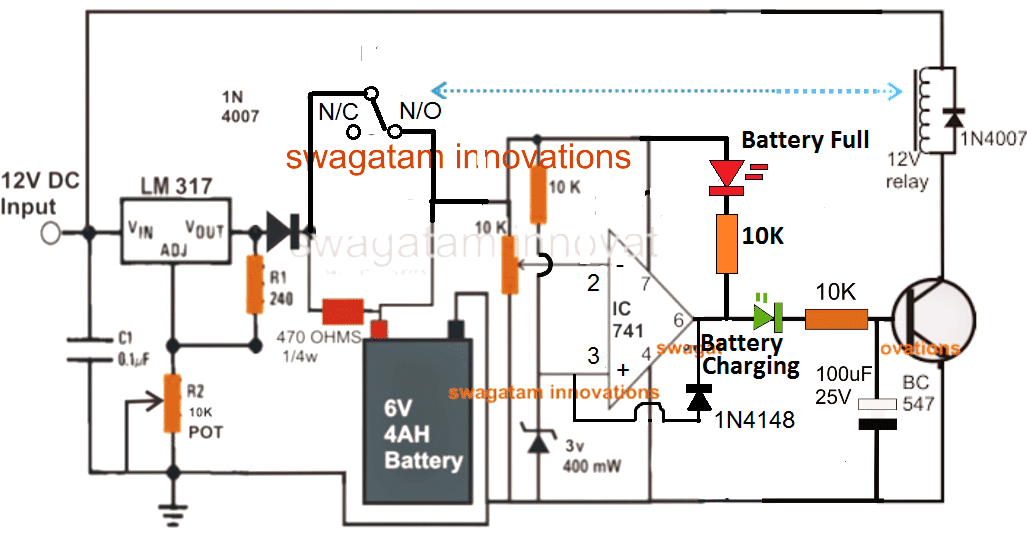
The following circuit shows a simple automatic 6 volt 4 to 10 AH battery charger circuit using a 12 volt relay, designed to automatically cut off the supply to the battery as soon as the full charge level for the battery is reached.
How it Works
Assuming no battery is connected with the circuit, when power is switched ON, the relay contact will be at the N/C and no power will be able to reach the IC 741 circuit.
Now when battery is connected, the supply from the battery will actuate the circuit, and assuming the battery to be in a discharged state, pin#2 will be lower than pin#3 causing a high at pin#6 of the IC. This will switch ON the transistor relay driver, which in turn will shift the relay contact from N/C to N/O connecting the charging supply with the battery.
The battery will now begin charging slowly and as soon a its terminals reaches at 7V, pin#2 will tend to become higher than pin#3, causing pin#6 of the IC to become low, switching OFF the relay and cutting off supply to the battery.
The existing low at pin#6 will also cause pin#3 to become permanently low through the linked 1N4148 diode, and thus the system will be latched, until power is switched OFF and ON again.
If you don't wish to have this latching arrangement, you can very well eliminate the 1N4148 feedback diode.
Note: The LED indicator section for all 3 following diagrams were recently modified after a practical testing and confirmation
Circuit#1
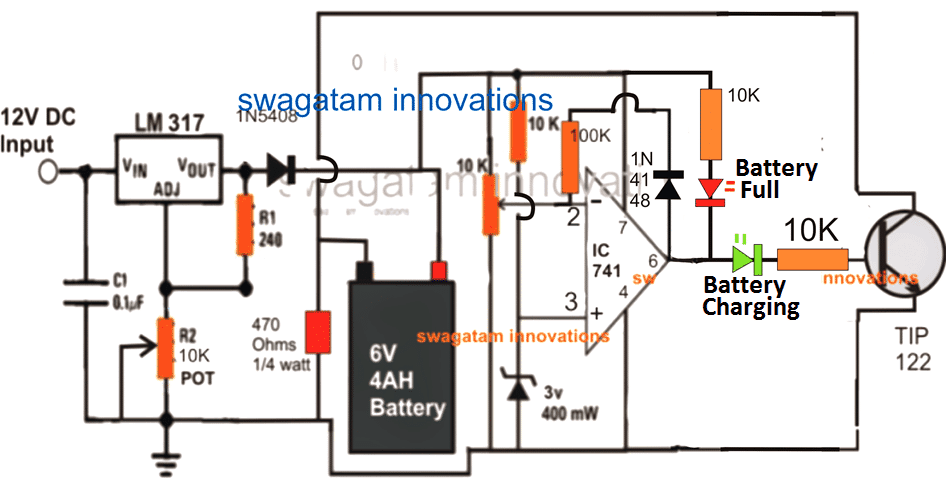
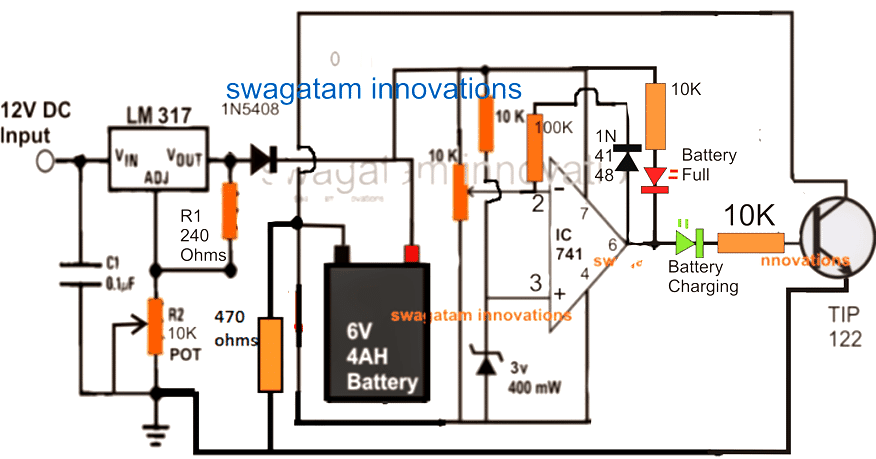
The following circuit shows a simple automatic 6 volt 4 AH battery charger circuit without using a relay, rather directly through a transistor, you can replace the BJT with a mosfet also to enable high Ah level charging also.
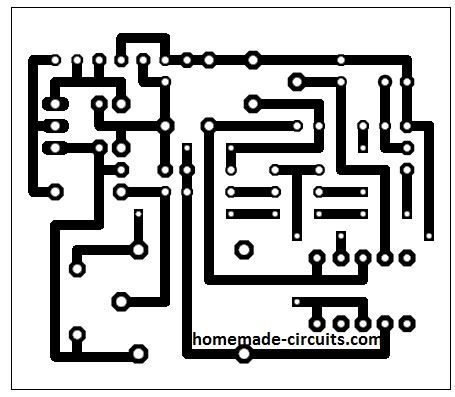
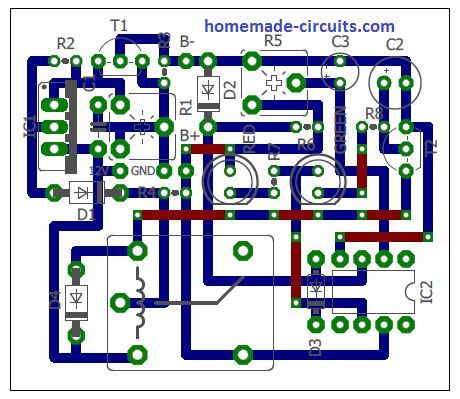
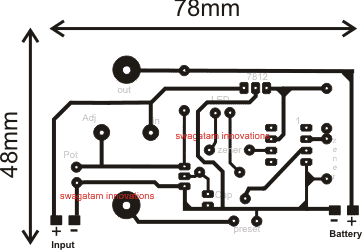
PCB Design for the Above Circuit
The PCB layout design were contributed by one of the avid followers of this website, Mr. Jack009
Circuit#2
Update:
The above transistorized 6V charger circuit has a mistake. At the full-charge level as soon as the battery negative is cut-off by the TIP122, this negative from the battery is also cut-off for the IC 741 circuit.
This implies that now the IC 741 is unable to monitor the discharging process of the battery, and will be unable to restore the battery charging when the battery reaches the lower discharge threshold?
To correct this we need to make sure that at the full-charge level, the battery negative is only cut-off from the supply line, and not from the IC 741 circuit line.
The following circuit corrects this flaw and makes sure that the IC741 is able to monitor and keep track of the battery health continuously under all circumstances.
How to Set Up the Circuit
Initially, keep the pin6 feedback resistor disconnected and without connecting any battery adjust R2 to get exactly 7.2V at the output of the LM317 (across cathode of 1N5408 and ground line), for powering the IC 741 circuit.
Now simply play with the 10k preset and identify a position where the RED/GREEN LEDs just flip/flop or change or swap between their illumination.
This position within the preset adjustment may be considered as the cut-off or the threshold point.
Carefully adjust it to a point at which the RED LED in the first circuit just lights up......but for the second circuit it should be the green LED that is supposed to get illuminated.
The cut-off point is now set for the circuit, seal the preset in this position and reconnect the pin6 resistor across the shown points.
Your circuit is now set for charging any 6V 4 AH battery or other similar batteries with an automatic cut-off feature as soon as or each time the battery becomes fully charged at the above set 7.2V.
Both the above circuits will perform equally well, however the upper circuit can be altered to handle high currents even up to 100 and 200 AH just by modifying the IC and the relay. The lower circuit may be made to do this only up to a certain limit, may be up to 30 A or so.
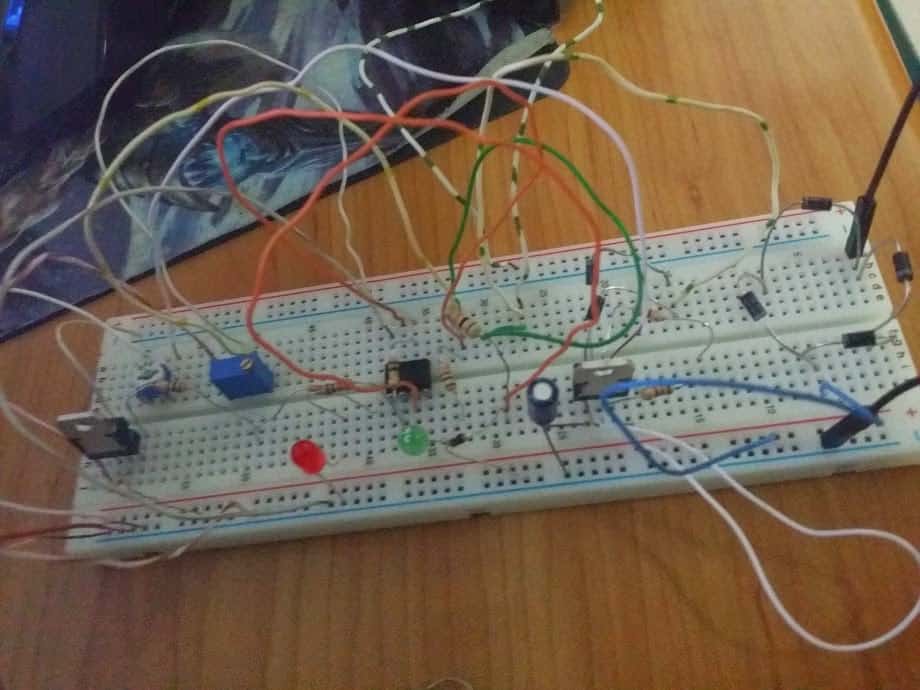
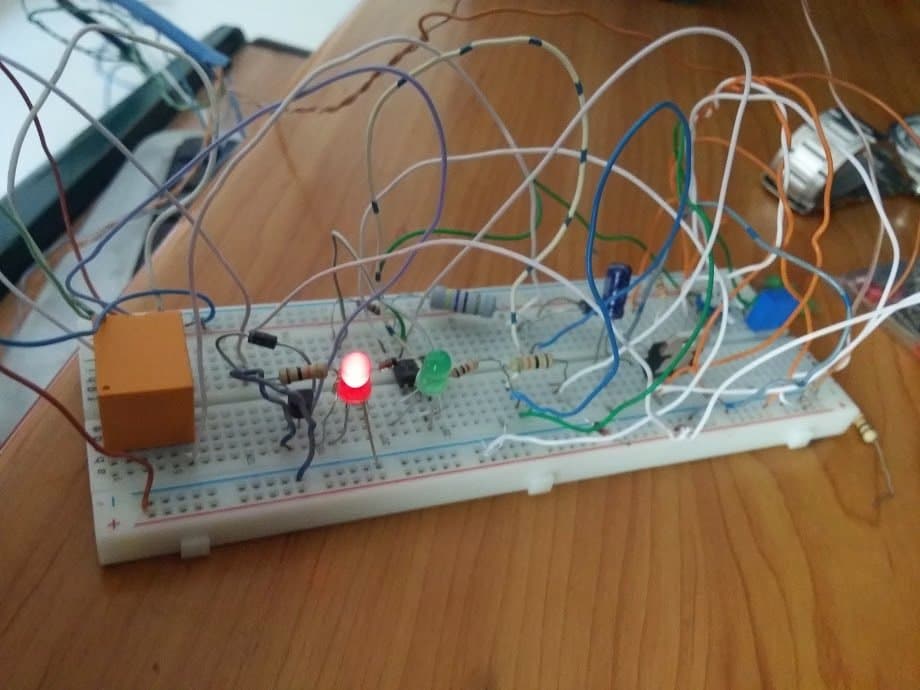
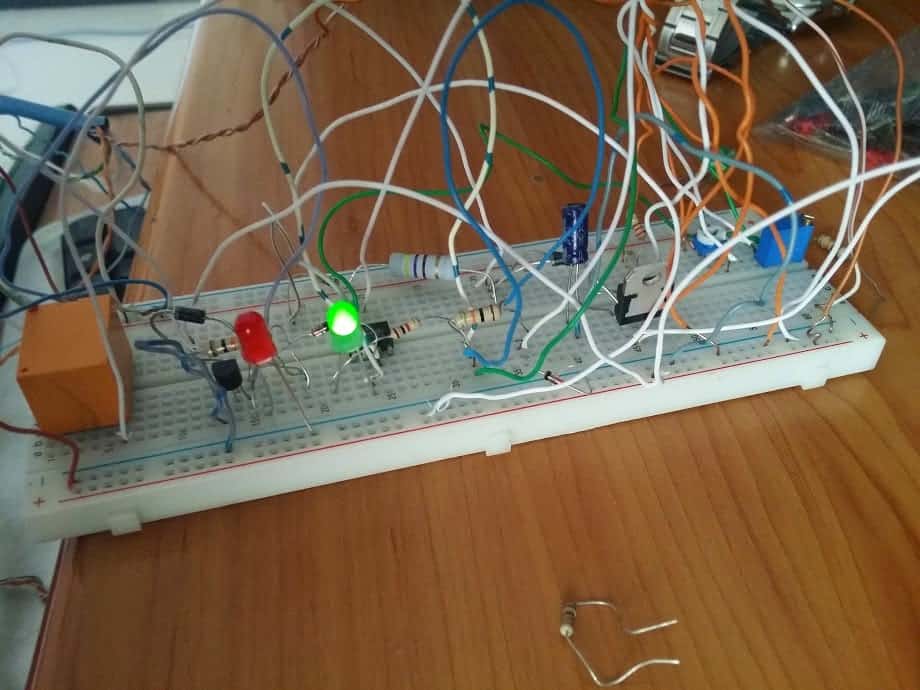
The second circuit from above was successfully built and tested by Dipto who is an avid reader of this blog, the submitted images of the 6V solar charger prototype can be witnessed below:
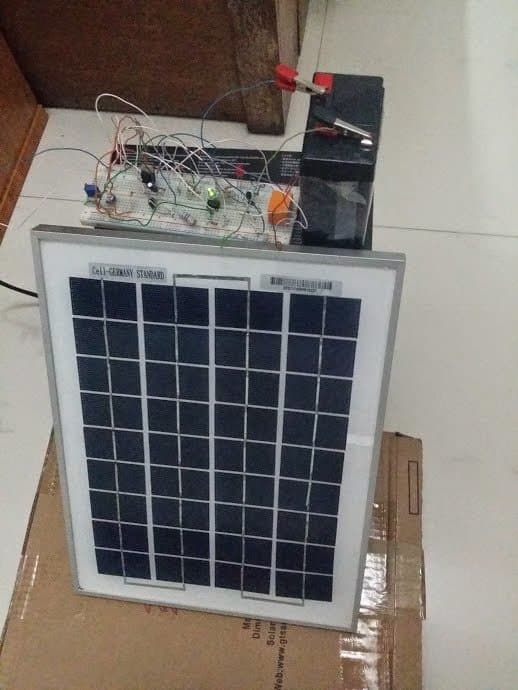
Adding a Current Control:
An automatic current control regulator function can be added with the above shown designs by simply introducing a BC547 circuit as shown in the following diagram:
Circuit#3
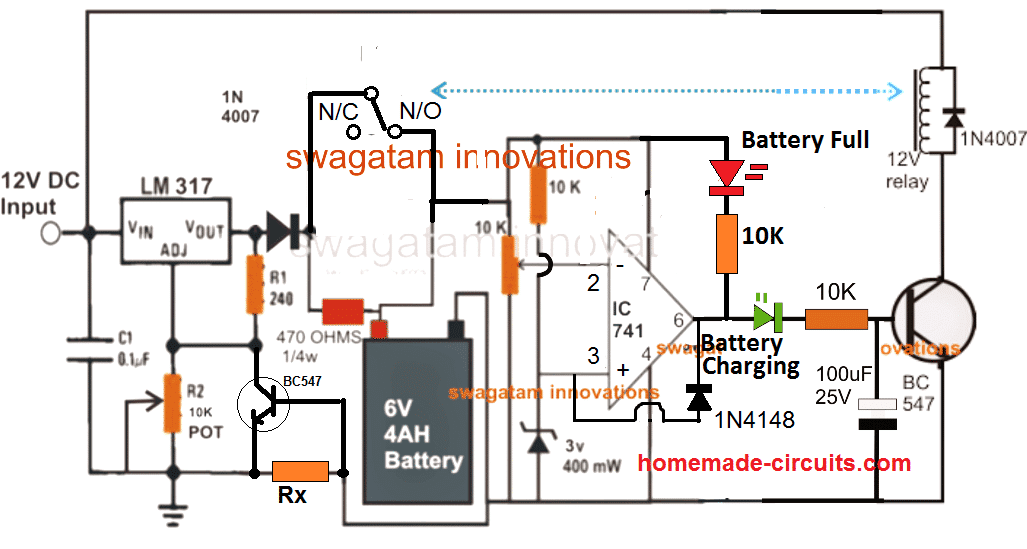
The current sensing resistor can be calculated through the simple Ohm's law formula:
Rx = 0.6 / Max charging current
Here 0.6V refers to the triggering voltage of the left side BC547 transistor while max charging current signifies the maximum safe charging for the battery, which may be 400mA for a 4AH lead acid battery.
Therefore solving the above formula gives us:
Rx = 0.6 / 0.4 = 1.5 Ohms.
Watts = 0.6 x 0.4 = 0.24 watts or 1/4 watt
By adding this resistor will ensure that the charging rate is fully controlled and it is never exceeded the specified safe charging current limit.
Test Report Video Clip:
The following video clip shows the testing of the above automatic charger circuit in real time. Since I did not have a 6V battery, I tested the design on a 12V battery, which does not make any difference, and its all about setting the preset accordingly for the 6V or a 12V battery as per user preference. The above shown circuit configuration was not changed in any manner.
The circuit was set to cut off at 13.46V, which was selected as the full charge cut off level. This was done to save time because the actual recommended value of 14.3V could have taken lot of time, therefore to make it quickly I selected 13.46V as the high cut off threshold.
However one point to be noted is that the feedback resistor was not employed here, and the lower threshold activation was automatically implemented at 12.77V by the circuit, as per the IC 741's natural hysteresis property.
6V Charger Design#2
Here's another simple yet accurate automatic, regulated 6V lead acid battery charger circuit which switches off the current to the battery as soon as the battery reaches full charge. An illuminated LED at the output indicates the fully charged condition of the battery.
How it Works
The CIRCUIT DIAGRAM can be understood with the the following points:
Fundamentally the voltage control and regulation is done by the versatile, work horse IC LM 338.
An input DC supply volt in the range of 30 is applied to the input of the IC. The voltage may be derived from a transformer, bridge and capacitor network.
The value of R2 is set to get the required output voltage, depending upon the battery voltage to be charged.
If a 6 volt battery needs to charged, R2 is selected to produce a voltage of around 7 volts at the output, for a 12 volt battery it becomes 14 volts and for a 24 volt battery, the setting is done at around 28 volts.
The above settings take care of the voltage that needs to be applied to the battery under charge, however the tripping voltage or the voltage at which the circuit should cut off is set by adjusting the 10 K pot or preset.
The 10K preset is associated with the circuit involving the IC 741 which is basically configured as a comparator.
The inverting input of the IC 741 is clamped at a fixed reference voltage of 6 via a 10K resistor.
With reference to this voltage the tripping point is set via the 10 K preset connected across the non inverting input of the IC.
The output supply from the IC LM 338 goes to the battery positive for charging it. This voltage also acts as the sensing as well as the operating voltage for the IC 741.
As per the setting of the 10 K preset when the battery voltage during the charging process reaches or crosses the threshold, the output of the IC 741 goes high.
The voltage passes through the LED and reaches the base of the transistor which in turn conducts and switches off the IC LM 338.
The supply to the battery is immediately cut off.
The illuminated LED indicates the charged condition of the connected battery.
Circuit#4
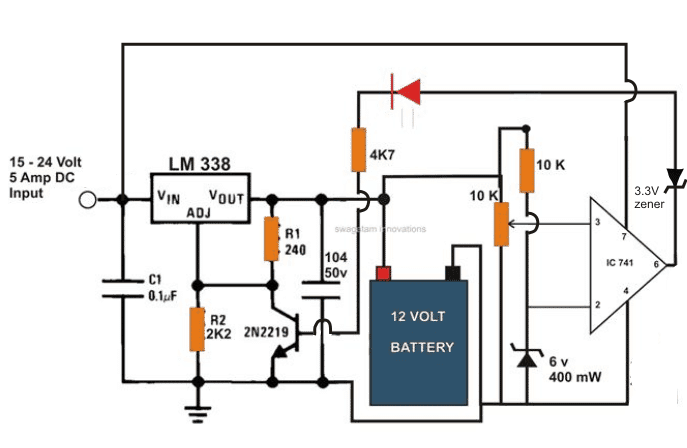
This automatic battery charger circuit can be used for charging all lead acid or SMF batteries having voltages in between 3 and 24 volts.
The above circuit was found not so satisfactory by some of the readers, so I have modified the above circuit for a better and guaranteed functioning. Kindly see the modified design in the below given figure.
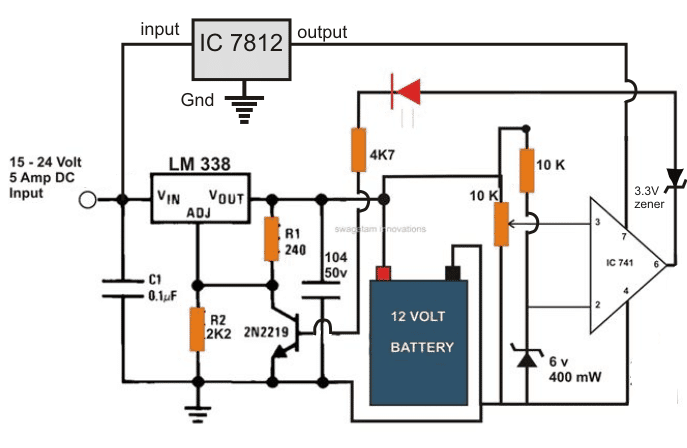
PCB Design for the above finalized 6V, 12V, 24V automatic battery charger circuit
Solar 6V Battery Charger Circuit with Over Current Protection
So far I have explained how to a simple 6V battery charger circuit with over current protection using mains input. In the following discussion I will try to explain how the same could be configured in conjunction with a solar panel, and also with an AC/DC adapter input.
The circuit also includes a 4 stage battery status indication feature, an over current controller stage, automatic switch OFF for the load and battery charging, and also a separate cell phone charging outlet. The idea was requested by Mr. Bhushan Trivedi.
Technical Specifications
Greetings, I trust you are well. I am Bhushan, and I am working on a hobby project currently. I am very impressed by the knowledge you share at your blog, and was hoping if you would like to guide me a bit with my project.
My project is around charging a 6V 4.5 Ah sealed battery with grid and solar panel.
This battery will supply power to led lights and a mobile phone charging point. Actually, the battery will be kept in a box. and box will have two inputs for battery charging. These two inputs are solar (9V) and AC (230V) for charging the 6V Battery.
There will not be any automatic switchover. Its like the user has an an option to either charge the battery from solar or grid. but both the input options shall be available.
For example, if on a rainy day or for some reason the battery can't be charged from a solar panel, then grid charging should be done.
So I am looking for an option of both the inputs to the battery. Nothing automatic hereThe battery level indicator LED should indicate in red yellow and green on the battery level.
Automatic battery cut off after voltage goes down certain limits to ensure long battery life. I am attaching a short problem statement along this email for your reference.
I am looking for a circuit for the arrangement shown in it. I am keen to hear from you on this
Kind Regards,
Bhushan
The 5th Design
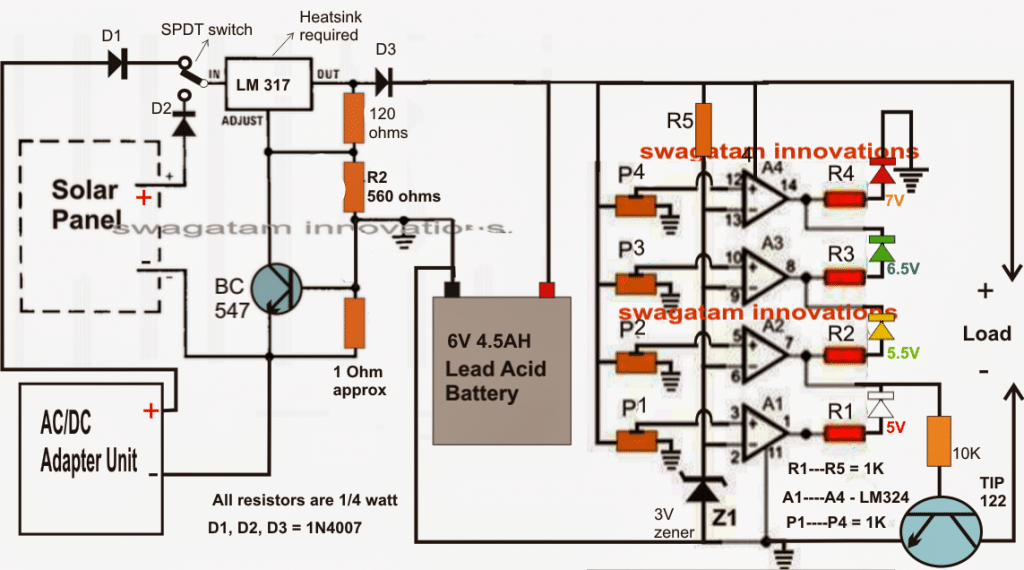
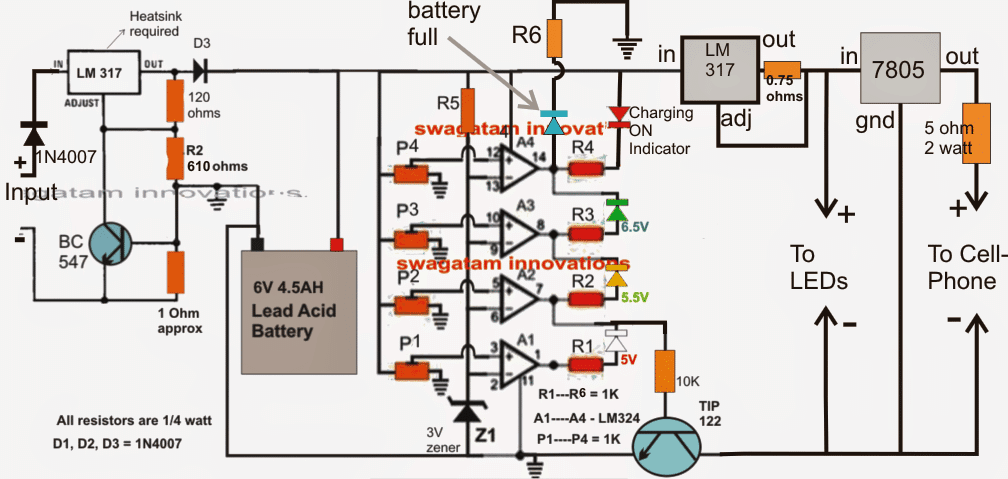
The required 6V solar battery charger circuit can be witnessed in the diagram presented below.
Referring to the diagram, the various stages may be understood with the help of the following points:
The IC LM317 which is a standard voltage regulator IC is configured to produce a fixed 7V output determined by the resistances 120 ohms and 560 ohms.
The BC547 transistor and its base 1 ohm resistor ensure that the charging current to the 6V/4.5AH battery never exceeds the optimal 500mA mark.
The output of the LM317 stage is directly connected with the 6V battery for the intended charging of the battery.
The input to this IC is selectable via a SPDT switch, either from the given solar panel or from an AC/DC adapter unit, depending whether the solar panel is producing sufficient voltage or not, which could be monitored through a voltmeter connected across the output pins of the LM317 IC.
The four opamps from the IC LM324 which is a quad opamp in one package are wired up as voltage comparators and produce a visual indications for the various voltage levels at any instant, during the charging process or during the discharging process through the connected LEd panel or any other load.
All the inverting inputs of the opamps are clamped to a fixed reference of 3V through the relevant zener diode.
The non-inverting inputs of the opamps are individually attached to presets which are appropriately set to respond to the relevant voltage levels by making their outputs high sequentially.
The indications for the same could be monitored via the connected colored LEDs.
The yellow LED associated with A2 may be set for indicating the low voltage cut-off threshold. When this LED shuts off (white lights up), the transistor TIP122 is inhibited from conducting and cuts off the supply to the load, thereby ensuring that the battery is never allowed to discharge to dangerous unrecoverable limits.
A4 LED indicates the upper full charge level of the battery....this output could be fed to the base of the LM317 transistor in order to cut-off the charging voltage to the battery preventing overcharging (optional).
Please note that since the A2/A4 do not have hysteresis included could produce oscillations at the cut-off thresholds, which won't necessarily be an issue or affect the battery performance or life.
Circuit#5
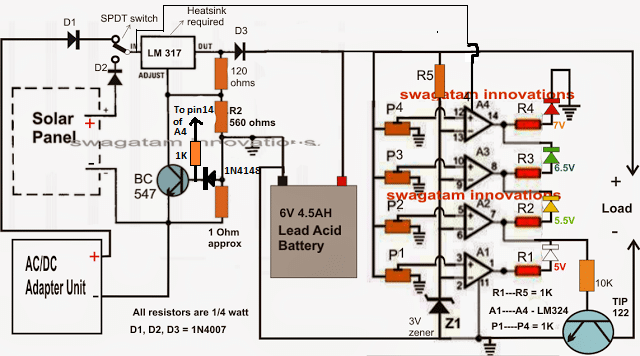
Adding an Auto-cut OFF on Batery Battery Full Charge
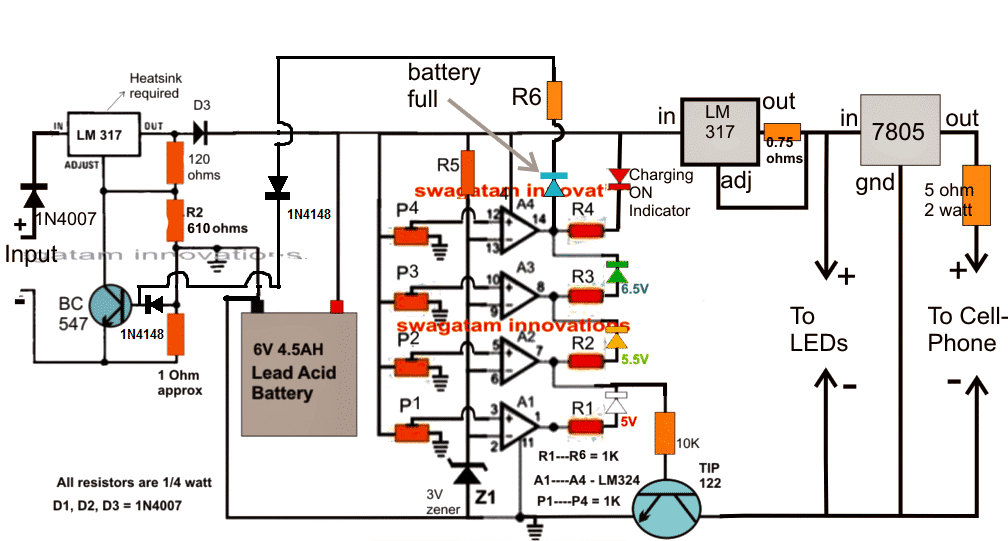
The modified diagram with over charge auto-cut of can be implemented by connecting A4 output with the BC547.
But now the current limiting resistor formula will be as follows:
R = 0.6 + 0.6 / max charge current
Feedback from Mr. Bhushan
Thank you very much for your continued support and the above circuit designs.
I have a few minor changes to the design now, which I would like to request you for incorporating in the circuit design. I would like to express that cost of the PCB and components is a big concern, but I do understand quality is also very important.
Hence, I request you to strike a fine balance between the performance and cost of this circuit. So to begin with, we have this BOX, in which will house the 6V 4.5 Ah SMF Lead Acid Battery and the PCB too.
The 6V 4.5 Ah Battery will be charged either through the followingn options from one single input:
a) A 230 V AC to 9V DC Adaptor (I wish to go ahead with a 1 amp rating charger, your views?) ‘OR’
b) A 3-5 Watt Solar module (Max Voltage: 9 V (6V nominal), Max Current: 0.4 to 0.5 Amps)
Block Diagram
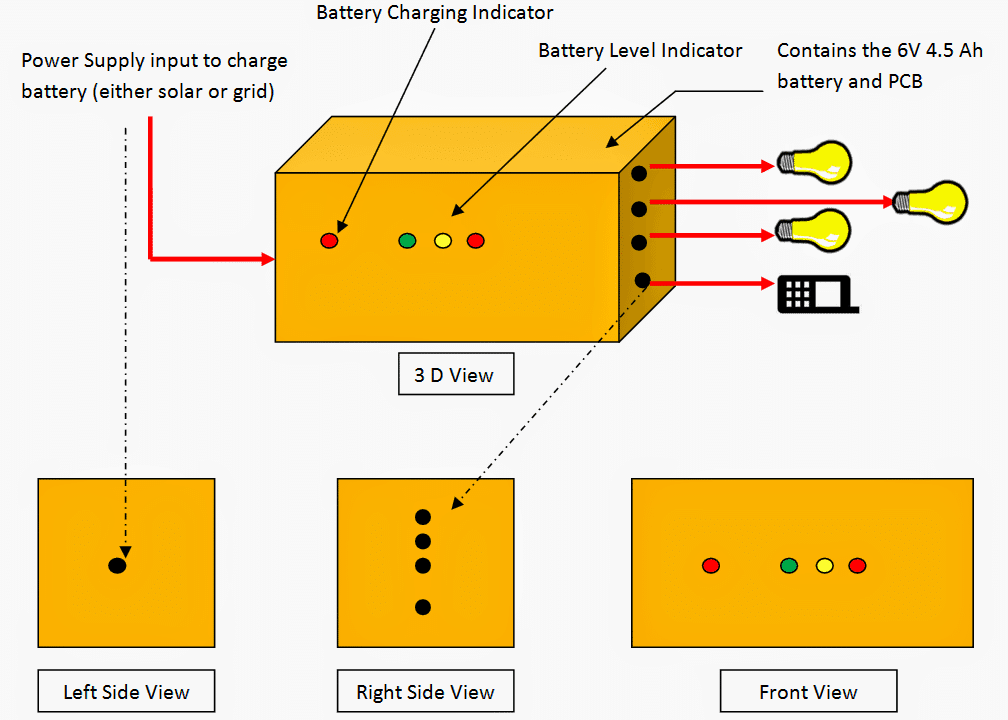
The battery can be charged by only one supply at a time hence will only have one input on the left side of the box.
For the time when this battery is being charged, there will be small red led light which glows on the font face of the box (Battery Charging Indicator in diagram) Now, at this point, the system should also have a battery level indicator (Battery level Indicator in diagram)
I wish to have three levels of indications for the battery state. These tables state the open circuit voltage. Now with the very little electronic knowledge I have, I am assuming this is ideal voltage and not the actual conditions, right?
I think I will leave that on you to decide and use any correction factors if required for calculations.
I wish to have the following indicator levels:
- Charge level 100% to 65% = Small Green LED is ON (Yellow and Red LED off)
- Charge level 40% to 65% = Small Yellow LED is ON (Green and Red LED off)
- Charge level 20% to 40% = Small Red LED is ON (Green and Yellow LED off)
- At 20% Charge level, battery disconnects and stops supplying output power.
On the Output side now (Right Side View in diagram)
The system will supply power to the following applications:
a) 1 Watt, 6V DC LED Bulb – 3 No’s
b) One output for Mobile Phone Charging I wish to incorporate a feature here. As you see, the DC loads connected to the battery are of relatively less wattage. (just a mobile phone and three 1 watt LED Bulbs). Now, the feature to be added in the circuit should kind of work as a fuse ( I don’t mean an actual fuse here).
Assume if a CFL bulb is connected here or some other application of higher wattage rating, power supply should be cut off. If the total power drawn is in excess of 7.5 Watts DC connected to this system, the system should cut off supply and shall only resume when the load is below 7.5 Watts.
I basically wish to ensure that this system is not misused or drawn excessive energy from, thereby damaging the battery.
This is just an idea. I do however understand this can potentially increase the complexity and cost of the circuit. I will look for your recommendation on this on whether to include this feature or no as we already are cutting off the battery supply once the state of charge reaches 20%.
I hope you find this project exciting to work on. I look forward to receiving your much valued inputs on this.
I am thanking you for all your help till now and in advance for your extended cooperation on this.
Kind Regards,
Bhushan.
The Design
Here's a brief explanation of the various stages included in the proposed 6V battery charger circuit with over current protection:
The left side LM317 is responsible for producing a fixed 7.6V charging voltage across its output pin and ground for the battery, which drops to around 7V via D3 to become an optimal level for the battery.
This voltage is determined by the associated 610 ohm resistor, this value can be reduced or increased for changing the output voltage proportionately if required.
The associated 1 ohm resistor and the BC547 restricts the charging current to around a safe 600mA for the battery.
The opamps A1---A4 are all identical and perform the function of voltage comparators. As per the rules if the voltage at their pin3 exceeds the level at pin2, the corresponding outputs become high or at the supply level..... and vice versa.
The associated presets may be set for enabling the opamps to sense any desired level at their pin3 and make their corresponding outputs go high (as explained above), thus A1 preset is set such that its output becomes high at 5V (Charge level 20% to 40%)....A2 preset is set to respond with an output high at 5.5V (Charge level 40% to 65%), while A3 triggers with a high output at 6.5V (80%), and finally A4 alarms the owner with the blue LED at battery level reaching the 7.2V mark (100% charged).
At this point the input power will need to be switched off manually since you did not demand for an automatic action.
Once the input is switched off, the 6v battery level sustains the above positions for the opamps, while the output from A2 ensures that the TIP122 conducts keeping the relevant loads connected with the battery and operative.
The LM317 stage at the right is a current controller stage which has been rigged to restrict the output amp consumption to 1.2 amps or around 7 watts as per the requirements. The 0.75 ohm resistor may be varied for altering the restriction levels.
The next 7805 IC stage is a separate inclusion which generates a suitable voltage/current level for charging standard cell phones.
Now, as power is consumed the battery level begins receding in the opposite direction, which are indicated by the relevant LEDs....
Blue is the first one to shut off illuminating the green LEd, which shuts off off below 6.5V illuminating the yellow LEd which identically shuts off at 5.9V making sure that now the TIP122 no longer conducts and the loads are shut off....
But here the condition may oscillate for some moment until the voltage finally reaches below 5.5V illuminating the white LEd and alarming the user for an input power switch on and commence the charging procedure.
The above concept can be further improved by adding an automatic full charge cut off facility, as shown below:




Questions & Answers
Hi Sir,
For providing a bat charging indicator
For your circuit no 4 with ic 7812 .
Can we connect a diode IN4007 reverse biased to pin 6 out put of 741 ic and in series to the diode a resistor
and an led and the led anode to the out put pin3 of 7812 will it work .
Regards. Sambath kumar
Hi Sambath,
An LED is already present in series with the pin#6 of 741, which indicates battery is fully charged.
Hi Sir ,
Thank you very much for your reply and fast responce regarding 12v bat charger circuit 4.
Regards Sambath.
No problem Sambath…
Hi Sir,
You said that bat should be connected to the supply pin of the 741ic to avoid chattering of relay during power on condition. But in your 4th circuit for a12v bat charger ckt the supply of the ic for 741is taken fr the input of 338 why is it so. Regards. Sambath
Sambath, In Circuit#4 since no relay is used so it does not matter from where the DC to the pin#7 of the 741 is supplied, but ideally it should be connected from the battery terminal only…
Hi Sir,
Sorry for the delay to your reply regarding 6v bat charger using 741 ic
your answer is very clear to me .
understood the importance of the bat voltage for the ic .
Thank you very much Sambath
No problem Sambath,
I am happy I could clarify the point…
Hi Swagatam Sir ,
In your 3rd circuit I think you can provide the 741 ic positive supply fr the out put of LM 317 through a IN4007 diode and also add a 47 mfd 16v cap from that point to gnd.
Regards. Sambath
Hi Sambath,
The 741 circuit must be supplied from the battery only, so that it is always in a position to detect the battery level, without errors, and if the battery is not connected then the whole circuit remains disabled. Otherwise, the relay might start chattering on power switch ON, in the absence of a battery.
Hello sir,
In my project i need to charge multiple batteries using switching circuit. from dc load one charger and same charging for 2 split batteries, charged battery will light the load when required. when dc source is not available. tell me how can i do this. give me your contact details
Hello Sheela,
I guess you are referring to a battery charger circuit that will charge two batteries alternately depending on which is fully charged or discharged.
You can refer to the Last circuit diagram from the following article using two op amps
https://www.homemade-circuits.com/automatic-dual-battery-charger-with/
I have a question about the automatic full charge cutoff in the last couple circuits. The output at the A4, pin 14 is connected to the transistor, but won’t it slowly let more and more current through as it approaches the desired charge? And consequently, won’t the output of the lm317 drop too as current starts to flow across the transistor, lowering the reference voltage? I guess I am failing to see how the battery will ever reach the desired charge. I would be delighted to hear what is wrong with my thinking. Really enjoyed reading about the design process. I am currently a student and I learned a lot.
The A4 pin14 will not change slowly rather it will change from 0V to 7V instantly and shut down the LM317, cutting off the supply to the battery. Op amp outputs are not designed to change state slowly, rather their output change state with a snap.
So when the 6V battery reaches its full charge level, let’s say 7 v, at this point the A4 input detects the full charge level and its output instantly changes state from 0V to 7 V shutting down the LM317 and cutting off the charging supply to the battery.
Please let me know if you have any further doubts or questions.
Hello sir, thank you for your sharing, I need the automatic cut-off charging circuit, but I cannot find the exact equivalents of some components (lm324) in the proteus isis program in the last circuit you shared, I request you to share the proteus files of this circuit or an alternative circuit.
Hello Murat, Sorry, I don’t proteus file for any of the above circuits. LM324 is a very common and standard IC and is most suitable for this application. You can try two LM358 ICs if you are having problem with LM324.
Good day, Sir. I would like to ask for your help. I’m planning to design a battery charging circuit for a microbial fuel cell that will possibly run an operating maximum voltage of 425mV. I would like to charge a battery of 12V and 8Ah. The battery will be used for charging a flashlight and a cellphone with micro USB charging port. Thank you very much for your help.
Hi Ish,
for your 12 V, 8 Ah lead acid battery you can simply use an LM338 based charger as shown below:
https://www.homemade-circuits.com/wp-content/uploads/2019/07/Li-ion-charger-LM317.jpg
Just makes sure to replace the LM317 IC in the diagram with an LM338 IC.
Next, adjust the pot to get an exact 14 V at the output for the battery, and calculate the RC to get around 1 amp at the output. The battery might take around 10 hours to get fully charged. For the transformer you can use a 9-0-9V transformer and use the 9-9 V taps for feeding the bridge rectifier.
Hello again, sir. Thank you for your reply. What if I want a DIY dc to dc booster to charge a 12V 8Ah battery? Like, around 400-500mV (maximum operating voltage from MFC) into around 9V.
Hi Ish, Charging a 9 V or 12 V battery from a 0.5 V source is almost impossible. Even a boost converter might not work correctly with a 0.5 V source.
Moreover, to charge a 8 Ah battery, the 0.5 V source must have a current output of 30 amps.
Hi. How about using an op amp LT1366 with the same 0.5V source? Is it possible to charge a cellphone battery? Thank you.
LT1366 needs a minimum of 1.8 V to operate and also the input source would need to have at least 8 amp current to charge a cellphone battery
Thank you for your replies. I really appreciate that you’re giving such a valuable time to answer my inquiries. As of now, I read an article at which they use a MCP1643. Can you tell me if it is possible for this microchip to be used for the same 0.5V source for cellphone battery charging or it is only good for LED booster?
You are welcome! You can try this IC, it might work! However, the cellphone battery will require at least 500 mA current to charge. This means your 0.5 V source must be able to generate at least 4 amp of current.
Hello Sir.
Please I can not find resistor 610ohms in our local market here, what can I do, or can I go ahead and use 680ohms ?
Hello Engr Bayo,
You can use the following software to calculate and adjust the desired R1, R2 values for getting the 7.6V output for the battery, after D3
https://www.homemade-circuits.com/lm317-lm338-lm396-calculator-software/
Dear Sir,
I use five LI-Ion batteries 3,6V 2000mAh in series to make a battery pack for my 18V cordless drill . Which circuit I should use to make a proper charger for it? I have looked trough those circuits and I am confused with power supply and zener voltages.
Thank you in advance.
Nedzad Niksic
Hello Nedzad, you can charge your battery simply with an LM338 variable regulator circuit. No need of complex opamp stage. You just have to adjust the output of the LM338 power supply to a point which is marginally lower than the full charge voltage of the battery. Once you do this the LM338 will charge your battery safely without the need of any auto cut off. To monitor the charge level you can attach voltmeter across the battery terminals.
Dear Sir,
I have maid simple charger for 18V battery, using LM338 variable regulator circuit only, as you suggested. I would appreciate if you help me to make a LED indication for fully charged battery. I guess by addition of a transistor.
Thank you in advance.
Nedzad Niksic
Hi Nedzad, you can probably build one of these circuits which are discussed in the following article:
https://www.homemade-circuits.com/battery-full-charge-indicator-circuit/
Sir,
I have made the first circute (having relay) with the same pcb layout given. Every thing is fine but the charging green led is always on when the 6 volt battery is connected to the circute. Could you please help me.
Midhun, try adding a diode in series with the emitter of the BC547. Anode of the diode will go to the emitter, and cathode to the ground line.
Alternatively, remove the green LED and replace it with a jumper link, and add the green LED with a 1k series resistor parallel to the relay coil.
Also make sure to add a 2k2 resistor between base emitter of the BC547
Sir thanks for your valuable reply.
You are welcome!
Hello Sir,
Is it possible to add to this design a modification to protect the battery charging system
on a 1975-80 Honda CT 90. This would help a large group of people.
Thank you for your time.
Hello Joseph, the battery will be well protected in all the above described circuits….
Hi,
This website is an excellent initiative that both helps and encourages hobbyist like me. I appreciate the efforts of swagatham.
Need an information on the pcb layout of the 1st circuit giive ( I mean the one with the relay ). Could you share the measurement ( length and width of pcb pls ). It appears scaled when printed out, so need to restrict to the actual scale.
Thanks!!
Thank you Priyan, glad you are finding my articles useful….
The easiest way to resize the PCB to the correct dimensions, is by matching the pinouts of an actual relay on the computer screen. The PCB size that perfectly matches the relay pinout distance will fix the real dimension of the board
You can punch the holes of the relay on a hardboard and then press the area over the PCB layout on your computer screen and keep adjusting the PCB dimension until the holes match correctly.
Hello Swagatam,
Your suggestion to have relay dimensions as reference to scale the print out worked well.
Thanks!!
Thanks Priyan, glad it solved the problem!
Is the PCB with components mounted available for sale?
I would like to buy 2 to 5 boards.
Sorry, we don’t sell parts or kits in this website!
hi.
for the second circuit without relay.
I got this circuit, I couldn’t.
Whereas it was very necessary for me