In this post we will discuss two methods of designing pure sine wave inverter circuits using 555 IC based SPWM processing. In the first concept we connect the 555 processors directly with the SG3525 outputs and do the sine wave conversion directly at the MOSFET gates. In the second concept we do it externally and then use the SPWMs to chop the gates of the MOSFETs for the sine wave conversion.
Using Integrators and 555 PWM Precessors
In the first diagram below we can see that the whole inverter is working in steps, first SG3525 makes square waves, then we change that square wave into a sine like wave, then we use 555 to convert that sine into SPWM, and finally we push that SPWM into MOSFET gates... The MOSFEETs now switch the transformer winding ON/OFF in accordance with the 555 SPWM sine waves causing the output 220V also to become like pure sinewave output...

SG3525 Square Wave Generation
Here the SG3525 is not used as a full PWM controller, it is only used as a stable oscillator and phase splitter, so now SG3525 makes two square waves which are exactly opposite in phase, one goes high when the other goes low, this is perfect for push pull inverter operation.
The timing resistors and capacitors set the base frequency, and dead time resistors make sure that both outputs never conduct together, so if dead time is present then MOSFETs stay safe and no shoot through happens.
At this stage the waveform is pure square wave, stable in frequency, and balanced on both outputs.
RC Integrator Sine Shaping
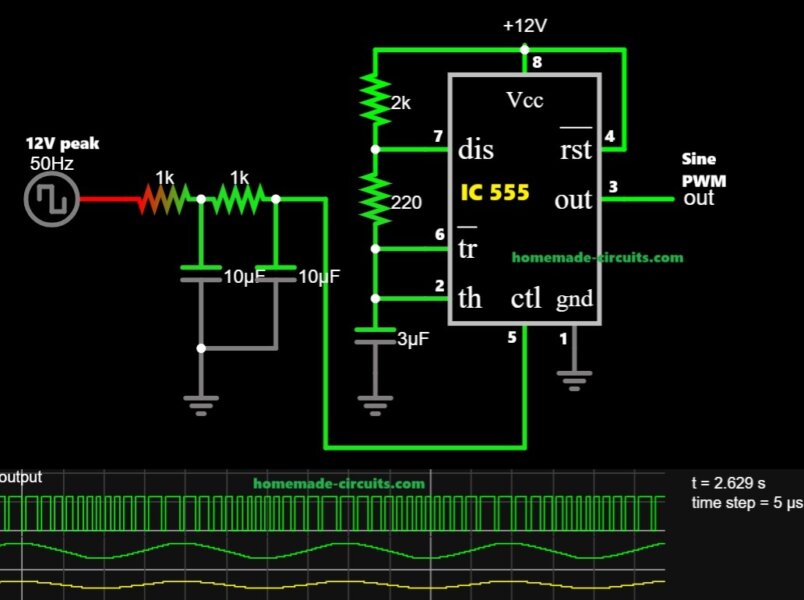
Now we take this square wave and pass it through RC networks made using 1k and 10uF, two stages are used so now higher harmonics get reduced more.
What actually happens is that square wave has many harmonics, RC networks act like low pass filters so the sharp edges get rounded and what remains looks like a sine wave.
This is not a mathematically perfect sine but it is good enough as a reference waveform for SPWM, and since the SG3525 frequency is stable, the phase shift caused by RC does not create serious problems.
If RC value is too high then sine becomes delayed and weak but if RC is too small then waveform remains rough, so the selected values are reasonable.
555 PWM Modulator Stage
Now comes the important block, the 555 ICs. Each 555 is running as a high frequency oscillator, usually in the range of few kHz to many kHz.
The sine wave from the RC integrator is fed into pin 5 of the 555, which is the control voltage pin.
Inside the 555, the internal ramp waveform is compared with the control voltage, so when the sine voltage is high, then PWM duty cycle becomes wide, and when sine voltage is low, then PWM duty cycle becomes narrow.
So now the output of the 555 becomes sine modulated PWM meaning pulse width follows the sine shape, this is classic analog SPWM technique and it is old but very reliable.
The 555 pwm processor and Integrator sections could be optimized as per the following Simulation results....
MOSFET Gate Drive And Power Stage
The SPWM output from each 555 goes to the MOSFET gates through 10R resistors, these resistors slow down switching slightly and prevent ringing.
IRF3205 MOSFETs are suitable for 12 V inverter because they have low Rds on and high current capability.
Each 555 drives one side of the push pull transformer primary, so when one side is active, the other is off.
If then gate drive is clean and timing is correct then transformer primary current becomes SPWM shaped.
Transformer And Output Waveform
The transformer does not pass high frequency PWM efficiently so core inductance and leakage inductance naturally filter the waveform.
Because of this filtering effect, the high frequency components get removed and the secondary voltage looks like a sine wave.
The diodes across the primary help in clamping spikes and protecting MOSFETs from inductive kickback, so now reliability improves.
Good Points In the Design
The design is fully hardware based, no microcontroller, easy to understand and easy to repair.
The signal flow is clean, square to sine to PWM to power stage so now troubleshooting becomes simple.
This type of inverter is suitable for long running systems and rural usage where simplicity matters.
Important Limitations To Understand
There is no output voltage feedback so if battery voltage rises or falls then output AC voltage will also change.
Load variation also affects output voltage because there we dont have regulation loop.
The control pin of 555 is sensitive to noise so decoupling capacitor and good grounding are very important, or else PWM jitter can happen.
Gate drive current from 555 is limited so at higher power levels switching losses can increase and MOSFETs may heat more.
Final Conclusion
So overall the inverter concept is correct, practical and proven.
The SG3525 generates stable square waves, RC networks convert them into sine reference, 555 converts sine into SPWM and MOSFETs amplify that power into the transformer.
With good layout, tuning, and optional feedback improvement, this circuit can give us clean sine like output and work reliably for long time.
Audio/Video Representation
Using Op amp based SPWM Processor and Chopping Concept
Now below next we will learn how to upgrade a standard SG3525 inverter circuit into a pure sine wave inverter using an opamp based SPWM generator, so let's understand the details through the following explanation:
How the Conversion from Squarewave to Sine wave Happens
You might be curious to know regarding what exactly happens in the process of the conversion which transforms the output into a pure sine wave suitable for all sensitive electronic loads.
It is basically done by optimizing the sharp rising and falling square wave pulses into a gently rising and falling waveform. This is executed by chopping or breaking the exiting square waves into number of uniform pieces.
In the actual sine wave, the waveform is created through an exponential rise and fall pattern where the sinusoidal wave gradually ascend and descend in the course of its cycles.
Using SPWM or Sine Pulse Width Modulation
In the proposed idea, the waveform is not executed in an exponential, rather the square waves are chopped into pieces which ultimately takes the shape of a sine wave after some filtration.
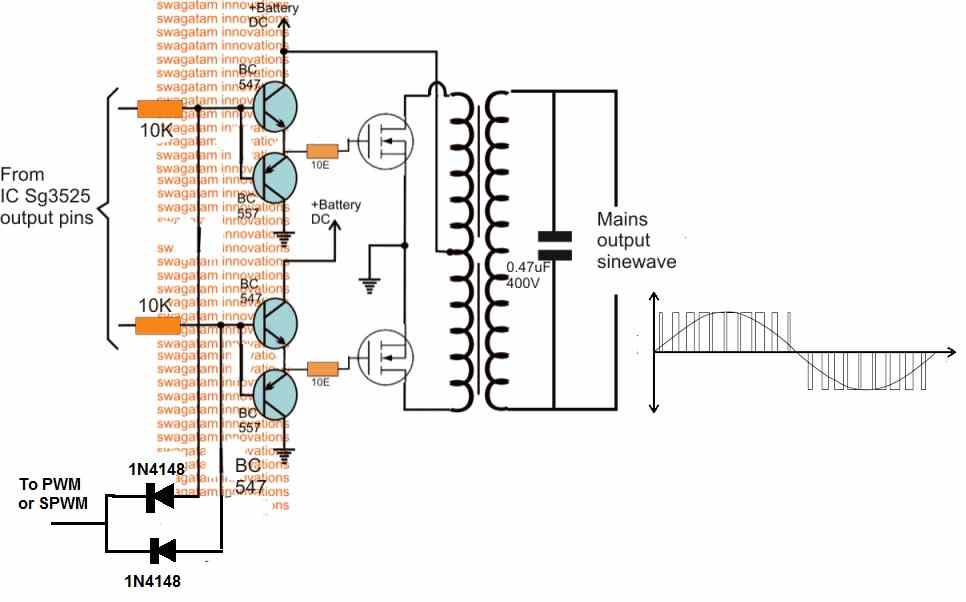
The "chopping" is done by feeding a calculated PWM to the gates of the FET via a BJT buffer stage.
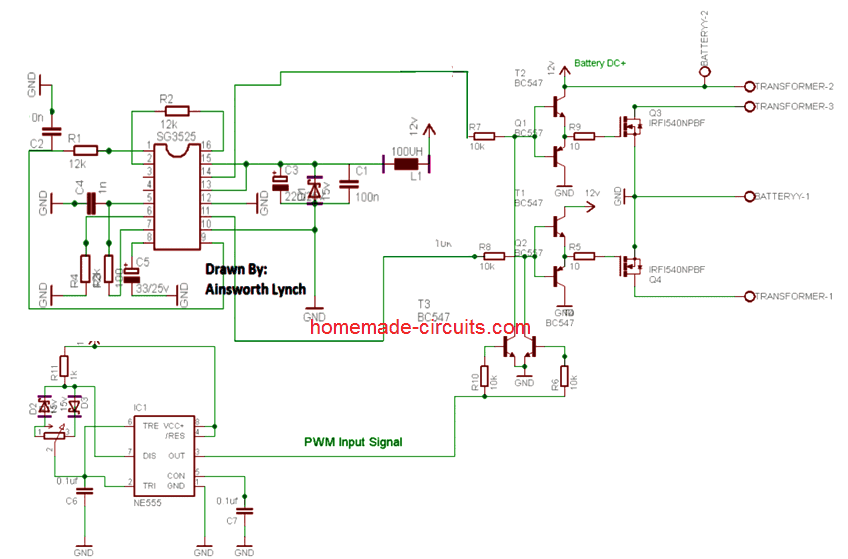
A typical circuit design for converting the SG3525 waveform into a pure sine wave waveform is shown below. This design is actually an universal design which may be implemented for upgrading all square wave inverters into sine wave inverters.
Chopping the MOSFET Gate with SPWM
As may be in the above diagram, the lower two diodes are connected to a PWM feed or input, which causes the transistors to switch according to the PWM ON/OFF duty cycles.
This in turn rapidly chop the 50Hz pulses at the bases of the BC547/BC557 coming from the SG3525 output pins.
The above operation ultimately force the mosfets also to turn ON and OFF in the same pattern as the SPWM for each of the 50/60Hz cycles. This SPWM is then induced into the transformer primary by the MOSFETs, consequently producing a sine waveform at the output or the secondary side of the transformer.
If an ordinary PWM is used as I have explained below, then its frequency should be 4 times more than the base 50 or 60 Hz frequency. so that each 50/60Hz cycles are broken into 4 or 5 pieces and not more than this, which could otherwise give rise to unwanted harmonics and mosfet heating.
PWM Circuit
The PWM input feed for the above explained design can be acquired by using any standard IC 555 astable design as shown below:
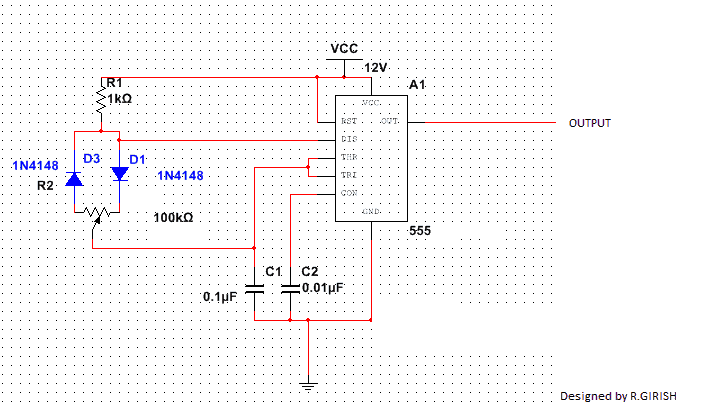
This IC 555 based PWM circuit can be used for feeding an optimized PWM to the bases of the BC547 transistors in the first design such that the output from the SG3525 inverter circuit acquires an RMS value close to mains pure sine wave waveform RMS value.
Using an SPWM
Although the above explained concept would greatly improve the square wave modified output of a typical SG3525 inverter circuit, an even better approach could be to go for an SPWM generator circuit.
In this concept the "chopping" of each of the square wave pulses is implemented through a proportionately varying PWM duty cycles rather than a fixed duty cycle.
I have already discussed how to generate SPWM using opamp, the same theory may be used for feeding the driver stage of any square wave inverter.
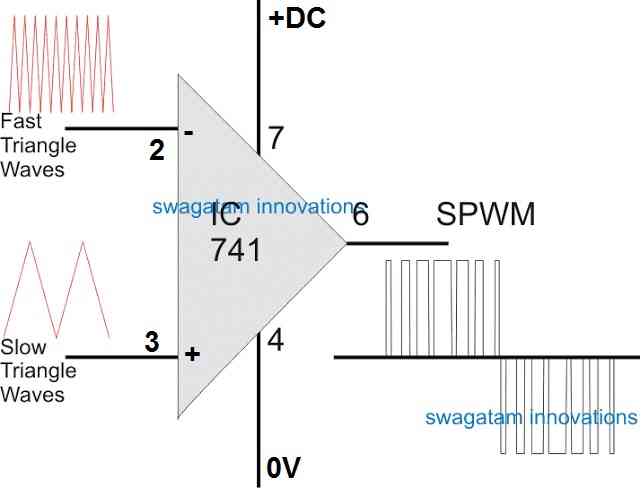
A simple circuit for generating SPWM can be seen below:
Using IC 741 for Processing SPWM
In this design we see a standard IC 741 opamp whose input pins are configured with a couple of triangle wave sources, one being much faster in frequency than the other.
The triangle waves could be manufactured from a standard IC 556 based circuit, wired as an astable and compactor, as shown below:
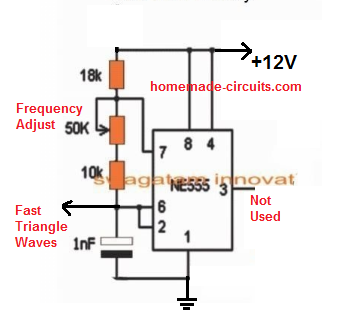
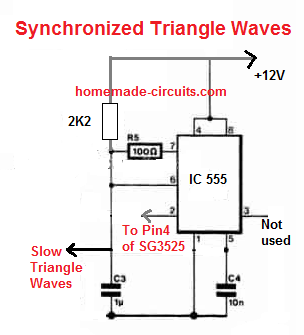
#UPDATE: The above "slow triangle waves" can be directly acquired from the Ct pin of the IC, that means you can now eliminate or ignore the above IC 555 stage for the slow triangle waves.
As can be seen in the above two images, the fast triangle waves are achieved from an ordinary IC 555 astable.
However, the slow triangle waves are acquired through an IC 555 wired like a "square wave to triangle wave generator".
The square waves or the rectangular waves are acquired from pin#4 of SG3525. This is important as it synchronizes the op amp 741 output perfectly with the 50 Hz frequency of the SG3525 circuit. This in turn creates correctly dimensioned SPWM sets across the two MOSFET channels.
When this optimized PWM is fed to the first circuit design causes the output from the transformer to produce a further improved and gentle sine waveform having properties much identical to a standard AC mains sine waveform.
However even for an SPWM, the RMS value will need to be correctly set initially in order to produce the correct voltage output at the output of the transformer.
Once implemented one can expect a real sine wave equivalent output from any SG3525 inverter design or may be from any square wave inverter model.
Finalized SG3525 Pure Sine Wave Inverter Circuit
The following diagram shows the finalized design of the pure sine wave inverter using IC SG3525 and SPWM, as per the above explanations.
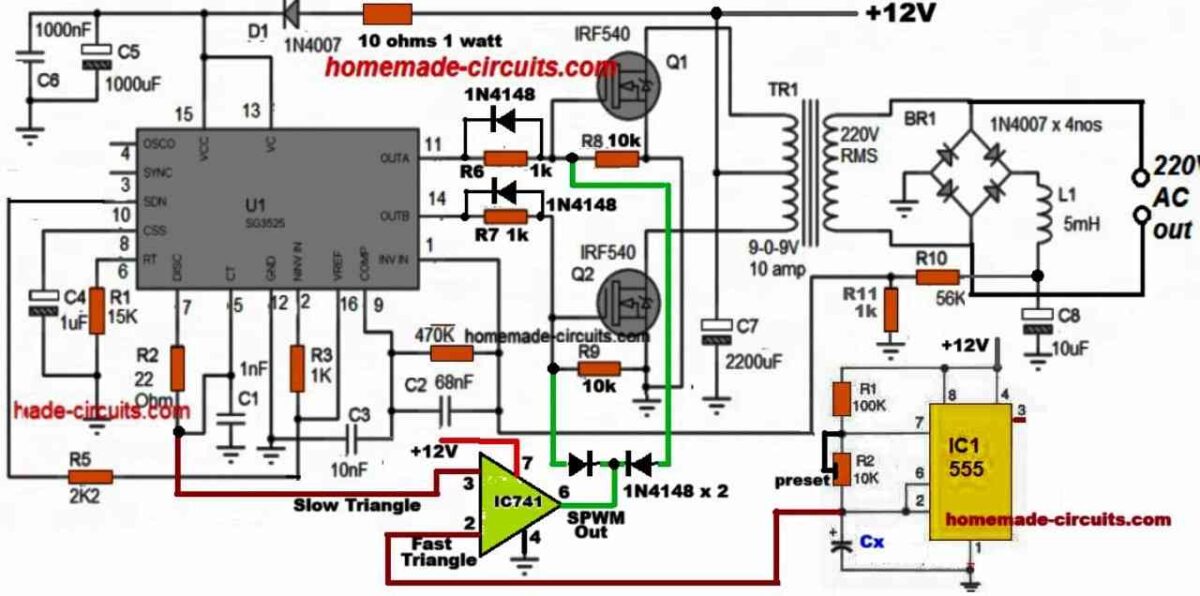
If you have any doubts regarding the above SG3525 pure sine wave inverter circuit you can feel free to express them through your comments.
A basic example design of a SG3525 oscillator stage can be seen below, this design could be integrated with our previous PWM sine wave BJT/mosfet stage for getting the required enhanced version of the SG3525 design:
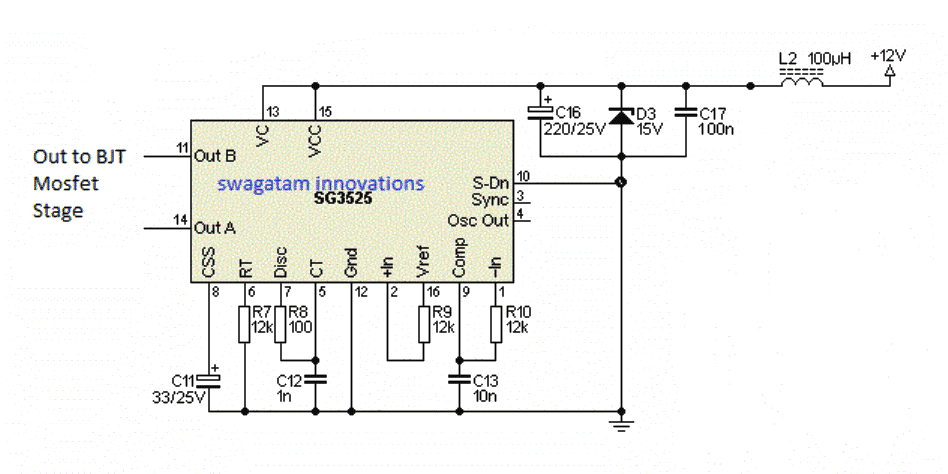
Complete circuit diagram and PCB layout for the proposed SG3525 pure sine wave inverter circuit.
PWM Modified Sine wave Inverter Circuits
Courtesy: Ainsworth Lynch
Design#3: 3kva Inverter circuit using the IC SG3525
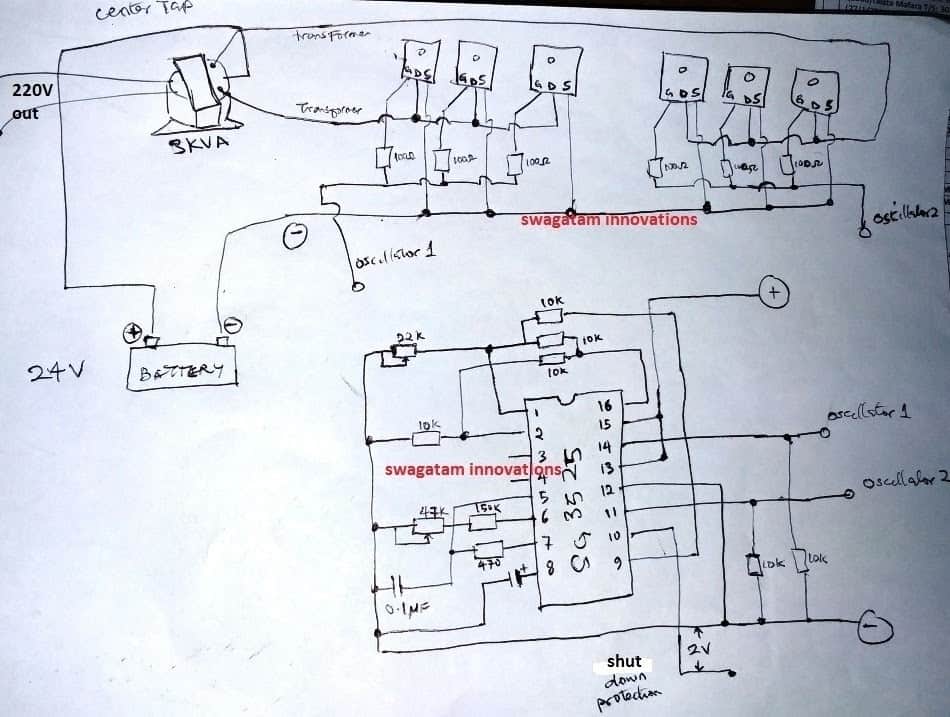
In the previous paragraphs we have comprehensively discussed regarding how an SG3525 design could be converted into an efficient sine wave design, now let's discuss how a simple 2kva inverter circuit can be constructed using the IC SG3525, which can be easily upgraded to sine wave 10kva by increasing the battery, mosfet and the transformer specs.
The basic circuit is as per the design submitted by Mr. Anas Ahmad.
The explanation regarding the proposed SG3525 2kva inverter circuit can be understood from the following discussion:
hello swagatam, i constructed the following 3kva 24V inverter modified sine wave (i used 20 mosfet with resistor attached to each, moreover i used center tap transformer and i used SG3525 for oscillator).. now i want to convert it to pure sine wave, please how can i do that?
Basic Schematic
My Reply:
Hello Anas,
first try the basic set up as explained in this SG3525 inverter article, if everything goes well, after that you can try connecting more mosfets in parallel.....
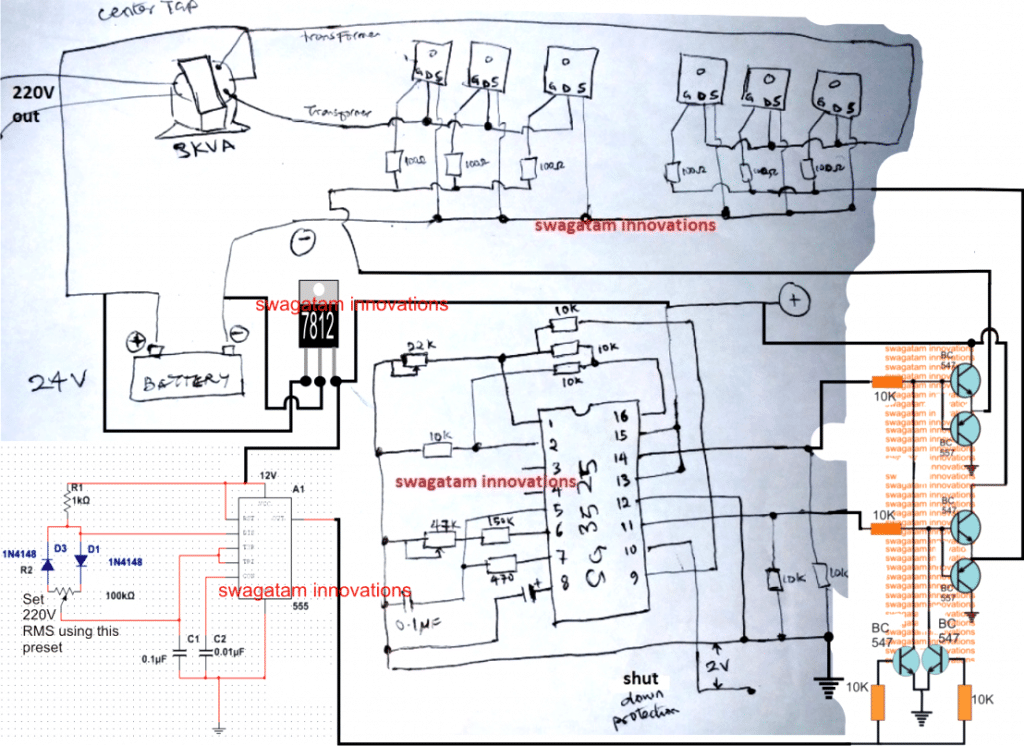
the inverter shown in the above daigram is a basic square wave design, in order to convert it to sine wave you must follow the steps I have explained below The mosfet gate/resistor ends must be configured with a BJT stage and the 555 IC PWM should be connected as indicated in the following diagram:
Regarding Connecting parallel mosfets
ok, i have 20 mosfet(10 on lead A, 10 on lead B), so i must attached 2 BJT to each mosfet, that's 40 BJT, and likewise i must connect only 2 BJT coming out from PWM in parallel to the 40 BJT? Sorry am novice just trying to pick up.
Answer:
No, each emitter junction of the respective BJT pair will hold 10 mosfets...therefore you will need only 4 BJTs in all....
Using BJTs as Buffers
1. ok if i may get you right, since you said 4 BJTs, 2 on lead A, 2 on lead B, THEN another 2 BJT from the output of PWM, right?
2. am using 24 volt battery hope no any modification to the BJT collector terminal to the battery?
3. i have to use variable resistor From oscillator to control the input voltage to the mosfet, but i don't know how i will go about the voltage that will go to the base of the BJT in this case, what will i do so that i want end up blow up the BJT?
Yes, NPN/PNP BJTs for the buffer stage, and two NPN with the PWM driver.
24V will not harm the BJT buffers, but make sure to use a 7812 for stepping it down to 12V for the SG3525 and the IC 555 stages.
You can use the IC 555 pot for adjusting the output voltage from the trafo and set it to 220V. remember your transformer must be rated lower than the battery voltage for getting optimum voltage at the output. if your battery is 24V you can use an 18-0-18V trafo.
Parts List
IC SG3525 Circuit
all resistors 1/4 watt 5% CFR unless otherwise specified
10K - 6nos
150K - 1no
470 ohm - 1no
presets 22K - 1no
preset 47K - 1no
Capacitors
0.1uF Ceramic - 1no
IC = SG3525
Mosfet/BJT Stage
All mosfets - IRF540 or any equivalent Gate resistors - 10 Ohms 1/4 watt (recommended)
All NPN BJTs are = BC547
All PNP BJTs are = BC557
Base Resistors are all 10K - 4nos
IC 555 PWM Stage
1K = 1no 100K pot - 1no
1N4148 Diode = 2nos
Capacitors 0.1uF Ceramic - 1no
10nF Ceramic - 1no
Miscellaneous IC 7812 - 1no
Battery - 12V 0r 24V 100AH Transformer as per specs.
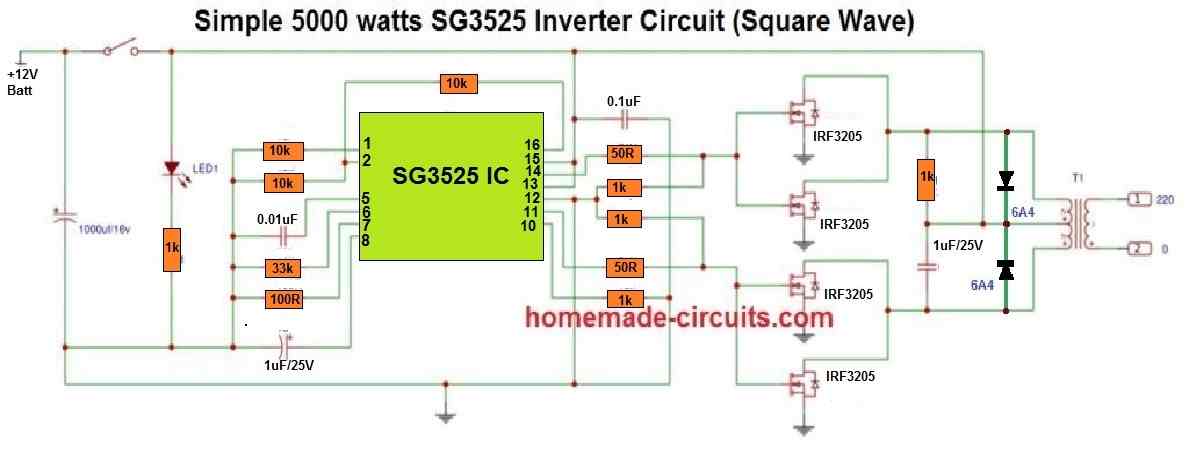
A Simpler Alternative


Comments
sir in this thread each spwm circuit you have mentioned doesn’t have any feedback for voltage regulation.
this could be a major problem for my requirement
sir can you implement feedback.
sir I wanna ask one simple question about efficiency of inverters
which one is better 50Hz transformer or hi frequency ferrite inverter.
I need atleast 70% efficiency
Hi Shankar, voltage control can be easily implemented using the pin#1 of the IC sg3525.
Please check the second sine wave inverter concept under the heading “Finalized SG3525 Pure Sine Wave Inverter Circuit”
Please see how the pin#1 of the IC SG3525 is configured with the output bridge rectifier, in order to keep the output voltage controlled at around 220V AC.
Ferrite core high frequency concept is certainly more efficient and compact than an iron core transformer, however you can get 70% efficiency with an iron core inverter easily at 50Hz, and around 90% efficiency using ferrite core high frequency…
sg3525 with ic 741 circuit how much load capacity?
It will depend on the MOSFET, battery and transformer ratings, you can upgrade them accordingly.
Please, how are you doing. I now obtained frequency of 42.2kHz on using a multimeter since I don’t have oscilloscope, thanks you. How do I check lm741 and 555 circuits to confirm whether they are also working.
If you are using the bottom sine wave inverter circuit, then that frequency is probably of the fast triangle waves, please measure the frequency of the slow triangle waves across the SG3525 Ct capacitor…
without a O’scope how will you confirm the waveforms whether it is sine wave or not? so without O’scope it is impossible to complete these circuits…
Ok, l will find one thanks. Should the frequency on the SG3525 be in khz need to be adjusted?
Sure, no problem…SG3525 frequency should be 50Hz…
How are you Sir? Please, I revisited the oscillator circuit separately and I got 6.1volts the pin 16 of SG3525 instead of 5.1volts with no oscillation. what can I do to obtain 5.1volts and oscillation? Thanks.
Hi David,
Pin16 generates a fixed reference voltage of 5.1V for the error amp comparators, it has nothing to do with oscillation frequency.
The output voltage from the IC will depend on the average value of the ON time and deadtime…and preferably you must check it using an oscilloscope not a multimeter.
How are you Sir? Please, I finished with your finalized pure sine wave inverter circuit but the IC is not oscillating and pin 16 is giving less than 5.1volt. I need your help. Thanks.
Hi David, if you build it altogether, it would never work….you must build and test the stages separately, step-wise… and then join them together to get finalized design. So please start with the basic square wave SG3525 inverter stage and test it, then test the sine wave generators stages separately and so on…let me know if you have any issues during these stages…
Thanks you very much for your prompt response; I will quickly do so. May you live longer with great knowledge, wisdom and prosperity.
You are welcome David!
our dear tutor how are you Sir. I would be very much grateful if you could provide me with short,over load protection, battery fully charged and change over circuit to add to your SG 3525 inverter circuit.Thanks, looking forward for your prompt response
Thank you David, you can refer to the following article, which you might find helpful, and solve your requirement:
https://www.homemade-circuits.com/sg3525-inverter-circuits-with-low-battery-cut-off-and-overvoltage-regulation/
sir, your finalized pure sine wave inverter circuit is very much interesting and touches my heart. Since pin10 of SG 3525 IC is already connected to pins 2 and 16 , can I still battery low cut off and battery fully charged and over load protections. what is the capacitor marked in blue ‘ cx’ on ic 555.?
Thanks David, yes you can still connect pin10 with an opamp battery low cut off through a diode, and overload shut down. But you cannot do that for a full charge battery, because SG3525 must not be shut down when battery is full, that doesn’t make sense…Cx decides the fast triangle wave frequency.
please can I use irfb4110 with this circuit and with transformer of 5kva
You can use them, no problems…
please I need circuit diagram of h bridge of 5kva 12v transformer with irfb4110 and sg3525 ic
Sorry, 5kva with 12V transformer is not practically possible…
Well done sir,
for the finalized circuit, what will the fast wave, 400hz and slow wave be?
Thank you Glo, fast waves ae generated by the IC 555 astable, while the slow wave is taken from across the Ct pin of the sg3524…
sir give me 12volt 500watts inverter pure sine wave diagram I don’t have 48volt battery
Samuel, for a 12V, 500 watt inverter also you might need a 200 Ah battery, and a 50 amp rated transformer…
ok sir, thanks, please their best recommended values
For the 555 fast triangle waves, you can use the following software to calculate the frequuency:
https://www.homemade-circuits.com/ic-555-timer-astable-circuit-calculator/
Thanks for the update, please how can I improve the sine wave purity, not that pure still saw tooth and triangular, what range of Khz should be best suited. I appreciate, you sir.
Glo, the output can be improved by adding a 3uF / 400V capacitor across the transformer secondary….
For the fast triangle waves you can use 400 Hz as the frequency
sir please what inverter can I build to give me 1kva 12volt pure sine wave inverter, I have wast a lot of money on building inverter all failed, give me correct one please
Samuel, 12V battery will not be practical for 1kva inverter, you will have to use 4nos of 12V batteries in series and make 48V, then you can built it perfectly, see the first diagram from this article:
https://www.homemade-circuits.com/make-this-1kva-1000-watts-pure-sine/
मै पिछले 35 वर्षों से ऑडियो एंप्लीफायर बना रहा हूँ, और अपने बोर्ड बनता हूँ, ट्रांसफार्मर भी अपने ही बनाता हूँ,बोर्ड और कैबिनेट डिजाइन भी खुद ही करता हूँ।
अब मै ये पूछना चाहता हूं कि क्या 12 या 24 वोल्ट इनव
र्टर में लेमिनेशन कोर की जगह फेरिट कोर यानि sm ट्रांसफॉर्मर से भी इनवर्टर बनाया जा सकता है क्या।
क्योंकि आजकल कॉपर की कीमत बहुत ज्यादा हो गई है।
Yes, surely you can use a ferrite core transformer for the above inverter projects.
You can use 50kHz frequency for the 555 IC astable frequencies and use 50Hz for the SG3525 circuit.
You can use the following software for calculating the ferrite transformer:
https://www.homemade-circuits.com/advanced-smps-flyback-transformer-calculator-for-high-power-converters/
Hello Good mornings sir merry xmas in advance please I built a 12v 1.5kva inverter using sg3525 and implemented the spwm oure sine wave conversion and I also used 4 irf3205 mosfet to drive the transformers in a 12- 0- 12 push pull topology everything was working fine tge frequency using multmeter vave me 49.9hz but the problem an having is that if I plug a 100w standing fan it doesn’t work at all but it light up bulb and cbarges ohine and laptop what could be tge issue and hiw should I correct it
Good Morning Samuel,
How did you check the power output of the inverter. The bulb you have tested, is it rated at above 500 watts?
Plea use a 500 watt bulb and check the results.
Also are you sure the fan is just 100 watts?
Please confirm the above and let me know…
Please, I made a circuit I saw on the Internet, I had to connect pin 10 of sg3525 to ground after connecting the battery low cutoff circuit before oscillation occurs, which I think there is a problem. I need explanation on the battery low cutoff circuit connection to pin 10 of the SG 3525ic.
If you ground the pin#10, then it will be disabled and have no effect and the low battery cut off will never work.
So please keep it connected to the opamp output through a zener diode as shown in the above article diagrams.
can use ups transformer , also can I use irf260
Your mosfet is rated at 200V, not suitable for 12V application, UPS transformer is ok…
I made 3 inverters center tap, how can I sync to work in 120phase, thanks
I don’t think we can use 3 separate inverters to make one 3 phase inverter…
sir please with in can I build from your diagram, that will give me 1000watts 50hz to 60hz with feedback, constantly output, low battery shutdown, pure sine wave
Hello Nnakwuzie, Yes that is possible, but you will test and verify the stage step wise, and initially with 100 watt load only.
And you will need an oscilloscope to test the waveforms. Initially please begin with this circuit and check the results:
https://www.homemade-circuits.com/wp-content/uploads/2025/04/sg3525-inverter-with-feedback.jpg
Dear Swagatam than you for your insights I want to build a 3KW 48V inverter using SG3525 and EGs001 board.How do I implement low voltage shutdown at 42volts and high voltage shutdown at 56Volts
Hey Benjamin, you can try the following circuit for achieving the automatic cut off for your battery:
https://www.homemade-circuits.com/wp-content/uploads/2021/08/simplified-48V-charger-circuit-compressed-compressed.jpg
Im planning to build a 48V 4kw ferrite inverter how will I go about it considering sg3525 can handle a maximum of 35V
It is not difficult. Regulate the supply DC to the IC SG3525 supply pins with a 18V regulator, and let the transformer center tap get the 48V DC separately…
You can use a small buck converter for the regulator such as this one
https://www.homemade-circuits.com/adjustable-1-2v-to100v-dc-buck-converter-circuit-using-lm5164/
Thank you very much, dear Swagatham. Good luck.
That’s Great, Dear Alexander!
The SG3525 output should be 50Hz for 220V AC output, or 60Hz for 120V AC output, and a corresponding 100Hz/120Hz across C1.
To get 400 Hz across the 555 capacitor, you can adjust its part values using the following calculator:
https://www.homemade-circuits.com/ic-555-timer-astable-circuit-calculator/