A relatively simple 1000 watt pure sine wave inverter circuit is explained here using a signal amplifier and a power transformer.
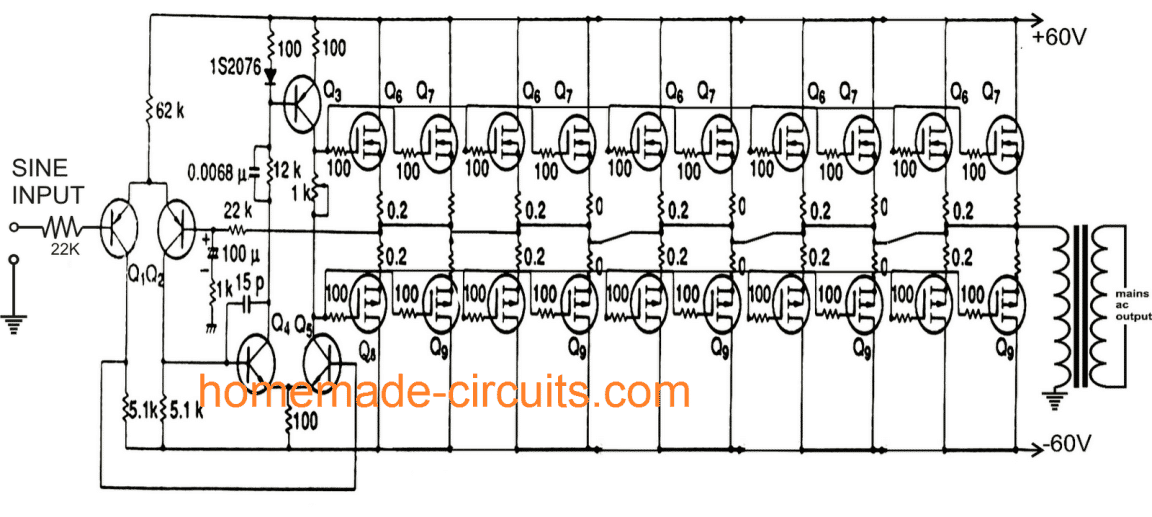
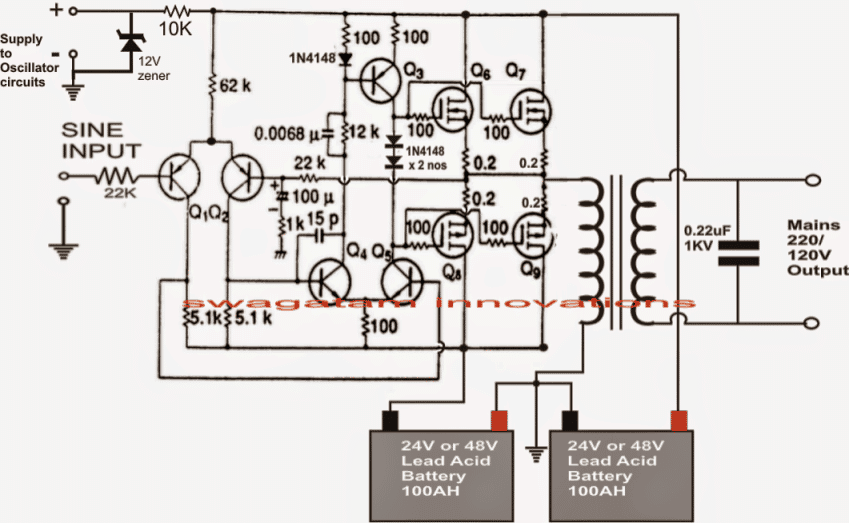
As can be seen in the first diagram below, the configuration is a simple mosfet based designed for amplifying current at +/-60 volts such that the connected transformer corresponds to generate the required 1kva output.
UPDATE:
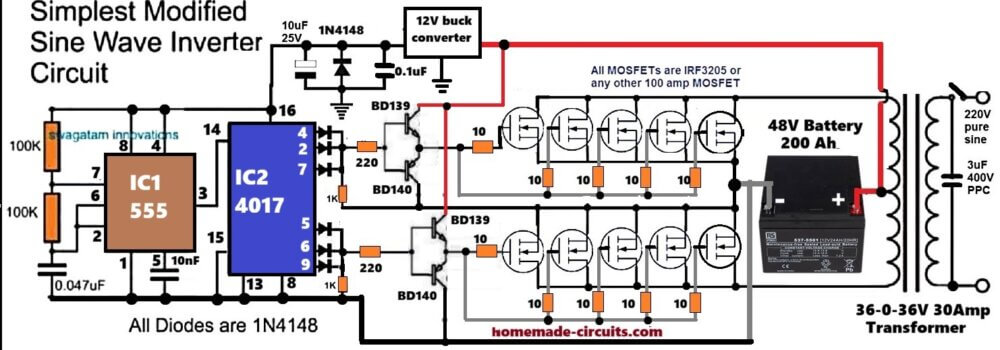
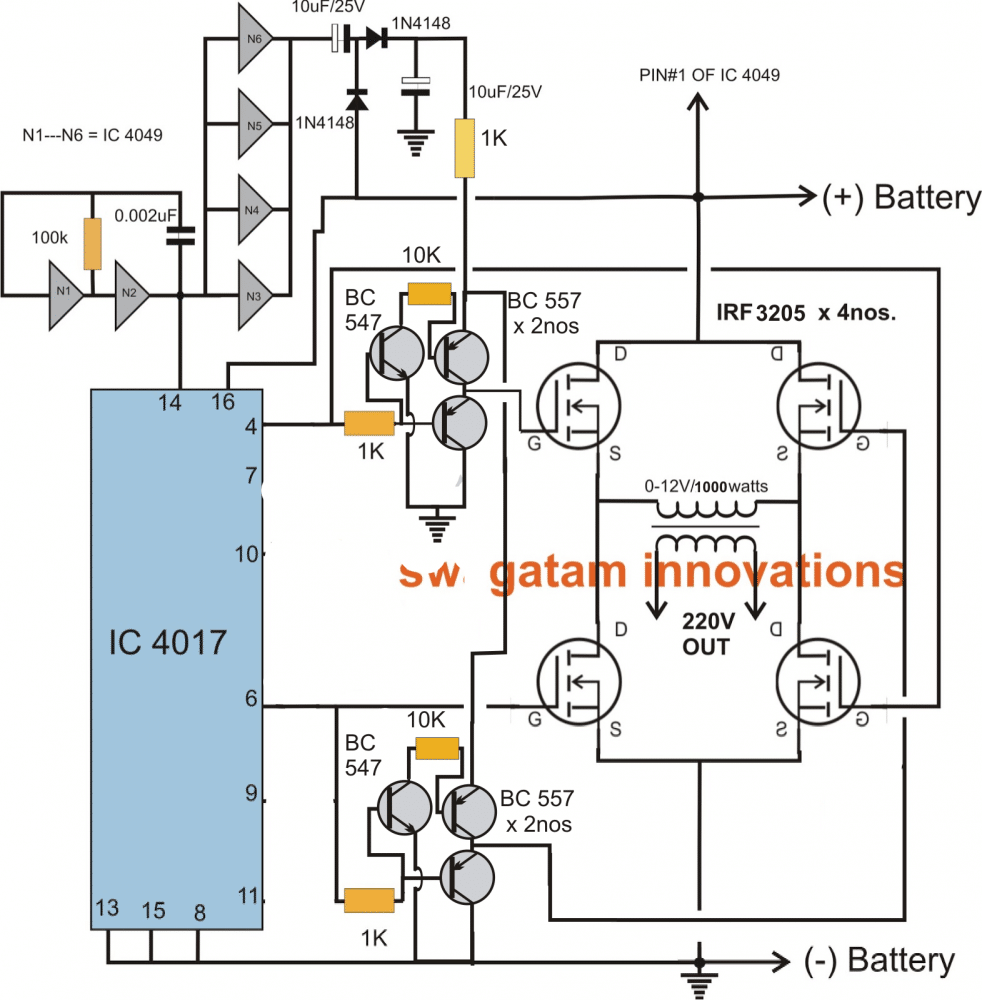
There's a much easier and efficient way of making a 1 kva inverter circuit using the following 4017 PWM version circuit. Since the PWM is created directly through the 4017 output, the PWMs are much accurate and the waveform is uniform and does not depend on any external adjustments.
The biggest advantage of using this circuit is that the output can be modified to almost a pure sine wave by adding a few PPC capacitors across the transformer output.
Here' the circuit which you can try:
Audio/Video Representation
Parts List
- Resistors
- All resistors are 1/4 watt 5% unless specified
- 100K = 2nos
- 100 ohm 1 watt = 1no
- 1K = 2no
- 10 ohm = 2no
- Capacitors
- 0.047uF ceramic or PPC = 1no
- 10nF ceramic or PPC = 1no
- 10uF/25V Electrolytic = 1no
- Semiconductors
- 1N4148 diodes = 7nos
- 12V/1 watt zener diode = 1no
- IRF3205 MOSFETs = 10nos
- Transformer 12-0-12V/220V/1kva
- Battery = 24V/500 Ah = 1no
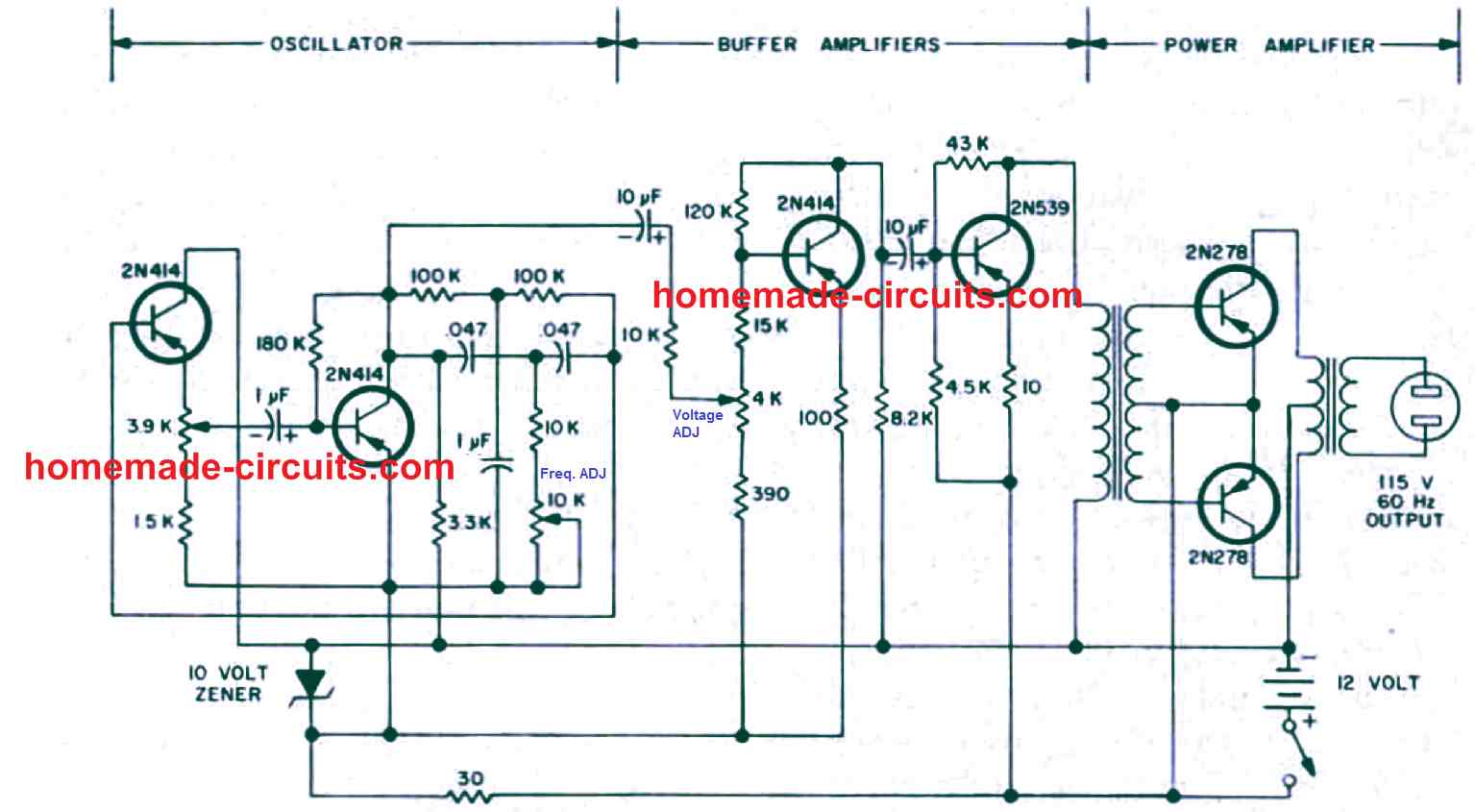
The previous original article which is continued in the following paragraphs also discusses a 1000 watt inverter circuit, however, this circuit being a linear amplifier is not so efficient, and may result in a lot of dissipation.
I would recommend trying the above circuit, which will give you a 100% results quickly.
Remember, you must first try and confirm the working of the inverter using single MOSFETs on each channel. Once the working is confirmed then you can add more number of MOSFETs in parallel to upgrade the power capacity of the inverter to 1000 watts
Circuit Operation
Q1, Q2 forms the initial differential amplifier stage which appropriately raises the 1vpp sine signal at its input to a level which becomes suitable for initiating the driver stage made up of Q3, Q4, Q5.
This stage further raises the voltage such that it becomes sufficient for driving the mosfets.
The mosfets are also formed in the push pull format, which effectively shuffles the entire 60 volts across the transformer windings 50 times per second such that the output of the transformer generates the intended 1000 watts AC at the mains level.
Each pair is responsible for handling 100 watts of output, together all the 10 pairs dump 1000 watts into the transformer.
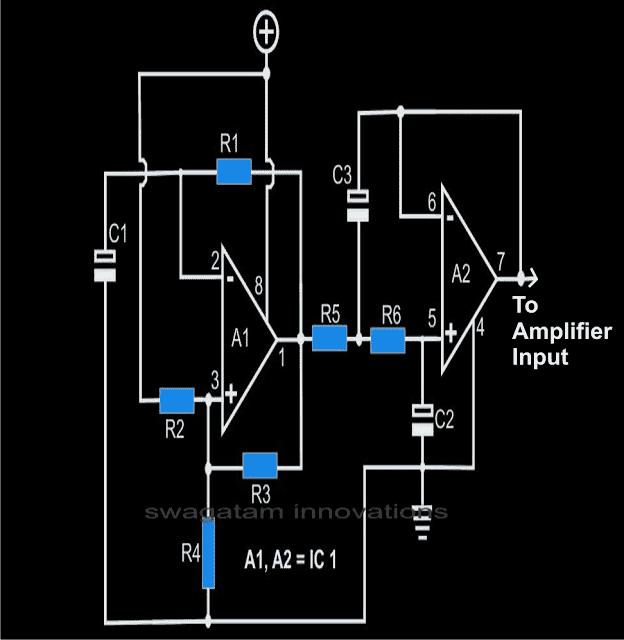
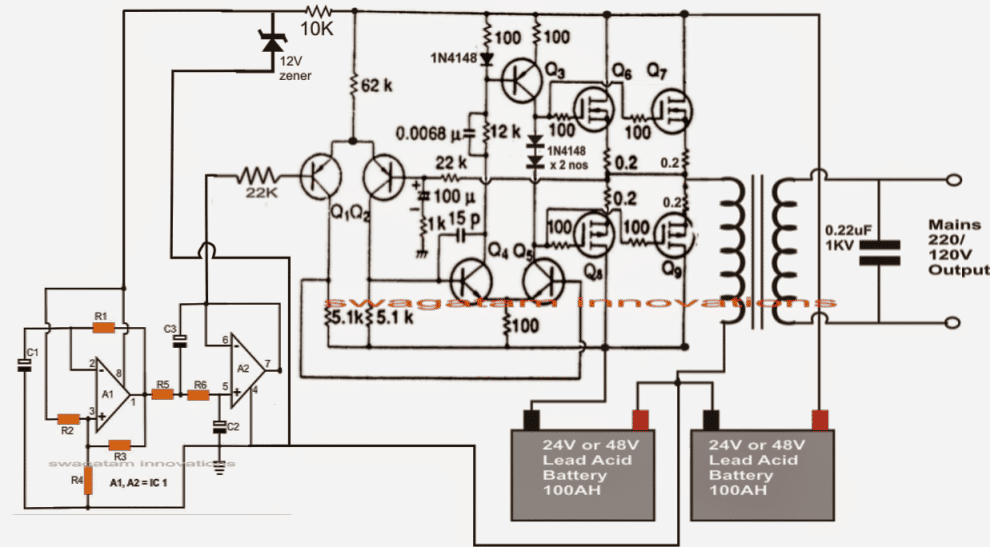
For acquiring the intended pure sine wave output, a suitable sine input is required which is fulfilled with the help of a simple sine wave generator circuit.
It is made up of a couple of opamps and a few other passive parts. It must be operated with voltages between 5 and 12. This voltage should be suitably derived from one of the batteries which are being incorporated for driving the inverter circuit.
The inverter is driven with voltages of +/-60 volts that amounts to 120 V DC.
This huge voltage level is obtained by putting 10 nos. of 12 volt batteries in series.
The Sinewave Generator Circuit
The below given diagram shows a simple sine wave generator circuit which may be used for driving the above inverter circuit, however since the output from this generator is exponential by nature, might cause a lot of heating of the mosfets.
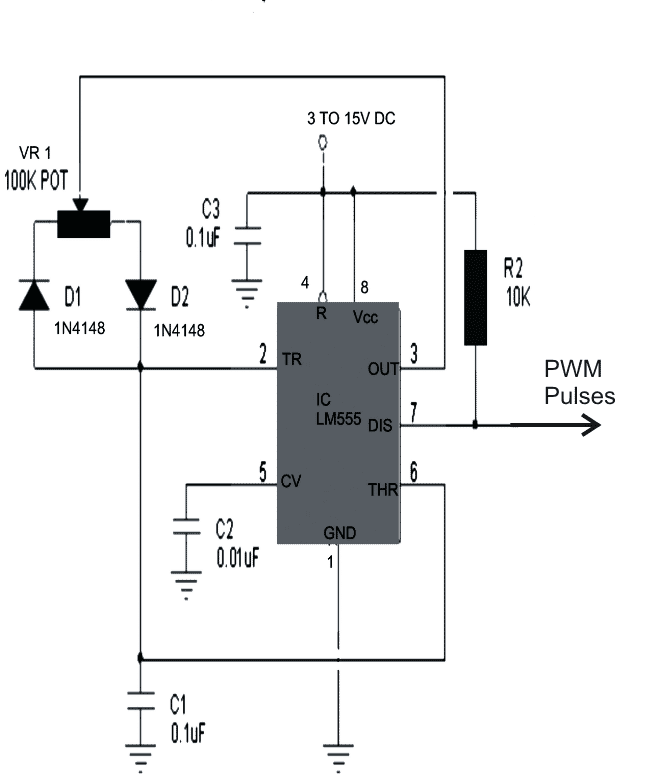
A better option would be to incorporate a PWM based circuit which would supply the above circuit with appropriately optimized PWM pulses equivalent to a standard sine signal.
The PWM circuit utilizing the IC555 has also been referred in the next diagram, which may be used for triggering the above 1000 watt inverter circuit.
Parts List for the sine generator circuit
All resistors are 1/8 watts, 1%, MFR
R1 = 14K3 (12K1 for 60Hz),
R2, R3, R4, R7, R8 = 1K,
R5, R6 = 2K2 (1K9 for 60Hz),
R9 = 20K
C1, C2 = 1µF, TANT.
C3 = 2µF, TANT (TWO 1µF IN PARALLEL)
C4, C6, C7 = 2µ2/25V,
C5 = 100µ/50v,
C8 = 22µF/25V
A1, A2 = TL 072
Part List for Inverter
Q1, Q2 = BC556
Q3 = BD140
Q4, Q5 = BD139
All N-channel mosfet are = K1058
All P-channel mosfets are = J162
Transformer = 0-60V/1000 watts/output 110/220volts 50Hz/60Hz
The proposed 1 kva inverter discussed in the above sections can be much streamlined and reduced in size as given in the following design:
How to Connect Batteries
The diagram also shows the method of connecting the battery, and the supply connections for the sine wave or the PWM oscillator stages.
Here just four mosfets have been used which could be IRF4905 for the p-channel, and IRF2907 for n-channel.
Complete 1 kva inverter circuit design with 50 Hz sine oscillator
In the above section we have learned a full bridge design in which two batteries are involved for accomplishing the required 1kva output. Now let's investigate how a full bridge design could be constructed using 4 N channel mosfet and using a single battery.
The following section shows how a full-bridge 1 KVA inverter circuit can be built using, without incorporating complicated high side driver networks or chips.
Using Arduino
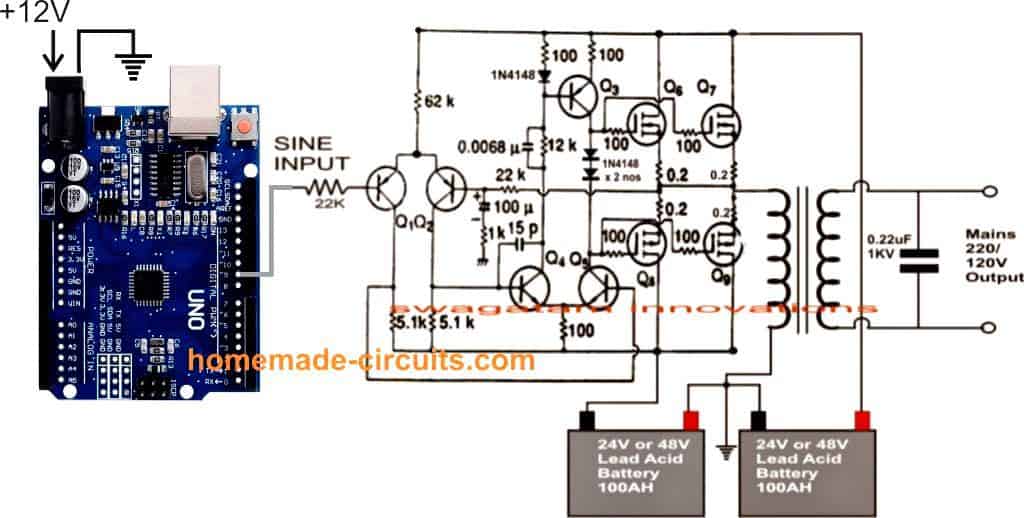
The above explained 1kva sinewave inverter circuit can be also driven through an Arduino for achieving almost a prefect sinewave output.
The complete Arduino based circuit diagram can be seen below:
Program Code is given below:
//code modified for improvement from http://forum.arduino.cc/index.php?topic=8563.0

//connect pin 9 -> 10k Ohm + (series with)100nF ceramic cap -> GND, tap the sinewave signal from the point at between the resistor and cap.

float wav1[3];//0 frequency, 1 unscaled amplitude, 2 is final amplitude

int average;

const int Pin = 9;

float time;

float percentage;

float templitude;

float offset = 2.5; // default value 2.5 volt as operating range voltage is 0~5V

float minOutputScale = 0.0;

float maxOutputScale = 5.0;

const int resolution = 1; //this determines the update speed. A lower number means a higher refresh rate.

const float pi = 3.14159;

void setup() {

wav1[0] = 50; //frequency of the sine wave

wav1[1] = 2.5; // 0V - 2.5V amplitude (Max amplitude + offset) value must not exceed the "maxOutputScale"

TCCR1B = TCCR1B & 0b11111000 | 1;//set timer 1B (pin 9) to 31250khz

pinMode(Pin, OUTPUT);

//Serial.begin(115200);//this is for debugging

}

void loop() {

time = micros()% 1000000;

percentage = time / 1000000;

templitude = sin(((percentage) * wav1[0]) * 2 * pi);

wav1[2] = (templitude * wav1[1]) + offset; //shift the origin of sinewave with offset.

average = mapf(wav1[2],minOutputScale,maxOutputScale,0,255);

analogWrite(9, average);//set output "voltage"

delayMicroseconds(resolution);//this is to give the micro time to set the "voltage"

}

// function to map float number with integer scale - courtesy of other developers.

long mapf(float x, float in_min, float in_max, long out_min, long out_max)

{

return (x - in_min) * (out_max - out_min) / (in_max - in_min) + out_min;

}
The Full-Bridge Inverter Concept
Driving a full bridge mosfet network having 4 N-channel mosfets is never easy, rather it calls for reasonably complex circuitry involving complex high side driver networks.
If you study the following circuit which has been developed by me, you will discover that after all it's not that difficult to design such networks and can be done even with ordinary components.
We will study the concept with the help of the shown circuit diagram which is in the form of a modified 1 kva inverter circuit employing 4 N-channel mosfets.
As we all know, when 4 N-channel mosfets are involved in an H-bridge network, a bootstrapping network becomes imperative for driving the high side or the upper two mosfets whose drains are connected to the high side or the battery (+) or the positive of the given supply.
In the proposed design, the bootstrapping network is formed with the help of six NOT gates and a few other passive components.
The output of the NOT gates which are configured as buffers generate voltage twice that of the supply range, meaning if the supply is 12V, the NOT gate outputs generate around 22V.
This stepped up voltage is applied to the gates of the high side mosfets via the emitter pinouts of two respective NPN transistors.
Since these transistors must be switched in such a way that diagonally opposite mosfets conduct at a time while the the diagonally paired mosfets at the two arms of the bridge conduct alternately.
This function is effectively handled by the sequential output high generator IC 4017, which is technically called Johnson divide by 10 counter/divider IC.
The Bootstrapping Network
The driving frequency for the above IC is derived from the bootstrapping network itself just to avoid the need of an external oscillator stage.
The frequency of the bootstrapping network should be adjusted such that the output frequency of the transformer gets optimized to the required degree of 50 or 60 Hz, as per the required specs.
While sequencing, the outputs of the IC 4017 trigger the connected mosfets appropriately producing the required push-pull effect on the attached transformer winding which activates the inverter functioning.
The PNP transistor which can be witnessed attached with the NPN transistors make sure that the gate capacitance of the mosfets are effectively discharged in the course of the action for enabling efficient functioning of the entire system.
The pinout connections to the mosfets can be altered and changed as per individual preferences, this might also require the involvement of the reset pin#15 connection.
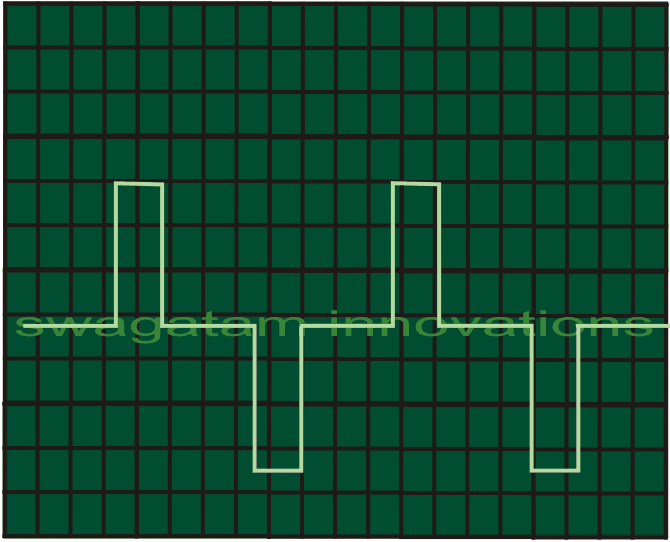
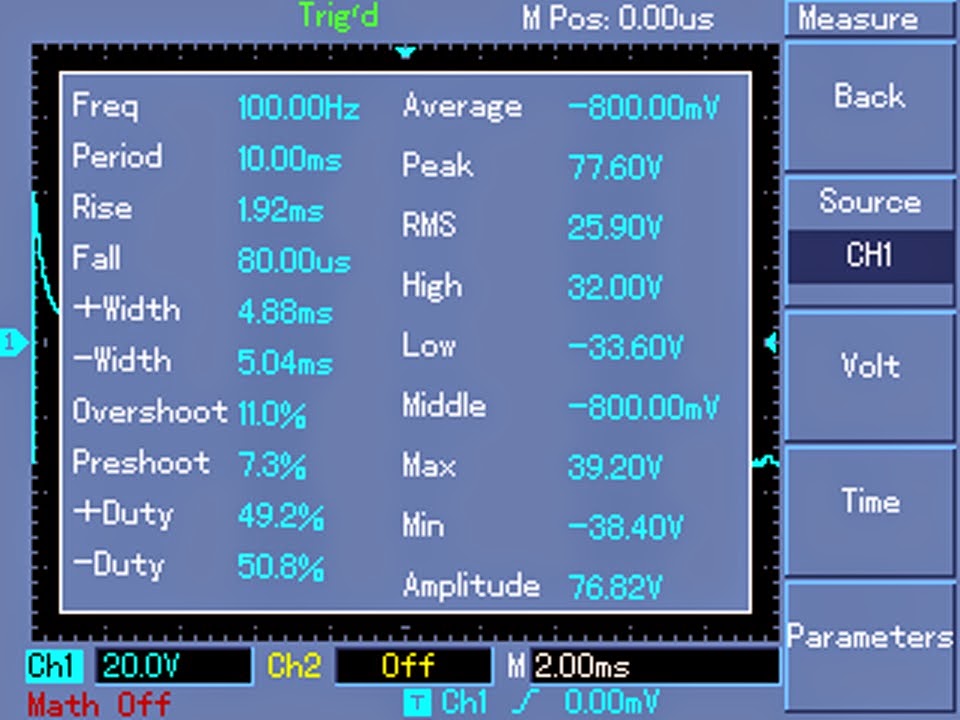
Waveform Images
The above design was tested and verified by Mr. Robin Peter one of the avid hobbyists and contributor to this blog, the following waveform images were recorded by him during the testing process.





Comments
Hello, good evening, Mr. Swagatam. I would like to ask you a question about this inverter… Is it really a pure sine wave, just like the 220 VAC mains supply? Thank you very much in advance. 🤝
Good morning Carlos, no it is not pure sine wave but quite identical to it, and much better than modified sine wave, and should work nicely for most of the electronic equipment and loads…
Thanks alot sir please may I have the complete circuit diagram also I’ll be glad if I can get any information that will making me reaching you anytime I needed a help.. because there are so many components that I don’t know where I can buy them to avoid been fraud
No problem Habeeb, here’s the full circuit diagram for you:
https://www.homemade-circuits.com/wp-content/uploads/2026/03/1-kva-sine-wave-inverter-circuit-diagram.jpg
Good day sir and thanks you for your help, please can i use this circut diagram for printer used in cafe shop like printing in a4 paper and photocopying, secondly can i used 12v battery with this 1kva circuit diagram?
Hi Habeeb, yes you can use it for printer, but using 12V may require a huge battery and transformer.
12V would mean using a 12V 400Ah battery and a 9-0-9V/100 amp transformer.
Make sure to use separate gate resistors for each of the MOSFETs…
Good morning Boss.
1. Please kindly help with the images of:
– 0.047μf (ceramic or PPC)
– 3μf/400v (PPC)
2. Can I use 2.2μf/400v in place of the 3μf/400v in the circuit above?
Hi Kunle, these will look exactly like this capacitor:
https://www.homemade-circuits.com/wp-content/uploads/2024/11/103-630V-PPC-capacitor.jpg
Yes, 2.2uF will do, but the filtering will be less effective than 3uF…
Sir, will this inverter still work fine with it’s 24v battery and 12-0-12 transformer without any side effects?
Hi Kunle, yes it will work safely with 24V and 12-0-12V transformer, you can do one modification to make it even safer, bring the 1k resistor directly across the gate and ground of the MOSFETs.
Good evening
I have just discovered your 1KW inverter, this circuit is complete with only 8 IRF 3205s.
1- I would like to start a 220V Mono 5.5CV motor which will drive a 220V 16KW alternator, to power my two OUTBAKK 48V inverters.
2-The Inverters are powered by 8 Rolls brand 6V 530AH batteries Battery 6V 530Ah C100 BX530
3-I have a 2×12 V /230V transformer of 1600W, less strong than in your diagram.
4-I would like to be autonomous without going through the national sector network.
5 – What power to start this engine.
Very nice presentation of your inverter.
Sincerely.
Gilou
Thanks, and glad you liked the first simple design….
You said you want to start 220V single phase 5.5 CV motor. That means about 4 kW mechanical power.
But you must know that when starting, motor needs very large surge current, normally about 4 to 7 times the normal running current.
So that means if motor is 4 kW then starting surge power can go up to 15 kW to 25 kW for few seconds.
You said your alternator is 220V 16 kW. So now, together with motor and alternator, total power becomes very big.
That is not simple. Very big power needed, especially at motor start time.
You told about 8 × 6V 530 Ah batteries, total 48V system. That is big Ah capacity.
But we must not think only about Ah, we must think about ability to give very high surge current.
That means several hundred amperes for few seconds during motor start.
You have 2×12V to 230V transformer of 1600W.
But that is too small, way too weak for this kind of job.
That transformer is only for small appliances, not for big inverters or big motors.
Yes it is possible to run fully autonomous system, not connected to national grid.
But then you must build very strong pure sinewave inverter circuit, big one, at least 20 kVA peak power,
And big battery bank, proper design, to supply enough current and Ah.
Also large MOSFETs or IGBTs must be used.
Battery wiring must be thick, very thick, to handle large surge safely.
My suggestion is:
Your system is very big.
Do not use small 1 kW inverter.
You need custom design for big load like motor plus alternator plus inverters.
If you want, I can help you design full strong system, no problem.
Good evening
First of all, thank you for your very detailed response.
I don’t want to drag myself into major expenses.
I will stay on my installation currently, that is to say start the motor with the 12V control at the output of my OUTBACK inverters towards the relay.
This relay supplies the 220V mains to the motor which drives the ‘Alternator to charge the batteries.
I will see the mains consumption for recharging the batteries.
Naturally if I don’t have enough sun or wind, my solar panels and the wind turbine.
I will consume more of the sector.
Thank you for your response, as many never respond.
Kind regards
Gilou
That sounds good! Thanks for your feedback and the updates. Wish you all the best!
Bonjour,
Je vous recontacte pour savoir s’il existe ou que vous avez publié sur un convertisseur de sortie d’un alternateur ou générateur 220V AC donc le signal est carré et non pure sinus.
Cela existe t-il.
Cordialement.
Gilou
Converting a sine wave from a generator into a square wave is actually not difficult.
We have to convert the 220V AC into 310V DC and then oscillate it into a square wave using an H-bridge circuit…very simple…
Thank you for your feedback.
But maybe I expressed myself badly.
It’s the opposite that I want to know.
(Convert a square signal produced by a 220V generator or alternator into a pure sine signal)
Sincerely.
Gilou
Thanks for the clarification, the google translate told me the opposite for your previous comment….
However, an alternator or generator will always produce a sine wave, never a square wave…???
for how long can it run using 24v?
can it run refrigerator and TV set at same time?
kindly help me with diagram that use mosfet 1010
To run a TV set and a refrigerator together, you might need to upgrade inverter design to 2000 watts minimum.
dear, friend I want making a Solar invertor 5 Kw 24 volt without battery. Please help me thanks,
Hello Abdul, with 24V, your solar panel will need to be rated at 5000/24 = 208 amps, which looks impracticable…
Hello! I know I’d already asked this circuit or subject 7 months ago but I revisited it today and I would to like ask again. The second circuit diagram that using sine generator circuit, is it pure sinewave circuit?
Yes, it is a pure sine wave inverter but the efficiency will be low due to high heat dissipation.
I’m interested buiding a power inverter and I like sinewave because of its nature that most elctronic devices it can be use. But on the other hand, I also read your modified sinewave 500 watts as well. Maybe I will just build latter first. In terms of effiecient, which is better the 1K sinewave or 500 watts modified?
Which 500 watt modified inverter are you referring to? Please provide the link of that article.
Can I use above H bridge ckt. for 24 v , 600Khz ?
I would recommend using the following circuit with the 4017 outputs, because it is much simpler.
https://www.homemade-circuits.com/wp-content/uploads/2017/03/sg3525-3.png
You can use 24V 600kHz with the above circuit.
Hey, I am new. In the Arduino based circuit diagram, I need only a 120 volt AC output. 220 is not required. What change can be done? Would really like to try this.
Hey Kerry, For 120V output you just have to use a transformer whose secondary winding is rated to produce 120V instead of 220V.
Thanks Swagatam. Do you know if there is a clearer drawing of the circuit somewhere?
No problem Kerry. I have an Arduino inverter article as given below. In this diagram you just have to replace the transformer with a 6-0-6V primary and 120V secondary winding. That’s all. If you this you will be able to get the required 120V from the inverter.
https://www.homemade-circuits.com/arduino-pure-sine-wave-inverter-circuit/
On the first schematic above. Is it modified sinewave or pure sinewave? cause on the diagram where in the transformer output there is “pure sinewave” written on it.
The first circuit will produce almost a pure sinewave AC once the 3uF output capacitor is connected.
Hello sir, i really appreciate the help you are rendering.
How can i use egs002 pure sine wave mosfet driver in the above circuit?
Hello Olusegun,
The EGS002 is itself a sine wave inverter module which can be configured with external mosfets for high power output. For the circuit diagram you can refer to the following article:
https://www.homemade-circuits.com/egs002-datasheet-circuit-diagram-explained/
Sir please. if I need any amount of power of my desire all I have to do is to keep increasing the BATTERY, the TRANSFORMER and RESISTOR Living the MOSFET the way it is ?
Yes that’s correct…but MOSFETs may also be required to be upgraded. However since the first design already has many high power mosfets connected in parallel, they won’t require an upgrade for 3000 watts.
Calculate Battery, Transformer, MOSFET in Inverter
With the diagram in this Article, it means it can take up to 3,000 watt without upgrading the recommended MOSFET already used in this Article… Is that correct?
I think you are referring to the IRF3205 msofets, yes that’s correct, if the mosfets are connected with large heatsinks and the battery voltage is around 48 V.
Sir please how can I increase the power to 3000w on the first diagram
Samuel, It can be done by using a 48 V 300 Ah battery, 24-0-24V 150 amp transformer. Change the 100 ohm 1 watt to 1K 2 watt
Thank you sir for answering my previous question Please can i use it to power my television and refrigerator.
Yes you can use it.
Sir please in that first article if I use 4 mosfet and 6v 50amp transformer with 12v 45ah can i get 1500watt
Hi John,
For getting 1500 watt a much bigger battery will be required. It should rated as follows:
1500 / 12 = 125 amps. 125 amps will be the discharge rate per hour. So if 5 hour back up is required, the battery will need to be 125 x 5 = 750 Ah
Can I use your circuit diagram to make same productions ?
How many mosfets will I add in each channel to get 2kva at 12v/200ah battery
You can add 5 nos of IRF3205 on each channel
Yes you can use them for production.