In this post we investigate a couple of quick and efficient methods of generating free electricity from the sea waves which is limitless and an infinite source of energy.
Introduction
Just like wind and sun, sea is another example of massiveness and a potential raw energy source that may be harnessed for acquiring electrical power. Yes, just as solar or wind power, sea surfs can also be effectively dimensioned and converted for generating electricity. How? We’ll learn in this article through one simple experimental set up.
Probably there would be hardly anybody who might not have visited the sea shore. We all have enjoyed the sea water and its exciting waves and the surfs. And definitely we all know and experienced the power of this natural attribution.
Sea surfs are powerful and nevertheless are consistently happening and will be available almost forever.
These rise and ebbs of the sea water has quite attracted the researcher and have compelled them to think seriously about ways of converting this useful force of nature to the benefit of the mankind.
I being a great admirer of nature truly appreciate this approach by the many researchers and strongly believe that indeed sea water is one of the important sources that can be harnessed for generating electricity that would light up not only homes but cities.
How the Set Up Works
A very simple experimental set up is discussed her, that would interest and enlighten the readers regarding how to generate electricity from sea waves through pretty ordinary means and installations.
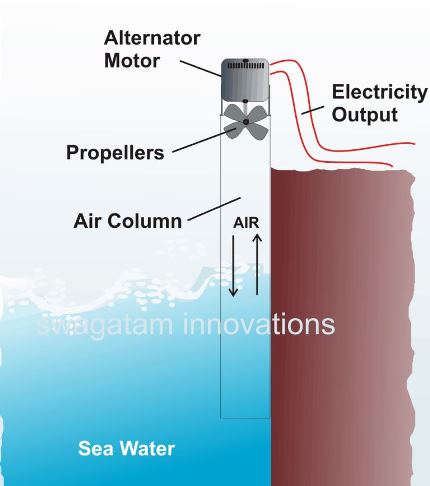
Referring to the figure below we see that the set up is especially intended for exploiting the rise and the fall of the sea water ebbs or rather the giant waves and the surfs.
How this Sea Wave Electricity System Works
Here we are looking at a very interesting idea for generating electricity from sea wave movement. That image is showing one vertical type pipe which is going deep into the sea water, and that pipe is having air trapped inside, so that is becoming like one air column.
Meaning we are using the up and down motion of sea water inside that pipe to make some kind of air pressure movement.
That moving air is finally used to rotate some propeller or turbine which is connected with one alternator motor, and from that we are taking electricity output.
How Sea Wave is Creating Air Motion Inside Pipe
So we see that when sea wave goes up outside, then sea water also goes up inside the pipe, because sea level is changing same way everywhere.
When that sea water goes up inside the pipe then it is pushing the air upward with pressure, because that air cannot go anywhere else. So that compressed air is coming out through upper side of the pipe with high speed.
Then when wave goes down, then water also goes down inside pipe and that time air is sucked back inside the pipe to fill that empty space.
So we get two-way air motion, up and down, inside the pipe and that motion is happening continuously due to the regular rise and fall of sea wave level. This is called oscillating water column effect.
How Propeller is used for Electricity Generation
Now at the top side of that pipe we are putting one propeller fan which is like a turbine blade. That propeller is getting hit by air from both sides, first when air is going up, then when air is coming down.
So this propeller is getting rotated in both the directions due to this back and forth air pressure. But we do not want it to rotate in different directions because that will not generate proper electricity.
So we must use some special turbine like wells turbine, which can rotate in one single direction even when air is flowing in both ways. That is possible due to special shape of blades.
Then we are connecting this turbine or propeller with one alternator motor shaft, and that alternator is converting that rotational motion into electricity, which is finally going to some output wires.
Why this Method is Good
We can say that this method is very clever and clean because no machine part is inside the sea water, everything is above water.
So less chance of corrosion and damage. Also we are not using any diesel or fuel, only free wave power from nature. So this method is very environment friendly and simple also.
Some Important points to Remember
But we must also think about some problems. Like if wave is too weak then air pressure will be less and propeller may not rotate properly.
Also we must use strong waterproof materials so that rain or storm does not damage the setup. And that turbine must be special type which can rotate in one direction from both side air flow otherwise it will not work. That is why many engineers use wells turbine or similar types.
Do we Really Need Wells Turbine here
So normally all the wave energy systems which are using air column type setup, like the one in that diagram, they always go for something like wells turbine.
That is because they want the turbine to rotate always in same direction, even when the air is coming from two sides, like first from bottom then from top.
But that setup becomes a little complex, and also that wells turbine design is not so easy to build at home or diy, because it is based on aerofoil blade structure which needs special angle.
But now Let us Think Differently
Why not we use just a simple propeller fan and connect that with a dc pm motor which can act like alternator.
Now that motor will rotate first in one direction when air goes up, and then it will rotate in reverse direction when air comes down.
So we get to and fro rotation of the motor shaft, and that will produce ac type voltage at the motor wires, like one pulse in positive, one pulse in negative, depending on the direction of spin.
So now what we can do is, we can just connect a bridge rectifier directly across that motor wires.
Then that ac type voltage whether it is from clockwise rotation or anticlockwise rotation, will be converted into one-direction dc output by the bridge.
So problem solved?
Yes, this can really work and in fact this method becomes more simple compared to using wells turbine.
Because now we do not care in which direction the propeller rotates, as long as the motor is producing some voltage.
Bridge rectifier will automatically make it into pure dc, so we can charge battery or use it with inverter.
But Some Limitations can Come
Now we must understand that not all motors will work nicely when rotated to and fro. Some motors need high rpm to produce good voltage. Also when motor rotates back and forth, then average voltage becomes very low and lot of time it may not be spinning at all. So we might get very fluctuating dc output unless we add some capacitor and boost converter at the output.
Also the mechanical jerking may damage the motor brushes if we use brushed type motor. So brushless motor is better here, and we can use permanent magnet alternator type motor, which can work better with slow speed and two-way spin.
This way we can see the concept working in real and even charge some battery or light some LEDs as demo.
Conclusions
So in simple words, we are using sea wave movement to push and pull air inside one vertical pipe, then that air movement is used to rotate propeller, then that is connected to alternator motor, then we get electricity. Very clean and smart way to use sea energy without touching water directly.
If we want professional and stable system then we may use wells turbine and keep unidirectional rotation with proper matching alternator. But for diy or experimental setup, the output bridge diode method is very practical. Just let the air push and pull a simple propeller, connect one small motor to it, and then put a bridge rectifier, and take out the dc to charge a battery.
Using Bridge Rectifier for Rectifying the Negative Cycles
The generated unstable electricity is first rectified by the bridge configuration and filtered appropriately by the filter capacitor. This filtered DC is fed to the input of the voltage regulator IC, which does the rest by controlling and keeping the voltage under check and safe for charging the connected battery.
The battery is charged safely, once it gets fully charged, it may be used for operating an inverter.
Safe and absolutely Free electricity that may be used just for ever.
Electricity from Sea Surfs
The next set up I have explained below is also a fairly easy to implement design and can used for generating huge quantities of free electricity from sea wave continuously.
Renewable Electricity from Sea
AS already discussed above, just like wind and solar power, another great source of free energy available on the surface of this planet is the sea or the ocean water.
The power from sea or ocean is normally in the form of wave power, which is rather cheaper and much easier to harness compared to wind or solar power. This is because the force or power impact of sea wave on a given cross section can be much higher than wind or solar power across the same area.
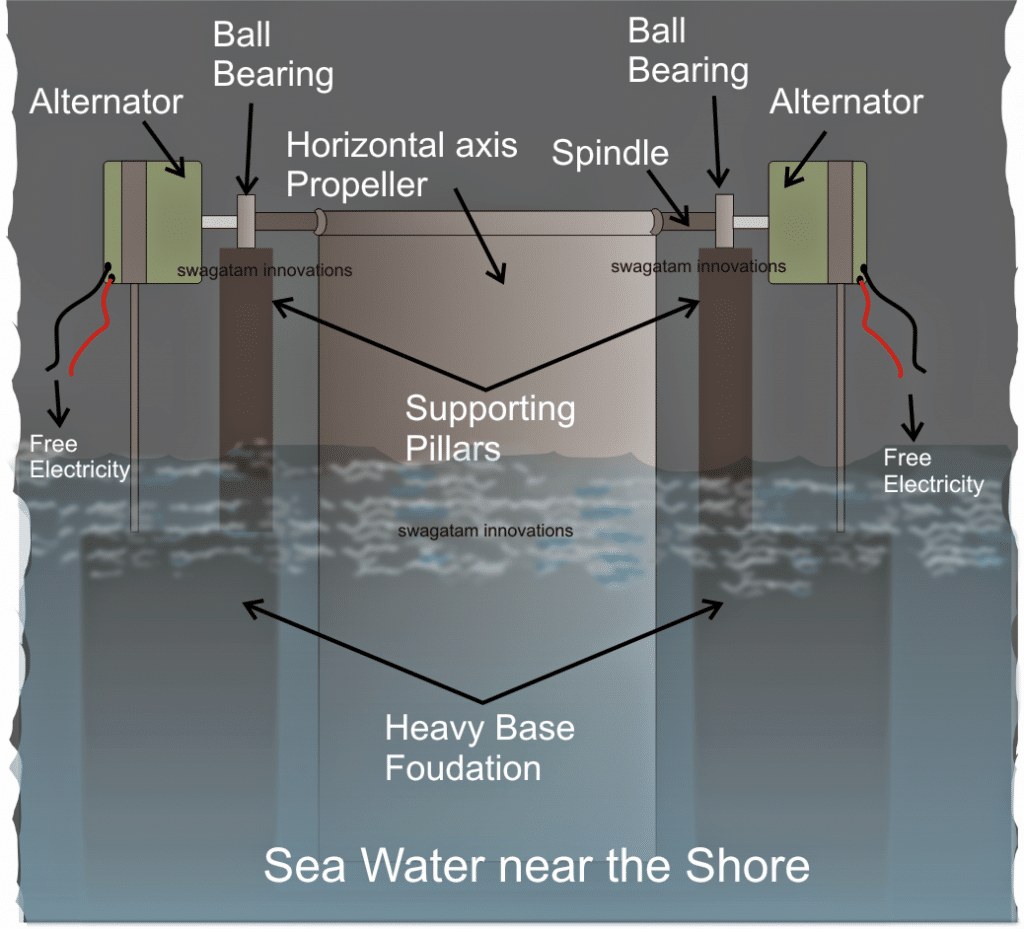
This set up which will generate electricity from sea waves or surfs can be seen in the following diagram. The set up once built can be lifted and anchored in sea water close to the sea shore for acquiring free electricity throughout the year without interruption.
The Sea Generator Setup
In the image above we can see a vertical long flap made up of a rigid plastic which is hoisted on a horizontal spindle, supported by two ball bearings at the ends, such that the spindle and the flap assembly is able to hang and oscillate in a see-saw form freely, across the two ball bearings.
The ball bearings are supported over two adjacent vertical long pillars which are in turn clamped firmly on heavy metallic bases.
The spindle ends across the ball bearings can be seen fitted with the two respective alternators, which implies that when the spindle goes through a lateral push and pull , the same is transferred across the alternator shafts which in turn enables their internal coil and magnet mechanism to go through a corresponding to and fro kicking movements.
The push pull thrust on the vertical propeller flap is generated by the sea waves since the flap is immersed in the sea water up to 60% of its entire length.
The above push pull, sea-saw like movement of the flap produces an identical movement of the alternator shaft causing a proportionate amount of electricity to be generated across the respective output wires of the alternators.
Electricity for Charging Batteries
This free electricity can be used for charging batteries which could be later taken out for powering LED lights or inverters.
The base structure which supports the two pillars and the entire mechanism must be substantially heavy (made from solid steel) and rounded at the corners (for ensuring minimum resistance to the waves). The bottom surface of the base must be as flat as possible for preventing the unit from sinking in the soft sand.
Once built, the entire structure may be simply lifted ( by a few men) and installed inside sea water close to shore or wherever one may choose to position it inside the sea water.



Comments
Hi
How much is cost for the equipment and installation charges.can you please explain in detail
You will have to work it out yourself depending on the magnitude of the set up…
Thanks I am a mother and very busy! This helped me alot!
Glad you liked it, keep up the good work!