In this post I have explained how to test mosfets using multimeter through a set of steps, which will show help you to accurately learn the good or faulty condition of a mosfet
Mosfets are Efficient but Complex Devices
MOSFETs are outstanding devices when it comes to amplifying or switching of various kinds of loads. Though transistors are also largely applied for the above purposes, both the counterparts are hugely different with their characteristics.
The amazing efficiency of mosfets are to a great extent neutralized by one drawback associated with these devices.It is the involved complexity which makes these components difficult to understand and configure.
Even the simplest of operations like testing a good mosfet from a bad one is never an easy task especially for the beginners in the field.
Though mosfets usually require sophisticated equipment for checking their conditions, a simple way using a multimeter is also considered effective most of the time for checking them.
We take the example of two types of N-channel mosfets, the K1058 and the IRFP240 and see how these mosfets can be tested using an ordinary digital multimeter through slightly different procedures.
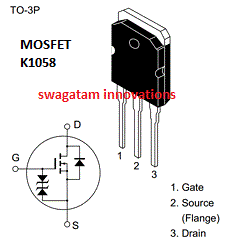
How to Check N-Channel Mosfets
1) Set the DMM to the diode range.
2) Keep the mosfet on a dry wooden table on its metal tab, with the printed side facing you and leads pointed towards you.
3) With a screwdriver or meter probe, short the gate and drain pins of the mosfet. This will initially keep the internal capacitance of the device completely discharged.
4) Now Touch the meter black probe to source and the red probe to drain of the device.
5)You should see an "open" circuit indication on the meter.
6) Now keeping the black probe touched to the source, lift the red probe from drain and touch it to the gate of the mosfet momentarily, and bring it back to the drain of the mosfet.
7) This time the meter will show a short circuit (sorry, not short-circuit rather "continuity).
The results from the point 5 and 7 confirms that the mosfet is OK.
Repeat this procedure many times for proper confirmation.
For repeating the above procedure each time, you will need to reset the MOSFET by shorting the gate and the drain leads using meter probe as explained earlier.
How to Check P-Channel Mosfets
For P-channel the testing steps will be as per 1,2,3,4 and 5, but the polarities of the meter will change. Here's how to do it.
1) Set the DMM to the diode range.
2) Fix the mosfet on a dry wooden table on its metal tab, with the printed side facing you and leads pointed towards you.
3) With a any conductor or meter probe, short the gate and drain pins of the P-mosfet. This will initially enable the internal capacitance of the device to discharge, which is essential for the testing process.
4) Now Touch the meter RED probe to source and the BLACK probe to drain of the device.
5) You will find an "open" circuit reading on the meter.
6) Next, without moving the RED probe from the source, remove the black probe from drain and touch it to the gate of the mosfet for a second, and bring it back to the drain of the mosfet.
7) This time the meter will show a continuity or a low value on the meter.
That's it, this will confirm your mosfet is alright, and without any problems. Any other form of reading will indicate a faulty mosfet.
If you any further doubts regarding the procedures please feel free to express your thoughts in the comment section.
How to Test an IRF540 Mosfet
The procedures are exactly similar to the above explained N-channel mosfet testing procedures. The following video clip shows and proves how it may be implemented using an ordinary multi-meter.
Practical Video Tutorial
Simple Mosfet Tester Jig Circuit
If you are not convenient with the above mentioned testing procedure using a multimeter, then you can quickly construct the following jig for checking any N channel mosfet efficiently.
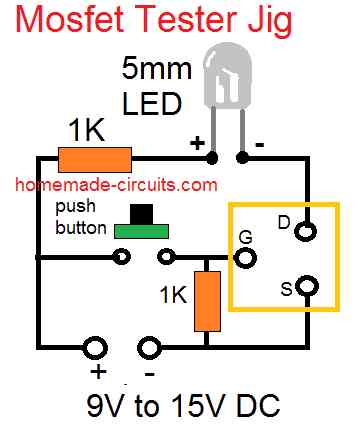
Once you make this jig, you can plug-in the relevant pins of the mosfet into the given G, D, S sockets. After this you just have to press the push button for confirming the mosfet condition.
If the LED glows only on pressing of the button, then your mosfet is fine, any other results will indicate a bad or defective mosfet.
The cathode of the LED will go to the drain side or drain socket.
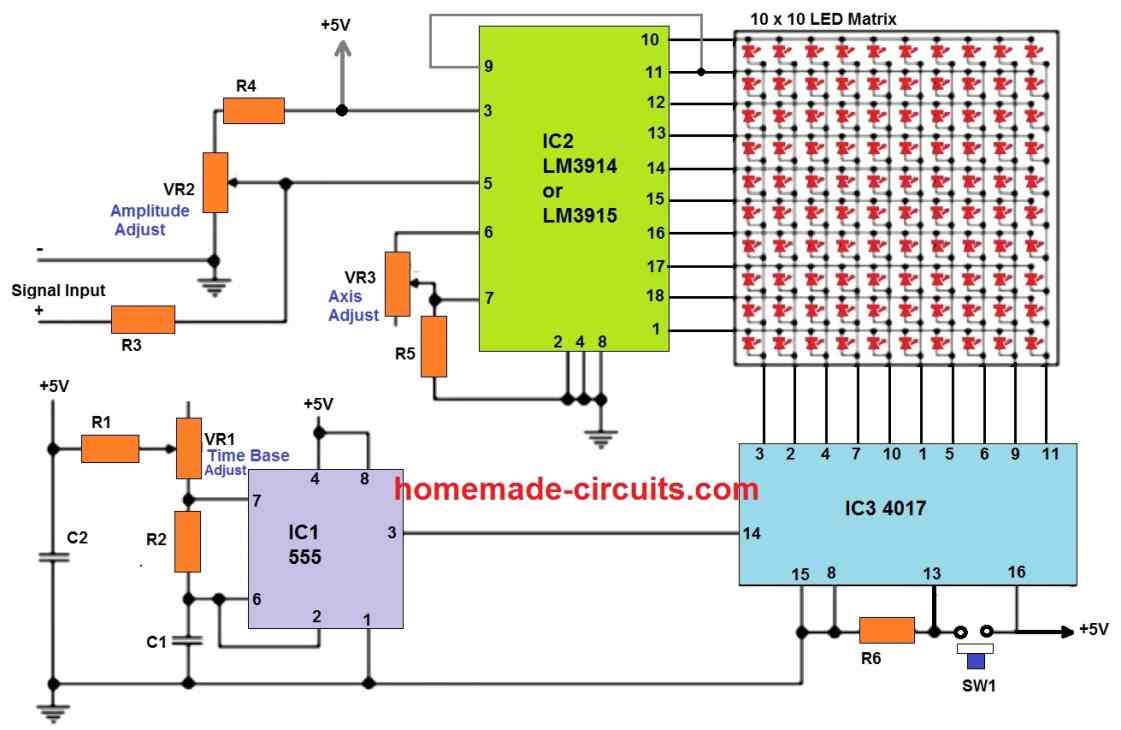
For p-channel mosfet you could simply modify the design as per the following image



Comments
Sayın Swagatom hocam Merhaba yaptığınız tüm çalışmalarınıza teşekkür ederim. Bizler sizlerin bu bilgi paylaşımlarınız sayesinde kendimizi geliştiriyoruz yukarıda bahsettiğiniz K1058 Mosfet transistörün Gate – Source ayakları arasında iki diyot kullanılmıştır. Bu diyotlar niçin kullanılmış
Bu mosfet transistörün yerine muadil mosfet transistör kullansam devrede çalışır mı. Bende arızalı besleme devresi var burada 26NM60N kullanılmış bunun yerine 26NM60 kullansam çalışır mı? teşekkür ederim.
Please sir how to identify the terminal when carry out a test, thanks.
You will have to refer to the datasheet of the mosfet for determining the pinouts
Really narration is too good with very simple English and very simple schematic diagrams too.
I would love to read the articles when ever I face problem in solving circuits.
I am glad the article helped you!
For dual gate MOSFETS, would you do the test twice swapping the gates every time
Yes that’s correct, however dual gate mosfets are very rare nowadays
what is difference between N and P channel test circuit ? It looks same .
supply polarity and the LED polarity are opposite
Ok supply polarity is different in P Channel circuit but LED has no any polarity label. Can you update it please ?
The lower diagram is for p channel, the LED polarity are indicated in this diagram. The upper diagram is for N channel mosfet, the LED pin on the drain side will have negative polarity.
thank u sir for your tips.
Dear sir
Thank you so much for the above simple circuit.Cramming the above 7 steps can be challenging when one needs speedy solution to a circuit problem.I would like you showcase steps for analog testing.most electricians- (electronics) use them.Please is there such a simple circuit for testing inductance and capacitance.I have one inductor i got from scrab which i want to use in a circuit but couldnt find the value on its body.is not here i would have given you what is writen on its body.its a toroid one about 2cm or more in diameter .
Thank you.
Patrick, inductance meter and capacitance meter circuits are already published in this website, please use the search box to find them.
Will the Circuit using the LED work for BJT too?
Yes it will, but it won’t check the hFE
The pic you have shown above is wrong
its shown source as middle pin but its drain instead
you can confirm and thank me.
Which pic are you referring to? The last two pictures indicate the wire connections only, not the pin orientation.
Doing the test on a NPN Mosfet, I have the continuity between source and draing after having charged the gate but this configuration is quickly (within few seconds) going to a open configuration, without touching anything. My understanding is that there is a parasitic resistance that discharge the gate and thus Mosfet is faulty. Could you confirm my understanding ? For notice, my NPN Mosfet has an integrated zener diod protection.
You may be right, because any other result than the explained one indicates a faulty MOSFET, you can further confirm this using the LED jig circuit as shown at the bottom section of the article.
Hello,
We have extend this offer for you to provide us with a price quote for the item listed below:
Extech EX350 Digital Multimeter or Compatible————186 pieces
Payment mode ——————–Net 30
Looking forward to doing business with your company
N.B: This offer for quote is only for USA based companies
Thank you.
Sincerely yours,
Aevolet Gravesd
President, Student Affairs
CITY COLLEGES OF CHICAGO
180 N. Wabash
Chicago, IL 60601
Sorry, presently we are not involved with selling or manufacturing electronic items.
Bonjour
quel est le rôle de diode entre gate et source intégré dans le mosfet?
It’s probably for safeguarding the MOSFET gate from reverse spikes and over voltages.
how I know n or p channel mosfet when it is connected to PCB without looking at ckt?
If the source side gets the positive then it’s a p channel.
First you say short the gate and the drain to reset, then you say short the gate and the source to reset. I know it’s gate and drain just a small typo I’m sure.
Thank you, yes that was a typo, I have corrected it now!
Pls, I’ll like to know if the pin configuration above is same for irf840 and irf1404. Bcos I use your method to test these mosfets bUT they’re not behaving as you said. What do you think am doing wrong. I guess the pins are not in the above order. You can reply through my email if you wish Sir. Thanks.
The pinout of the two mentioned mosfets are the same.
Just now I checked the IRF540 as per the above explained instructions and I could check it perfectly, I will the upload a video soon for everybody.
Sir,
After connecting supply MOSFET has burning how can I check it in microtek hb1125
Rajesh, a mosfet will mostly burn due to a short circuit at the output, connect a fuse in series with the battery to verify the issue…
But I think this article is talking on SO3 MOSFETs,how do I to with SO8 MOSFETs both P & N Channel II meet them on Laptop circuit boards
Thanks,
Amos.
the process will be identical and will need to be done twice for the pair…
I Have Irfp260n giving me read even after I touched the gate is that mean I have to replace it ?
No, it looks OK to me..
I cant have any institute in my country
i need your help to give me some of method to be able to repair any device
you can feel free to ask anything about electronic circuits I will try to sort it out for you.
Sir i want to learn inverter service ,help me to send inverter circuit diagram with service tips
anbarasan, it's not that easy, you'll have to go an institute or a relevant coaching classes to learn it theoretically and practically