An AC mains high/low cut-off device will cut off or disconnect the mains supply from home electrical whenever a high voltage or low voltage situation is detected. In this way it ensures total safety to the home wiring and appliances from fire hazards, due to abnormal over voltages, brown outs or low voltages.
In this article I have explained 3 accurate automatic over and under voltage cut out circuits can be made at home for protecting the domestic appliances from sudden dangerous high and low voltage influxes.
The first cut-off circuit discusses a transformer based circuit with 4 LED indicators, the second and third voltage protection circuits use only a couple of op amps, and work without a transformer, while the fourth concept explains a transistor based cut off circuit.
All of these units can be installed at home for controlling over and under voltage cut off protection.
1) High/Low Mains Voltage Cut-off with Indicators
The AC mains high and low voltage cut off circuit I have explained in this article is very easy to build and yet very reliable and accurate.
The circuit utilizes a single IC LM 324 for the necessary detection and instantly switches the relevant relays so that the connected loads are isolated from the dangerous inputs.
The circuit also provides visual indications of the respective voltage levels during any instant.
The following circuit utilizes a transformer for powering the circuit
Circuit Diagram
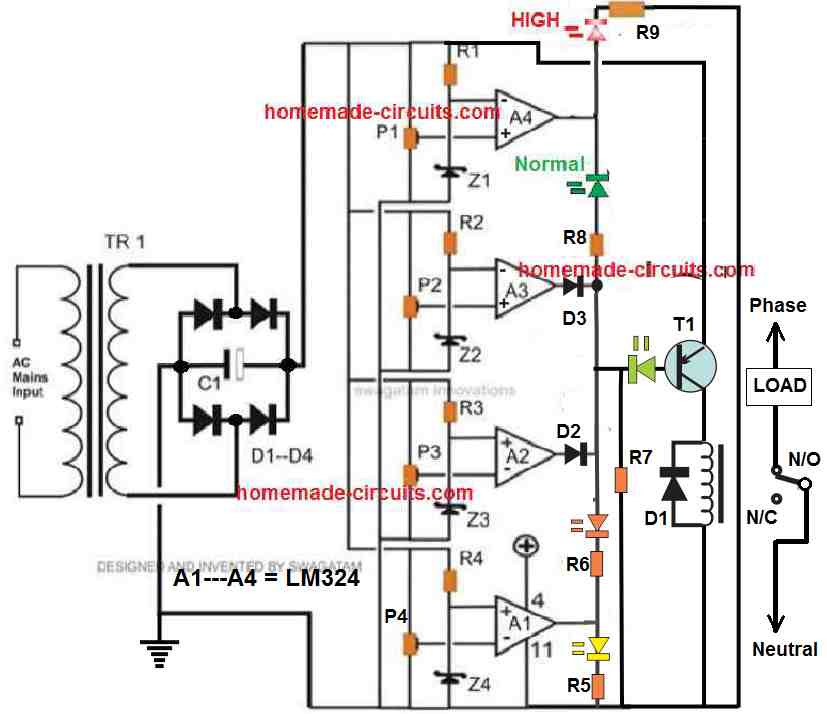
Parts List for the proposed high, low mains voltage protector circuit.
- R1, R2, R3, R4, R5, R6, R7, R8, R9 = 4K7 = 9
- P1, P2, P3, P4 = 10 K Presets = 4
- C1 = 1000 uF/ 25 V = 1
- Z1, Z2, Z3, Z4 = 6 Volts, 400 mW = 4
- D1 = 1N4007 =1
- D2, D3 = 1N4148 = 2
- T1 = BC557B = 1
- LED = All are 20 mA, 3.3 V = 5
- Transformer = 0 – 12 V, 500 mA = 1
- Relay = SPDT, 12 Volt, 400 Ohm = 1
Circuit Operation
The present design of a high voltage and low voltage cut off circuit is not only highly accurate but also provides visual indications regarding the relevant voltages insteps.
The accuracy is so high that virtually the thresholds can be separated and sensed within 5 volts range.
The incorporation of opamps in the circuit equips it with the above feature and therefore the whole idea become very much reliable.
Let’s understand the circuit in details:
How the opamps Operate as Comparators
The opamps, A1, A2, A3, A4 are obtained from a single IC LM324, which is a quad opamp IC, means consists of four opamp blocks in one package.
The IC is outstandingly reliable and easy to configure and hardly poses a problem with its functioning, in short it has robust specs and is too flexible with most of the configurations.
The four opamps are rigged as voltage comparators. The inverting inputs of all the opamps are clamped to a fixed reference value of 6 volts which is done through a resistance/zener network for each of the opamps discretely.
Op amp A2 and A3 are configured as window comparators, meaning the outputs of both these opamps will be zero volts or logic low, as long as the input AC is within the normal range, as set by the presets P2, P3.
A2 controls the low voltage cut-off while the A3 monitors the high voltage cut off point.
The remaining opamps A1 and A4 are simply rigged as voltage indicators along with the associated yellow, orange, green, red LEDs.
How to Setup
Setting up of the presets P1 to P4 are implemented by first evaluating the various DC levels that would match the corresponding AC mains voltage levels.
This is elaborately explained under the "Calculating the Cut-off Thresholds" section below.
Let's assume the DC supply voltage from the bridge is 12 V when the mains input AC is at 220 V.
Next, let's suppose we want to illuminate the yellow LED at 10 V in response to 183 V, orange LED at 11 V in response to mains 201 V, top green LED at 14.5 V corresponding to 265 V input AC, and RED LED at 15.5 V corresponding to 284 V mains input.
Initially keep the transformer disconnected, and the relay also disconnected from the transistor.
Using a variable power supply, set a voltage of 10 V across the op amp circuit, and adjust the P4 preset until the yellow LED just illuminates.
Next, increase the supply to 11 V, this should instantly shut off the yellow LED. Now tweak and shuffle the P3 preset until the orange LED just light up.
Increase the voltage supply to 12 V, this should instantly shut off the orange LED.
Next, increase the DC supply to 14.5 V, tweak and shuffle P2 until you find a point on the preset P2 where the green LED at the transistor base just shuts off, but reducing the voltage slightly below 14. 5 V quickly illuminates it.
Finally, adjust the DC level to 15.5 V, which should switch OFF the transistor base LED. After this, tweak and shuffle the preset P1, until you see the red LED just illuminating.
This completes the Setting up procedures, now you can connect the relay with the transistor collector, and the transformer input with the mains, and expect the circuit to work exactly as per the settings.
2) Using Two Op amps Only
After some analysis, I realized that the above high, low mains voltage cut off protector circuit could be simplified into a much easier version using just a couple of op amps.
Please refer to the diagram given below; it's self-explanatory and very simple to understand.
However if you have problems understanding it, shoot me a comment.
Caution: Visually Conflicting Issues
All the op amp based diagram I have explained below have a few visually conflicting issues, which are I have explained below. Readers are requested to kindly take these issues into consideration and adjust the interpretation accordingly:
- The lower op amp is set to control the upper voltage limit.
- The upper op amp is configured to control the lower voltage limit.
- Preset P1 is designated for op amp A2.
- Preset P2 is designated for opamp A1.
As you can see the the designations of the parameters are conflicting with each other.
Except the above issue, the circuit is technically perfect and will work exactly as specified in the descriptions.
There are many versions of the high/low AC mains protection circuit included in the present article.
The first one below explains a capacitive powered version, using only two opamps and a triac.
Transformerless/Triac Version
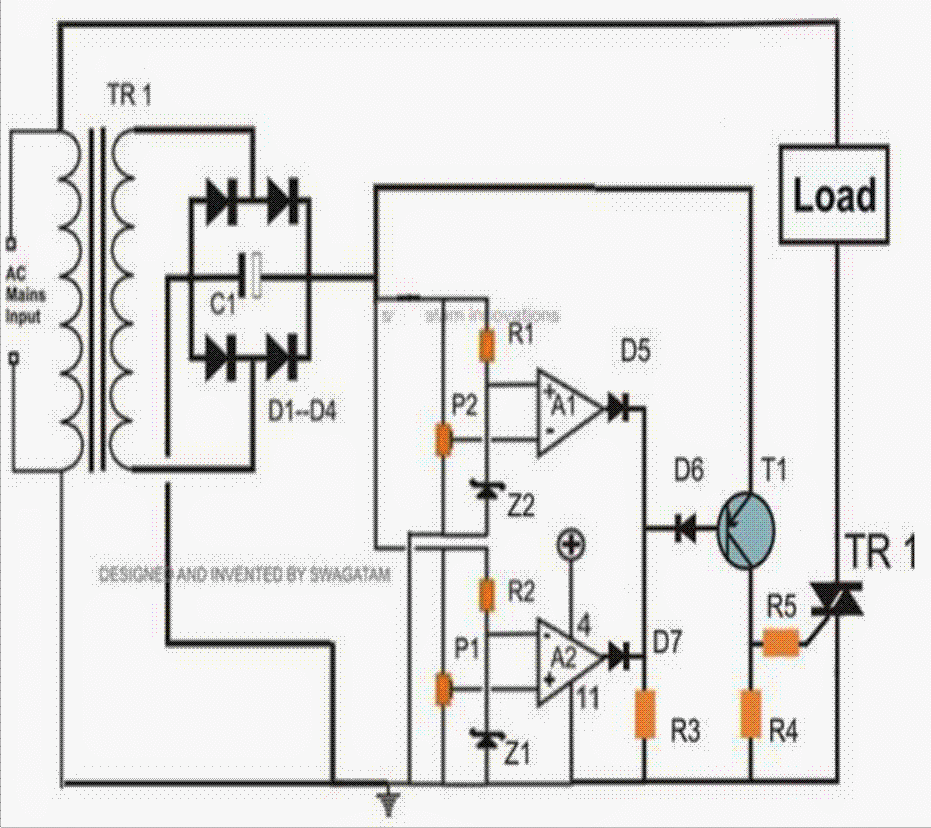
The transformerless mains high low voltage cut off circuit version of the above explained design can be visualized in the following diagram:
Warning: The below shown circuit is not isolated from mains AC. Handle with extreme caution to avoid a fatal mishap.
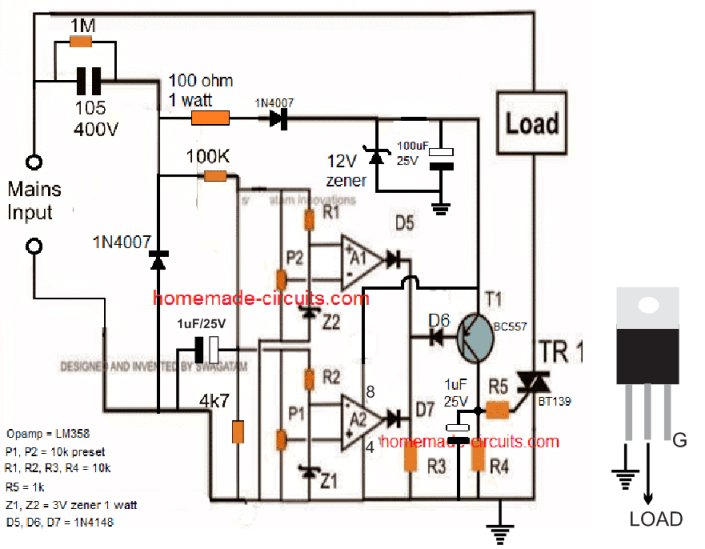
Using a Single Relay
If a single relay is intended to be used instead of a triac, the design could be modified as shown in the following figure:
Please use a 22uF/25V capacitor across the transistor base and ground, just to make sure the relay does not stutter during the changeover periods...
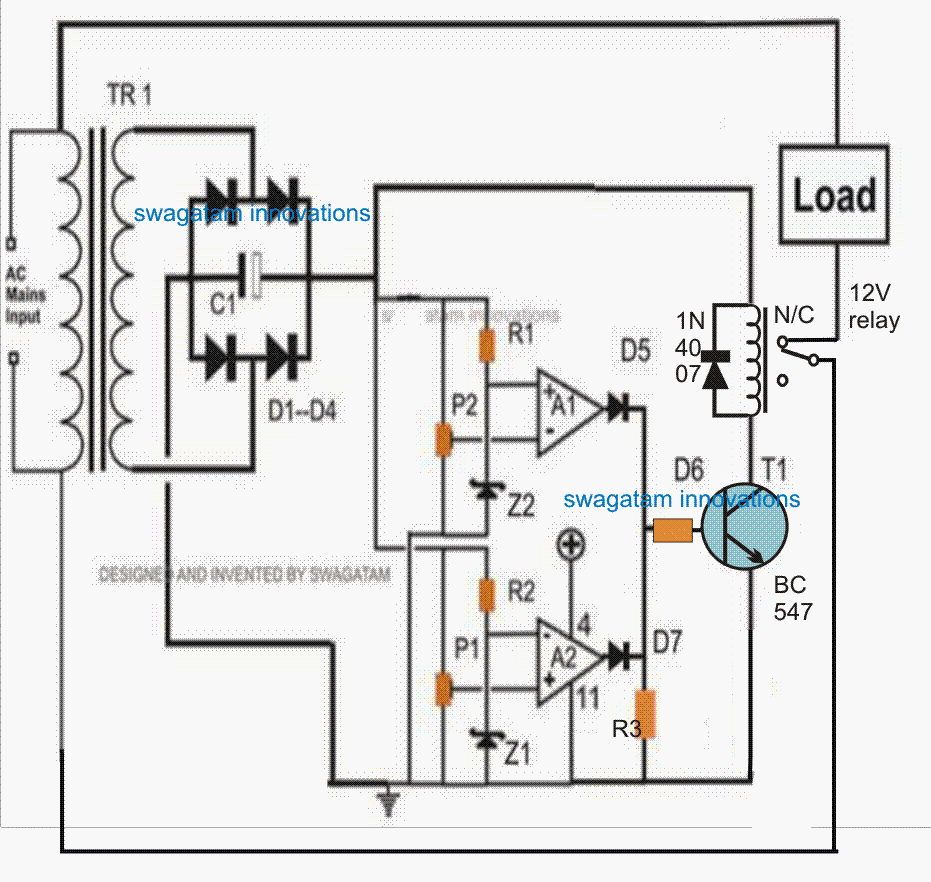
Using PNP Relay Driver
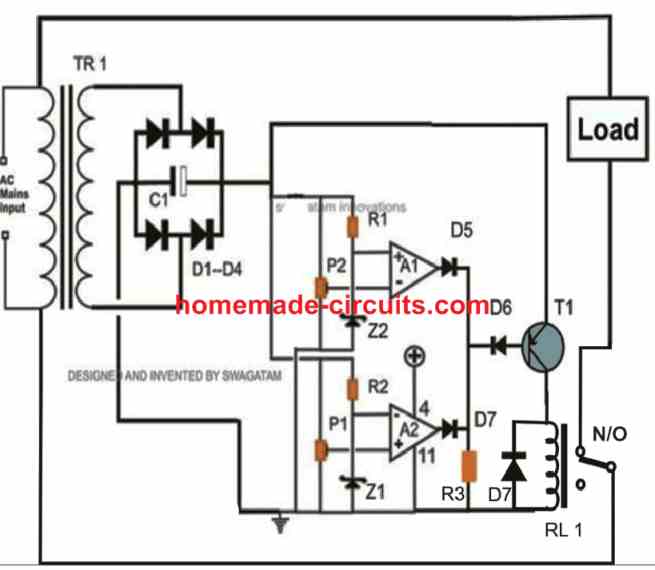
As shown in the given mains AC high, low voltage protector circuit, we can see two opamps from the IC LM 324 are used for the required detection.
The upper opamp has its non inverting input rigged to a preset and is terminated to the supply DC voltage, pin #2 here is provided with a reference level, so that as soon as the potential at pin #3 goes above the set threshold (by P1), the output of the opamp goes high.
Quite similarly the lower opamp is also configured for some voltage threshold detection, however here the pins are just reversed, making the opamp output go high with low voltage input detection.
Therefore, the upper op amp responds to high voltage threshold and lower op amp to low voltage threshold. For both the detections, the output of the respective op amp becomes high.
Diodes D5 and D7 make sure that their junction produces a common output from the opamp output pin outs.
Thus whenever any one of the op amp output goes high, it is produced at the junction of D5, D7 cathodes.
Transistor T1’s base is connected to the above diode junction, and as long as the opamps output remain low, T1 is allowed to conduct by getting the biasing voltage through R3.
However the moment any of the opamp output goes high (which may happen during abnormal voltage conditions) the diode junction also becomes high, restricting T1 from conducting.
Relay R1 instantly switches OFF itself and the connected load. Thus the connected load remains ON as long as the opamp outputs are low, which in turn can only happen when the input mains is within the safe window level, as adjusted by P1 and P2. P1 is set for detecting high voltage levels while P2 for the lower unsafe voltage level.
Calculating the Cut-off Thresholds
The basic idea is to make A2 output HIGH, when the mains AC goes above the higher mains voltage cut-off point, and to make A1 output HIGH when the AC mains input goes under the lower voltage cut-off threshold.
The outputs of A1, and A2 op amps are supposed to remain LOW, as long as the input AC stays within the stipulated normal voltage range.
The mains input AC voltage levels will be very linear with the DC output levels across the +/- lines of the circuit, or across the bridge rectifier output.
Therefore, the DC level across the bridge rectifier, applied to the circuit will vary linearly in response to the varying AC mains input.
This means that, we have to first check and measure the DC levels that exactly coincide or correspond to the upper and lower cut off thresholds of the mains AC.
This can be done in the following manner:
Remove the complete circuit from the bridge rectifier output, and check the DC voltage across the bridge rectifier through a DC voltmeter.
Let's say you find it to be 13.2 V, now quickly change the range of the meter to AC mains level and check the voltage at the AC mains side of the transformer. Let's say you find it to be 230 V.
This would mean that 230 V input AC produces an output DC of 13.2V.
Once the above info is confirmed, the corresponding upper and lower thresholds could be calculated through a simple cross multiplication, as I have explained below:
230/200 = 13.2/A
- Here, 230 represents the normal AC input voltage.
- 13.2 indicates the corresponding normal DC at 230 V input AC
- 200 is assumed to be the lower cut off threshold.
- A is the required DC corresponding to the 200 V lower cut off threshold
Solving the above gives us:
A = 11.47 V which is our lower cut-off DC at 200 V input AC.
Likewise, the upper cut-off DC can be found as:
230/260 = 13.2/B, here B is the upper cut-off DC corresponding to the 260 V high AC input.
Solving the above gives us:
B = 14.92 V, which is our higher DC cut-off voltage value, corresponding to the 260 V high AC voltage.
Setting up the Presets
Now, since we know the lower and the upper DC levels at which the relay needs to activate, we can set up the two presets accordingly, with the help of the following points:
- You will need a variable power supply for the setting power supply, which should be able to produce an adjustable output from lower than 10 V DC to a maximum of 15 V DC, or higher.
- First, adjust the above power supply output to the lower cut off level of 11.47 V or 11.50 V
- Disconnect the opamp/relay circuit from the bridge rectifier circuit and connect this 11.50 V with the op amp.
- Connect a DC voltmeter across A1 op amp output and the ground line.
- Tweak and adjust the P2 preset until you find A1 output becoming HIGH.
- Now adjust the input supply DC to slightly over 11.50 V, let's say to 11. 90 V.
- This should immediately cause the A1 output to turn LOW.
- Once you see this you can confirm that the lower cut-off level corresponding to the 200 V and below is set.
- Now, increase the input DC level to the upper cut-off level of 14.92 V.
- With the DC voltmeter now connected across the A2 output and the ground line, start adjusting and tweaking the preset P1, until you find the A2 output turning HIGH.
- Once you find the output turning HIGH at 14.92 V, decrease this level slightly down to may be 14.70 V. This should instantly turn the A2 output LOW again.
- This will confirm that your upper cut-off threshold corresponding to 260 V is set and working.
- To confirm the results even further, vary the input DC between 10 V and 15 V, you should find the transistor getting switched OFF as soon as the voltage is reduced below 11.50 V or when the input DC is increased above 14.90 V.
- This also means that the transistor will remain switched ON and the relay will remain activated (in NO position) only as long as the input DC is within the window limit between 11.50 V and 14. 90 V, which corresponds to the normal AC level between 200 V and 260 V. Beyond or outside these limits, the relay will get deactivated (in NC position) causing the relay and the load to switch OFF.
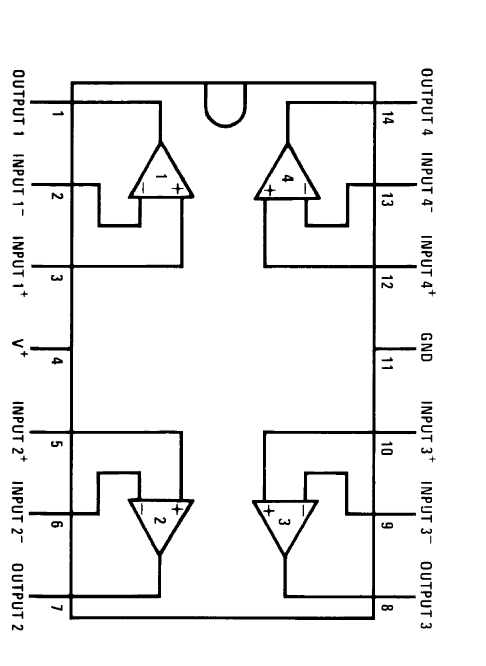
Pin Details of IC LM 324
Parts List for the above mains high, low voltage protector circuit
R1, R2, R3 = 2K2 = 3
P1and P2 = 10K preset = 2
C1 = 220uF/25V = 1
All diodes are = 1N4007 = 8
T1 = BC557 = 1
Relay = 12 V, 400Ohms, SPDT =1
op amps = 2 opamps from IC LM 324 = 1
Zeners = 4.7 volts, 400mW =1
Transformer = 12V, 500mA =1
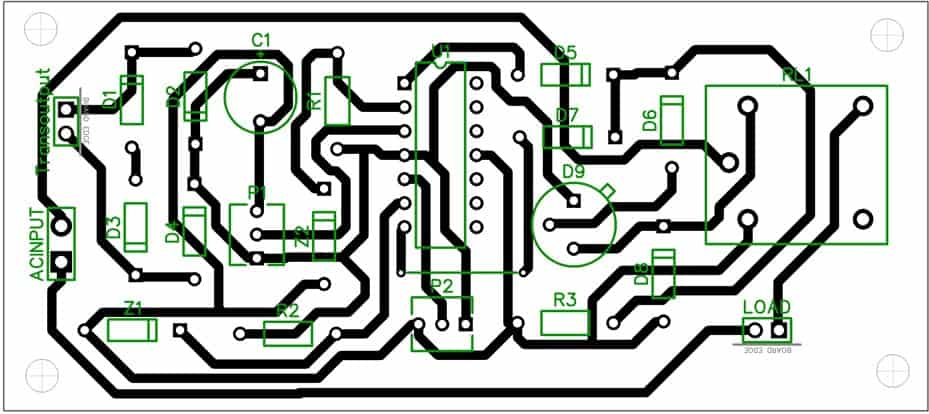
PCB Layout
So far I have explained an IC version of the circuit, now let's see how a mains 220V or 120V operated over voltage and under voltage protection circuit can be built using just a couple of transistors.
A very simple circuit presented when installed in the house electrical may help in restricting the issue to a great extent.
Here I have explained two designs of over and under voltage circuits, the first based on transistors and the other one using an opamp.
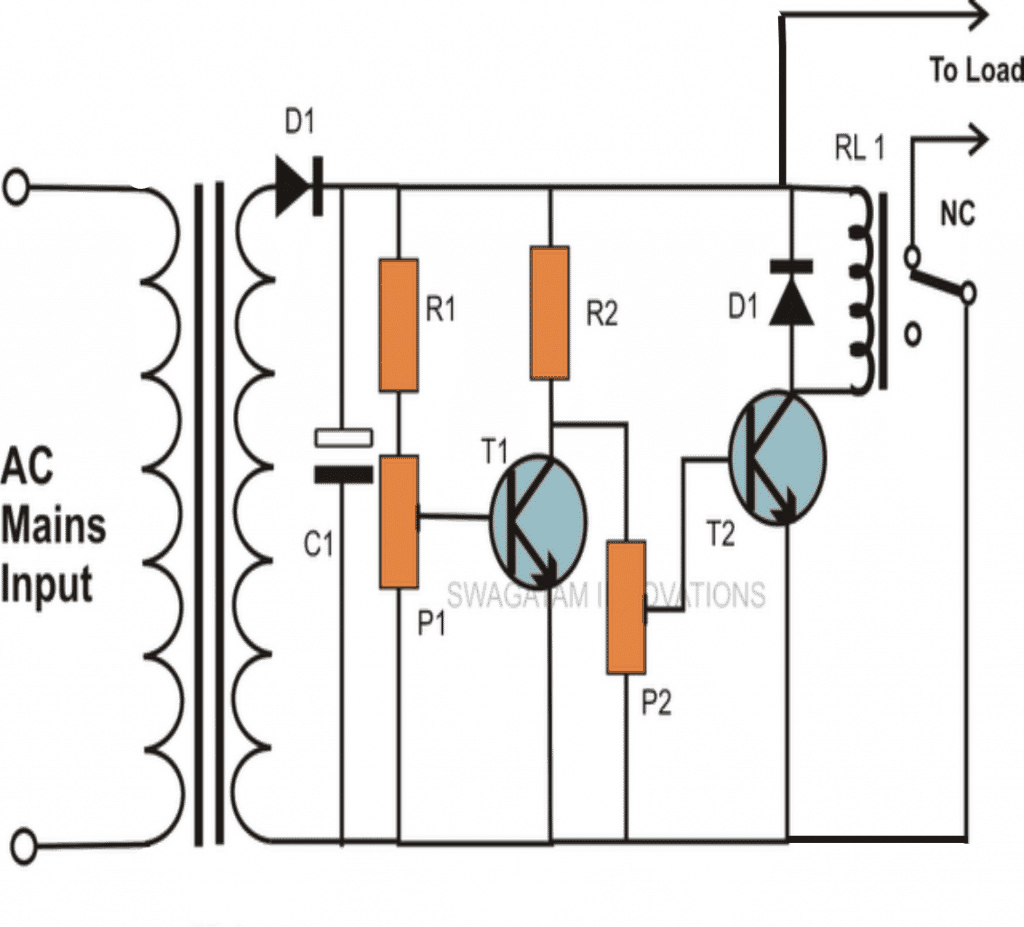
3) Over/Under Voltage Cut Off Circuit Using Transistors
You will be surprised to know that a nice little circuit for the said protections can be built using just a couple of transistors and a few other passive components.
Looking at the figure we can see a very simple arrangement where T1 and T2 are fixed as an inverter configuration, meaning T2 responds oppositely to T1. Please refer to the circuit diagram.
In simple words when T1 conducts, T2 switches OFF and vice versa. The sensing voltage which is derived from the DC supply voltage itself is fed to the base of T1 via preset P1.
The preset is used so that the tripping thresholds can be determined precisely and the circuit understands when to execute the control actions.
How to Set the Preset for Automatic Cut off
P1 is set for detecting high voltage limits. Initially when the voltage is within the safe window, T1 remains switched OFF and this allows the required biasing voltage to pass through P2 and reach T2, keeping it switched ON.
Therefore the relay is also kept activated and the connected load receives the required AC voltage.
However in case suppose, the mains voltage exceeds the safe limit, the sensing sample voltage at the base of T1 also rises above the set threshold, T1 immediately conducts and grounds the base of T2. This results in switching OFF of T2 and also the relay and the corresponding load.
The system thus restricts the dangerous voltage from reaching the load and safeguards it as expected from it.
Now suppose the mains voltage goes too low, T1 is already switched OFF and at this situation T2 also stops conducting due to the settings of P2, which is set so that T2 stops conducting when the Mains input goes below a certain unsafe level.
Thus the relay is once again tripped OFF, cutting of power to the load and prompting the required safety measures.
Though the circuit is reasonably accurate, the window threshold is too wide, meaning the circuit triggers only for voltage levels above 260V and below 200V, or above 130V and below 100 V for 120 V normal supply inputs.
Therefore, the circuit may not be very useful for folks who might be looking for absolutely accurate tripping points and controls which can be optimized as per ones personal preference.
To make this possible a couple of opamps may be required to be included instead of transistors.
Parts List for the above AC mains over voltage, under voltage protection circuit.
- R1, R2 = 1K = 2
- P1, P2 = 10K =2
- T1, T2 = BC547B =2
- C1 = 220uF/25V = 1
- RELAY = 12V, 400 OHMS, SPDT = 1
- D1 = 1N4007 = 1
- TR1 = 0-12V, 500mA = 1




Comments
Hello,
I need to cut 120v AC through to a battery charger based upon the battery state of charge. Specifically, when the voltage from the battery drops to 13.2 volts DC, AC cuts through. Once battery voltage reaches 14.6, AC is cut off. I’m assuming the AC cutting through and off is via a physical relay, so just need to control that make break. Sounds simple, but thought I’d run it through an expert for opinion.
Thank you,
MK Black
Hi, if you want the cut-off to happen on the 120V side, then I would recommend using a triac based circuit as explained below. However it will not initiate when the battery drops below 13V, in that case you may have to use a DC side cut off arrangement…
https://www.homemade-circuits.com/battery-charger-circuit-using-triac/
Do you have any tested and assembled low and high voltage cut off boards working in 6 volts and three phase low voltage and high voltage cut off
The above circuits are all tested. However, I do not yet have a 3 phase version of the above designs..
Hi Mr. Swagatam, i have recently made one of your circuit, the one which is a transformer based. I noticed that when the applied ac voltage is below 100 ac volt the relay is not activated may be because the power coming out of the transformer is not enough to power up the relay. Upon seeing your transformer less design i was fascinated by it. I’m not an electronic but i love doing electronic stuff. I’m wondering how to put an LED indicaror. Can I just put an LED on the base of the pnp transistor and on the out put of the comparators. Thanks in advance.
Thank you Alinader,
Yes the relay may not be activating due to low voltage, in that case you can try using a 5V relay.
The transformerless alternative is also very good, since it is a solid state version and more reliable, although is very dangerous to touch in powered condition.
You can attach a series LED with the base of the PNP for getting the ON/OFF indications of the load.
You may also find the following design intresting:
https://www.homemade-circuits.com/mains-ac-home-protector-circuit/
Thanks a lot sir, the one you recommended is the one i exactly replicated. I also modified it by removing the low voltage feature using only one of its op amp to detect only the high voltage and still whenever the input ac voltage is below 100 volt the relay is not triggering and the green LED is barely lit. Your recommendation to use 5 volt relay is the answer, i have actually tried replacing my 1 ampere 12 volt transformer to 200 milliampere transformer and it made a difference and it operates now on a little bit lower voltages i think at 100 ac volt. This made me think if i instead use a 6 volt transformer and a 5 volt relay. But the transformer less version is still the best, because very small power is needed to trigger the triac. I hope in the near future you can modify it to include the LED indicators. I was wondering if i should remove the d6 on base of PNP transistor or just insert the LED in series with that d6 diode. Thanks once again, i wish you good health and more project to come.
You are welcome Alinader,
Using 6V transformer and 5V relay would give you the same results, the relay might fail to operate at lower AC levels.
Instead, you can use a 12V transformer (200mA) and supply the 5V relay through a 7805 IC.
Yes, the transformerless version is the best but since it is not isolated from mains AC, it is dangerous to touch in the open and powered condition.
You can remove D6, or keep it as is and wire the LED in series with D6, both will work.
I need pcb layout of first circuit.
Sorry, I do not have the PCB layout, you may have to contact a PCB designer for this…
I successfully made the pcb layout of first circuit.
That’s great Ritesh, all the best to you.
I was going through your Mains AC Home Protector Circuit. It is amazing. I was also going through your 3 Tested 220V High and Low Voltage Cut OFF Circuits Using IC LM324 and Transistors, wherein I was fascinated by the transformerless mains high low voltage cut off circuit version in the section Using Two Op amps Only.
I must accept my weakness for transformerless circuits with triacs b’cos of their compactness and efficiency. I think risks can be avoided in such scenario using fuses. Thus the almost same query that I have posted in your other page. Can Mains AC Home Protector Circuit be amalgamated with transformerless mains high low voltage cut off circuit version in the section Using Two Op amps Only with suitable modifications to enjoy all the features of both, i.e. high low voltage cut off with surge protector without using transformer and relays.
Yes, i think that’s possible, I will try to update the design in my home protector circuit article soon.
Very nice post. Thank you for sharing your design. I’m retired in the Philippines where stable power is but a dream. Our emergency generator logged 237 outages totaling 333 hours in 2022.
Because at least a couple of those outages included “brown-outs” where voltage dropped down to around 130-150 VAC in a quick repetitive fashion (should be between 220-240) I added a time-delayed contactor to our house circuit so that every outage will be at least 30 seconds long, giving the generator time to spool up and saving our appliances from damaging repetitive power surges which are hell on the motors. But it doesn’t trigger reliably on low-voltage events so I’m going to apply your circuit to the application.
Because parts are a pain to locate over here, I’m hoping I can find a pre-built solution. But in the worst case I have your circuit in my back pocket if it comes to that.
Thank you again for sharing.
Thank you for your feedback, appreciate it!
Hi Engr Sir.
I’m Kings Jerry.
Thank you sir for this clear and well explained diagram.
But pls sir according to the diagram, the rated step down transformer is 12v. but while setting using variable power supply, the setting of the op amp was both 12v ,14.5v, and 15.5v, while the rated transformer to carry the circuit is 12 volts .
so pls Sir throw small light regarding this sir.
Hi Kings,
The 12V after rectification can become as high as 16V. So what you are seeing is correct, the 12V transformer after rectification will produce outputs higher than 15 V.
Hello I’m mark MUSYOKA kindly sent for a circuit of voltage cut off delay alarm
Dear sir,
Please sir, I don’t really get the outcome for the settings of P1 to P4 in the first circuit with indicators.
1. Please sir, what will be the low cut off voltage and high cut off voltage as per the values you have used to illustrate?
2. From second circuit (i.e transformerless version)
Concerning setting up the presets P1 and P2 from point 5 down in the article.
Please sir, how do I know when the OpAmp is High and when it’s Low while adjusting the presets?
Thank you very much sir
Hello Godfrey,
First you will have to connect a low equivalent DC supply with the op amps that corresponds to 230V, for adjusting the high voltage switch ON, and then connect a low equivalent DC supply that corresponds to 190V for adjusting the lower threshold switch ON.
I have explained the procedures under “Calculating the Cut-off Thresholds” and “Setting up the Presets”
Dear sir.
Please sir, out of the 3 tested 220V high and low voltage cut off circuits, which one has the narrowest window threshold?
Such that I can set it to operate on the following conditions:
1. To cut off the supply to the load when the voltage reaching the load is above 220v , say 230v from 220v mains supply.
I. e cutting off at exact 230Vac
2. To cut off the supply to the load when the voltage reaching the load is below 200V, say 190V from the 220v mains supply. I.e cutting off at exact 190Vac
Good day sir! I know you hardly have chance these days to post new projects. There is this commercially available product called tv/ fridge guard which has OFF, WAIT and ON LEDs indicating the state of mains voltage. I know that WAIT is delaying period and ON is when the relay is latched and power is supplies to the load but the period of OFF is what I don’t understand. Please can you suggest a circuit diagram for that tv guard with such qualities having the appropriate position where the LEDs can the placed to demonstrate OFF, WAIT and ON.
Hi Mosses,
I have posted plenty of new circuits in this blog, you can check them under the “New Projects” link.
What is the function of the unit, is it a delay ON timer circuit? Or a stabilizer?
The OFF LED is confusing, because if there is no mains power how can the OFF LED get the supply to switch ON?
Presently I do not have any such design in this blog, except a fridge protector delay ON timer circuit, but without any LEDs.
https://www.homemade-circuits.com/simple-refrigerator-protector-circuit/
Hi Godfrey,
You can make the window wider or narrower by setting the two presets appropriately.
You can set the high voltage cut off by suitably adjusting the P1 preset, and the low voltage cut off using P2 preset.
However, the cut off cannot be perfectly accurate, if you set it for 230V then the cut off may happen at 228V or 232V sometimes
Okay sir,
Thank you so much.
Please sir, are you referring to the first circuit( transformer based) or the second circuit (transformerless/triac version)?
Thank you
All the op amp based circuits are identical, and have identical setting up procedures.
Good day sir. From the circuit using lm358; what is function of 1N4148 connected to the base of bc557 and i don’t understand the way its cathode and anode is being connected. Won’t it block the base of bc557 from getting negative signal from the output of the opamp?. Also what is the function of the 1micro farad/25v. Does it function as time delay?
Thanks sir. I now understand. I want to incorporate the circuit to my contactor-based automatic 3-phase selector that I constructed, so that if there is over/under voltage in any of the phases or the selected phase, the triac will disconnect the ANLY TIMERs pin 2 which is connected to the coil of the contactor, to de-energize the contactor
No Problem Emmanuel, you can go ahead with it, but remember to adjust the presets correctly otherwise the circuit can malfunction.
I stumbled on this article while looking for an off-the-shelf low-voltage AC cut-off. I have two household loads hard-wired to a dimmer and would like one of the loads to shut off at a specific voltage, but have the other stay on (I need to test more, but around 60V-AC). I picture the end result to be dimmer that is hard wired directly to both loads, but the load that needs to turn off would have this similar circuit hard-wired inline.
This kind of circuit design/construction is way out of my wheelhouse, but I do have basic electrical knowledge and can solder… I don’t mind taking the time to figure things out, but this is a bit over my head. Before I dig in, I’m hoping you can at least verify if this circuit is a reasonable way to solve my issue if I take the time to figure out how to change the low voltage cut-off. Also, I have limited space (about the size of a single electrical box), so hoping to make the smallest circuit possible. Since I don’t need the high voltage cut-off, would the circuit be appreciably smaller and/or simpler if that feature was removed?.
I am afraid basic electrical knowledge will not do for this design. If you are not an electronic circuits expert then making this circuit successfully can be almost impossible for you. The circuit will consists of an opamp with presets and a lot of adjustments. Setting it up can be a big headache if you are not well versed with electronic circuits and op amps.
Thanks, better to know that ahead of time. Any recommendations on the best way to find someone to hire who would do a project like this as a one-off, or is that not really a thing…. Thanks again.
You are most welcome! You can probably find many good electronic engineers online for hire through sites like freelancer . com, upwork . com etc
I want a circuit with lower limit cut off Ac 90 v and upper limit cut off Ac 120 v available AC 110 V can u design for me
You can use the same concept that are presented in the above article, by adjusting the presets accordingly.
Hi,
I’ve made the circuit using PNP relay driver by using BD140 PNP transistor (available with me). When the comparator O/Ps are low, it is able to switch ON the load. But if the voltage rises/ lowers to the preset value, it isn’t able to switch off the relay. Suppose after a power interruption, a low voltage/ high voltage appears at the input supply, in that case also the relay is able to switch ON. My point of concern is the relay shouldn’t be ON in the High/ Low Voltage range. Also kindly let me understand this point as “However the moment any of the opamp output goes high (which may happen during abnormal voltage conditions) the diode junction also becomes high, restricting T1 from conducting”. But how? The Diode D6 will be in reverse biasing during abnormal (High/ Low) voltage. And until voltage appears at the PNP base terminal, the relay will not be switched off. Kindly help me in this regard.
Hi, If either A1 or A2 output turns high, then the cathode of D6 will become high which will block the T1 emitter current from reaching the ground line via R3, ensuring T1 is switched OFF. T1 can conduct only when D6 is forward biased which can happen only when both the op amp outputs are low.
You can replace the D6 diode with an LED which will give you a clear indication regarding the switching of the transistor T1.
Remember T1 can conduct only when the current from its emitter passes through the base diode diode D6 and through the resistor R3. If D6 is reversed biased then this current cannot flow, and T1 will be switched off.
Also, try increasing the value of R3 to 10K and connect a 4k7 across base/emitter of T1…. this will further ensure that T1 switches OFF when A1, or A2 outputs are high.
Sir,
How to setup Tranformerless low and high voltage cut off circuit using Trac
Deepak, It is explained under “setting up the presets”
I am unable to understand ,how we set the upper and lower threshold value and how we vary them.
Further how much precisely does it detect the over/ under voltage and what is its tolerance %
I needed the solution soon as I am using this circuit in my college project
I will try to update the info soon in the artcile.
20 to 25 seconds cannot be possible. You can get 5 seconds delay by putting a 1000uF/25V capacitor parallel to R4. And make sure R4 value is a little high around 47K
Dilip, you can join a DC 12V piezo buzzer parallel to the R3 resistor. Positive wire will go the op amp side, and the negative wire will go to the ground line. The connection will be the same for the transformerless version also.
And 3 i want delay 20to 25 second delay then which value of capacitor I can use and which one transistor I can join
Sir exactly where join in series in circute , buzzer and capacitor
And can I use buzzer in tranformar less circuit
Yes I have seen it. Thanks
There was a slight mistake in the explanation, I have corrected it now, please check it out.
SETTING UP THE PRESET
The relay will remain deactivated only as long as the input DC is within the window limit between 11.50 V and 14. 90 V, which corresponds to the normal AC level between 200 V and 260 V. Beyond these limits, the relay will get activated causing the relay and the load to switch OFF.
I am confused does it mean that the output from the relay to load is taken from COM and N/C contacts of the relay since at normal AC inputs between 200v and 260v the relay remains deactivated according to the procedure you gave us. Please I need clarification.