• Skip to main content
  • Skip to primary sidebar

Homemade Circuit Projects

Need circuit help? Post them in the comments! I've answered over 50,000!

Blog | Categories | About | Contact | Calculators-online
You are here: Home / Voltage Control and Protection / Do We Need a Freewheeling Diode Across the Inductor in Boost Converter?

DIY Circuits | Learn Basics | Arduino Coding


Do We Need a Freewheeling Diode Across the Inductor in Boost Converter?

Last Updated on May 11, 2025 by Swagatam Leave a Comment

So here we are trying to understand whether we must put a freewheeling diode directly across the inductor in a boost converter or not, to safeguard the switching transistor?

How Boost Converter Works

So in a boost converter, we got one inductor, one power switch like a MOSFET, one diode and one output capacitor. Input is from DC source like 12V.

When MOSFET switches ON then current from the DC source flows through inductor and charges it, energy goes inside inductor in magnetic form. During this time, diode is reverse biased so it does not conduct, load gets power from output capacitor.

Then, when MOSFET switches OFF, the inductor wants to keep current flowing and since MOSFET is OFF now, the diode becomes forward biased and all that energy from inductor pushes ahead through the diode and charges the output capacitor and powers the load. This is how voltage gets boosted.
What Happens if We Add Diode Across Inductor?

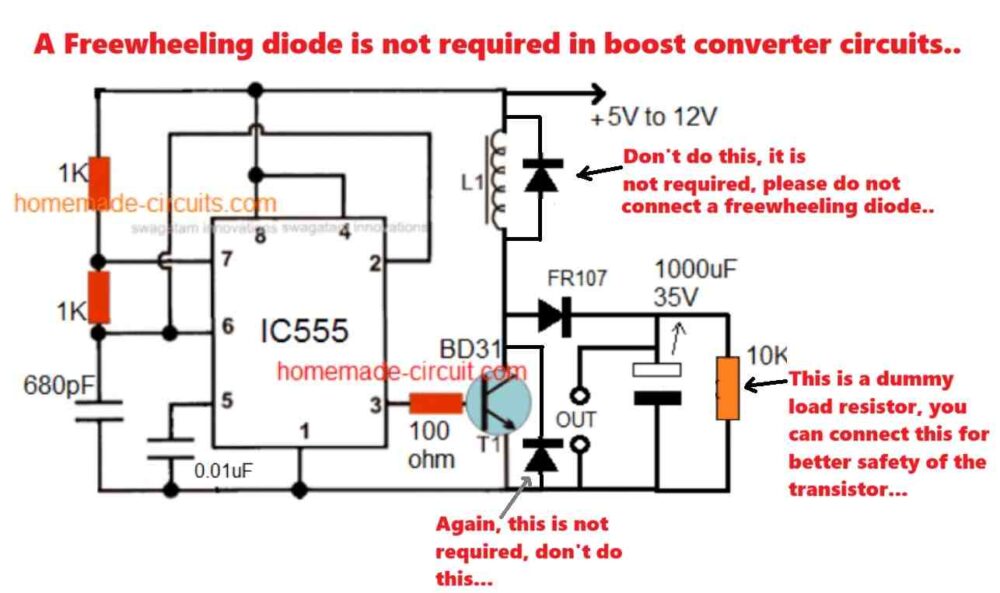
Now suppose we add one freewheeling diode across the inductor directly. That means the diode cathode goes to one side of inductor and anode to other side.

When MOSFET turns OFF then this diode will try to conduct and give inductor an alternate path. So now instead of pushing current to output, the inductor will dump energy back to itself via this diode loop, and whole boost effect is gone. So output never gets boosted.

That diode becomes a short cut path and kills the boost action.

What About No Load Condition?

Now some may ask what happens if there is no load at output? Like when nobody is drawing current. Will inductor flyback cause damage to the transistor?

Answer is no, because the inductor already has a proper flyback path through the output diode and capacitor. Even if load is zero, energy still goes to output capacitor.

Voltage might increase slightly if output cap is small but no harm to components. If you are too worried then just add some dummy load like a resistor at output to soak some charge.

No Load Can Still Be Risky in Some Cases

So when we say "risky without load," it does not mean the boost converter will immediately blow up. What we mean is — under no-load condition if the output capacitor is too small or the feedback loop is not smart then yes, voltage can keep rising and rising with each switching cycle because nobody is there to consume that extra energy. This can push the output voltage above safe limits.

But… that does not mean you need to put a freewheeling diode across the inductor. That would totally ruin the boost process like we discussed. The solution is not diode, but to:

Make sure you have a decently rated output capacitor (big enough to absorb temporary excess energy).

Use a minimum dummy load resistor if your circuit allows, just to drain some charge if nothing else is consuming.

Most importantly, have a proper feedback system (PWM control) that senses output voltage and stops boosting once target is reached.

So yeah — it is not dangerous because of inductor not having flyback path (that is already handled by output diode), it is dangerous if you have bad control or no feedback in no-load cases.

Conclusion

So in short, never put any freewheeling diode directly across the inductor in a boost converter. It will kill the boost process. That diode is not needed. Instead, always make sure output diode and capacitor are there and properly connected, along with a small dummy load. That is all we need for safe operation.

You'll also like:

  • Explained: Snubber Circuit for MOSFET H-Bridge
  • pwmPWM Controlled Voltage Stabilizer Circuit
  • LM324 Operational Amplifier5 KVA to 10 KVA Automatic Voltage Stabilizer – 220 Volts, 120 Volts
  • voltage to current and current to voltage conversionSimple Voltage-to-Current and Current-to-Voltage Techniques – By James H. Reinholm

Filed Under: Voltage Control and Protection Tagged With: Boost, Diode, Freewheeling, Inductor, Need

About Swagatam

I am an electronics engineer and doing practical hands-on work from more than 15 years now. Building real circuits, testing them and also making PCB layouts by myself. I really love doing all these things like inventing something new, designing electronics and also helping other people like hobby guys who want to make their own cool circuits at home.

And that is the main reason why I started this website homemade-circuits.com, to share different types of circuit ideas..

If you are having any kind of doubt or question related to circuits then just write down your question in the comment box below, I am like always checking, so I guarantee I will reply you for sure!

Previous Post: « How Load Conducts in Half-Bridge Driver Circuits like IR2184 or IR2110
Next Post: Real MPPT Solar Charger Circuit Using Arduino, LCD, and Manual/Auto Switch »

Reader Interactions

Need Help? Please Leave a Comment! We value your input—Kindly keep it relevant to the above topic! Cancel reply

Your email address will not be published. Required fields are marked *

Primary Sidebar

circuit simulator image


Subscribe to get New Circuits in your Email


Categories

  • Arduino Projects (93)
  • Audio and Amplifier Projects (133)
  • Automation Projects (17)
  • Automobile Electronics (101)
  • Battery Charger Circuits (85)
  • Datasheets and Components (109)
  • Electronics Theory (149)
  • Energy from Magnets (27)
  • Games and Sports Projects (11)
  • Grid and 3-Phase (20)
  • Health related Projects (27)
  • Home Electrical Circuits (13)
  • Indicator Circuits (16)
  • Inverter Circuits (95)
  • Lamps and Lights (159)
  • Meters and Testers (71)
  • Mini Projects (28)
  • Motor Controller (68)
  • Oscillator Circuits (28)
  • Pets and Pests (15)
  • Power Supply Circuits (91)
  • Remote Control Circuits (50)
  • Renewable Energy (12)
  • Security and Alarm (64)
  • Sensors and Detectors (106)
  • SMPS and Converters (34)
  • Solar Controller Circuits (60)
  • Temperature Controllers (43)
  • Timer and Delay Relay (49)
  • Voltage Control and Protection (42)
  • Water Controller (36)
  • Wireless Circuits (30)


Other Links

  • Privacy Policy
  • Cookie Policy
  • Disclaimer
  • Copyright
  • Videos
  • Sitemap


People also Search

555 Circuits | 741 Circuits | LM324 Circuits | LM338 Circuits | 4017 Circuits | Ultrasonic Projects | SMPS Projects | Christmas Projects | MOSFETs | Radio Circuits | Laser Circuits | PIR Projects |

Social Profiles

  • Twitter
  • YouTube
  • Instagram
  • Pinterest
  • My Facebook-Page
  • Stack Exchange
  • Linkedin


Recent Comments

  • Swagatam on Arduino 2-Step Programmable Timer Circuit
  • Swagatam on Simple Buck-Boost Converter Circuits Explained
  • Swagatam on IC IR2111 H-Bridge MOSFET, IGBT Driver IC: Full Datasheet, Circuit Diagram
  • Swagatam on Electronic Circuit Projects, Tutorials, and Practical Engineering Solutions
  • Kadir on Simple 3 Phase Inverter Circuit

© 2026 · Swagatam Innovations