The post presents a simple cellphone triggered remote control circuit that can be applied as a cellphone operated remote car starter. The unit would cost less than $20 to build.
I have already covered quite a few interesting cellphone remote control circuits in this blog, all of which can be implemented to control or toggle some electrical equipment remotely using ones own cell phone, exclusively.
How it Works
The basic cellphone controlled relay circuit stage involved in all the previous circuits can be also effectively utilized for starting the ignition system of a vehicle, through the owners cell phone. The schematic for the same may be witnessed below and may understood with the following explanation:
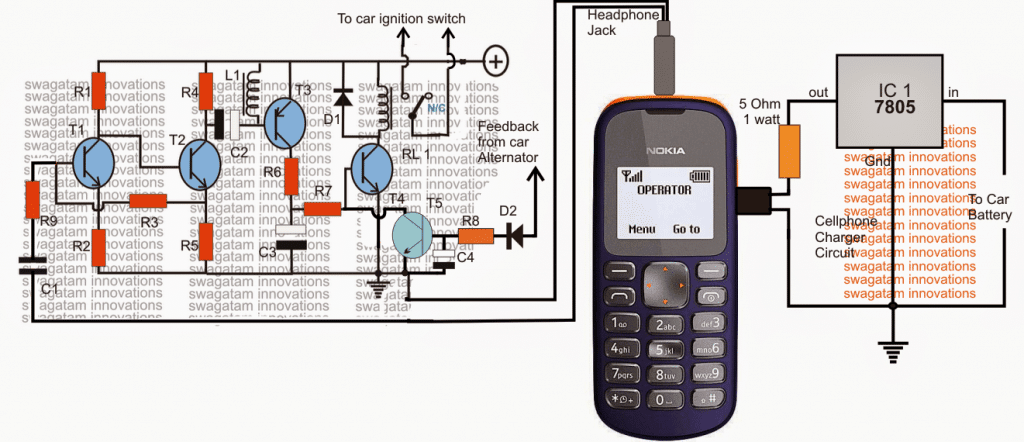
The design is basically a transistorized audio amplifier circuit, which is positioned for amplifying the assigned ringtone from the adjoining cell phone modem. The cellphone shown with the circuit stays permanently attached with the circuit and forms the integral part of the whole system.
The diagram shows a NOKIA 1280 cellphone as the modem, however any cheap cellphone may be employed for the purpose provided the cellphone includes the "assign tone" feature discretely for the particular selected numbers.
The number of the owner or the user is first stored and assigned with a suitable ringtone available within the cellphone modem so that the modem responds only to the owners phone and not to any other irrelevant numbers. The default ringtone of the modem is set to "empty" in order to mute all other unwanted calls.
When the owner calls the modem cellphone, the ringtone is detected by the circuit and amplified to a level sufficient for the relay to get energized. The relay stays energized for so long as the call remains connected.
Configuring the Relay Contacts
Since the relay contacts are configured or integrated with the ignition switch of the car, immediately triggers the ignition system of the vehicle starting the engine and the whole system.
A feed back from the activated alternator makes sure that the relay is instantly shut off irrespective of the call duration from the owner's cellphone.
The car ignition thus is able to start without the owner or the driver having to get inside the car and go through the manual operations. The car starts remotely through the owner's cell phone, a fail proof and a foolproof procedure yet as cheap as anybody can think of.
Parts List
- R1 = 22k
- R2 = 220 Ohms,
- R3 = 100K,
- R4,R6,R7 = 4K7
- R5 = 1K
- R8 = 33K
- R13 = 100 ohms,
- T1, T2, T4, T5 = BC547
- T3 = BC557,
- C1 = 0.22uF
- C2,C3, C4 = 100uF/25v
- D1, D2 = 1N4007
- L1 = 40 mH coil, example: a piezo buzzer coil will do.
- diode = 1N4007
- Relay = 12V/SPDT
- Modem = NOKIA 1280
The charger section is shown in the diagram, and needs to remain connected permanently with the attached cellphone modem.


Comments
Helle, is it possible to open an electrique door of garage
Merci
may be possible if you build it correctly.
Good Morning!
just came across this article while doing research for a remote car start for cold mornings.
interesting circuit, but what type of car/vehicle are you starting here.
My vehicles would require a relay to energize the starter, and a relay to energize the ignition system.
Once the vehicle has started the starter would disengage (as in your circuit) but the ignition would need to stay energized to keep the engine running.(which is not indicated by your circuit).
I am assuming you are starting a older diesel type engine with this, and not a more modern gasoline engine that my be ECM controlled.
Thanks for the articles.
Louis
Hi, the circuit can be used in the modern cars also since the working principle is standard. The relay contacts shown in the diagram are supposed to be connected parallel to the ignition switch. So basically the indicated relay replaces the ignition switch. When the cellphone is called, it turns on the relay which initiates the ignition. Once the ignition is initiated the alternator motor actuates, and a sample voltage from the alternator is fed back to the circuit for deactivating the relay.
… there are two functions of the ignition switch.
1) to activate the starter motor to turn the engine. This is a momentary function that is released once the engine starts.
2) the actual ignition which activated the spark device (for simple terms) and accesory power.
… this circuit only shows one side of the equation. Once the engine starts and the alternator feedback deactivates the relay, all power is removed from the ignition circuit.
Will study this more, but I do not see the second supply relay that stays energized to keep the engine running. The alternator does not supply power to the vehicles ignition, in my case #1 the distributor.
Thank You for your reply, will continue to research.
Louis
Thanks for your feedback….The relay here only replicates the manual ignition key switch ON function. Thus, as soon as the relay switches ON, the ignition initiates which starts the vehicle combustion, and the alternator. The alternator voltage now takes over the complete ignition control, and also simultaneously switches off the relay. This is my opinion about the ignition system, although I am not sure if it’s correct.
Noted: pls correct if if I am wrong the ignition switch is has 3 position. Accessories, ignition ready start. Can we built a two channel remote start so on standby the ignition will not be on only when we are ready to start.
you are correct, but I am not sure about the wiring details of a two channel remote with the ignition internal contacts
Hi Swagatam. Why not make the circuit as a tone detector that can understand or discriminate between tones so that it can be used as a multipurpose ie, on or off just using one phone and one circuit. It’ll be nice to have that circuit.
Hi Kassim, most phones already have the facility of assigning unique tone to a unique number, so tone detection may not be essential. Still for other applications not involving phone the tone detection can be achieved using IC LM567
If called and the car has started example of cars like harrier ipsum etc. Then if I want to switch it off ,how do I go about it my master SWAGATAM, can making a second call switch it off with the above circuit.thanks
Hi Davis, This circuit is only for starting a car. Switching OFf can be simply done through the ignition switch.
Just make another circuit like this one for starting with a second phone and make and use a bistable multivibrator for switching off.
hi mr swagatam, pls i need a reference on cellphone controlled car starter!
Sorry, i did not understand what you mean!
thank sir Mrs swag regard your’s
pls Mrs swag how do I summarised the cellphone controlled car starter circuit diagrammatically in block
there’s one pre-amplifier stage at the input using T1/T2, T3 is the amplifier stage, T4 is relay driver stage and T5 is the feedback stage
OK thank u sire Mrs swag. i will keep it up any information or modifications I will let u know.
hi Mrs swagatam am yet doing my project in my diploma in electrical engineering , and I chose one of your do to make it on my own but something is missing to me. what all I need is the write up of the “cellphone controlled car starter” I need your help.
Hi Zubairu, the circuit is elaborately explained in the above article, you can read it and create your own write up from the given details.
OK thank sire Mrs swag. I will do that, but one more question when the circuit is built, and in terms of operations if I operate the car that is when d car is started, what next will be the second, to off the car ?
it will trigger the ignition system for a second or two, and this needs to be a momentary action, once the engine is started the relay no longer needs to remain ON. The car can be stopped as it is done normally by turning off the gas to the engine….you can consult an automobile mechanic to learn the details and let me know if you need any modifications in the circuit
Foes this circuit only works with nokia phones or?? Because I.used Samsung phone and it didnt work. The first relay goes on clicking. And the second relay only works when the audio jack is touched. please explaim
sir can u make the same circuit to controll(on ,off) a.c appliances
arun, you can use this circuit
https://www.homemade-circuits.com/2012/01/how-to-build-gsm-based-cell-phone.html
Sir, my only problem is when I switched on the voltage supply for circuit, it automatically starts the system and relay works without me calling the phone,, I'm using Nokia 1280.. Pls advice me sir,, as I need to finish this project in 5 more days Sir…Tq Sir..
Rinosh, the relay will operate only if T4 conducts, and T4 will conduct only if T3 conducts, but T3 will never conduct without a music trigger input.
so check why and how these transistors in your case?
T3 might conduct without music input if C2 is faulty or it is connected wrongly
Sir, last question, headphone jack has 3 wires, are the 2 headphone wires in your design the 2 positives or is it one negative and one positive???
connect the ground wire of the circuit with the largest terminal of the pin
One wire will join with the largest terminal, other wire can be connected to any one of the smaller terminals of the pin
Sir, I have also given a 6V supply for circuit as I'm using a 5V relay,,,I can detect a voltage of 4.5V at the T4, but it doesnt seem to reach the diode or the relay..Pls advise me ..
12V supply is recommended, through a 7812 regulator…use 12V relay for a 12V supply
Thank u sir,,one more thing,, the plus sign in your circuit stands for how many volts Sir?? And should I use a 12V relay or 5V relay is good enough??
test by connecting an LED across the relay coil
Sir,I have connected everything accordingly, im also using nokia 1280 as the modem, before i call to the phone, it already has a voltage of 2.5V at the headphone jack…the problem i have is when i call to the phone, I can hear the ringing tone thru the piezo buzzer at L1, but my relay doesn't get energized…secondly, I have connected my relay to a DC 12V (8 pcs of 1.5V batteries) supply and used a 12V DC motor to replace my car engine…Is that ok????
RaJ, use a 12V 1 amp power supply for testing the circuit instead of battery, do not use any load with the relay initially until the relay operation is confirmed.
connect a LED with 1 K resistor parallel to the relay to confirm the operation, this will verify whether the relay transistor is conducting or not…
How can Uadd a flip flop relay stage
it's shown here:
https://www.homemade-circuits.com/2012/01/how-to-build-gsm-based-cell-phone.html
But according to the diagram, the relay is supposed to only start the engine & to stop any engine there must be a connection between the ignition system & the vehicle's ground so am very confused about how it can stop in the above diagram, thanks.
kakooza connect the indicated relay wires parallel with the car ignition key switch terminals…make sure to take the help of a qualified auto technician for the installation…
the above circuit will not stop the car, as you rightly said it will only start the car….you will have to include a flip flop relay stage additionally which can be wired in series with the spark wire….this relay can be toggled for stopping the car.
How can the car be stopped wiz the phone call?
by calling the modem from the assigned user's cellphone.
Can I use 'Inductor Choke Coil' in place of L1?
If yes then what value?
any coil around 40mH will do, or do you have a small spare relay, you can use its coil also for L1
What can I use for L1? Pls help
Where can I get Buzzer coil?
L1 can be a standard "buzzer coil", the one which are used for driving piezo electric transducers, or you can make it yourself by winding about 1000 turns of 32SWG wire over any ferrite material.
it'll prevent the circuit from false activations due to cell phone's internal RF disturbances.