Here we are talking about one circuit which many people know by the name Blood Electrification Unit, and this circuit became known because of Bob Beck many years back in the 1990s time, so now people also call it Beck Blood Electrifier.
This unit is nothing complicated looking but the idea sounds heavy because it uses a very low frequency and very low current electrical signal, and this signal is applied from outside the body using electrodes, so it does not go inside directly.
Usually these electrodes are placed on the wrist area, above the big blood vessels, so that the signal can pass through the blood area easily.
Bob Beck already said clearly that this device is not a medical treatment device and it is not medicine, but it is only an experimental bio electrical signal generator which came from some early laboratory thinking.
The circuit diagram shown here is a full working version of this idea and it is built using simple analog parts, mainly the LM358 operational amplifier so now even normal electronics learners can understand it.
General Concept Of Blood Electrification
The main idea of blood electrification is actually very simple but people feel confused when they hear the name first time.
A very low frequency square wave signal is passed through the body using electrodes but the current is kept very very small, usually in microamp level, so that it does not hurt or shock.
Bob Beck said that the frequency should be around 4 Hz and this value comes because it is half of the Earth Schumann resonance frequency which is around 7.83 Hz, so now that relation is used.
According to Bob Beck, the goal was not to stimulate tissue or give shock but only to put a gentle changing electrical field into the blood stream.
The circuit diagram attached is made exactly for this reason so it creates a low frequency bi phasic square wave output, nothing much aggressive.
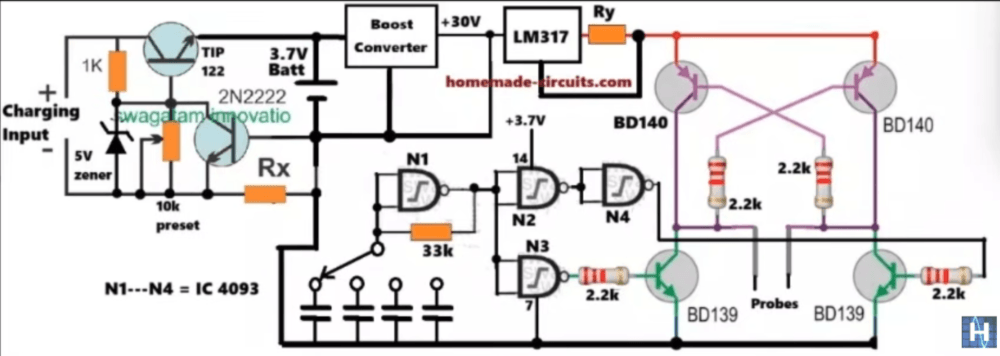
Audio/Video Representation
Another Design using Opamps
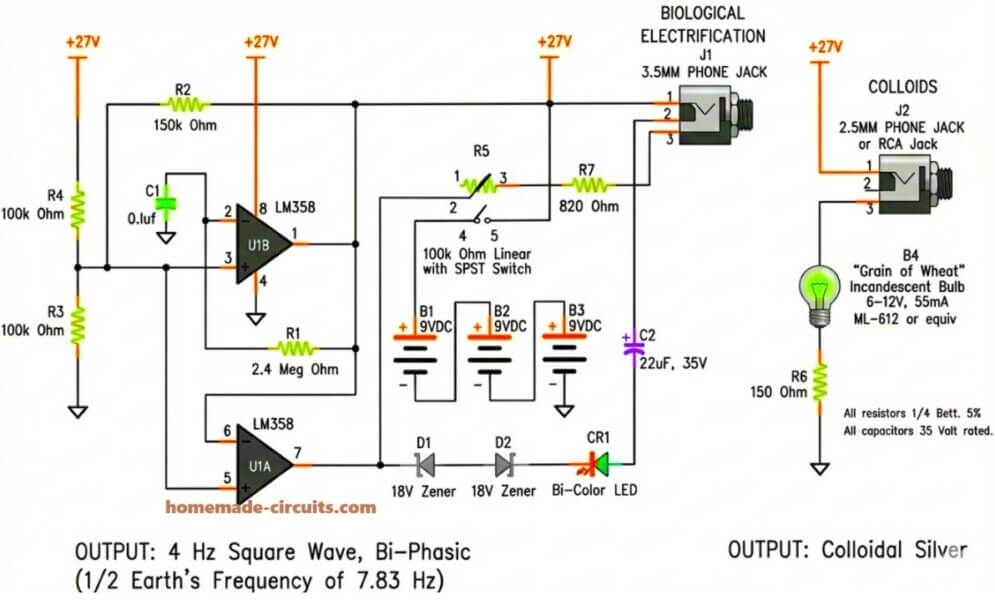
When we look at the circuit diagram slowly then we can see that it is divided into different sections, so now understanding becomes easier.
- One part is power supply section.
- One part is oscillator and waveform making section.
- One part is output current limiting and protection section.
- One part is electrode output connection section.
All these sections work together and since they are connected properly, so now the signal stays low frequency, stable, current limited and also safe from dangerous electrical levels.
Power Supply Arrangement
This circuit uses three 9 V batteries, marked as B1, B2, and B3. These batteries are connected in series, so the voltage becomes higher, but still the system runs only on batteries.
This point is very important because Bob Beck clearly said that battery power must be used, since if mains power is used then there is danger.
The batteries give around 27 V DC and this voltage is used to run the LM358 op amps and the output part.
Even though the voltage looks big, the current is strongly limited so now the user never feels strong current.
Oscillator And Square Wave Generator
The main working part of the circuit is made using two sections of the LM358 dual operational amplifier, named U1A and U1B. These two op amps are set as a low frequency oscillator.
Resistors R1, R2, R3, and R4, along with capacitor C1, decide how fast the signal changes.
The values are chosen so that the frequency comes near 4 Hz which means the signal changes polarity four times in one second, so now a bi phasic square wave is produced.
The waveform here is square wave and not sine wave. Bob Beck wanted square wave because it has fast rising and falling edges, and according to him this was important.
The output of U1A and U1B goes positive and negative again and again, with respect to ground.
Frequency Adjustment And Control
In the diagram, resistor R5 is shown as a 100 k Ohm potentiometer and it also has an SPST switch. This allows small adjustment of frequency around 4 Hz, so now tuning becomes possible.
This adjustment is needed because real components never have exact values and since tolerance exists, so frequency can move a little. This potentiometer helps bring it back.
The switch on R5 allows the user to turn the output on or off, without removing battery power.
Bi Phasic Output And Signal Conditioning
After the square wave is created, then signal goes through some extra parts for safety.
Diodes D1 and D2 are 18 V Zener diodes, and they act like limiters. If suppose something goes wrong then these diodes stop the voltage from going too high.
CR1 is a bi color LED and it shows the signal working. When the polarity changes then the LED color also changes, so now the user can see activity.
Capacitor C2 helps to smooth things a little, so sharp spikes do not reach the electrodes.
Current Limiting And Safety
Current limiting is the most important part of this circuit. Resistors like R6 and R7 are put in series with the output so the current always stays very small, in microamp level.
This is important because the human body is sensitive and Bob Beck strongly said that the current must stay far below any dangerous or noticeable level.
The circuit is designed so that if the electrodes touch each other then the current still does not rise to harmful value, so that safety is always there.
Electrode Output Connections
The output goes to phone jacks marked as J1 and J2. These jacks allow wrist straps or hand electrodes to be connected.
Bob Beck suggested placing electrodes on the wrists, above radial and ulnar arteries so that the electrical field passes through the blood vessels.
The diagram also shows a small bulb marked as B4. This bulb is sometimes used for showing load or for demo, but it is not needed for real operation.
Operating Principle In Simple Words
When the unit is turned on then the oscillator starts making a slow 4 Hz square wave. The signal goes positive and negative again and again.
This signal passes through current limiting and protection parts before reaching electrodes. When electrodes are placed on the body then a very small changing electrical field is formed across tissue and blood vessels.
The current stays very low, and since it uses batteries only, so now it is isolated from mains power.
Important Disclaimer
It must be clearly said that this circuit is shown only for learning and history interest.
Bob Beck said that this is not a medical device and it is not meant to treat, cure, or prevent any disease.
If someone studies or builds this circuit then it should be treated only as an experimental low frequency signal generator and not as medical replacement.
Conclusion
The Blood Electrification Unit by Bob Beck is basically a low frequency bi phasic square wave generator, with strong current limiting and battery isolation. The circuit uses LM358 op amps, Zener diodes, and resistors to keep the output safe and stable.
From electronics side this circuit is interesting because it shows how simple analog parts can make very low frequency signals safely. Whether someone studies it for learning, curiosity, or analog practice, this design still stays as an example of low frequency bio electrical experiment.


Questions & Answers
Do you have gerber files or pcb boads available. I am very able to populate the board and purchase components. I would also be interested in a complete unit. Where would they be available
Sorry, I do not have gerber files for this project. You can get them through a professional PCB manfacturer.
do you have any design files. I would like something that I can send to a pcb manufacturer. may e Gerber files aren’t what I need. or do you have boards for sale.
You can send the schematic diagram to the PCB manufacturer, he will do the rest. I don’t have readymade PCBs.
hi can you please build a few devices and mail it to Canada. affordable price. thanks
Sorry, that may not be possible, due to my busy schedule…
Can you build a Bob Beck zapper with 100% true constant current control? Can you design it to be USB-C rechargeable and able to replace the batteries, like how some vapes are? Can you provide an option to select other frequencies (like 4 hz, 8 hz, 12 hz, 16 hz)? Also, can you make A Frequency Specific Microcurrent (FSM) device with full manual control? I can send you the specs. I have other projects I’m interested in as well. I am not asking for free labor.Trying to find someone who knows what they’re doing. Thank you. Rob
These are the specs the original units had. (See below … section.)
Very important for me is access to manual programming settings (most consumer, patient units come with pre-set protocols which can only be set or changed by the practitioner and require a monthly subscription, activation to use) and ability to charge, recharge by USB-C port with replaceable rechargeable batteries (not a built-in rechargeable battery that can’t be easily replaced). I’m not as concerned about weight. Manual mode is most important but it would be cool to able to program the unit via Bluetooth or wireless app and plug in USB cable to phone or PC to give greater access to different devices, setups. Trying to keep costs minimal. Being able to do programming through a basic phone, tablet, or PC rather than built into the device (such as using a touchscreen) could keep things simple. Just have a display screen that shows the data, settings. Prefer to design the device to be able to be simple and able to be worked on easily, like replacing the battery or the wifi, Bluetooth without a technician. Trying to make it accessible to everyone.
…
Device 1 (original)
The PrecisionCare© has two independent channels that can each be set to a three-digit specific frequency plus one decimal point precision. The current can be set between 10 and 600 microamps and is delivered with a variable slope ramped square wave. The DC current can be used in alternating, positive, or negative mode making it ideal for treating virtually every kind of patient with any condition. The unit comes with four leads, two for each channel, connected through a state of the art DIN plug. Dual tipped probes plug into the DIN plug and can be purchased separately for the practitioner who uses probes as a treatment method.
The frequencies being delivered, the polarity, the time elapsed and remaining, and the current level are all shown on the LED screen. This feature is essential on any unit being used for delivering frequency-specific treatments. In the event of a beneficial effect or any reaction, the practitioner needs to know what frequency was running when that effect occurred.
This device uses 6 D cell batteries. With average daily clinical use the batteries last approximately one to two years. Battery life will vary depending on quality and age of the battery, how they have been stored and how many hours they have been used. Use of rechargeable batteries is not recommended. The unit will notify user when the battery is too low to operate the device.
Device 2
The MEND Professional™ Unit is ideal for the practitioner who needs options. The device has the following features:
2 channel output
Programmable and stores up to 999 protocols
Easily go into Manual and Automated modes
Batch mode function allows you to daisy-chain up to 9 protocols
Quickly and easily access any automated program
Change parameters during run-time including frequency, waveform, intensity, polarity and duration
Backlit display
Keypad to change frequencies on channels
Device Specs
Frequency Range: 0.1 – 999.9 Hz programmable
Wave Form: Square pulses
Duty Cycle: 50%
Current Intensity: 20μA to 400μA
Constant current generator
Output Polarity: Programmable alternating, positive or negative
Output Load Resistance 0 to 100K ohm
Output Channels: Two fully independent channels
Output Connection: 2.35 mm shielded jacks
Programming Port: microUSB Type-B
Memory: Professional-holds up to 999 programmable protocols
Power Supply: (2) AA alkaline batteries
Dimensions: 5.1 x 3.2 x 1.2 inches
Weight: 6.42 oz
Hey Rob, thanks for sharing the details!
Looking at these specs, a device with dual independent channels, 0.1 Hz precision, and digital memory is actually a very advanced piece of engineering. It requires complex programming and special power safety features that go way beyond what I can design and test for this blog right now…so I am really sorry it won’t be feasible for me….it is way too complex.
Okay. Well what about upgrading the Bob Beck Pulser to use just 1 or 2 easily removable 18650 &/or 21700 lithium batteries rechargeable via a USB-C plug-in port, as well as, if possible, automatic constant current built into the circuit, a max current for safety, a display with voltage, current, and remaining battery life (or 2 separate screens)?
Also,
the selection of DC (direct current) output instead in order to have a good treatment method for localized infections (an infection in one part of the body)
Frequency Selector: The output frequency can be set via a switch to the frequencies of 4, 8, or 16 hertz.
Damped Wave Option: It comes with one extra switch that allows you to select the output waveform, either standard square wave or damped wave. By “damped” I mean that the leading “square” edge of each polarity reversal is rounded off. This prevents the intitial spike of electric current that true square wave outputs cause. The spike makes the output more deadly to microbes but is also potentially harmful to blood cells if usage extends more than the standard two months. The spike is also what damages skin.
OK, here’s the full schematic of the upgraded bob beck pulser. For dampening the pulses, just add a 1uF/50V capacitor across the probe terminals:
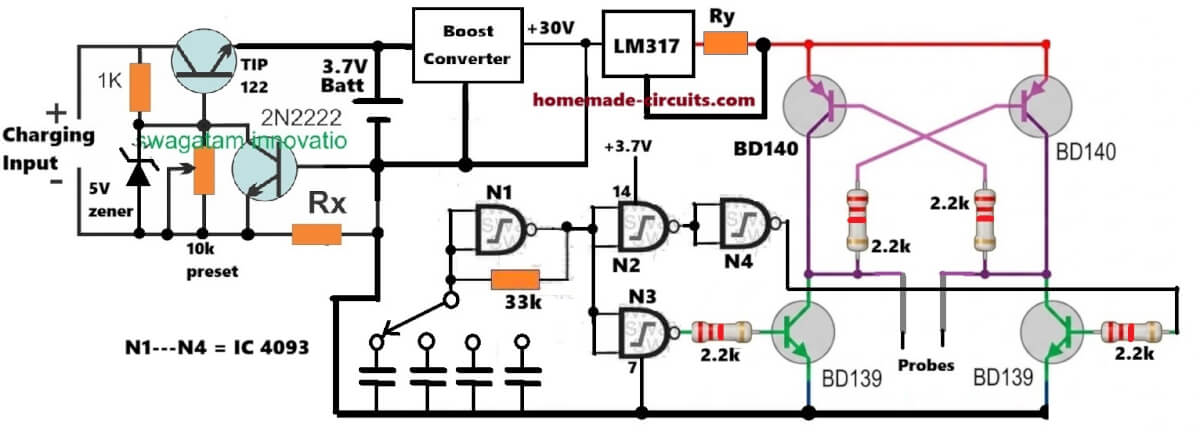
Yes we can definitely do this. This version uses simple analog parts instead of complex programming.
We can use a rechargeable 18650 battery, a toggle switch for the 4, 8, and 16 Hz speeds, and inexpensive mini-screens to show the power levels. Adding a switch to round off the sharp wave edges is also very easy using basic components.
I will design it, and let you soon!
Hello, Thanks for reaching out. Yes absolutely. Every feature you listed is completely possible using modern electronics. for the dual-channel, manual-control FSM device, that looks like an exciting project. Drop the specs over, and I will try to figure out the design…