In this post I have explained a simple yet very useful 0 to 50V dual power supply circuit which will enable a full 0 to maximum dual voltage +/- control of the input power supply DC. It also includes a wide range current control feature right from 0 to 10 amps. The idea was requested by Mr. Tamam.
Technical Specifications
It was my long term dream to build a 2 channel power supply for personal use, I have seen a lot of circuits, but those does not fit my criteria.
However, please take a look at the following requirements and let me know if its possible or not, if possible I will be the happiest person in the world.
1. Output voltage range: -50V to 0V to +50V ( must be adjustable by individual channel )
2. Output Current range: 0A to 10A ( must be adjustable by individual channel )
3. Output would be Duel channel, means total 6 outputs,
Channel 1 (Positive, GND, Negative) Channel 2 (Positive, GND, Negative)
4. Power Supply Unit should contains 2 Voltmeters and 2 Ammeters (Analogue) for 2 individual channel.
5. Power Supply Unit must have short circuit protection and cooling fan featured and extreme heat protection.
6. I don't want to use any PIC or AVR, so please avoid those.
Money is not a matter here, I will spend continuously until above requirement meets.
Even If I need any custom transformer I will order and make it from our local area.
I have seen many ready made power supply in market but I want to make it by own hand. You just show me the way... please bro, I will be pleased to you for lifetime.
Thank you very much !!
Best Regards,
Tamam
For calculating the part values accurately, you can refer to this bench power supply article
Circuit Diagram
The Design
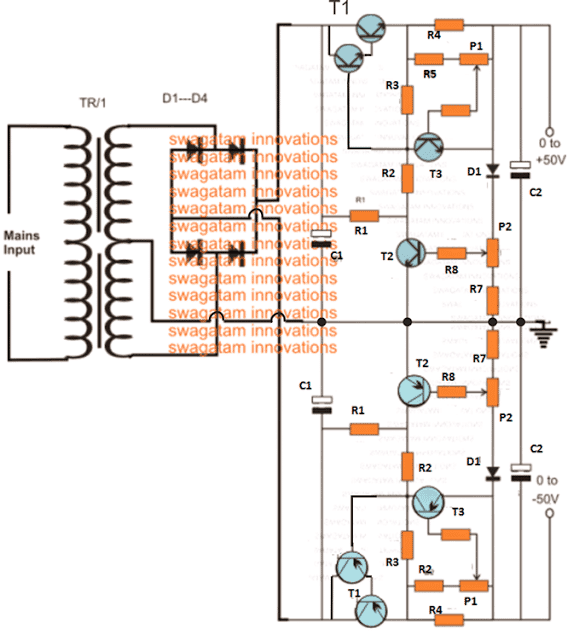
The basic design of the proposed 0 to 50V variable dual power supply circuit with 0 to 10 amp variable current facility is shown in the above figure.
The entire design is transistor (BJT) based and is virtually indestructible. Moreover it's equipped with an over load and over current protection features.
The two section included in the design are exactly similar with their configurations, the only difference being the use of PNP devices in the lower configuration while NPN in the upper configuration.
The upper NPN design is configured to produce a variable response right from 0.6V to 50V positive while the lower PNP section becomes responsible of producing an oppositely identical response from -0.6V to -50V output.
The Transformer Specs
The maximum limit could be suitably changed simply by changing the voltage rating of the transformer. However for higher voltages you may have to appropriately upgrade the BJT voltage ratings accordingly.
In both the designs, P2 executes the function of varying the voltage levels as desired by the user, while P1 functions as the current regulator and is used for adjusting or setting the output anywhere from 0 to 10 amp current. Here too the maximum rating depends on the selection of the transformer amp rating and may be changed as per individual preferences.
T1s in the both the sections become the fundamental part or the heart of the entire voltage control functioning in the circuit, which becomes possible due to the popular common collector configuration of the devices.
The other two active BJTs only help to implement the same just by controlling the base power of the T1s thus making it possible to adjust the thresholds to any desired user defined voltage and current levels, as per the ratings of the transformer or the input supply.
You may also like this LM317 based Dual Power Supply Circuit
Parts list
- R1 = 1K, 5 watt wire wound
- R2 = 120 Ohms,
- R3 = 330 Ohms,
- R4 = to be calculated using Ohms law, R = 0.6/Maximum Current Limit, Wattage = 0.6 x Maximum Current Limit
- R5 = 1K5,
- R6 = 5K6,
- R7 = 56 Ohms,
- R8 = 2K2,
- P1,P2 = 2k5 presets
- T1 = 2N6284 + BD139(NPN), 2N6286 + BD140(PNP)
- T2, T3 = BC546 (NPN) BC556B (PNP)
- D1, D2, D3, D4 = 6A4,
- D5 = 1N4007,C1, C2 = 10000uF/100V,
- Tr1 = 0 – 40 Volts, 10 Amp
Using Op Amps and TIP35
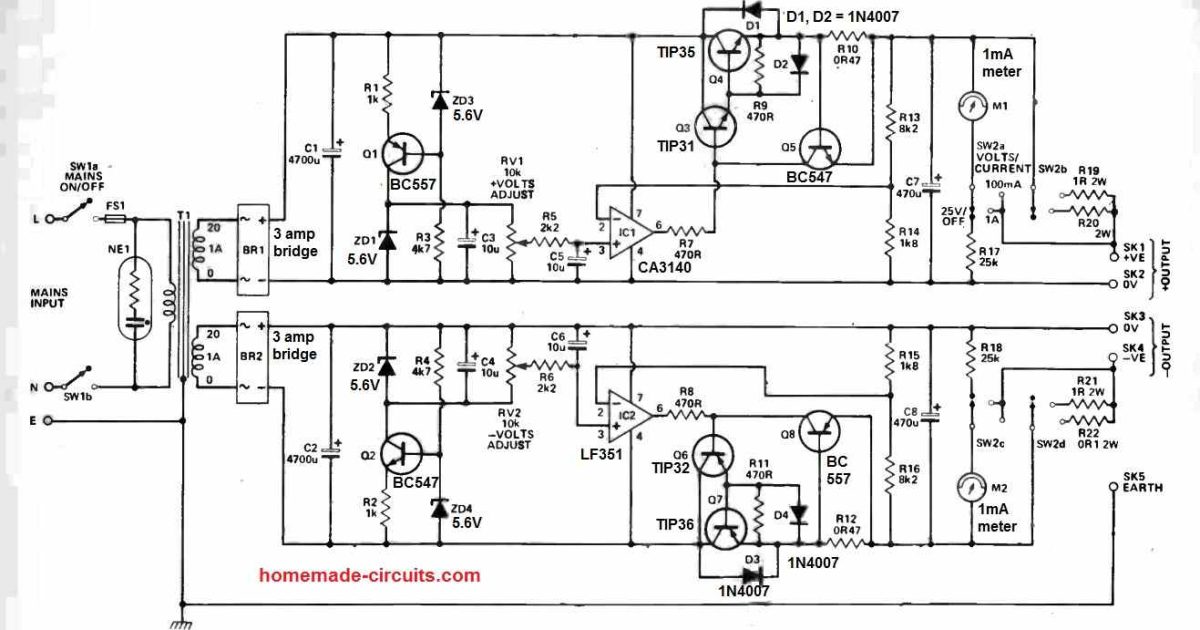
Here's another accurate adjustable dual power supply circuit, for your reference:
Using MJ2501 and MJ3001
The versatile dual power circuit featured here can supply a maximum of 50 volts across its two output rails, capable of handling currents of up to 3 amperes.
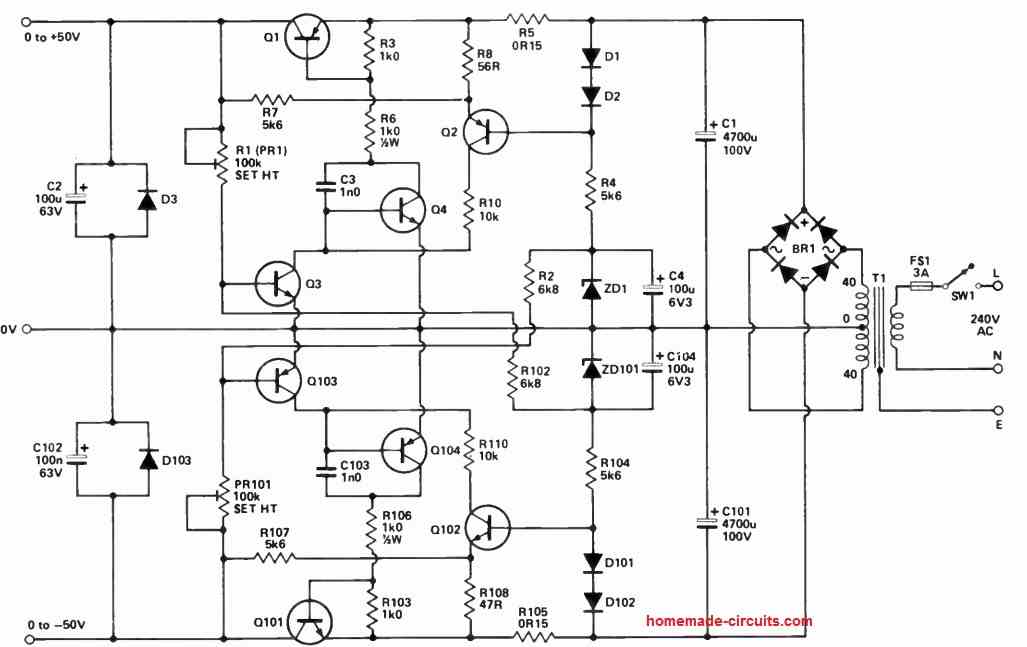
To support these output levels, the secondary of T1 should have a rating between 4.5 and 5 amperes. Furthermore, it includes comprehensive current limiting protection.
This circuit is well-suited for applications involving audio power amplifier modules that demand supply rails of up to 50 volts. Please take note that R8 should be set at 47 ohms.
NOTE:
Q1 IS MJ2501
Q2, Q104 ARE BC448
Q3 IS BC182
Q4, Q102 ARE BC447
Q101 IS MJ3001
Q103 IS BC212
D1, D2, D101, D102 ARE ANY GENERAL PURPOSE SILICON DIODES
D3, D103 ARE 1N4002
ZD1, ZD101 ARE 5V6 400rnW ZENERS
BR1 IS 600V 10A BRIDGE RECTIFIER



Comments
pls can you help with a dual variable power supply circuit that I can use a chopper transformer since I has a 19 volt chopper transformer
can I use chopper transformer without rewinding as fresh
Here’s a chopper transformer circuit with dual DC output:
https://www.homemade-circuits.com/smps-2-x-50v-350w-circuit-for-audio/
How do you eliminate the .6V minimum. I need a true 0 to 30 Volts?
Hey there Ned Sheats! It’s me, Seth, from the Face Book forum! I just needed a 0 to -50 or maybe 0 to -75 VDC supply for a grid bias supply for a vacuum tube tester that I am building. I also need to put a 1KHz to 5KHz AC signal onto the grids. The 5KHz volt meter will set me back some but… If you need it, and I do. Cheers, mi amigo! Good luck. P.S. I do have some wonderful old regulated tube PSUs that have 0 to -150 VDC bias outputs. Some of them have very little current available.
In the first diagram, please replace the D1 and R7 with short circuit.
Hi mr. Swagatam.
I have a problem with making an overload / short circuit protection for a dc-dc buck converter output.
I want to make a bench power supply but this buck converter with lm25116 control ic, it dose not turn off the output in short circuit or overload conditions and this causes a damage to the output mosfets.
The input voltage is 26v.
Te output voltage is 1v to 25v and the current is 0.1A to 15A.
The dc-dc buck converter is 300w 20A.
Help me with a proper overload / short circuit protection circuit.
Hi Talal,
The LM25116 IC has all the voltage and current control features available in the IC.
You have to configure a current sensing resistor in series with the source pin of the low-side MOSFET, and then connect the junction to the CSG pinout of the IC.
Full information can be obtained from the following pdf:
https://www.ti.com/lit/ds/symlink/lm25116.pdf?ts=1722424800958&ref_url=https%253A%252F%252Fwww.google.com%252F
Hi swagatam What you thinking for output 20 amper give circut design also ıts give adjustable voltage.
Hi Enes, 20 amp is too high and is not recommended for this type of circuits due to high heat dissipation.
Hello Swagatam . I want to make a 0-60V 20A regulated power supply, can I provide this in the circuit you have given?
Hello Inesta, as we all know the biggest drawback of all linear regulator power supplies using transistors as explained above is high power dissipation, which is proportional to the difference between the input and the output voltage levels.
So at 20 ampere the heat generated on the transistors will be immensely high at low output voltage settings, therefore I cannot recommend you the above design.
Swagatam If you want to lower the power dissipation then use transformer wingdings to lower voltage according to your required Voltages………….
Thanks Zia, that’s right, we can use tapped transformer secondary winding and select it according to the output requirements, to keep the dissipation on the BJTs low.
Hi.. swagatam
I will like to build this power supply +-50v 0-10amps
* Can I Change the variable resistors value to a common value like 5k or 10k ? Will they be any effect when done?
* How can MOSFET be used in this circuit how do I use it?
* will they be any effect?
Hi Davis,
The variable resistors can be replaced with fixed resistors after calculating their values appropriately.
You can replace T1 with MOSFETs, however if a MOSFET the minimum output will not be lower than 8V. Make sure to put a 12V zener diode across gate and source of the MOSFETs.
MOSFET will allow higher current output compared to BJTs.
Ok, I mean can I use a 5k or 10k variable resistors for both P1 and P2 instead will they be any effect on the voltage or current? Because it will difficult to get 2k5 variable resistors here in my electronic store.
Using MOSFET could have been better but since you said it minimum output voltage can’t be less than 8v then I think I will just go for the BJTs
But can’t it be 4v minimum because of it gate voltage? What if I use 6v or 4v zener diode?
Yes, you can use 5k potentiometer in place of the 2.5k, although the adjustment range might not be from start to end of the rotational dial rather might end somewhere in the middle of the travel.
Sorry, it is actually the maximum voltage that might be 6V lower than the maximum input supply voltage, meaning if the maximum supply is 50V, then the maximum output that can be achieved using a MOSFET will be around 50 – 6 = 44V
Ok,that makes sense now using FET, but will the voltage be 0v when voltage knob is turn down to 0 ?
If I will be using FET in place of BJT how will it be connected ? and what resistor value should be at the gate and gate to source
How do I connect FET?
Yes, almost 0V should be achievable.
I think you can modify the second diagram as explained in the following article:
https://www.homemade-circuits.com/0-300v-variable-voltage-current/
Okay…
If I will be using FET in place of BJT how will it be connected ? and what resistor value should be at the gate and gate to source
How do I connect FET?
Please see the second circuit as given in the previous link. You can build the same design for fulfilling your requirements.
Dear Sir, In the 0-50V dual PS, where do I take connection for the Digital volt(100v) and amp(0-10A) meter? size:48x29x21mm
Hi Parthasarathy,
you can connect the voltmeters parallel with C2 capacitors.
You can connect the ammeters, one in series with the + output and the other in series with the – output of the power supply.
Very kind of you.
Mr Swagatham,thank you for the post.I have assembled the circuit on a breadboard and was able to regulate volatge as well as current.However,not able to reduce the volatge to zero and current also to zero.Lowest voltage achieved is 1.4volts and lowest current possible is 80 ma.by tinkering the values of R5,R7,R8 some reduction is possible but not down to zero..By also removing the diode D1 and shorting T3 emiiter with P2,the lowest voltage can be reduced to 0.7 volts.Why do you need diode D
Thank You Vedamurthy, Glad you could make the circuit successfully.
D1 is positioned to ensure a minimum output voltage of 1.5V, which is in most cases quite low.
However, if you want it to be 0V, you can replace D1 and R7 with direct wire jumpers.
Current will depend on R4, so you can increase this R4 value to a level which causes the output to shut-down even at currents as low as 1 mA
Please let me know if you have any further questions.
Thanks for the reply.The lowest current of 80 mA was achieved for a R4 value of 39ohm(5W).However as the value of R4 is increased,the lowest current range can be lowered but it also reduces the maximun current range.At lower values of R4(less than 1 ohm),current control is somewhat impossible.Even after replacing D1 and R7 with jumper wires lowest voltage obtained is 0.9 volts.Also at a minimim voltage setting of 3 volts,the circuit draws a quiescent current of 20 mA which is otherwise zero above 3 volts..all these observations are pertaining to the circuit assembled on a breadboard.Hope i will get better precise reading for a soldered circuit .
Actually R7 is not relevant to the 0V output, only D1 is relevant.
The problem is that, even if D1 is shorted, T2 would still require around 0.7V to conduct, therefore the output has to reach 0.7V or slightly higher in order to enable T2 conduction and the control, so perfect 0V may not be feasible.
For the current variations you can perhaps try using selector switch for selecting the desired maximum or minimum output current limit range. Yes, being a high current linear regulator the quiescent current intake will be on the higher side.
Thank you for the reply.Appreciate you time and effort.
You are welcome…
Hello,
I got 50V / 800W toroidal transformer, interested in building adjustable linear power supply ( is it possible 0-50V / 16A ?)
Regards
Hi, Yes it is possible, however at 16 amps the power devices can dissipate a lot of heat.
Hello jonney I have a 28v± power supply .I want to reduce it to 18v± supply .can I use this circuit .if isnt what are the variations of this circuit .thank you very much .
You can do it using the above the circuit. No changes would be required.
Hi, Swagatam. I Want to know the value of the base resistor at T3 since i cannot see it. Thanks.
Hello Johnny, it can be a 1K 1/4 watt resistor. R5 can be eliminated, it is not necessary.
Thankyou so much, my man !!! You truly are one in a million. Now i can proceed with this project. God bless.
You are most welcome Johnny!
Consulta, si cruzo las puntas, la fuente sigue inyectando corriente?
If you short circuit the output, the output will continue to supply current as determined by R4.
No problem Jaival,
You can definitely try those options and see which one is more feasible to you.
Yes, you are right, if you use the half winding for the two boards, then the input current will be divided by half.
Thanks Swagatam for the idea.
First one if able to break the center tap wire of the transformer (Need to check its feasibility) then be able to create a full capacity of Power supply each one 0-30/3A capacity.
And the second one is easy but its current capacity is half of the first one. (Am i correct??)
Thanks again for the same, will check feasibility and go ahead.
Thank you Jaival,
I think what you are saying may be correct but simulating the situation in mind is slightly confusing, but it is better to avoid using a common center tap for the two boards.
The only two ways I can find is, one by breaking the center tap wire into two, so that the two 24V winding are fully separated, or use a single 24V winding for both the boards.
Thnks a lot Swagatam for quick & prompt reply. some more clarification if that is fine for you.
I have two old pcb boards of 0-30v/3A and 24-0-24 centre tapped transformers. and both has bridged rectifier so I believe it is not possible to connect 24-0 winding of transformer to one board & 0-24 other winding to another board. As seems 2 bridge rectifier with centre tapped transformer create short in one of sine wave cycle (And also seen that in all above dual PS design used single bridge). Please correct me If this is wrong. And also please suggest if you have any idea to overcome this limitation.
Yes, you can connect the the two 0V lines to create a common 0V supply line.
You can also use a center tapped transformer and configure a common ground line, exactly as shown in the first diagram, using transistors.
Q1 :
In above Using Op Amps and TIP35 circuit tbere are 2 output pair first named as +output (+ & 0) and second named as (0 & -) . can we connect 0 of +output & 0 of
-output to create + , 0, – supply.
==============
Q2:
In above Using Op Amps and TIP35 circuit, transformer has 2 separate winding but can i use centre tapped transformer ?
or can we create opAmp based variable Dual
bench power supply s above using centre tapped transformer ?
Thank you Poloko, Glad you found the post useful.
Yes 10 of those transistors can work, however since the specified transistors are not Darlington pairs, their response might not be as good as TIP142.
Perfectly explained thanks a lot MR Swagatam, i used to read the comments first before asking a question, and of course i got it “To get 25 amps, you may have to replace the T1 with at least 5nos of TIP142 transistors in parallel and mounted over a common single heatsink.” Except how about using c5200 and a1943 instead of tip142 they are readily available in my country.
I know you’re always an answer to my technical problems.
On behalf of the electronic hobbyist
May God bless you
Best regards
Poloko
You are welcome!
Thank you very much sir