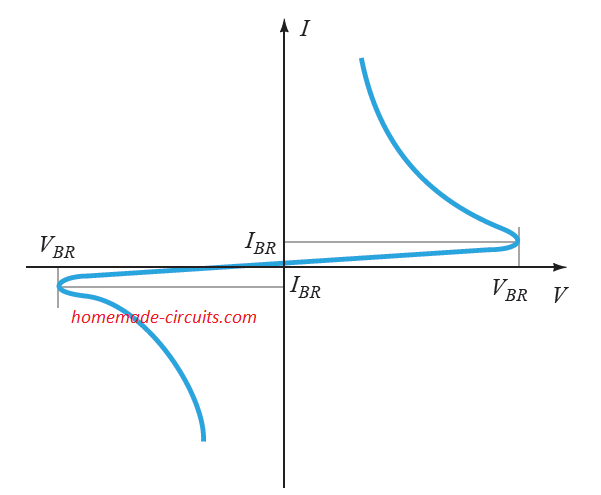
The diac is a two-terminal device having a combination of parallel-inverse semiconductor layers, which allows the device to be triggered through both directions regardless of the supply polarity. Diac Characteristics The characteristics of a typical diac can be seen in the following Figure, which distinctly reveals the presence of a breakover voltage in across both […]
Newly Updated Circuit Projects:
12 Basic Digital Logic Circuits Explored
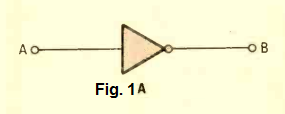
In the following paragraphs I will try to explain the most basic foundations of digital electronic circuits: namely logic gates and logic flip-flops. Whether it is a complex and larger digital circuits, or as simple as a BCD counter, for example the 7490, or a large-scale integration (LSI) microprocessor chip, eventually all of these comprise […]
How RC Circuits Work
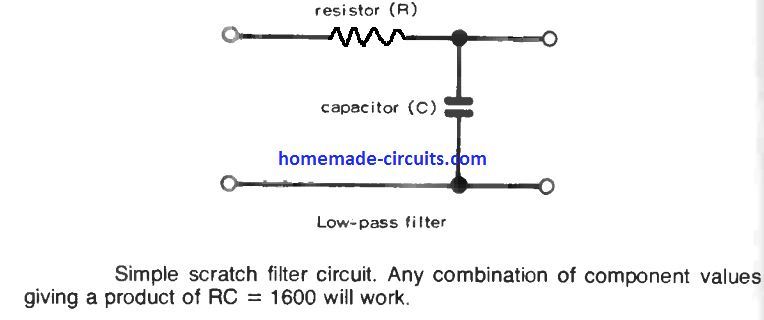
In an RC circuit, a combination or R (resistor) and C (capacitor) is used in specific configurations in order to regulate the flow of current, for implementing a desired condition. One of the main uses of a capacitor is in the form of a coupling unit which allows AC to pass but blocks DC. In […]
Simple Triac Phase Control Circuits Explored
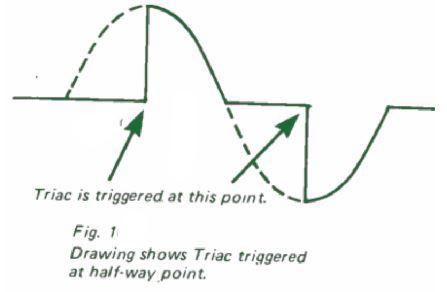
In a triac phase control circuit, the triac is triggered ON only for specific portions of the AC half cycles, causing the load to operate only for that period of the AC waveform. This results in a controlled supply of power to the load. Triacs are popularly used as a solid-state replacement of relay for […]
What is IGBT: Working, Switching Characteristics, SOA, Gate Resistor, Formulas

IGBT stands for Insulated-gate-Bipolar-Transistor, a power semiconductor which includes the features of a MOSFET’s high speed, voltage dependent gate switching, and the minimal ON resistance (low saturation voltage) properties of a BJT. Figure 1 exhibits IGBT equivalent circuit, where a bipolar transistor works with a MOS gate architect, while the similar IGBT circuit is actually […]
Simple Triac Triggering Circuits Explained
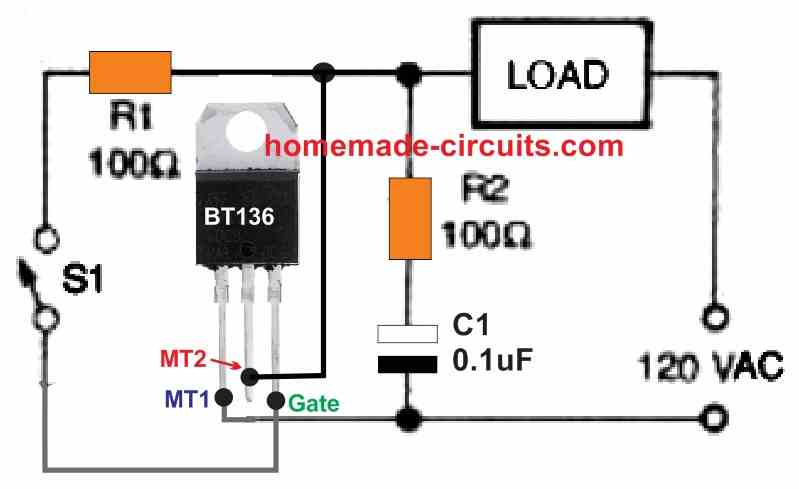
In this post I have explained the fundamental methods of triggering a triac, and also discuss the right way to connect the terminals of a triac. Triacs are solid-state bidirectional thyristors that can switch across both the AC half cycles on a 120-volt or 240-volt Ac power system. A triac could be activated (switched on and […]