If you feel strobe lights very interesting but are disappointed by the fact that these wonderful light effects can be produced only through complex xenon tube then probably you are quite mistaken.
It is very much possible to make any light a strobe light if you are equipped with a proper driving circuit capable of handling different lighting devices to generate the desired strobe light effect.
The present article shows how a circuit as basic as a multivibrator may be modified in different ways and made compatible with ordinary bulbs, lasers, LEDs to produce spectacular light pulses.
A strobe light may be used for warning, scientific analysis or as an entertainment device, whatever may be the application the effects are simply dazzling. In fact it is possible to make any light a strobe light through a proper driving circuit. Explained with Circuit Diagrams.
Difference Between Flashing and Strobing
A light when made to blink or flash indeed looks pretty eye-catching and that’s the reason why they are used in number of places as a warning device or for decorations.
However a strobe light in particular may also be considered a flashing light yet is uniquely different from ordinary light flashers. Unlike them in a strobe light the ON/OFF pattern is so optimized that it produces sharp dazzling pulsed flashes of light.
There’s no doubt why they are mostly used in conjunction with fast music to enhance a party mood.
Nowadays green lasers are being popularly used as a strobing device in party halls and gatherings and have become hot favorite among the new generation.
Whether it’s LEDs, lasers or an ordinary filament bulb, all can be made to flash or rather strobe using an electronic circuit capable of producing the required pulsed switching in the connected lighting element.
Here we will see how we can make any light a strobe light using a simple electronic circuit.
The following section will acquaint you with the circuit details. Let’s go through it.
Pulsating any Light to Produce Strobing Effect
Through one of my previous articles we came across a nice little circuit able to produce interesting strobe effects over a few of the connected LEDs.
But this circuit is only suitable for driving low power LEDs and thus cannot be applied to illuminate big areas and premises.
The proposed circuit allows you to drive not only LEDs but also powerful lighting agents like incandescent bulbs, lasers, CFLs etc.
The first diagram shows the most basic form of a multivibrator circuit using transistors as the main active components. The connected LEDs can be made to strobe by suitably adjusting the two potentiometers VR1 and VR2.
UPDATE:
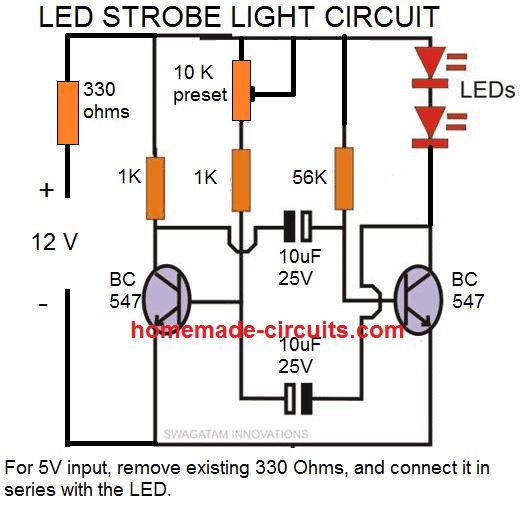
I have explained a few transistorized strobe light circuits in this article, however the below shown design is the easiest one and is tested by me. So you can begin with this design, and customize it as per your own preference and liking.
Video Illustration
The above discussed simple design can be further modified as I have explained below for greater control and refined outputs.
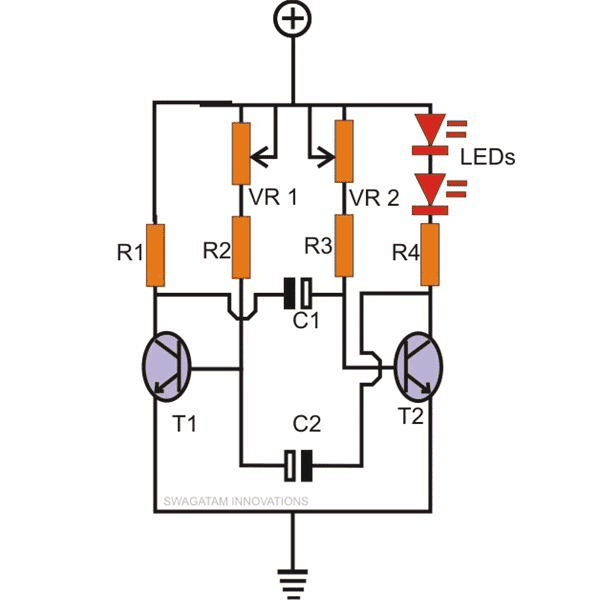
The above circuit forms the base for all the following circuits through some suitable modifications and additions.
Using a Flashlight Lamp as Strobe Light
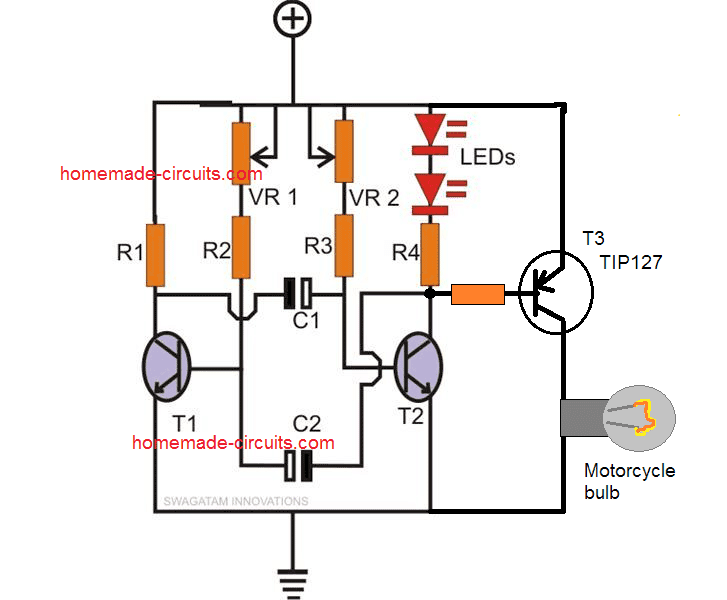
For example if you want to illuminate and pulsate a small torch bulb using it, you would just need to do the simple modifications as shown in the second diagram.
Here by adding a PNP power transistor and triggering it through the collector of T2, a torch bulb is easily made to strobe. Off course, optimum effect is achieved only through proper adjustment of the two Pots.
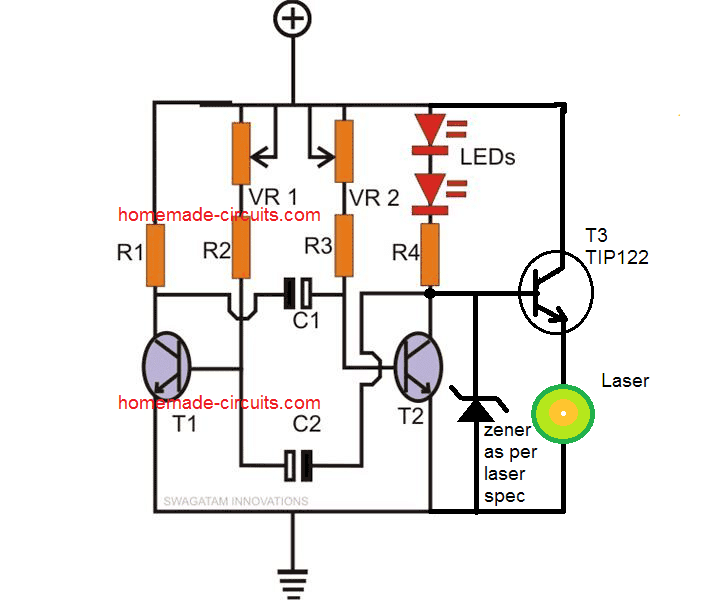
As already discussed already in the previous section, green laser pointers are pretty popular nowadays; the diagram illustrated shows a simple method of converting the above circuit into a pulsating green laser pointer strobe light.
Here the zener diode along with the transistor works like a constant voltage circuit ensuring that the laser pointer is never supplied with a voltage higher than its maximum rating.
This also ensures that the current to the laser can also never exceed the rated value.
This the zener and the transistor functions like a constant voltage and also an indirect constant current driver for the laser.
Using AC 220V or 120V Lamp as Strobe Light
The next diagram shows how an AC mains lamp may be used as a strobing light source using the above circuit. Here a triac forms the main switching component receiving the required gate pulses from T2’s collector.
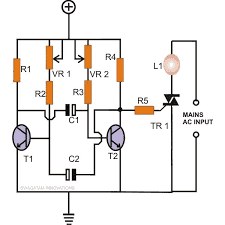
Thus we see that through the above circuit designs it becomes very easy to make any light a strobe light simply by doing the relevant modifications within a simple transistor based circuit as exlained in the above examples.
Parts List
- R1, R4, R5 = 680 Ohms,
- R2, R3 = 10K
- VR1, VR2 = 100K pot
- T1, T2 = BC547,
- T3, T4 = BC557
- C1, C2 = 10uF/25V
- Triac = BT136
- LEDs = as per choice
Police Strobe Light Circuit
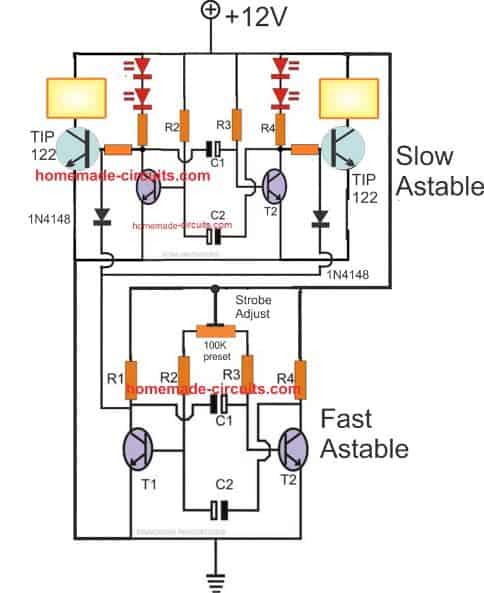
For the slow astable use the following parts:
- R1, R4 = 680 Ω
- R2, R3 = 18K
- C1 = 100 μF
- C2 = 100 μF
- T1, T2 = BC547
For the Fast astable use the following parts
- R1, R4 = 680 Ω
- R2, R3 = 10K
- preset = 100K
- C1 = 47 μF
- C2 = 47 μF
- T1, T2 = BC547
36 Watt Current Controlled Strobe LED Light
This 36 watt LED strobe light circuit with current control feature was requested by one of the dedicated readers of the website, Mr. Rohit.
The design idea can be learned from the following explnation:
I am trying to make a fast flash LED strobe light like the ones used by cameramen for photography. I have seen some circuits on your website regarding LEDs like constant current driver, powering high wattage LED lights, LED strobe light. However, I think my application is a combination of these projects.
So what I want to do is power 18W or 36W LEDs for 1 microsecond flash and need a constant current driver so that every flash has the same intensity.
I hope to hear from you soon. Feel free to contact me if you have any questions by email or call me to discuss further
The complete circuit diagram for the 36 watt high power LED strobe light with current control feature can be witnessed in the following image:
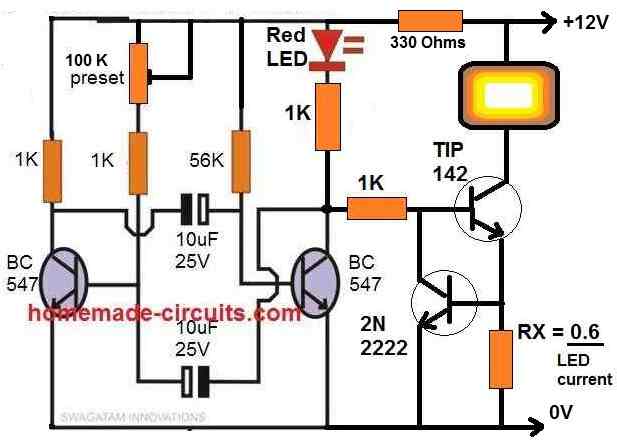
Parts list
- All resistors are 1/4 watt 5% unless specified
- 1K = 4nos
- 330 ohms = 1no
- 56K = 1no
- 100k preset = 1no
- RX = as given in the diagram
- Capacitors
- 10uF/25V Electrolytic = 2nos
- Transistors
- BC547 = 2nos
- TIP142 = 1no
- 2N2222 = 1no
- RED LED = 5mm 20mA type
- PowerLED = 12V, below 5 amps.



Comments
Hy Swagatam
For a zeotrope project with an arduino Uno, I want to make a strobe with power LEDs. I need to simultaneously flash 5 LED matrices of 50 watts of 1.5A each operating at 36 volts. In total it will be 250 watts. I will use a 36V DC 4A power supply. This power supply is not a constant current LED driver. My LEDs must flash at a frequency of 10 to 30 times per second and the adjustable pulse duration will be from 1ms to 10ms. I am thinking of a circuit that will charge power capacitors and discharge into the LEDs. The LED matrices will be in parallel, driven by one or more mofsets. I am an electronics amateur, I do not have the knowledge to create an electronic circuit and find the right value of the components. Can you help me produce a clear electrical diagram as well as the value of the components?
I realize this is a lot of work. Thanks for pointing me in the right direction.
The following points should be considered:
1. Limit the peak current to avoid damaging the LEDs. The duration of the light pulse will also be determined by the capacitor discharge rate and the resistance in the circuit. Perhaps add limiting resistors in series with each group of LEDs and use inductors to limit the current rate of change (dI/dt)?
2. Discharge voltage: The voltage across the capacitors will decrease during discharge. Ensure that the voltage remains within the LED operating range (30 to 38V) for the duration of the pulse for optimal illumination.
3. Capacitor charging time: To achieve the desired flash rates (10 to 30 Hz), the capacitors must recharge sufficiently quickly between each discharge.
4. Flash capacitors: One or more high-capacitance capacitors (the exact value will depend on the desired pulse duration and the required current). The capacitors’ nominal voltage will also need to be considered.
Also, add smaller decoupling capacitors for fast transitions.
5. Power transistors to switch the capacitor discharge across each LED array. These will be controlled by the Arduino. Perhaps one or more IRLZ44Ns.
6. Flyback diodes: Diodes placed in reverse parallel with the LED arrays to protect the transistors from overvoltage when the power is turned off.
7. Safety discharge resistors for the capacitors when the system shuts down.
Hello Fabrice, Can you please tell me which capacitor are you referring to that needs to be charged and discharged, and what is the purpose of these capacitors? Capacitors are normally used in oscillator circuits for enabling the switching frequency at their outputs, or for causing delay in the ON/OFF periods of the load. However if an Arduino is used then these capacitors may not be required, according to me. Limiting the current to the LEDs is not a problem…
Swagatam,
Thanks for the quick response!
I want to use the principle of a photographer’s electronic flash.
I don’t know if I’m wrong, but the idea of using power capacitors is to allow me to use a smaller power supply. My five 50W LED arrays would require a 10A constant current power supply at 36V. These power supplies are rare, big and expensive! If my circuit is well optimized, a 36V power supply at 3A should allow four power capacitors to be charged during the period when the LEDs are off.
Four power capacitors in parallel would each have a value of about 1200uF/60V for a total of 4600uF. I don’t know if it would work. I haven’t tested it on the breadboard yet, as I don’t have the right components on hand.
Also, my electronics skills are very limited.
What do you think of my approach?
Thank you Fabrice, Now I have understood the application fully, and it can be designed using both an Arduino, or without an Arduino, through discrete components… please let me know which method do you prefer?
Great! I can’t wait to see what it would look like with an Arduino. Thanks for your time!
Sure!! here’s the code and the diagram:
https://www.homemade-circuits.com/wp-content/uploads/2025/05/Arduino-code.txt
https://www.homemade-circuits.com/wp-content/uploads/2025/05/Arduino-alternate-dump-capacitor-switching-circuit.jpg
Thanks, Swagatam, I like your suggestion. It doesn’t use MOSFETs. It’s very informative. I’ll test it on a breadboard as soon as I have all the components. The MJ11033 power transistor is expensive. It’s a 50A, 120V Darlington. Can I replace it with another one, and what is the acceptable value range? I have other questions:
1) Can you also give me the values of R5, R6, and R7?
2) What is the role and value of C1? Is it a single capacitor or several power capacitors capable of supplying the necessary power for my five 50W LED arrays?
3) What is the value of D1?
4) Will this setup work with a 36V, 3A power supply?
5) Do my LED arrays need a current-limiting resistor, or does this setup deliver a constant current of 1.5A?
6) Do the LED arrays require a freewheeling diode?
Thank you for your patience and for sharing your knowledge!
No problem Fabrice, hope it works as expected! You can check the response correctly by initially keeping the switching frequency slower, maybe around 2 seconds ON/OFF which will clearly give you an idea how the charging discharging process is happening…
You can also use a MOSFET like IRF9540 in place of T6 for improved conduction. Or you can replace the MJ1033 with a TIP127 and check if it works without heating up or not, or attach a large heatsink to it.
R5 caan be 10k, R6 is 22 ohms, and R7 = 0.6/Max LED Current
C1 is your charge/discharge capacitor, it will depend on your circuit specifications. It should be ideally many capacitors in parallel.
D1 can be a 6A4 diode.
Yes, the output circuit is designed to work with 36V, but make sure to supply a 12V to the Arduino black DC socket.
Since the current is limited by T5, T6, R7, no resistor is required for the LEDs, but for better safety you can put a 2 ohm 2 watt resistor in series with the LEDs.
The pots can be 100k each.
Freewheeling diode is not required because there’s no inductor or capacitor involved across the LED.
Thanks, Swagatam! This is getting very interesting. I can’t wait to try it out.
I understand this setup runs on 36V. I was initially aiming for a 3A power supply. How do I know if that will be enough?
Thanks for your advice. I’ll continue to follow your other projects on your blog.
Thank you Fabrice, you are most welcome!
Swagatam,
I think I expressed myself poorly. In my case, the load will consist of 5 LED arrays in parallel. Each array has a nominal current of 1.5A. The total load will therefore be 7.5A. The goal of this project is to supply 7.5A for a single pulse with a power supply of only 3A. Can the circuit you’re proposing do that? Regarding R7 = 0.6/Max LED Current, is the formula: 0.6 divided by 7.5A (Max LED Current)?
Thank you Fabrice, For 5 LED arrays you may have to use the specified MJ11033 transistor for T6 or a MOSFET.
Unfortunately a 36V 3amp can never be converted to 36V 7.5 amps. I checked your initial comment but could not find this specification in it, otherwise I would have informed you about this before.
Yes, please use 7.5A in the formula, and the wattage of the resistor will be 7.5 * 0.6
For better safety you may have to put series resistor 1 ohm 3 watt with each LED array.
No problem Fabrice, let us know how it goes.
The input current does not matter as long as the load voltage is also rated same as the input supply. However, even if the load voltage spec is lower than the input supply still it won’t matter because we have a current limiter stage at the output. For optimal performance and efficiency, the load voltage should be same as the input supply voltage and current rating lower than the input current rating.
If staring with 12 volt led strove light, how do I modify it to be constantly on ( no strove or flash)?
To make the LEDs ON constantly you can add a switch across the collector/emitter of the transistor which is driving the LEDs. This switch can be used to bypass the transistor switching and allow the LED to light up directly without strobing.
Hi Swagatam
Spoke to you few months ago.
Now I copy a circuit for a strobe LED and works fine with 13.5V except this circuit does NOT work with less voltage, say with 3V or 4V or 5V. It does not work not even with 10V or 11Volts
I use for this 13.5 V circuit a 3.3KΩ resistor, a BC547 transistor, a 150Ω Resistor and two caps. One is 330μF and the second is 100μF on a bread board
What component should I need to remove or replace or add in order this LED to work as strobe like it does now but with 13.5 Volts only
I thank you in advance for your reply
Pat
Thank you pat,
I tried to figure out the values of the parts so that the transistorized astable could be used with a 3V supply.
I used the following calculator to calculate the values:
https://www.homemade-circuits.com/transistor-astable-multivibrator-amv-calculator/
I got the following values:
Collector resistors = 135 Ω
base resistors = 3833 Ω
C1 = 188.2 μF
C2 = 188.2 μF
Use only only one LED with the collectors of the transistors.
Thanks Swagatam,
I should say that the Base (B) of the BC547 transistor is NOT connected anywhere.
Only the Emitter (E) is connected with the 3.3KΩ resistor and the positive side of the 330μF cap and the Collector (C) with the150Ω resistor as well the anode of the LED are connected.
So, is it correct to replace the two resistors with 135Ω and 3833Ω and the two caps with 188.2μF each?
Here a schematic of the circuit I am talking about.
Voltage is 13,3
……3.3KΩ…………………….
+ | |
| | E
330 μF B _ _/ BC547
| .100μf \ C
| | | |
………………..|.|.led.|150Ω.|
_
Regards
Pat
Thank you Pat, However, I am finding it difficult to understand the schematic.
I was actually referring to the following concept:
https://www.homemade-circuits.com/wp-content/uploads/2019/08/strobe.jpg
Sorry Swagatam,
I did draw a little schematic with dots, straight lines, etc. and locate components and values on it just to get an idea but once I send my comment the schematic became a straight line so you cannot read it.
Any how I like this circuit because the strobe is strong as well the timing of the flashes and it does have just 6 components (tiny circuit) that can fit in a locomotive cell but I wish to make it operate with a voltage range from 3V to 17V
If I change the resistors and capacitors with those values you suggested a little earlier you think this circuit will work at 3V?
Thanks
Pat
No problem Pat,
You can try the circuit which is suggested in my previous comment, it should work at 3V also.
However if you want to use with varying voltages from 3 to 17V then that might not work, because varying the voltage will change strobing nature of the circuit also.
I that case I would recommend using a 3.3 V voltage regulator with the circuit, and then it will be possible to use any voltage between 3 and 17V, but again at 17V the 3.3 V regulator can get immensely hot.
The component which I suggested earlier should work with a 3V supply for this circuit (the first circuit from top)….make sure to remove the 330 ohm resistor which is connected in series with the positive supply
OK thanks Swagatam,
I ll try to built this circuit you suggest and see what happens.
Now I remember purchased some time ago from a hobby shop a little electronic circuit with some additional electronic components connected to it, made strictly to be installed on HO scale locomotive engines, and the strobe effect was very nice.
This entire thing include a tiny volts reducer pcb, inlet was 17V or less, with outlet to 5V (this pcb was D-SUN Y4183, size of a stamp) plus whoever build it had installed a resistor on the anode power supply wire to LED plus an eight pin piece, look like timer IC555 but was not an IC555.
I know this, because I try to copy and built several pieces like this, (had purchased a few D-SUN PCB pieces from e-bay) but the IC555 I connect was smoked and burned with 5-6Volts of power to it.
So I do not know what was the IC piece on there, because there were no any letters or numbers to read but it had a very nice strobe LED.
Still works in one of my locomotives
Anyway as I said I will try to build the circuit you suggested
Regards
Pat
Thank you for updating the information Pat, I appreciate it.
Sure, you can try it and let me know how it goes.
As I said Swagatam I ll try to built the circuit you suggested.
You may e-mail me if you come with an idea using less components to built a strobe LED circuit
NOW, I have heard lots of stories about electronic components come from China that are NOT good,although look brand new.
Is any way to test with an Ωmeter the pins of an IC555 timer to see if is good or not?
Thanks
Pat
Thank you Pat,
Yes, there can be parts which are not original, however, unfortunately there’s no way you can test a 555 IC with a multimeter.
OK Thanks
I appreciate your suggestions, however to position all this on a 20x30mm board seems not possible, and with battery i need to be under 9 gm.
Could it be that large capacators, pots, and transistors were the way to go 30 years ago, but perhaps now circuit board technology has changed and everything is miniaturized?
Thanks Ernie
The 555 circuit which I suggested does not have any large parts or capacitors, except the pot. All these parts can be obtained as SMD parts, except the pot.
Yes, the SMD parts are the miniaturized version which can be accommodated in extremely compact or miniature PCBs.
Hi
I understand that you think we might work through my requests by positng here and that’s kind of you, but my experience as an old fellow age 72, is it may be too hard, so might you be willing to help for pay to cover a Gerber, Bom, and programs for an ic?
On programing, i wonder if you or someone you know is capable of programming an ic with instructions for strobe operation with 3 colors and 2 types of flashing., plus a battery charging circuit, if needed?
This may or may not work with your 36w circuit, because our board can be no larger than 20x30mm. I assume that means we have no room for the usual large capacitors or pots etc on that small board.
Because of the unusual small size, I think we’ll have trouble unless you can see a pic. I have a high res that I can send, but temporarily you can get an idea by viewing it at https://www.getfpv.com/vifly-strobe-anti-collision-drone-led-light.html?gclid=Cj0KCQjwnbmaBhD-ARIsAGTPcfU-650VozYoNNBPXE9SHQEwH57M37fhCd7MzjNmI6JQZs5HJuHpnJMaArFmEALw_wcB
The only thing on the back is the battery.
As before, I plan to use 6) white 5w Cree brand “epe” as the white strobe. I may or may not go forward with the red and green shown in the pic.
Pretty sure now the battery will be 250mah lipo, and now 3.7v, so any usb cell charger should work. Would like a red light to show charging.
I know you mentioned a 555 to control the strobe. I’d prefer ic control if possible and there we can control the flash duration and frequency. I’m guessing we may want 1 ms for duration to try first and go from there. In your experience how does that sound? We’ll try 1 or 1.5 sec for frequency.
So it’s a lot of detail for 20x30mm! Our object is to have 90 min+ battery life with white strobes and the brightest mini strobe in the world at 1200 lumens, but not sure if we have a way to measure it.
I look forward to hearing your thoughts.
Thanks Ernie
Hi,
Thanks for the detailed explanation, however, I am sorry, it might not be possible for me to help you with the Gerber files or programming of an IC. I can only help you with a transistorized strobe light circuit or an IC 555 based strobe light circuit. Both these circuits can be accommodated within the specified area if SMD parts are used.
By the way if you don’t use a potentiometer then how would you control the flashing rate of the LEDs? If you intend to have a fixed flashing rate without the adjustable facility then the potentiometer could be replaced with fixed resistors.
For a 555 based circuit you can try the following design:
https://www.homemade-circuits.com/wp-content/uploads/2022/05/DC-lamp-dimmer.jpg
The brightness control pot is actually the PWM control pot which translates into brightness control. The flashing frequency can be altered by changing the C3 capacitor value.
The IRF540 mosfet can be replaced with a TIP122 transistor.
D1 and C1 can be simply eliminated, since they do not have a crucial function.
The R3 can be reduced to 100 ohms for a 5V supply.
For charging your 3.7V cell you can use the following voltage regulator circuit:
https://www.homemade-circuits.com/wp-content/uploads/2022/07/simple-voltage-regulator-circuit.jpg
You will have to adjust the zener value with some experimentation to make sure that the selected value produces an accurate 4.2V at the output side which can be used to charge your 3.7V cell.
And the transistor must be replaced with a TIP122 transistor.
So that’s it, these are probably the most compact circuit ideas which you can build using SMD parts to fulfill the specified application.
Let me know if you have any further doubts or queries.
Hi
I thank you for your patience in talking with me. Not sure if you noticed that I’ve seen stribes with 6) 5w Cree xpe series leds on one board 1″ x 1.5″ and powered by a 250mha lipo battery. I understand at 5v this is a 6A load which is quite a lot for that battery, yet the one i saw works well and the battery lasts 2 hours. I don’t know the duration of the flash, though I think the interval may be about 1 sec, maybe 1.5 sec.
I can send you a pic if helpful, if you wish to write me at my email of etbrown44@gmail.com
I could be open to engaging you to help me with this design if you are willing. I am not sure how the duration of the flash and frequency can be controlled without an ic, and I need a usb charging circuit for the battery.
Thanks Ernie
Hi, thanks for your explanation.
Pictures may not be required since I have understood your requirement and I will surely try to help you through this platform.
In the last circuit which we are discussing, the flashing frequency can be varied by adjusting the 100K preset which can be actually a 100K potentiometer.
And the frequency range can be further varied by selecting different capacitors for the 10uF/25V capacitors. Higher values would decrease the flashing frequency and vice versa.
If your battery is a 5V battery then it will require around 6V to charge fully, so a USB charging may not be possible since the maximum output from an USB is only 5V.
Hi
Many thanks for yoir kind reply!
The battery really is 250 mah. Im guessing it is 5 or 6v.
Ive seen a strobe like what i have in mind and they are powering 6) 5w cree xpe leds. 1000 lumens! Not sure their flash frequency or duration, but they get 2 hours of battery life.
With those leds, and that battery, can your schematic be revised to work.
Thanks Ernie
OK, no problem, the mAh rating simply indicates how much backup can be acquired from the battery.
You can still use the same circuit for your 5 W LEDs, except the 330 ohm resistor which could be reduced to 100 ohms or simply eliminated.
A 5w LED at 5 V would consume 5/5 = 1 amp current, so 6 LEDs would consume 6 amps which is too high for the 250 mAh battery. However since the LEDs would be flashing and not constantly lit, a 2 hour backup could be perhaps achieved, but I am not confident about it.
Hi
I wonder if your 36w schematic can be altered to be powered by a 250 mah lipo battery. ?? Voltage around 5v. Thinking of using 6) 5w Cree brand xpe series leds, for very bright strobe!
Kindly let me know what you think.
Thanks Ernie
Richmond Va
Hi, I guess your Lipo battery is rated at 2500 mAh, you mistakenly wrote it as 250 mAh. Yes, in that case it can be used. Since the voltage is just 5 V, the 330 ohms resistor could be perhaps reduced to 100 ohms.
Hi Swagatam,
In the 1st circuit, I want to use a 3.7V Li-Ion battery.
What changes do I have to do?
Hi Nelio, to use 3.7V in the first circuit you can remove the 330 ohms and connect the positive directly with the circuit. However, now you can use only one LED, and make sure to use a 100 ohm resistor in series with the LED.
Also, the preset is wrongly shown as 10K preset, it must be a 100K preset instead.
Hi Swagatam,
Ok.
Thank You
Best Regards.
You are welcome Nelio!
Hello, thanks for your circuit, and your explications, I’m planning to use strobe lights in my motorcycle, and I think your circuit will work, but my question is, do I need to use several circuits for each one of the bulbs, or one board can be used for the four bulbs.
Thanks in advance
Hi, glad you liked the circuit. You can use a single circuit to drive all the 4 bulbs, which will then strobe simultaneously.
Hi, I’m planning to build the circuit in the next days, I hope works fine. You’re doing a good job with this webpage. Thanks again.
My pleasure Arnold, all the best to you!
My pleasure Donald.
As always sir, thank you for your advice!
Hi Donald,
5 watts at 12V means the current will be = 5 / 12 = around 400 mA. This current is quite less for the TIP142 since it is rated to handle 10 amp current.
Are you sure the transistors are original and not duplicate.
Anyway you can consider adding a heatsink to the transistor if it is getting hot as the last resort.
Mr. Swagatam,
Thank you for sticking with me as I am working this thru.
Although I have not soldered it all together (I’m still working on that skill) I have purchased much better-quality components and have the strobe light working at 5 watts. (about a third of what it operates at without the circuit).
I have noticed that the TIP142 Transistor is getting hot after a few moments of operation. Do you think that has something to do with it?
Thanks again!
Donald
Hi Donald, is the driver transistor which powers the LED heating up too much? If it is heating up then it might blow off and cause the LED to be dim, if not then there could be a fault in your connections. If everything else is in good order, there can be only 3 reasons for the LED to get dim 1) The LED itself gets damaged due to over heating. 2) Transistor over heats and gets damaged, 3) Power supply fails to provide the required amount of current. It would be better to assemble the circuit by soldering instead of a beadboarding, to ensure 100% good connections.