In this article I will elucidate a simple universal H-bridge module using BJTs and N-channel MOSFETs.
This module can be integrated with any standard oscillator ICs such as IC 4047 or IC SG3525 or even IC 555, to create a highly efficient H-bridge inverter circuits.
Why using 4 N-channel MOSFET H-Bridge is the Most Efficient
Using 4 N--channel MOSFETs in an H-bridge configuration is considered to be the most efficient topology because N-channel MOSFETs have much lower RDSon compared to their P-channel counterparts.
Lower RDSon means lower drain to source resistance, which ensures lower heat dissipation and higher current transfer across the MOSFETs.
The Challenge behind 4 N-Channel MOSFET H-Bridge
However creating a H-bridge using N-channel MOSFETs can be difficult since it involves a relatively complex a bootstrapping network.
The bootstrapping network refers to a small circuit network around the gates of the high-side MOSFETs which enables the high-side MOSFETs to conduct freely by ensuring that its gate voltage is always around 12V higher than its instantaneous source voltage.
Now, let's try to understand how our universal H-bridge circuit module using N-channel MOSFETs works.
How the Circuit Works
If you don't want to read the following description, you can watch this video instead:
Referring to the diagram below, let's assume an instantaneous moment where the left side oscillator input is low, and the right side oscillator input is high.
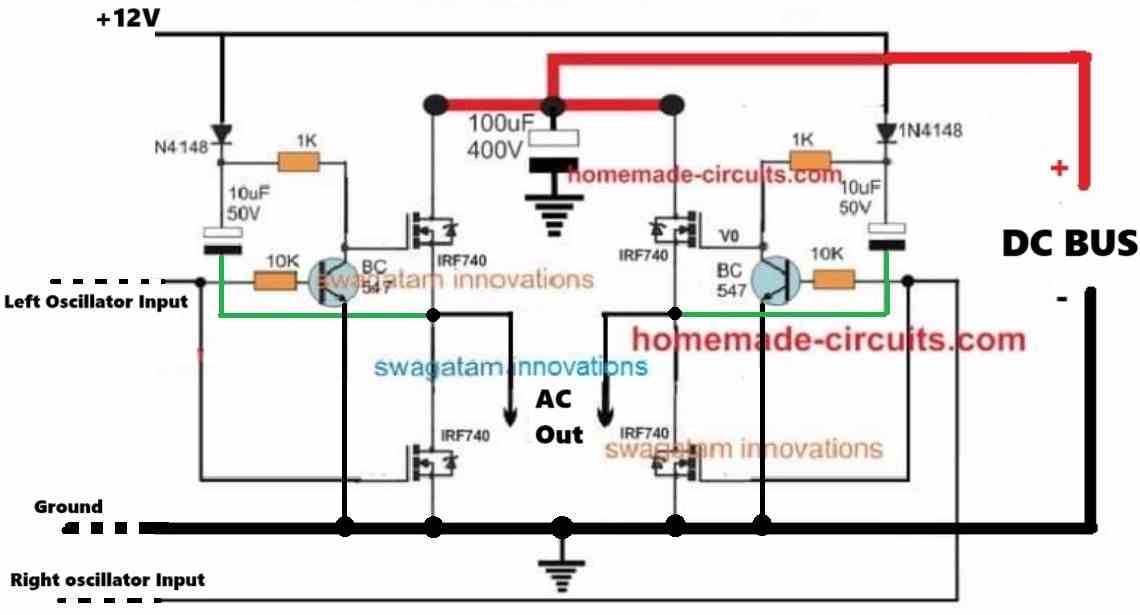
In this situation, the left side BC547 is turned OFF due to the absence of the base switching voltage, and the left side 10uF/50V capacitor is charged up to the battery voltage level through the 1N4148 diode.
Now, the left high-side MOSFET gets its voltage through the 1N4148 diode, and the 1k resistor, and makes an attempt to conduct.
However, as soon as the MOSFET drain voltage reaches its source terminal and exceeds its gate voltage (12V), the conduction stalls, because as we know, ideally, for any MOSFET to conduct, its gate potential must be around 10V higher than its source potential.
This is where our BC547 and 10uF bootstrapping network comes into action.
When the Left high-side MOSFET drain voltage reaches the source terminal, this voltage is forced into the 10uF capacitor through its negative terminal.
This source voltage entering the negative terminal of the 10uF capacitor now comes in series with the existing 12V stored inside the 10uF capacitor.
So, as the source voltage rises it pushes the stored potential inside the 10uF higher so that the total voltage at the gate of the MOSFET is always 12V higher than the source voltage of the MOSFET.
So, when the source voltage is 12V, it adds up with the internal 12V of the 10uF capacitor producing 12 + 12V = 24V at the gate of the high side MOOSFET.
This means the effective gate voltage is now the difference between the total gate voltage and the source voltage, that is 24V minus 12V = 12V, or if suppose the drain supply is 100 volts, then the effective gate voltage will be 100 volts plus 12 volts minus 100 volts = 12 Volts
This ensures that the gate voltage of the high side MOSFET is always held at 12V higher than its source voltage.
This in turn enable the high side N channel MOSFETs to conduct freely and efficiently, regardless of the applied drain voltage level. This may not be possible if P-channel MOSFETs are used, although P-channel MOSFET wouldn't require a bootstrapping.
A High-side P-channel MOSFET might not require a bootstrapping, but the main disadvantage of using P-channel high-side MOSFETs is, its drain voltage cannot exceed the gate voltage, which simply means that if the oscillator IC output is 12V, then the load voltage cannot exceed 12V, which appears to be a big drawback, which is completely eliminated if N-channel MOSFETs are used.
That's it! this concludes our tutorial on a simple H-bridge circuit module using N-channel MOSFETs which can be used to transform any center tapped inverter into an H-bridge inverter.
I hope you liked the tutorial…. for any further doubts or queries, please feel free to comment below for quick replies.
Summary
The H-bridge inverter topology is the most efficient one, since it does not necessitate the use of center tap transformers, and allows the use of transformers with two wires. The results become even better when four N-channel mosfets are involved.
With a two wire transformer connected to an H-bridge means the associated winding is allowed to go through the push pull oscillations in a reverse forward manner. This provides better efficiency as the attainable current gain here becomes higher than the ordinary center tap type topologies.
However better things are never easy to get or implement. When identical type mosfets are involved in an H-bridge network, driving them efficiently becomes a big problem. It is primarily due to the following facts:
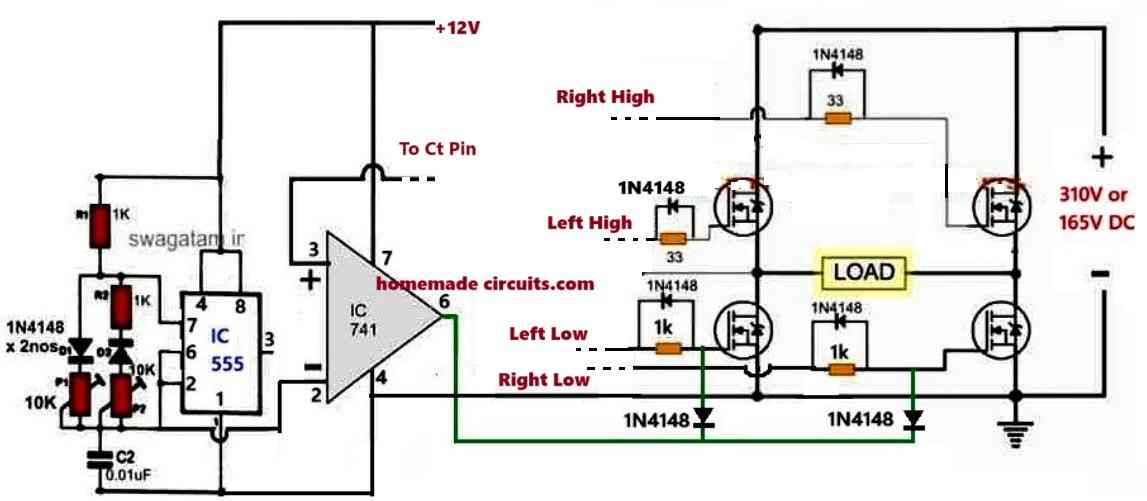
As we know an H-bridge topology incorporates four mosfets for the specified operations. With all four of them being N-channel types, driving the upper mosfets or the high side mosfets becomes an issue.
This is because during conduction the upper mosfets experience almost the same level of potential at their source terminal as the supply voltage, due to the presence of the load resistance at the source terminal.
That means the upper mosfets come across similar voltage levels at their gate and source while operating.
Since as per the specs, the source voltage must be close to the ground potential for efficient conduction, the situation instantly inhibits the particular mosfet from conducting, and the entire circuit stalls.
In order to switch the upper mosfets efficiently they must be applied with a gate voltage at least 6V higher than the available supply voltage.
Meaning if the supply voltage is 12V, we would require at least 18-20V at the gate of the high side mosfets.



Comments
Hello, good afternoon, my name is Carlos from Argentina, I am a faithful follower of the website. I want to build the inverter with lm555 and cd4017 with bridge H and 4 mosfet .. The question is I have a transformer of 12v x 15 amps without central cover how much power I will have output .. Thank you very much.
Atte: Carlos from Argentina
Can u explain me sir nand gate in ic 4049 with their pin number… Means which pin number 1,2,3,4…so on…because i can not find which pin 1 and which pin 10 and so on…
Apurva, I have updated the IC pinouts in the above article. But please note that I have not yet tested this design practically
Can i do this design for practically or not…
If you have understood the concept and confident about it, then you can do it.
And also suggest me that. can i do second cricuit diagram aur not…..i waiting for suggestion sir… If the first project will be not succeed then can i do second one where 2 ic is used 555 and 4017…
Ok sir i will waiting for tomorrow…
I have updated the design under this article:
https://www.homemade-circuits.com/2014/01/simplest-full-bridge-inverter-circuit.html
What Some cricuit miss out from given cricuit diagram..
I’ll update the missing things tomorrow!
Sir.. One more rply sir… Can i increase the transformer wattage if i connected two transformer which are 12v-0-12v… Actually i found this transformer from dvd player… And also share me what is the wattage of these transformer which are generally used dvd player…
Two transformers cannot be used, and it must 0-12V not a center tapped one.
Sir can u give cricuit diagram of ir2103 ic where it is used… I think it is present in my location…
You can try this diagram: https://www.homemade-circuits.com/wp-content/uploads/2018/12/IR2110-3.png
The HIN, LIN inputs can be supplied through an oscillator circuit, I’ll update it after sometime.
U know i am not fully experienced preson but i will do this project because it is my hobby… And one more thing is that is possible with ur support… Sir… I want know that.. Can this diagram is correct or not…i waiting for ur comments sir..
Hi Apurva, I won’t recommend the above idea to a newcomer, because this concept will require some serious understanding and optimizations.
I will again advise to go for an IC based full bridge inverter circuit….
Buy two of these ICs, and then you build a good full bridge inverter
https://www.infineon.com/dgdl/ir2103.pdf?fileId=5546d462533600a4015355c7b54b166f
does anyone have proteus library for SG3525 IC
dear Sir, how i control my inverter output voltage level. my inverter output voltage is 330 volt but i want 240 volt. please tell me about that. thanks
Dear Pizush, you can incorporate the following circuit with your inverter for correcting the issue:
https://www.homemade-circuits.com/2014/01/automatic-output-voltage-regulator.html
hii Mr. Swagatam… I have checked my HCF4049UBE on the google and found of its vdd is 10V, so .. this device still can be used for 12V vdd or needed to regulate it to 9V or should i go for 4049 with the specification more high (15V) VDD ??
no problem Hui, that sometimes happens:)
ow.. im sorry.. may be i little careless to see datasheet.. after i saw next page .. yess.. ur right sir the voltage supply is so wide .. .. i have been tricked with vdd 10v has pF ..on the first page.. i will careful next time.thx , sir..
Hi Mr.Hui, the IC HCF4049UBE is specified to work with supplies from 3 to 20V, so it can be used safely with a 12V supply, just as any other IC 4049 variant
Dear Swagatam Sir,
I tried to use 2 N MOS and 2 PMOS for inverter circuit.I used IRF540 and IRF 9540.But when I increase the supply voltage beyond 8 V,the current increases abruptly and my DC voltage source get shorted.Can you please figure out the problem?
Dear Faris, it will be difficult to troubleshoot because an H-bridge using N and P mosfets can be extremely unpredictable, that's why the use of specialized H bridge driver IC is recommended for implementing such topologies safely…
Hi swagatam
I put another diode on each leg of the 4017 outputs ie:2,4,7,10 and 5,6,9,11 and the output voltage rose to 220v.
When i put a load(4w) on the voltage drops considerably even after increasing the trafo wattage from 12w to 120w i still get quiet a big voltage drop, now to prevent this voltage drop would puting fet's in parrallel(ie doubling up on the mosfets) so as to entice more current to flow through the trafo solve the problem?
And would the 4017 ic be able to switch for instance 8 mosfets comfortably
Regards
Hi Robin,
If you are using a 120 watt transformer with a 100Ah battery and fets specified to carry currents above 20 amps then the voltage should not drop unless the load exceeds 120 watts.
so i don't think paralleling the mosfets would improve the results because the problem could be somewhere else.
yes the 4017 outputs and the BJTs are all capable enough to make any msfet trigger fully since the gate impedance of an FET is very high,
May be you could switch to a professional full bridge design using a single IC fully bridge driver as explained here:
https://www.homemade-circuits.com/2014/01/simplest-full-bridge-inverter-circuit.html
Hi Swagatam
The moment i connected a trafo i relized the fets were still not switching
I replaced the 1k resistor that i removed from the voltage doubler to the 557 emitter with a 100k resistor and got 23.5v at the emitter(which i think is correct?)But now it does'nt switch through to the collector.Remember previously i just had a wire.
I need that voltage to switch through to the collector and thus the High/side fet gates
Shoo,but i think we're getting there
cheers
Oh,I just want to mention that i am working with a 100AH battery,its big enough and fully charged
Hi Robin,
you may have to check the stages separately.
first disconnect the bases of the mosfets from the transistors, next disconnect pin14 from the 4049 clock and feed the clocks from an external oscillator at a very slow rate, may be at around 0.5 Hz.
Next, you can confirm whether the transistors are providing the required voltages at the intended levels over the indicated points or not.
Once this is confirmed then you can integrate the mosfets and continue checking the results without altering the 0.5 Hz sequence rate.
If there's any fault somewhere the above method will be able to trace it out.
Hi Swagatam
Just one other thing,the Zener diode part seems to bring the voltage down so i left that out and connected directly to the battery
cheers
OK no issues Robin, you are doing a great job
so far it's been very interesting, let's see what finally transpires from the efforts.
yes a 0-9V trafo would surely yield the required 230V
Hi Swagatam
I had my oscilloscope on ac instead of dc for channel 1 therefore could'nt pick up the voltage doubler reading(big mistake lots of time wasted)
Ok i got the fet's switching 100%,Trafo used=12W {220v in and 12vac 1000ma out}.
output voltage=180v if i used trafo=220 in and 9v out i would've got higher output voltage
I will e-mail you the images of 1) low/side fet gate voltages
2)high/side fet gate voltages
3)trafo output waveform(there are 6*10k resistors across the output,so i put the scope over one 10k)
I will e-mail you the images immediately
cheers
Thanks a lot Robin,
if possible please do send the images of the working prototype!!
Hi Swagatam
I got the fets switching properly now,I removed the 1k resistor from the voltage doubling circuit to the bc557 emitter and put a wire there.I didnt get any voltage there but got 21.2v at the collector.
In the other H-bridge circuit there is a resistor there,maybe there should'nt be?
There is an extra resistor at the top right high-side fet which i left out.
I'll do some further testing tomorrow
Hi Robin, that's great keep it up…
appreciate your outstanding efforts in verifying my circuits.
hi swagatam,
thank you for sharing your knowledge
I have implemeted your circuit but it has some problems.
the first is oscillating frequency. How 1 khz on the 4017 ic will be 50 hz on the h bridge?
The second is that the output is 220 volt ac without load but with load the volt decreases suddenly to 40 volt ac.
How could I preserve the volt with load?
Hi Ahmed,
I have divided the 1khzwith the total number of outputs used from the IC 4017, so 1000/10 = 100Hz, and this fvrequency when divided across two mosfet arms gives 50Hz.
You can adjust it as per your own calculations if the above results look incorrect.
The output voltage will depend on trafo wattage and battery AH capacity, they must be sufficiently rated well above the load wattage, otherwise it will drop proportionately.
ok sir thank you but sir please im still in the 4049 some of the pins is not shown in the circuit such as pin8 and pin16 i can see the pin8 is gnd or ground please sir where is the pin16 connect to? that is all my problem im looking forward to hear from you.
bianzz, what does the datasheet say about pin16? Please follow exactly as mentioned in the datasheet
hi sir in this circuit i want to ask you that the IC4049 please sir is N1 start from (2 to 3) and (N2 4 to 5) up to 15? i guess you are understand what i mean cos im confused about it i build it but it don't work that is why im asking maybe i didn't connected the pins correctly thank you sir im looking forward to hear from you son.
Hi bianzz, all gates inside the 4049 are identical so you can organize them as per your choice, only the input and outut pins of the selected gates needs to be connected correctly as per the diagram.
check the datasheet of this IC you will get the idea regarding the involved gate pinouts.
hi swagatam
this is srinivas cani use this design for 3kva transformer (0-36 volts)220volt out put,please suggest me
regards
Hi Srinivas,
yes you can use it.
Hi, Swag,
I am have built an inverter but the problem lies in the charging area in that when there is power from the mains and the inverter is charging, do we have to build a different charger for the inverter or we should allow the power mosfet to charge the battery.
Also what are the side effect of charging with the mosfet. And is it advisabe to build a different charger for the inverter.
Regards
Hi Itoro,
Which circuit are you referring too?
All inverters mostly use a separate transformer or winding for charging.
Without actually inspecting the circuit it will be difficult for me to comment precisely.
using solar panel as input can i get 600W at output side in this inverter circuit…??
and what should be the circuit and specification of transformer and solar panel….???
for 600 watts, the solar panel must be at least 200 watts rated and the transformer at 800 watts.
The battery should have minimum current capacity of 200ah.
Hi, thanks for reading my blog!
yes, you can send it to homemadecircuits@gmail.com