In this post I have explained how to generate electricity from our shoe while walking. This electricity can be simultaneously used for charging a cellphone battery.
In a few of my previous posts I have explained how simple machines can be efficiently used for extracting free electricity, you may learn more on this through the following posts:
Free Energy from Body Weight
Our feet is an excellent example of a simple machine which can be compared to a lever. Each time we move to take a step forward we effortlessly lift our entire body on our toes and then restore it back on the ground, we continue to do this as long as we walk, with absolutely no trouble at all.
This becomes possible due to the extremely efficient design of our ankle bone mechanism which is able to implement the work so efficiently that we hardly understand the amount of work we are able to carry out so many times throughout the day.
Even though a walking action may appear too easy for us, our feet actually does a significant amount of work by lifting around 60 kg (average) of the ground and then bringing it back to the ground, which constitutes an upward and a downward force that may equal to the 60kg gravitational equivalent.
In our walking action, our feet are able to lift our body very efficiently due to the lever mechanism of the ankle joint, and while releasing the body weight the gravity becomes responsible for restoring the mass back on the ground.
In both the occasions massive amounts of forces are exchanged, and we are presently interested in harnessing this force for generating free electricity while walking action is being carried out.
The concept is actually not new, people have tried this before but by using piezoelectric material in shoes.
Using Piezo Element as an Option
Piezo electric material converts pressure into electricity but the magnitude of electricity generated with a piezo concept is so trivial that it simply looks useless.
When you have adequate pressure and force freely available to harness then you wouldn't want to waste it by using an inefficient and underrated concept like a piezo electric for the purpose.
Using Motor or Dynamo
Using a motor or a dynamo looks good for the application, however these gadgets require cranking with gears which can make it very undesirable for implementing with a shoe due to unnecessary complexity and noise which may be generated while the walking process cranks the machine.
A cool alternative, feasible method of generating electricity from our shoes could be by using a small solenoid, as shown in the following image:
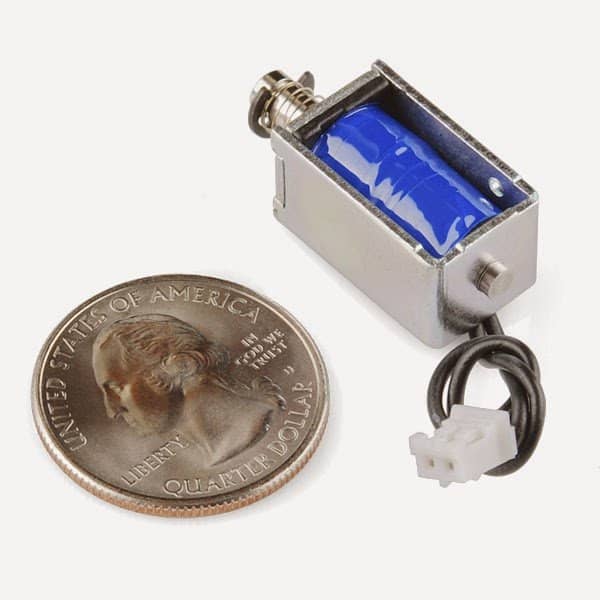
Image Courtesy: https://cdn.sparkfun.com//assets/parts/6/3/2/2/11015-04.jpg
The above figure shows a small 5V spring loaded solenoid which appears to be the right choice for our proposed shoe generator application.
Using a Solenoid
Since the solenoid is specified to operate using a 5V input @ 1amp, we can assume almost the same amount of power across its wires when it's subjected to a push and pull mechanical force.The right parameters which may be perfectly suitable for charging a cellphone battery.
A big advantage of using these solenoids is that these have a spring loaded shaft mechanism, which means that the only effective force required for generating electricity by the unit is the gravitational force, while our feet is at rest, and when the feet is being lifted the spring action of the solenoid complements the action making the system extremely efficient.
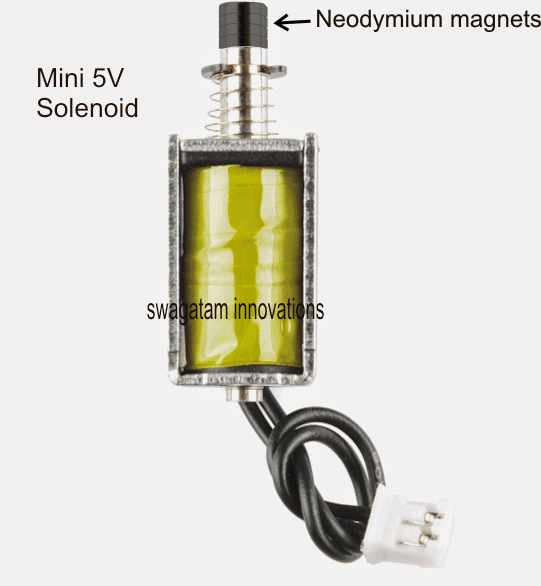
However, since solenoids normally use an iron rod as the plunger, we can't expect the system to generate any electricity until this bar is transformed into a magnet first, because only a moving magnet will be able to generate electricity when moved through a coil of wire.
This modification can be simply implemented by attaching a few neodymium magnets at the top edge of the solenoid rod, as shown below, this will transform the entire plunger into an effective magnet, which would be then able to interact with the coil of the solenoid for generating electricity, if you have any other effective method of transforming the rod into a permanent magnet, you can use it for producing a better response from the operations.
In the following section we'll learn how to generate electricity from shoe while walking, and which may be used for charging a Li-ion cell.

The set up above is presented in a pictorial format for showing the connection details regarding how to generate electricity from shoe, practically all the elements will need to be appropriately concealed inside an enclosure and firmly attached with the shoe heel.
In the figure we can clearly see how the solenoid needs to be positioned at the heel of the shoe, such that the solenoid is subjected to a pressing and a releasing pressure on its shaft while the user walks.
Each time the solenoid shaft is pulled or pushed, the magnet associated with the shaft inside the unit interacts with the coil surrounding the magnet generating electricity which becomes available across the connecting wires of the solenoid.
Since the to and fro motion of the solenoid shaft is supposed to induce an alternating current at the output, this needs to rectified for acquiring a DC, that's why a bridge rectifier may be seen connected with the wires of the solenoid.
The rectified DC now can be used for charging a Li-ion battery or any other battery that may be rated at the specified voltage level.
Using a Cranked Flashlight Mechanism
If you find optimizing a solenoid mechanism difficult and not yielding enough current, you could try an alternative concept using a cranked flashlight mechanism.
Cranked flashlights as we all know make use of a spring loaded motor/gear mechanism in which the gear is cranked with manual force to produce rapid multiple rotations of the motor spindle with the help of calculated gear ratios. This forced rotation of the motor ultimately generates the required electricity for the connected load.
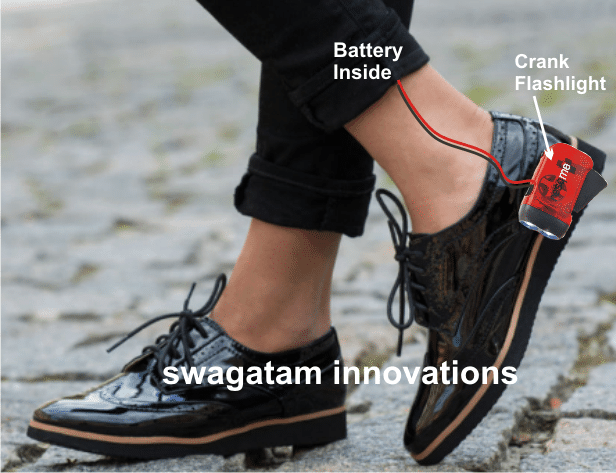
The same principle can be applied for generating electricity from shoe by appropriately installing a small cranked flashlight mechanism on a shoe and wiring its output with a battery, as shown below. Make sure to remove the LED section from the unit and use only the mechanism for the intended charging of a battery.
Warning: The circuit does not include an over charge protection, which can be dangerous for the battery, nowadays Li-ion cells come with internal PCMs or protection circuit modules which ensure total safety for the cells against over charging or over discharging...make sure the Li-ion cell has this module attached so that you can charge it safely using the proposed concept of generating electricity from while walking.


Comments
What is output voltage and current of the solenoid ? and how it can be determined ?
You can read this explanation
https://www.quora.com/When-a-magnet-moves-inside-a-coil-electricity-is-produced-How-can-one-calculate-how-much-voltage-is-produced-this-way
Hello
Which of the 3 ways do you think would be the most effective in powering a powerful strobe light?
Thank you
Michelle
Hello, using crank flashlight method is the most effective way
could I use one of the other ways to make it.
If you are confident of the results, then you can try…
That is very kind of you for this prompt responding. I understand you are a serious expert !
The problem I have is I cant even generate meaningful V for the rectifier. Any one done though that already ?
Best regards
I had tested a similar solenoid/magnet assembly with hand, and it had worked perfectly for me, I could illuminate an LED brightly for a fraction of a second…not sure why your solenoid is not generating any voltage.
anyway if you are having difficulty with this design, you could probably replace the solenoid mechanism with a motor/crank mechanism which you could salvage from any tiny cranked flashlight unit and use it with a shoe as explained…that would most probably start producing instant results without any complications.
Hi, Swagatam, I had managed to experiment on testing it.
it seems not as what you proposed in a way that it only "generate' as little as 0.05 V by using exactly the version 5V solenoid, and neo rare earth magnet (Grade N38) to the strongest point that the magnet can be still pulled back and forth;
I then swapped with a 12VDC solenoid of the same size by external dimension, the result is doubled, at merely 0.1V….Can please advice why and what can be wrong with what I have done?
Best Regards
Paul
I
Hi Paul when we say a 5V solenoid it means the solenoid coil is specified to work with a 5V supply, that also implies that if the same solenoid coil was subjected to a push or pull motion through a specified magnetic field, an identical 5V should appear across the coil terminals? This seems logical and technically correct right?
You will need to settle this issue first on a work bench, and make sure you measure the output through a bridge rectifier network, possibly with a filter capacitor
Is it really working? Reply fast
it will depnd on the solenoid's voltage generating capacity which in turn will depend on the walking speed.
so first you will need to check the above by experimenting with the solenoid
anyway 5V looks too big, a 3.7V batt could be tried instead, or a much reasonable option would be to try a few Ni-Cd 1.5V cells in parallel
can we charge a 5v 1.5A battery with this supply? if yes then what time will it take?
Can we charge a 5v 1.5A battery with this ? If yes what time will require ?
3 to 5V at 100mA
the shoe quality must be good so that the system could be fitted tightly without movements.
you can try the piezo version if you wish…it will illuminate small fancy LEDs but won't charge a battery.
the solenoid will infact facilitate easy walking due to its spring action and in turn will produce free electricity.
first make sure you check the response on your workk bench before the actual installation.
yes but it's too small…
My pleasure!
Where can I find a 5V solenoid with spring and neobydium magnets?
please Google it
Wow, this indeed is a nice one.
for the safe charging of the above proposed cell an lm317l, 100ma version would suit best, isn't it? everything in a small container box and inside the shoe. That's amazing…….\
finally it's GREEN THINKING.
Hi, Sherwin, Did you ever try if the system really work as proposed? My result is very disappointing though……
thanks sherwin, I appreciate you thoughts