• Skip to main content
  • Skip to primary sidebar

Homemade Circuit Projects

Need circuit help? Post them in the comments! I've answered over 50,000!

Blog | Categories | About | Contact | Calculators-online
You are here: Home / Automobile Electronics / EV Wireless Battery Charger Calculator Tool

DIY Circuits | Learn Basics | Arduino Coding


EV Wireless Battery Charger Calculator Tool

Last Updated on February 4, 2026 by Swagatam

This calculator helps estimate resonant frequency or compensation capacitor for a wireless EV charging primary coil. It is for first-step design and learning, not final tuning...

Calculator by homemade-circuits.com
EV Wireless LC Resonance Calculator

EV Wireless LC Resonance Calculator

Stay within 50–100 kHz for mid-range EV wireless power. Remember that secondary coupling modifies the effective primary inductance. Use measured L values.

1) What You Are Actually Calculating

In wireless charging, primary coil is always used with a resonance capacitor, together forming an LC tank. This calculator finds one unknown when two others are already known.

  • Coil inductance (L).
  • Resonant capacitor (C).
  • Target operating frequency (f).

You must already know at least two, otherwise nothing works.

2) Measure Coil Inductance First (Very Important)

Before using the calculator, let us be clear.

  • Build the actual primary coil.
  • Mount ferrite backing if used.
  • Measure inductance using an LCR meter.

Always measure inductance in microhenry (µH). Do not rely only on online coil formulas. This measured value is what you enter as Primary Inductance.

3) Choose What You Want To Calculate

At the top, select Calculate.

  • Resonant Frequency: when L and C are known.
  • Capacitance: when L and frequency are known.
  • Inductance: when C and frequency are known.

For beginners, mostly you will use Capacitance (µF), that is common case.

4) Enter The Two Known Values

Typical example.

You measured:
Primary inductance = 110 µH.

You want:
Operating frequency = 85,000 Hz.

So enter:
One field: 110 and select Primary Inductance µH.
Other field: 85000 and select Frequency Hz.

Order does not matter, calculator will handle it.

5) Enter The Coupling Coefficient (k)

This shows how well primary and secondary coils couple magnetically.

If unsure, use safe beginner values.

  • Coils very close and aligned: k = 0.3 to 0.4.
  • Moderate air gap or slight misalignment: k = 0.2 to 0.3.
  • Poor alignment: k = 0.15.

For first designs, 0.25 is a good starting value. This matters since coupling changes effective inductance. Ignoring k gives wrong resonance prediction.

6) Click CALCULATE

Calculator will show either:

Estimated resonant frequency or required resonance capacitor value.

This is starting design value we can use....

7) Choosing Nearest Standard Capacitor Value

Exact capacitor value never exists in real life.

Example:
Calculated value = 0.148 µF.

Use:
0.15 µF, or combine capacitors in parallel.

Always use polypropylene film capacitors, high voltage rating, low ESR. Electrolytic capacitors are not suitable.

8) Important Check

This calculator gives theoretical resonant point only.

  • In real wireless EV charging:
  • Vehicle position changes
  • Coupling changes
  • Load changes
  • Frequency shifts slightly

So expect fine-tuning, expect small frequency or capacitor adjustment, this is normal and unavoidable. All commercial systems do this.

9) Recommended Oscillator Or Driver Setup (Wireless Charge Transmitter)

Once resonance values are known, use one of these.

Best option, industry standard.

Phase-shifted full H-bridge
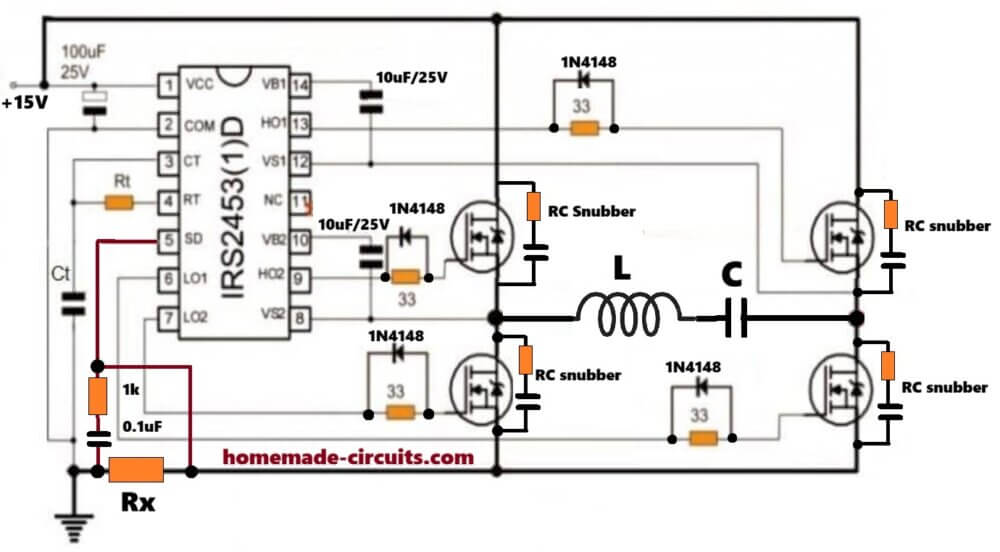
  • Fixed frequency
  • Controlled power
  • ZVS Control through deadtime control
  • Suitable as EV chargers

Medium power option.

Half-bridge resonant inverter
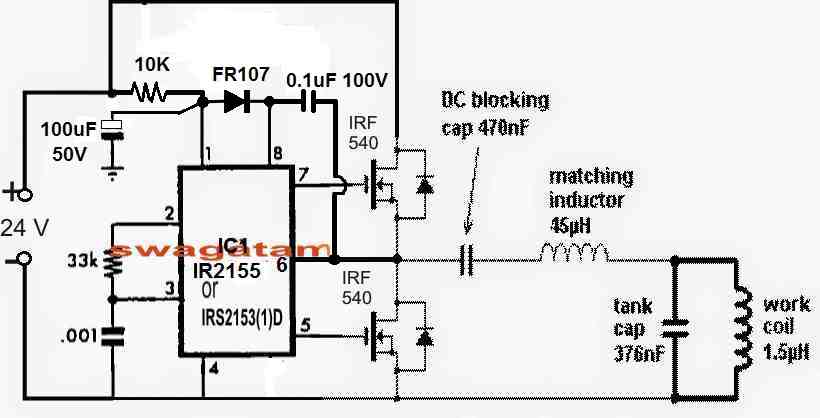
  • Simpler
  • Good efficiency
  • Still controllable

Learning only.

Self-oscillating ZVS (Royer/Mazzilli)
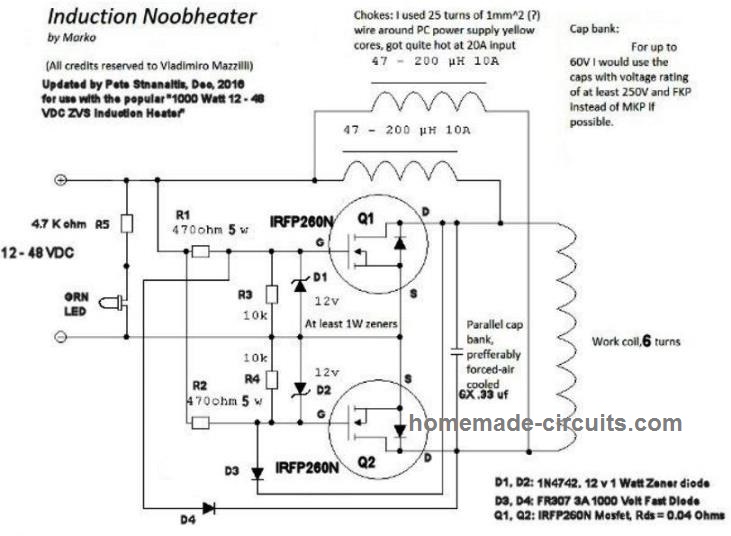
  • Easy to build
  • Frequency drifts
  • Not suitable for professional EV systems

You'll also like:

  • auto adjusting vehicle headlamp dipper circuit compressedSelf Adjusting Automobile Headlamp Circuit
  • lichargerHow to Select the Right Charger for Li-Ion Battery
  • FlasherwithmalfunctionindicatorLamp Outage Detector Circuit for Car Turn Signal
  • Nicd Charger circuitSimple Ni-Cd Battery Charger Circuits Explored

Filed Under: Automobile Electronics, Battery Charger Circuits Tagged With: Battery, Calculator, Charger, EV, Tool, Wireless

About Swagatam

I am an electronics engineer and doing practical hands-on work from more than 15 years now. Building real circuits, testing them and also making PCB layouts by myself. I really love doing all these things like inventing something new, designing electronics and also helping other people like hobby guys who want to make their own cool circuits at home.

And that is the main reason why I started this website homemade-circuits.com, to share different types of circuit ideas..

If you are having any kind of doubt or question related to circuits then just write down your question in the comment box below, I am like always checking, so I guarantee I will reply you for sure!

Previous Post: « How To Use And Program ATmega Microcontrollers From Scratch Without Arduino
Next Post: Make this EV Battery Charger Circuit »

Primary Sidebar

circuit simulator image


Subscribe to get New Circuits in your Email


Categories

  • Arduino Projects (94)
  • Audio and Amplifier Projects (133)
  • Automation Projects (17)
  • Automobile Electronics (103)
  • Battery Charger Circuits (87)
  • Datasheets and Components (109)
  • Electronics Theory (149)
  • Energy from Magnets (27)
  • Games and Sports Projects (11)
  • Grid and 3-Phase (20)
  • Health related Projects (27)
  • Home Electrical Circuits (13)
  • Indicator Circuits (16)
  • Inverter Circuits (95)
  • Lamps and Lights (159)
  • Meters and Testers (71)
  • Mini Projects (28)
  • Motor Controller (68)
  • Oscillator Circuits (28)
  • Pets and Pests (15)
  • Power Supply Circuits (91)
  • Remote Control Circuits (50)
  • Renewable Energy (12)
  • Security and Alarm (64)
  • Sensors and Detectors (106)
  • SMPS and Converters (34)
  • Solar Controller Circuits (60)
  • Temperature Controllers (43)
  • Timer and Delay Relay (49)
  • Voltage Control and Protection (42)
  • Water Controller (37)
  • Wireless Circuits (30)


Other Links

  • Privacy Policy
  • Cookie Policy
  • Disclaimer
  • Copyright
  • Videos
  • Sitemap


People also Search

555 Circuits | 741 Circuits | LM324 Circuits | LM338 Circuits | 4017 Circuits | Ultrasonic Projects | SMPS Projects | Christmas Projects | MOSFETs | Radio Circuits | Laser Circuits | PIR Projects |

Social Profiles

  • Twitter
  • YouTube
  • Instagram
  • Pinterest
  • My Facebook-Page
  • Stack Exchange
  • Linkedin


Recent Comments

  • Swagatam on 7 Simple Continuity Tester Circuits Explained
  • Swagatam on Ultrasonic Fuel Level Indicator Circuit
  • Swagatam on 9 Simple Solar Battery Charger Circuits
  • Swagatam on BLDC Ceiling Fan Circuit for Power Saving
  • Ghulam Mohio Din on Ultrasonic Fuel Level Indicator Circuit

© 2026 · Swagatam Innovations