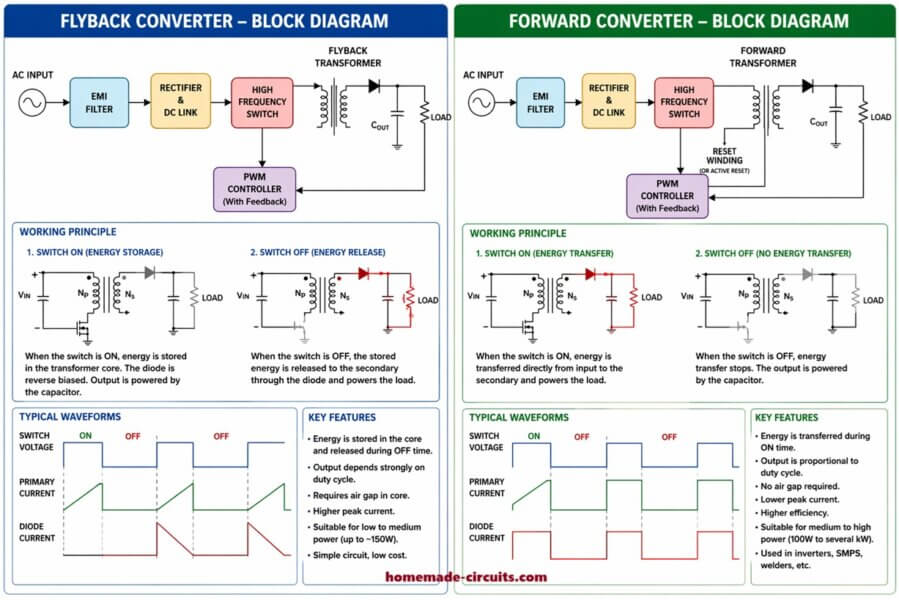
We know SMPS can be made in different ways, but two common ones are flyback converter and forward converter, which may look same at first. But inside working is not same at all, so this part matters before you design transformer or power stage.
Audio/Video Representation
Flyback Converter
We see a flyback converter works in a way where it stores energy in transformer core during ON time, and then when switch goes OFF, then that stored energy is pushed to output, so it does not give output during ON, it waits.
Practical Flyback Converter Example
How it Works as Flyback Converter
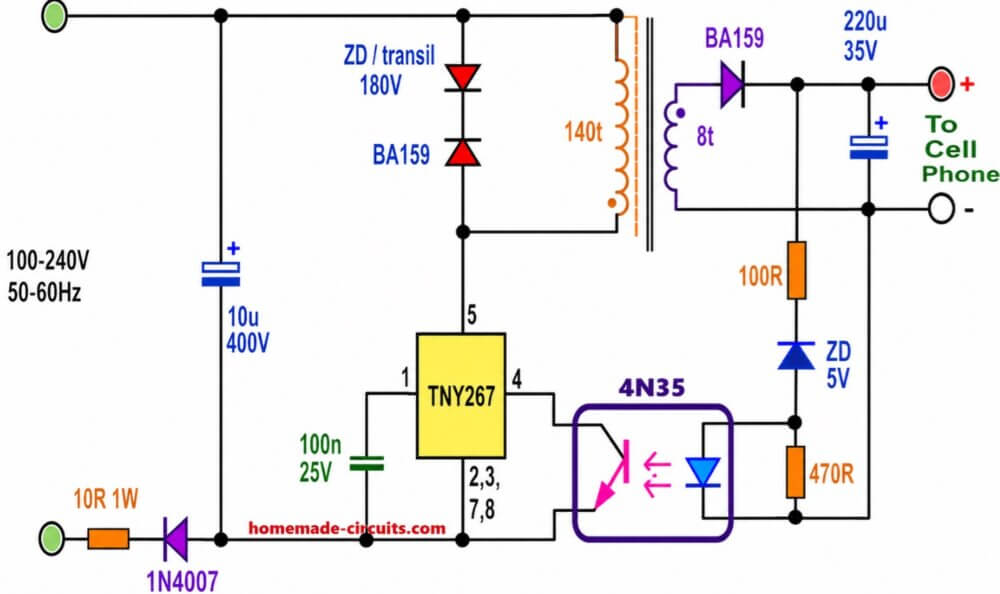
Here the IC TNY267, it keeps turning ON and OFF fast, very fast, that is the basic thing here.
So when it turns ON, then current goes through that primary 140T winding and we see energy is not going to output yet. It is getting stored inside the core, just like a magnet holding it. But the secondary side, that BA159, it stays reverse biased, so nothing comes out, no output yet.
Then when the IC switch turns OFF, then things flip. Magnetic field collapses and now that stored energy inside the primary winding has to go somewhere. So it moves to the secondary 8T winding, diode starts conducting, capacitor takes that charge, and output shows up there.
So we see why this is called flyback, because energy does not go directly to the output.... It first gets stored during IC MOSFET ON periods, then later it is released during IC MOSFET OFF periods. So output only comes during OFF time, not during ON, that is the key behavior.
Transformer here is not just passing energy, it is acting like storage. Just like an inductor holding energy for a moment, then giving it back.
In one simple way we can say, ON then store, OFF then deliver, that is all...
If you look casually, then this feels like store and dump kind of action. But in forward type, this one does instant transfer, no waiting, energy goes directly from input to output during ON periods.
We also see some hints in the diagram itself, single switch like TNY267 which usually means flyback style, not forward. And also there is no continuous AC on secondary, only pulses when OFF happens.
That output diode and capacitor, they just catch that released energy and smooth it, nothing else.
Now it is clear, forward topology below works like forward transfer, but the above type, we have delayed transfer, true flyback behavior.
Forward Converter
However forward converter does not store like that, it sends energy directly from input to output when switch is ON, just like a normal transformer, no waiting kind of behavior.
Practical Example Circuit

Why the above Circuit is a Forward Type Topology
We have that IR2153 driving two IRF840, but not together, one then the other, back and forth. So now this looks like half-bridge action happening.
Because of that switching, the transformer primary starts seeing something like AC. It is not pure sine, just square wave type, but it works.
Now when one MOSFET turns ON, then that side conducts, voltage hits the primary, and energy does not wait, it just moves across, straight to secondary, no storing, no delay, just flow.
So at that same time, secondary gives around 56V AC, not later, not after OFF, but during ON itself. This tells us something important.
We see here energy is going directly from input to transformer to output. It is not sitting inside the core, which means no flyback type storage. It is behaving like normal transformer, just faster switching, high frequency, that is all.
So the difference becomes clear. In flyback when energy is pushed in, then it waits. And when switch goes OFF then it comes out, but here it does not wait, it passes through when switch is ON.
Simple way, flyback feels like charge and release. But this forward topology feels like pass through when ON, no holding, no dumping later.
That is why even if circuit looks like half bridge from outside, inside behavior is forward type, because energy is moving instantly, not stored then released.
Core Working Principle
Flyback Operation
When switch is ON then energy builds inside core, stored in magnetizing inductance, but output side does not get power at that time.
When switch is OFF then that stored energy moves to secondary side and feeds output, meaning output comes only in OFF time.
Forward Operation
When switch is ON then energy flows straight to secondary, no storing and waiting, direct transfer happens.
When switch goes OFF then energy flow stops immediately, nothing extra is delivered after that, so output stays only during ON time.
Main Features
| Feature | Flyback | Forward |
|---|---|---|
| Energy transfer | Indirect (store then release) | Direct |
| Transformer role | Acts like inductor | Acts like transformer |
| Output timing | During OFF time | During ON time |
Voltage side first.
In flyback, output voltage depends a lot on duty cycle, it is not simple, it bends around, like:
Vout ≈ (Vin * D) / (1 - D) * (Ns / Np)
So when D changes, then output does not move straight, it shifts more sharply, which makes things a bit tricky.
But in forward, it is more direct, we see:
Vout ≈ Vin * D * (Ns / Np)
So here when duty cycle changes, then output follows in a simple way, no bending too much, just scales along.
Meaning one is nonlinear, flyback side, and forward stays more linear, easier to think.
Now coming to transformer part.
Flyback transformer, it stores energy, so it needs air gap, which means it behaves more like an inductor than pure transformer, and since energy is sitting inside core, then stress becomes higher, and at higher power it starts losing efficiency.
But forward type, it does not store energy like that, so no air gap needed, it works like proper transformer, transfer happens directly, so core stress is less, and efficiency stays better when power goes high.
Now current behavior.
In flyback, current peaks go high, sharp spikes, not smooth, and output current comes in pulses, so we need bigger output capacitor to smooth it out.
But forward side, current stays lower in peaks, more smooth flow, less ripple feeling, so it suits better when power level goes up.
Power Capability
| Type | Typical Power Range |
|---|---|
| Flyback | 5W to ~150W |
| Forward / Full Bridge | 100W to several kW |
Applications
This is why people split it like this, Flyback goes into adapters, chargers, small things. But Forward converters or full Bridge type goes into inverters, welders, industrial SMPS, because power level changes everything.
Efficiency
Efficiency also shifts, Flyback works but at higher power it starts losing more. However Forward stays better there, since losses are lower in comparison.
Reason is simple, Flyback stores energy first and then gives it, which creates losses. Peak currents go high, stress also increases, so things heat more.
Duty cycle part
This is important, in Flyback we see duty directly controls output voltage, more duty means more energy stored, then output rises.
But in Forward, duty does not act exactly same way. It mainly controls energy transfer rate. And in regulated designs then it also affects output voltage, but not in that same storage-release way.
Now in high current applications such as welding SMPS, if we do not use no feedback, no output capacitor, load behaves almost like short. So here duty cycle ends up controlling output current and welding strength directly, since load pulls whatever comes.
Reset also matters,
Flyback resets core automatically during OFF time, but Forward needs extra reset winding or symmetry.
In full bridge, however, reset happens naturally because polarity keeps flipping. So core does not stay biased.
Examples make it clear, Flyback used in mobile charger, LED driver, small SMPS, but Forward or Full Bridge goes into industrial supplies, inverters, welding machines.
So we understand now why Forward is used in applications like spot welder, since it needs very high current, also needs efficient transfer, and cannot afford energy storage losses inside core.
If Flyback is used here, then current stress becomes too much, core can saturate, efficiency drops badly, so it fails in that kind of use.
So final idea
Flyback stores energy and then releases, Forward transfers energy instantly, Flyback is simple but power limited, Forward is more complex but efficient.
The choice depends on power level, efficiency need, and how much complexity you can handle. For low power Flyback is fine, but for high power like inverters and spot welders, then Forward or Full Bridge becomes the correct path.


Need Help? Please Leave a Comment! We value your input—Kindly keep it relevant to the above topic!