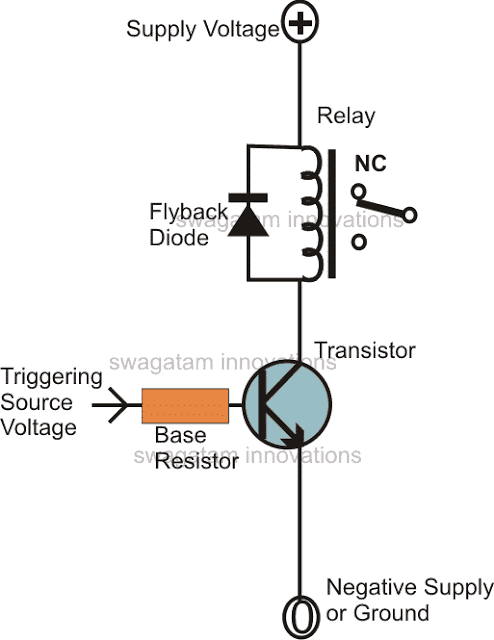
In this article we will comprehensively study a transistor relay driver circuit and learn how to design its configuration by calculating the parameters through formulas. Importance of Relay Relays are one of the most important components in electronic circuits. Especially in circuits where high power transfer or mains AC load switching is involved, relays play […]
Newly Updated Circuit Projects:
Make this LED Cricket Stump Circuit at home
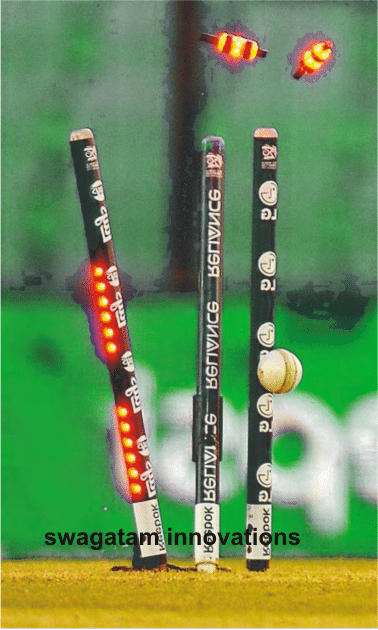
In this post I have explained how to make an illuminated LED cricket stump and bails for helping umpires declare a foolproof OUT, NOT-OUT decisions. The Circuit Concept You might be seeing these amazing cricket stumps in the ongoing 2015 ICC world cup cricket matches, which can be seen dazzle or light up brightly as […]
How to Make Logic Gates using Transistors
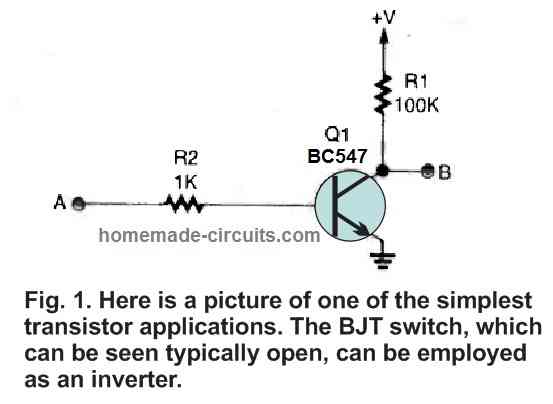
In this post I have explained how to build NOT, AND, NAND, OR, and NOR logic gates using discrete transistors. The main advantage of using transistor logic gates is that they can work even with voltages as low as 1.5 V. In some electronic applications the available voltage may be inadequate to power TTL or […]
How to Make a LED Flashlight Circuit

White LEDs have become so common nowadays that even school kids today know how to use them for making simple LED projects. LEDs are typically used for illuminating purposes, the discussed circuit is also intended for similar applications. The post talks about how to wire LEDs and battery to make a simple DIY LED flashlight. […]
Light Emitting Diodes (LED) Explained
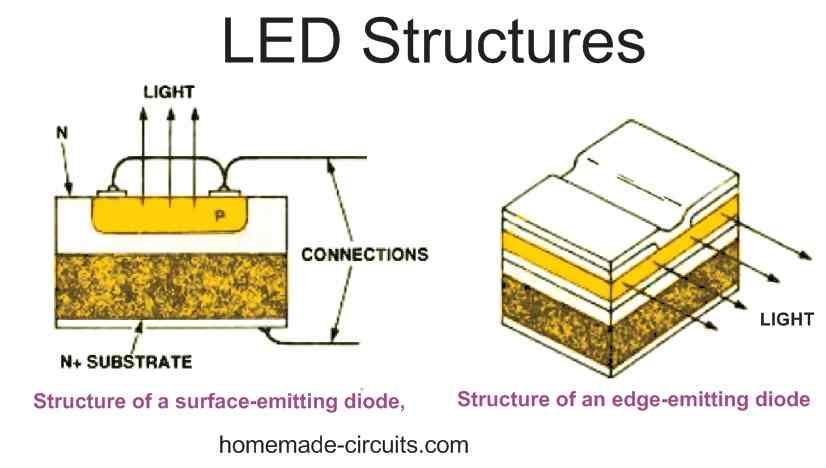
The full form of LED is Light Emitting Diode. LEDs are special type of semiconductor diodes which emit light in response to a potential difference applied across their terminals, hence the name light emitting diode. Just like a normal diode LEDs also have two terminals with polarity, namely anode and cathode. To illuminate an LED […]
Transistor Multivibrator Circuits [Astable, Bistable, Monostable]
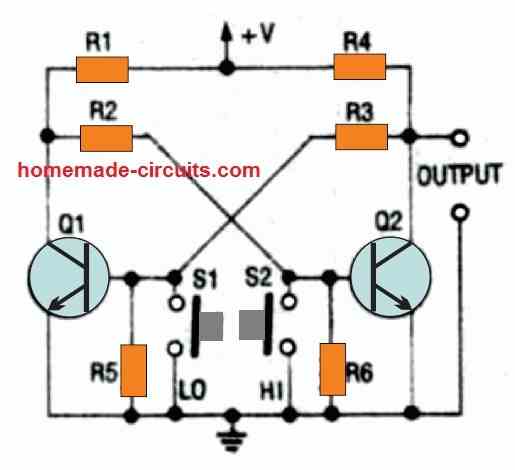
A transistor or BJT multivibrator is a two-stage switching circuit that is configured in a cross-coupled manner. This allows each of the active BJT stages to be regeneratively cross-coupled with the other BJT stage, so that one switches ON when the other switches OFF, and vice versa. This cross-coupling may be set up to switch either a […]