The post describes a simple homemade RF signal jammer circuit that can be used for jamming any RF signal within a radial range of 10 meters. The idea was requested by one of the interested readers of this blog.
Technical Specifications
I am not a large business interest, but am in need of a circuit which would not only help me, but eventually be welcomed by just about everyone now alive.
I am in need of a circuit which will jam RFsignals. I realize jammers are illegal when they disrupt cellphone communication and commercial enterprise. I am only looking to jam (1.) remotely controlled harassment devices and (2.) spyware within the confines of my property. Jamming range limited to around a 25' x 25' area.
There is a growing community of victims of electronic harassment. We all experience an invasion of our personal lives/finances and private conversations, and are sometimes physically stalked and attacked.
Due to the nature of electronic harassment, it will take time for justice and protection to catch up and solve the problem. As for electronics, some circuits to control the misuse of flux & solder are long overdue in the marketplace.
Up until now, most of the interest has been placed on projects of invasion and abuse, such as those contained on many different website
I am not overly skilled in electronics, and only come to it in self defense. I am self taught and can follow a schematic and complete a project, and am slowly gaining understanding of the underlying theory.
Please advise regarding your interest to help, and your financial requirements. I look forward to hearing from you.
Circuit Diagram
Parts List
- All resistors are 1/4 watt 5% CFR
- 22 K = 3
- 330 Ohms = 1
- 4.7 K = 1
- 100 Ohm = 1
- 10 K = 1
- Capacitors are all Ceramic Disc, unless specified
- 22 nF = 4
- 2.7 pF = 1
- 6.8 pF = 2
- 33 pF = 2
- 15 pF = 2
- 18 pF = 1
- 10 nF = 1
- 1 nF = 1
- 10 uF / 25 V Electrolytic = 2
- Trimmers 33 pF = 2
- Semiconductors
- Zener Diode 16 V 1 watt = 1
- 1N914 Diode = 1
- TR1 = BC547
- TR2 = 2N2369
- IC7809 = 1
- IC 78L05 = 1
- Inductors = See Text
- Antenna = Telescopic antenna
Introduction
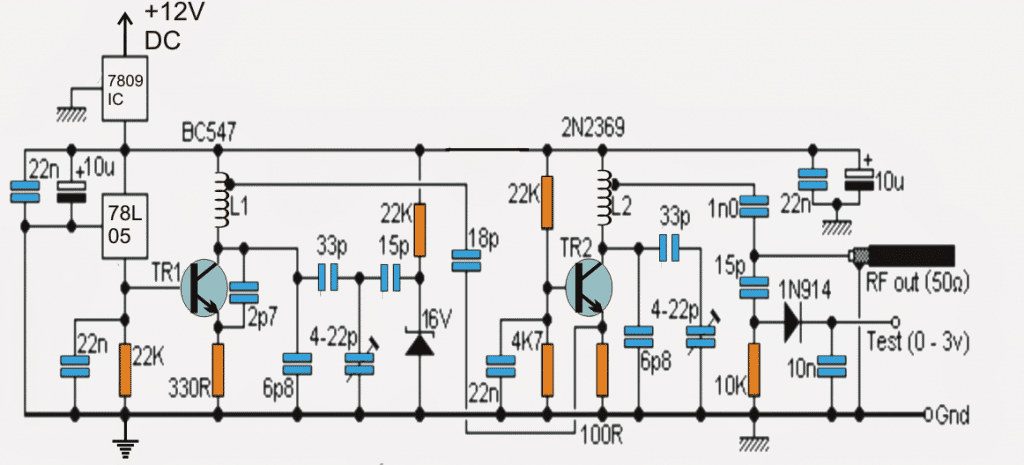
A simple looking RF signal jammer circuit can be seen in the above diagram, which may be capable of jamming all sorts RF signal within the range of 5 to 10 meters.
The circuit can be made suitable with any desired frequency to be jammed by merely using different sets of L1/L2 and by tweaking the 22pF trimmers accordingly.
The frequency that could be jammed using this circuit could be well in the range of 50 MHz to 1Ghz, however making it compatible with frequencies above 500 MHz could get much complex and parameters much critical owing to the fact that higher frequencies require shorter interconnections and may involve other stability issues.
The present design can be used for jamming FM radio stations situated in the within 40 meters radial distance or even higher.
The circuity of the proposed RF signal jammer is basically made of two distinct stages:
RF Circuit Stages
The one comprising T1 and the associated parts form the RF oscillator stage while the other stage consisting of T2 and the complementing parts for amplifying and transmitting the low voltage oscillations from T1 into the air.
The above strong RF carrier signals transmitted by T2 may be appropriately modulated with any external frequency such as an audio or speech by feeding the signal across the terminal indicated "Test".
The circuit is highly stable and doesn't falter with varying input supply voltages due to the presence of the 78L05 voltage regulator at the base of T1 which clamps the base of T1 with a constant biasing current making sure that the oscillations created by the T1 stage stays very stable and consistent.
The above feature is perfectly complemented by the T2 stage which accepts the oscillations from the T1 stage and amplifies and transforms the signals with much higher current so that the signals are able to travel across larger radial distances in the air.
However in order to implement an optimal transmission of the signals, 50 OHM impedance antenna must be used with the output of the circuit.
This could be any ordinary aluminum dipole yagi antenna. A simple flexible wire measuring about a meter would also do but would reduce the transmission strength by about 60 % making the unit much inefficient as far as the transmission range is concerned.
How to Peak the Resonance
The performance of the RF jammer could be highly improved by adjusting the presets to produce peak resonance. This can be done with the following points:
- Connect a 0 - 10V DC voltmeter across the point "test" and the ground line.
- Adjust the right side 22p trimmer such that the meter reads around a maximum of 3V on the meter.
- This might disturb the initial frequency of the system that you might have set for the jamming purpose.
- So go back to the left side 22p trimmer and fine tune it again to set the desired frequency back into place.
Your peak resonance for the circuit is set now, and you can expect maximum efficiency from it.
RF Jammer Coil Specifications
For making the RF jammer compatible with other frequencies, the coil L1 and L2 must be shortened in terms of their number of turns and/or also the diameter...this will need some experimentation until the right frequency is determined.
The adjoining trimmers may also tweaked for getting an optimal response from the jammer circuit or until a perfect jamming is achieved through the circuit.
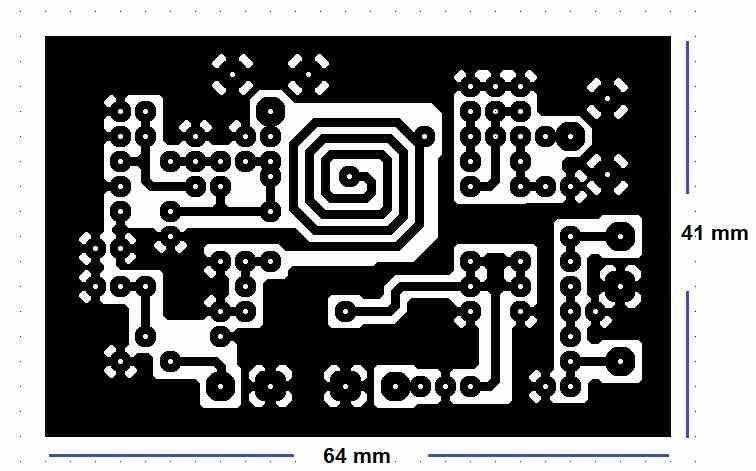
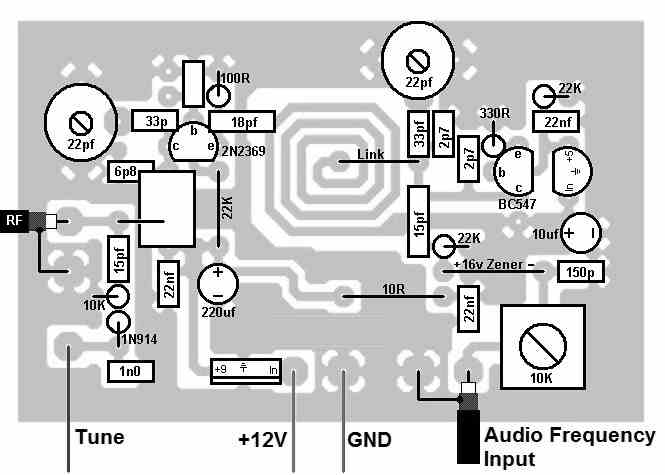
A good quality, well designed PCB is strictly recommended for constructing the RF jammer circuit
For jamming standard FM broadcasts within a range of 50 meters, L1 and L2 may be built as indicated in the following images:

PCB Etched RF Coil
The above image shows the construction L2 using a 7 turn, 1mm super enameled copper wire with a diameter of approximately 5 to 6mm (internal)....see how the tap is extracted from the relevant end of the coil.

The following image shows how L1 can be designed by etching the tracks on the PCB itself or the same could be built using pieces of diode leads as explained in this FM wireless MIC circuit
PCB Designs



Questions & Answers
I did my research and found they are communicating via Terahertz and with a jammer the NeuralDust is done, no more audio in our brains, remote neural monitoring and no more V2K
Thank you for the feedback!!
thank you for your site. my situation is audible rf from nearby tower. freq range about 50hz up to 15khz. which components are needed to acheive this?
ron
Hi, thanks!! I don’t think it may be possible to jam powerful RF from a tower using this small jammer.
Hello.
So the circuit isn’t safe to assemble, since I’ve seen comments that its electronics don’t match?
Please clarify…
Best regards.
Hello,
It is perfectly safe if you are well versed with RF transmitter circuits and know how to assemble and test them…
Dear Ing. Swagatam,
How can I increase action range of a jammer? Wich electronic components are responsible to provide the range?
Is it posible to change this components in a manufactured jammer in order to improve its range?
Many thanks in advance and blessings
Hi Arthur,
The output transistor associated with the LC tank circuit controls the output power, along with the length of the antenna.
It is difficult to modify an existing circuit unless all the parts around the output transistor are appropriately calculated and modified accordingly…
Currently I am connected too with the punch, and I need detailed instructions about how to destroy it best method available
Thanks a lot Sir.!
You are welcome Arthur!
Hey, I was looking at these diagrams and got a little confused by it all, im just getting into the world of breadboards, basic electronics, and soldering, any books or sources that I should look at to help me understand all this?
Hey, thank you for your feedback! i do not know about any online books, but you may find many good you-tube videos which you can watch to learn the basics of electronics…
hi. can i have two of this?you can ship to italy?and can i have the bom of the components of this project?
Hello vivacedinotte, sorry, I no longer manufacture electronic items for sale, so it might not be possible to fulfill your requirement.
Hello, can you create a schematic of a device that can jam FM radio broadcasts? Because my sibling always plays radio broadcasts quite loudly and it’s very disturbing.
Hi, the circuit explained in the above article will do exactly the same.
Hi, can you make it for me? And how much does it cost? Thank You.
Hi, Very sorry, making and selling the unit may not be possible at this moment.
Can you make 13.56 mhz jammer I will pay.for it or diagram
Jeff, the diagram is already given in the above article, you just have to adjust and coils and the trimmer for aligning it to the desired frequency range in Mhz..
I have no idea I’m new.
Sorry, the above design is not recommended for newcomers. It is recommended only for users who are relatively experts with electronics and circuit building. In that case you can probably look for readymade boards or kits in amazon.
Hello
why do we need semiconductor
We need transistors to amplify the signal.
It will really jam all RF signal
Sir can this jammer jam Rc toy signal and IR signal
Abahy, the above circuit can jam only RF signals, not IR.
But that PCB design is not accepting in PCB website l am buying this PCB board from this website
Contact the PCB manufacturer through a phone call and ask them to help you with the above PCB design.
Hello sir, can you please send me the PCB board design.
PCB design is already given in the above article, there’s no other design available.
That’s actually close to them design I made… how would I get the 13.56 mhz range
I think that manufacturers specific. It a rf signal… can I send you my email I will show you a pic… I made one just not right signal…
I can help only with the circuit diagram explained in the above article, not with any other external design, that will be difficult.
I put one together I couldn’t get it to jam… I was wondering which ones I would need to change to jam 13.56 Mhz
How did you measure the 13.5 MHz adjustment? You will need to first confirm whether the initial circuit is able to jam FM radio or not?
You will have to tweak the L1, L2 inductors and the 22pF trimmer capacitors.
What does it take to make a 13.56 Mhz
Adjusting in MHz is simple, you just have to tweak the inductors and the trimmers. Adjusting in GHz can be complicated.
What does that mean???
What
Hi sir, can you tell me how many types of RF signal will it jam and what is the maximum range of it to jam
hello sir thank you very much
so, i would like two know this diagram can jammer all line i mean from 88- 108mhz? how range? if not can you make a diagram for me
Hello EMMANUEL, yes, it can jam the whole range of 88 to 108 MHz if correctly adjusted. Distance range will be around 20 to 30 meters radial…
Hi Abhay, You can customize the circuit to any desired frequency range, but as you increase the frequency you will need to strictly optimize the layout by the circuit by making the interconnection shorter and the inductor also will need to optimized with lot of care. All these can be very complex unless you are an expert with RF circuit designs.
Can I use it to jam mobile phones signal also
For jamming mobile phone you may have to set the frequency to GHz level, which can be very difficult and complex.
Hello sir, can you please make a little big size jammer so that I can make this in my project and also please send the link of video of making it.
Hello Abhay,
Making a video can be difficult for me due to lack of time.
I had tested this circuit long ago and it worked very nicely. I could jam most FM radio signals within 100 meter range using this jammer circuit.
Since I adjusted the circuit between 90 and 110 MHz I could jam FM signals within this range, however this frequency could be changed to other MHz values to jam other desired signal ranges also.
hello, I would like to know how to check that we have reached the frequency of 433Mhz for example
You will have to keep a 433 Mhz receiver and transmitter switched ON such that the receiver is tuned and activated by the transmitter. Then tune the jammer until the 433Mhz receiver’s switch ON response breaks.
Hello I am a middle aged woman alone under horrendous cyber attack visual and audio in my home and car I need help desperately I am unable to make this device I so urgently need. It is the most difficult and scary and violating feeling I have ever had in my life
I am wanting to make a signal jammer for adjustable capitator 5pf-20pf to name a 13.56 Mhz. What all components would I need to complete this circuit. Where can I get a circuit board to make it?? What site sells these components. I got a adjustacle capitator from eBay. Here is my cell # 14056279236
salut, j’avais également une question: celle de savoir si ce jammer est efficace pour les digital remote controller de 315/433 Mhz
Hi, You will have to adjust the 22pF trimmers and also the L1 L2 appropriately for jamming the desired 433 MHZ frequency
I have updated the parts list and the PCB design for the convenience of the users. You can get the parts from any online spare part retailer store.
Is the components on here for a signal of 13.56 with a trimmer capitator? Cuz I’m not for if it’s exactly 13.56 just guessamtion
The components are for 100 MHz jammer. You may have to reduce the number of turns on the coil or stretch the coil to widen the distance between the turns in order to achieve a 13 MHz frequency.
Is there a way I get a signal jammer that’s 13.56 can get jammed. With the trimmer capitator. Or have some make it or just the parts and circuit board????
You will have to adjust the parallel trimmer capacitors, and also adjust the antenna coil winding for getting the desired frequency jamming.
Like antenna coil
Yes, just as we adjust the antenna coil.
Can I use regular copper wire for the coil?
Use Super enameled copper wire or magnet wire.
Did it help? I am literally experiencing this exact situation in my home as i believe all my neighboring households are as well.
Please erite me 6025159295, or 4803769819
Pleasee! I am desperate!!!
Well can I use this circuit to jam signals with Frequencies between 600MHz and 2.5GHz ?
If it can’t handle what kind of modifications do I need to do to reach that frequency.
If you reduce the number of turns of L1 and L2, or if you stretch the coil wide apart then its transmitting frequency will also increase proportionally. However I don’t think this jammer will be able to handle above 1 GHz. And as the frequency is increased the part terminals will need to be reduced significantly, or SMD parts will need to be employed.
Well atleast is it capable of blocking some amount of mobile signal….?
And one more thing what are the test (0-30V) and RF out 5ohms.
RF out must be the output antenna for the signals. Is it….?
I also would like to know how to connect the RF out. Practically.
0-3V is the test output, and 50 ohm RF is output for the antenna…I have explained them in the article. You can connect a TV dipole antenna to the 50 ohm RF output points
I am in great need of a signal blocker as I am highly sensitive to several frequencies resulting in terrible headaches and insomnia. I really only need it for 1 level 40’×30′ in my home.
Can someone help me, please?
Thanks so much.
What you need is to make a “Faraday cage” around your house and specially around your bed area.
You can make a “semi-effective” cage, by running strong copper wire, all-around the edges of the rooms, and connecting them all to the “ground”. Make a “ground” by inserting a 1 to 2 meter copper rod into the ground!
True “Faraday cages” would completely encase the areas with metal and ground it, so RF / EMF are blocked.
You could use special EMF blocking paint (expensive), or some LEAD PAINT! That really blocks everything properly (now banned, wonder why…)
Apart from those “blocking” options, you have these… let’s say “smoothing/filtering” options:
Orgone and/or Shungite “devices”, tthey turn most bad and aggressive emissions into a harmless environment around them.
Although I called it a Orgone “device”, they have no moving parts. They are made out of crystals (mostly quartz) and metals (copper wire and aluminum and other powdered or shaved metals), encased in epoxy or other constricting material (to make use of the piezo-electric effect) in usually small pyramids or other “paper-weight-like shapes and also wearable pendants and necklaces.
Shungite is a mineral found only in Russia, that has some protective effect on radiation, much like Orgone, and is made out in pendants and small objects too.
Hope this helps
A Jammer would be much worse. They are the equivalent of shouting over the original signal to drown it out.
I believe it could be just a psychological problem, you must consult a Doctor before thinking about installing electronic devices or signal blockers.
Want to buy a ready to use radar police jammer, for long range.
Please contact me.
Thanks,
Roni Blum
GOOD AFTERNOON. YES, I WOULD LIKE TO KNOW HOW TO GET ONE. I ALSO A, TRYING TO MAKE A LASER AUDIO LISTENING DEVICE BUT SINCE I DO NOT HAVE THE EXPERIENCE TO UNDERSTAND WHAT IM DOING, I NEED ADVICE. I WOULD LIKE TO KNOW IF YOU PROVIDE CLASSES OR JUST ASSEMBLED? THANKS CARLOS
I like building things, it is the way I learn. Whats the chances of getting a kit for the signal jammer?
I am glad you are learning the procedures, however getting a ready made kit may not be possible at this time.
Thank you for your reply. I’ll look into getting breadboards.
Breadboard might not work since it is a sensitive RF circuit….you will have to solder the items on a strip board to get proper results…
Hi swagatan
I am just saw your design now but I didn’t built it to see whether it is working or not but I really appreciate how you are responding or answering questions.
Thank you
Thank you Muhd, I appreciate your response. Let me know if you have any further questions.
Just reading all of this and I’m tired. Great job buddy!
I take it the electronic harassment you talk about is the Cuban syndrome type or what TI’s call v2k correct?
If so I’ve bought two Jammers that are supposed to jam various signals and different frequencies and channels, but don’t seem to do much. I use a EMF meter to see what’s going on when they’re on, and seem to be doing something, but still I hear this crap. I use a software that I can record the stuff that’s illegally sent to me and on the settings it has TFFT thing that shows all the frequencies and the highest points while playing the recording back. The last reading I got was 4484hz -4499hz but at times it can go as high as 800 or more hz so I need a RF Jammer that could cover that. I also found a tool that shows me what applications are used at these frequencies and on the chart it shows Radars, mobile phones, and commercial wireless.
It also shows that it’s at a super High frequency, so I need something that would jam that any ideas?
and that diagram above have you made it yet and plan on making those for sale? I’ve read on other sites that an analog jammer would be best since digital jammers are too easy for the perps the criminals to hack. I have no idea how to do the above schematic I have no electronics engineering knowledge whatsoever so I need one built for me.
Thank you for the detailed explanation, I understand you want to build a good jammer circuit, however, if you do not have any prior knowledge or experience in the field of electronics, then the above project can be virtually impossible to build and test for you. Providing a ready made kit may not be possible either since the above circuit will require a PCB which is not available with me at this moment of time.
So can you provide a parts list please ?
Hello,
Please, can you share your mail, or some contact, like to exchange ours achievement, think that we are in the same boat.
Can I used your jammer for HF band, like to jam between 0-30 MHz, and don’t need to be 10m, 1m would be enough, or how and what need to buy to jam something between 0-30 MHz.
Yes it can be used to jam 0 to 30MHz signals, by suitably modifying the coils L1 and L2 used in the design
Are you sure about this, what I read about jamming on net, you need actually 30% more power than transmit source, also digital modulation within HF range from 3-30MHz is harder to jam comparing with GSM or LTE signal. I like to jam two main frequency on 14MHz and 20MHz, both of tham have 3-5 digital signal around 14 and 20MHz, within 1MHz bandwith.
I didn’t catch if your jamming is device which is actually sweeper, which can made let say “white noise” between 3-30 MHz, or it’s actually jamming device which disrupt exactly certain frequency.
If I like your answer and you have spare time, and willing to earn extra money, I can hire you for some private contract.
I tested this jammer for FM radios in the range of 88MHz to 108MHz, and I could silence the music over a particular station from a distance of over 20 meters. Based on this experience I have posted this design , and I believe by suitably altering the coil dimensions the jamming frequency can be altered accordingly. Yes the jammimg power has to be higher than the source power, that is why the range distance is important, and also the antenna length.
I wish I could do it for you, however due to lack of time I may not be able to provide a practical help to you.
Yes inducing a white noise at the base of the left transistor can enhance the effect of the jamming a lot
Hello,
What changes I need to made on coil L1 and L2, to jam this 2 major frequencies, and what is approximately price for electronic parts.
You will have to experiment by adding a few number of turns to the coil, and check the transmission frequency until it reaches the desired 30 MHz mark….you can further tweak the frequency by slightly squeezing or stretching the turns of the coil.
Thanks, but you didn’t answer about price for electronic parts, when you made schematic, presume that you calculate price for jammer.
You can get the price from any online electronic spare part store