A joule thief circuit is basically an efficient, self-oscillating voltage booster circuit, built using a single transistor, resistor and an inductor, which can boost voltages as low as 0.4 V from any dead AAA 1.5 cell, to much higher levels.
Technically it may seem impossible to illuminate a 3.3 V LED with a 1.5V source, but the amazing concept of joule thief makes this look so easy and effective, and virtually unbelievable. Moreover the circuit additionally makes sure that not a single drop of "joule" is left unused in the cell.
A joule thief circuit is pretty popular with all electronic hobbyists, because the concept allows us to operate even the white and the blue LEDs from a 1.5V source which normally require 3V to illuminate brightly.
Design#1: Joule thief 1 watt LED Driver
The present article discusses 3 such circuits, however here we replace the traditional 5mm LED with a 1 watt LED.
The concept discussed here remains exactly identical to the usual joule thief configuration, we just replace the normally used 5mm LED with a 1 watt LED.
Of course this would mean the battery getting drained pretty much earlier than a 5mm LED, but it's still economical than using a two 1.5 cells and not including a joule thief circuit.
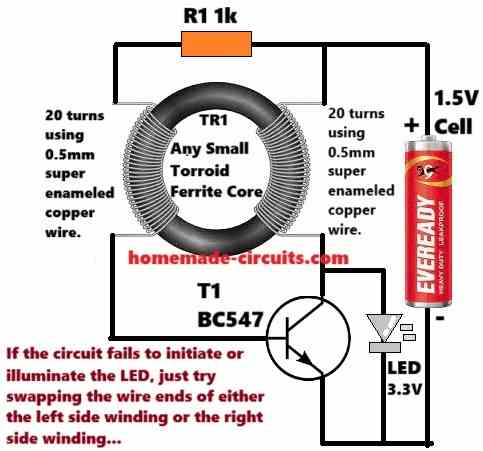
Let's try to understand the proposed circuity with the following points:
If you see the circuit diagram the only seemingly difficult part is the coil, rest of the parts are just too easy to configure. However if you have a suitable ferrite core and some spare thin copper wires, you would make the coil within minutes.
The above design may be improved further by attaching a rectifying network using a diode and a capacitor, as shown below:
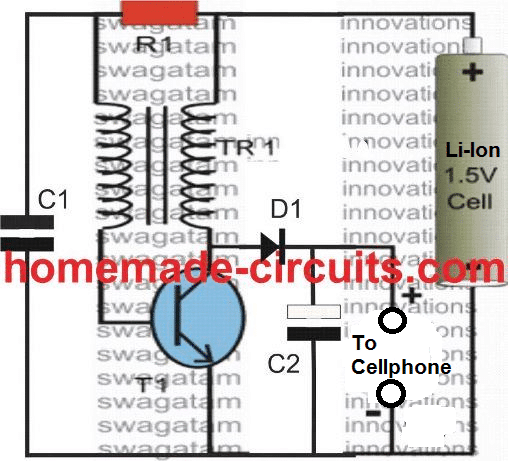
Parts List
- R1 = 1K, 1/4 watt
- C1 = 0.0047uF/50V
- C2 = 1000uF/25V
- T1 = 2N2222
- D1 = 1N4007 better if BA159 or FR107 is used
- Coil = 20 turns each side using 1 mm enameled copper wire over a ferrite ring which accommodates the winding comfortably
The coil may be wound over a T13 torroidal ferrite core using a 0.2mm or 0.3mm super enameled copper wire. About twenty turns on each side will be quite enough. In fact any ferrite core will, a ferrite rod or bar will also serve the purpose well.
After this is done, its all about fixing the parts in the shown manner.
If everything is done correctly, connecting a 1.5 V penlight cell would instantly illuminate the attached 1 watt LED very brightly.
If you find the circuit connections to be alright yet the LED not illuminating, just interchange the coil winding terminals (either the primary ends or the secondary ends) this would fix the problem immediately.
How the Circuit Functions
When the circuit is switched ON, T1 receives a biasing trigger via R1 and the associated primary winding of TR1.
T1 switches ON and pulls the entire supply voltage to ground and in the course chokes the current across the primary winding of the coil so that the biasing to T1 dries up, shutting off T1 instantaneously.
The above situation switches OFF the voltage across the secondary winding triggering a reverse emf from the coil which is effectively dumped across the connected LED. The LED illuminates!!
However the shutting of T1 instantaneously also releases the primary winding and restores it to original condition so that the supply voltage now can pass across to the base of T1. This initiates the whole process yet again and the cycle repeats at a frequency of around 30 to 50 kHz.
The connected LED also illuminates at this rate, however due to the persistence of vision we find it illuminated continuously.
Actually the LED is ON only for 50 percent of the time period, and that's what makes the unit so economical.
Also because TR1 is able to generate voltages that may be many times greater than the supply voltage, the required 3.3V to the LED is sustained even after the cell voltage has dropped to about 0.7V, keeping the LED well illuminated even at these levels.
Video Demonstration
How to wind the Torroid Coil
As can be seen in the shown joule thief circuits, the coil is ideally made over a torroid core. The details of the coil could be found in the following article. The coil structure is exactly similar and compatible with the circuits discussed on this page.
How to Calculate Joule Thief Circuit Parameters
Base Resistor (Rb) Calculation:
The formula for the base resistor ( R_b ) is:
Rb = (Vbattery - Vbe) / Ib(target)Where:
- ( Vbattery ) = 1.5V (battery voltage)
- ( Vbe ) = 0.7V (base-emitter voltage of the transistor)
- ( Ib(target) ) = 1mA (base current)
Inductor Transformer Turns Calculation:
For the primary inductor, the number of turns ( N ) can be calculated using the following formula:
L = (N2 * μ * A) / lSolve for ( N ):
N = √[(L * l) / (μ * A)]Where:
- ( L ) = 100 µH (target inductance)
- ( μ ) = 1000 * μ₀ (permeability of ferrite, where ( μ₀ = 4π × 10⁻⁷ H/m ))
- ( A ) = 2.5 × 10⁻⁶ m² (core cross-sectional area)
- ( l ) = 0.01 m (length of the magnetic path of the core)
Turns Ratio and Output Voltage:
To find the voltage output, use the turns ratio:
Vout = Vbattery * (Nprimary / Nsecondary)Where:
- ( Nprimary ) = Primary turns (calculated above)
- ( Nsecondary ) = Secondary turns (usually fewer turns than primary, e.g., 12 turns)
- ( Vbattery ) = 1.5V (battery voltage)
Transformer Voltage Ratio:
To calculate the voltage ratio between primary and secondary:
Voltage Ratio = Nsecondary / NprimaryThis gives the relationship between the input and output voltages.
Example Code for Base Resistor and Turns Calculation:
Base Resistor Calculation (Rb):
Rb = (Vbattery - Vbe) / Ib(target)
Where:
Vbattery = 1.5V, Vbe = 0.7V, Ib(target) = 0.001A

Inductor Turns Calculation:
N = √[(L * l) / (μ * A)]
Where:
L = 100 µH = 100 * 10-6 H, l = 0.01 m, μ = 1000 * μ₀ = 1.256 * 10-3 H/m, A = 2.5 * 10-6 m²

Output Voltage Calculation:
Vout = Vbattery * (Nprimary / Nsecondary)
Where:
Nprimary = 57 (calculated primary turns), Nsecondary = 12 (example secondary turns)

Voltage Ratio:
Voltage Ratio = Nsecondary / Nprimary
Additional Explanations:
Base Resistor (Rb):
Here, for finding the base resistor, we no need to worry much because the formula is super easy and direct. We just take like this:
Rb = (Vbattery - Vbe) / Ib(target).
That means we subtract Vbe from the battery voltage then divide by the base current we want. That is all. It helps us to quickly get the exact base resistance we must use, no headache.
Inductor Turns (N):
Now when we talk about how many turns we need for the inductor then we cannot just fix any number randomly.
We have to use a proper formula which depends on few things, like inductance value we need, magnetic property of the core material and also the shape or geometry of the core.
So all these things affect how many turns we finally wind. We can play with these parameters depending on what core we are using and what goal we want to achieve from the design.
Voltage Output:
Here the output voltage depends mainly on the winding ratio. So if we want more voltage at output, then we increase the secondary turns compared to primary and if we want less voltage, then we reduce.
That means by adjusting the number of turns in both primary and secondary we can easily set the output voltage to our required level.
Example Configurations:
So like in our example code, we are using a common winding setup where we have 56 turns in the primary coil and 12 turns in the secondary coil. But these numbers are not fixed or strict.
We can change them anytime as per our circuit design or performance target. That gives us flexibility to customize the output.
Example Output:
For example if you use the following values:
Vbattery = 1.5V
Vbe = 0.7V
Ib(target) = 0.001A (1mA)
L = 100 µH
μ = 1.256 * 10-3 H/m (ferrite core permeability)
A = 2.5 * 10-6 m²
l = 0.01 m
Nprimary = 57 turns
Nsecondary = 12 turns
The calculations would look like:
Rb = (1.5 - 0.7) / 0.001
= 800 Ohms

N = √((100 * 10-6 * 0.01) / (1.256 * 10-3 * 2.5 * 10-6))
= 56.57 turns (round to 57)

Vout = 1.5 * (57 / 12)
= 7.13V (approx.)

Voltage Ratio = 12 / 57
= 0.21
This output matches the working of a basic Joule Thief circuit, which is as per our exprectations.
Overunity Circuit using Joule Thief Concept
Parts List
R1 = 1K, 1/4 watt T1 = 8050 TR1 = see text LED= 1 watt, high bright Cell = 1.5V AAA penlight
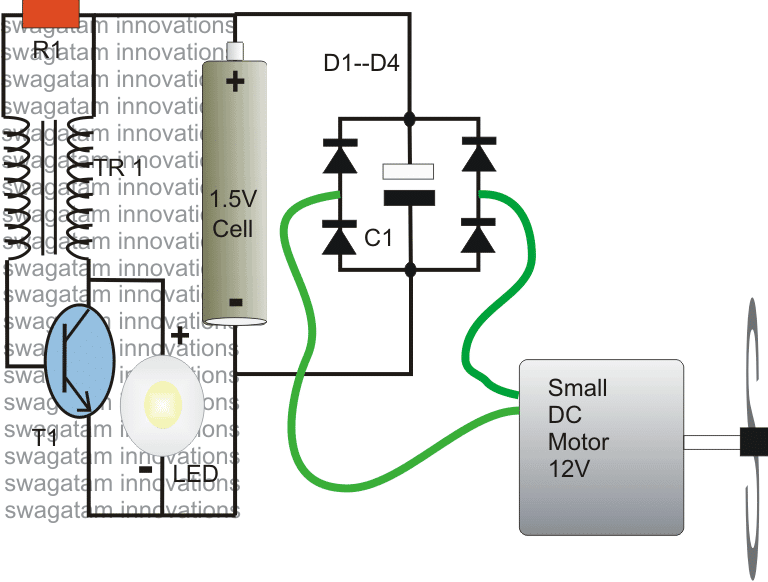
The above circuit can be also driven using a DC motor. A simple diode and a filter capacitor rectification would be enough to convert the supply from the motor suitable for illuminating the LED very brightly.
If the motor rotation is sustained with the help of a turbine/propeller arrangement and operated by wind energy, the LED can be kept illuminated continuously, absolutely free of cost.
Video Demonstration
Parts List
- R1 = 1K, 1/4 watt
- T1 = 8050
- TR1 = see text
- LED= 1 watt, high bright Cell = 1.5V Ni-Cd
- D1---D4 = 1N4007
- C1 = 470uF/25V
- M1 = Small 12V DC motor with propeller
Design#2: Illuminating a Blue LED with 1.5V Cell
LEDs are getting popular day by day and are being incorporated for many applications wherever an economic lighting solution becomes an issue.
LEDs are by itself are very economic as far as power consumption is concerned, however the researches are never satisfied and they are trying hard, relentlessly to make the device yet further efficient with their power requirements.
Here's an alternate joule thief design of a simple Blue and white LED driver that works with just 1.5 volts for the illuminating 3.3V LEDs, and looks pretty amazing and too good to be true.
If we go through the datasheet of a blue or a white LED, we can easily find that these devices need a minimum of 3 volts to light up optimally.
However the present design employs just a single 1.5 V cell for producing the same as with a 3 V battery.
That’s where the whole configuration becomes very special.
The Importance of Inductor
The trick lies with the inductor L1 which in fact becomes the heart of the circuit.
The entire circuit is built around a single active component T1, which is wired up as a switch and is responsible for switching the LED at a very high frequency and at a relatively high voltage.
Thus the LED is never switched ON continuously rather stays ON only for a certain portion of the time period, however due to persistence of vision we find it switched ON permanently without any oscillation.
And because of this partial switching the power consumption also becomes partial making the consumption very economic.
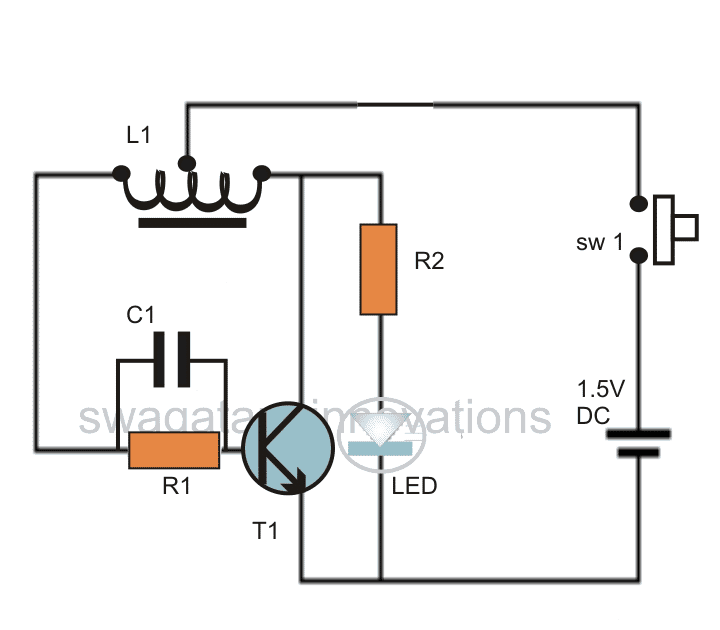
This LED Joule thief circuit may be simulated with the following points:
How it Works
As can be seen in the diagram, the circuit involves only a single transistor T1, a couple of resistors R1, R2 and the inductor L1 for the main operation.
When power is switched ON, transistor T1 is forward biased instantaneously through the left half winding of L1. This pulls the current stored inside L1 through the collector of T1 to ground which is technically twice the value of the applied supply voltage.
The grounding of L1 instantly switches off T1since the action inhibits the base bias current of T1.
However the moment T1 switches OFF, a peak voltage twice the value of the supply voltage, generated as a result of a back EMF from the coil is dumped inside the Led, illuminating it brightly.
The condition however stays only for a fraction of a second or even less when the T1 switches ON once again, because its collector is no longer pulling the base drive to ground during that instant.
The cycle keeps on repeating, switching the LED as described above at a very rapid rate.
The LED consumes a nominal 20 mA in the switched ON condition, making the whole proceeding truly efficient.
Making the Coil L1
The making of L1 is by no means difficult at all, in fact it does not carry much criticality, you may try a number of versions by varying the number of turns and by trying out different material as the core, of course they all must be magnetic by nature.
For the proposed circuit, one can use the wire from a discarded 1amp transformer. Use the secondary winding wire.
A 3 inches nail may be selected as the core over which the above wire needs to be wound.
Initially you may try winding about 90 to 100 turns over it, don’t forget to remove the center tap at 50th winding.
Alternatively, if you a have some lengths of telephone wire in your junk box, you may try it for the design.
Tear apart one of the wires from the twin section and wind it over an iron nail having a length of about 2 inches. Wind at least 50 turns and follow the procedures as explained above.
Rest of the things may be assembled with the help of the given schematic.
Switching ON power to the assembled circuit will instantly illuminate the LED and you can use the unit for any relevant desired application.
Parts List
You will require the following parts for the proposed 1.5 white/blue LED driver circuit:
- R1 = 1K5,
- R2 = 22 Ohms,
- C1 = 0.01uF
- T1 = BC547B,
- L1 = as explained in the text.
- SW1 = Push to ON switch.
- LED = 5 mm, Blue, white LED. UV LEDs can aso be driven with this circuit.
- Supply = From 1.5 penlight cell or a button cell.
Design#3: Illuminating four 1 watt LEDS with 1.5V Cell
Can you imagine illuminating four numbers of 1 watt LEDs through a a few 1.5V cells? Looks quite impossible. But it can be done simply using a coil of ordinary speaker wire, a transistor, a resistor and of-course a 1.5V pencil cell.
The idea was suggested to me by one the keen followers of this blog Ms. MayaB, here are the details, I have explained them:
Circuit Operation
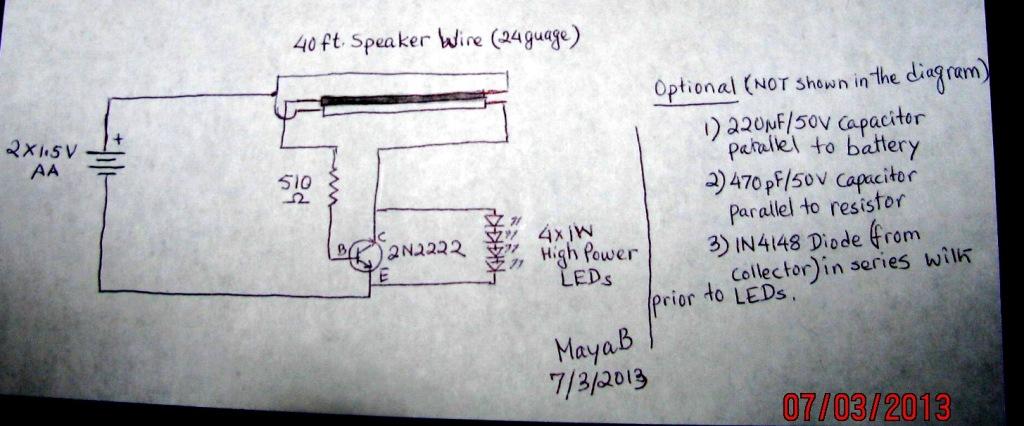
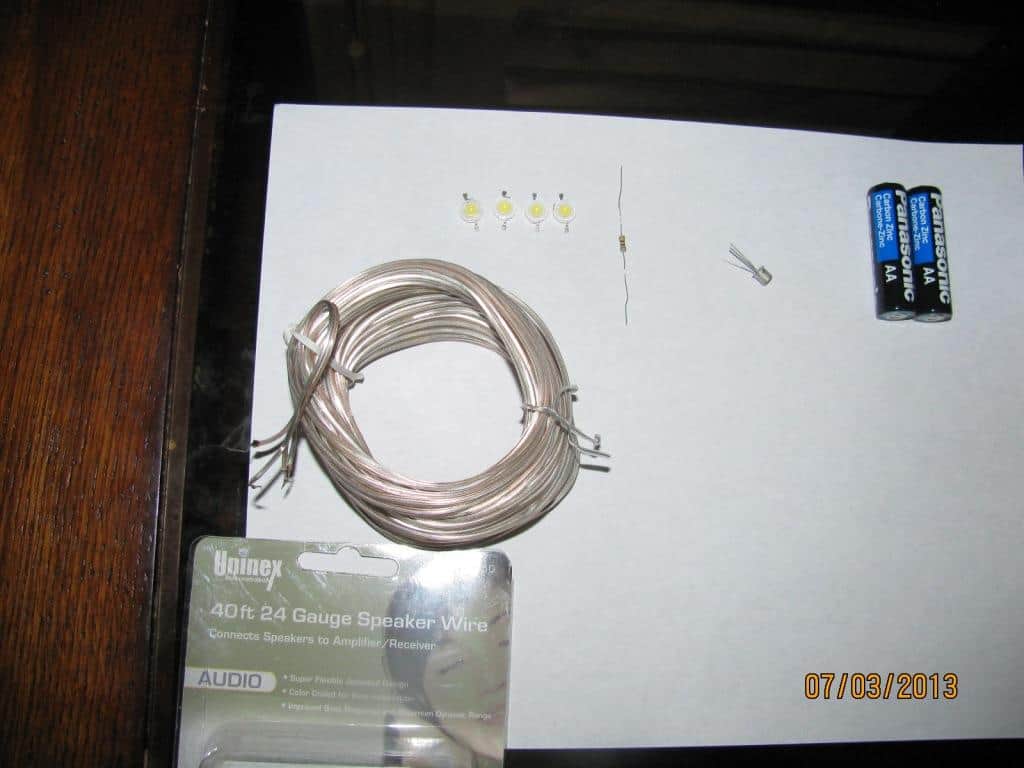
FYI, I tried this simple JT using a 40ft. paired speaker wire (24AWG) purchased at dollar store (of course, for $1).
No torroid, no ferrite rod, just simple air core wound to make it more like a coil (about 3" diameter) and tied the wire with a twistie tie (so that the wire will stay as a coil).
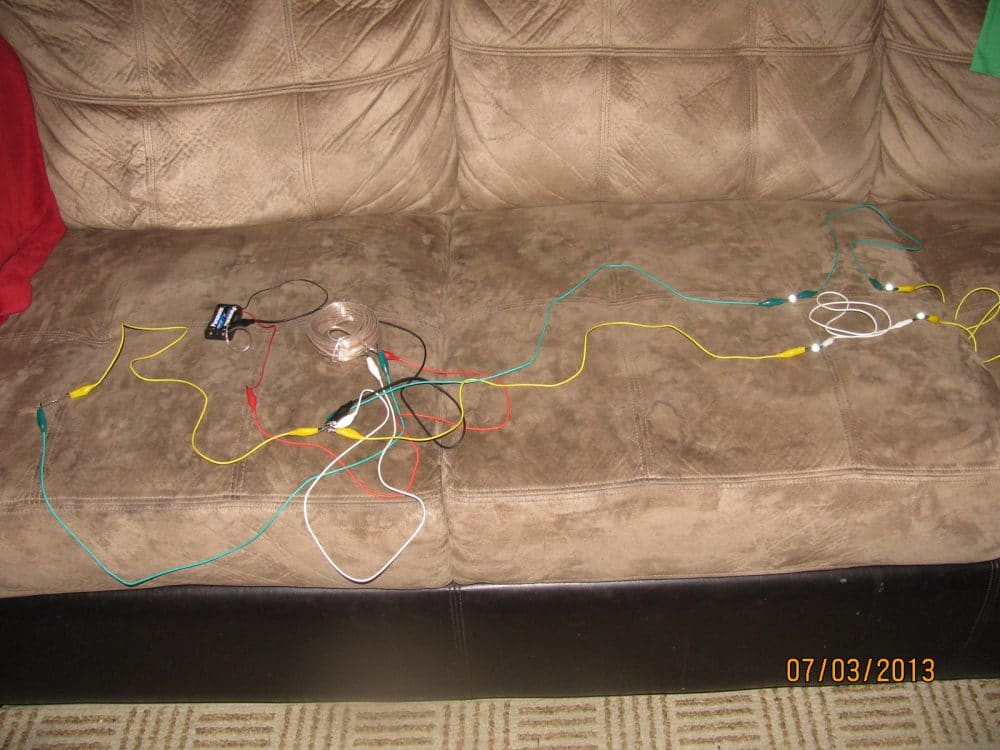
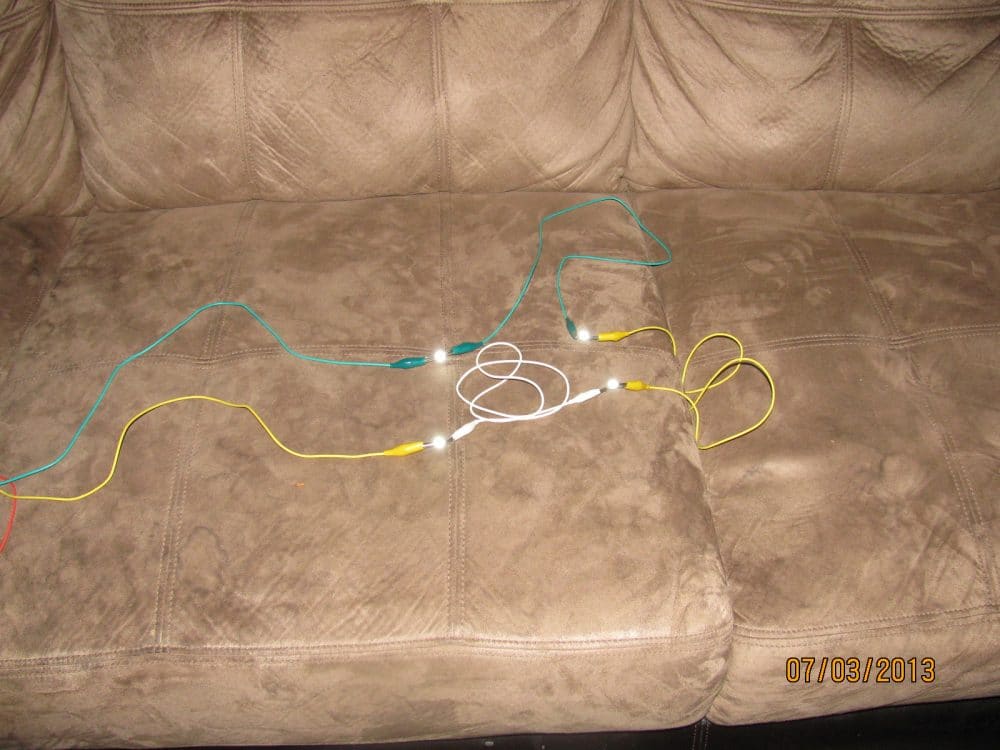
I used 2N2222 transistor, 510 ohm resistor (found out that is the best with a help of potentiometer) and was able to BRIGHTLY lit four (that is all I had) 1-watt high power LED in series (which requires same amount of current as if it was used for only one LED) using two 1.5V AA batteries (that is 3V power supply).
Can be used only one 1.5AA but will be dim (of course). I have also added a diode 1N4148 at the transistor's collecter pin just before the LED but can't tell if it increased any brightness.
Many people have used a capacitor in parallel to the battery claiming it will light the LEDs longer, I have not tested that part yet.
I have read adding a 220uF/50V electrolytic capacitor parallel to the battery would make the lights run longer, adding a 470pF/50V ceramic disc capacitor parallel to resistor will recouple the waste current in the resistor, and adding a 1N4148 diode (it is a switching diode but I don't know how would that effect the brightness) at collector of the transistor before the LEDs in series makes the LEDs brighter.
Using AAA 1.5V Cells
I don't have an oscilloscope to check all that effects. However, I would like to use rechargeable batteries instead of regular AAA 1.5V battery and make it self-regulated (or at least semi-self regulated) circuit by adding a calculator solar cell and a mini Joule Thief on a small toroid to keep charging the battery to last much-much longer.
I indeed need to add a LDR to light the LEDs only at dark and recharge the batteries during the daytime. Your suggestions and ideas are always welcome. Thanks, once again, for your interest.
Regards,
MayaB
Circuit Diagram
Prototype Images
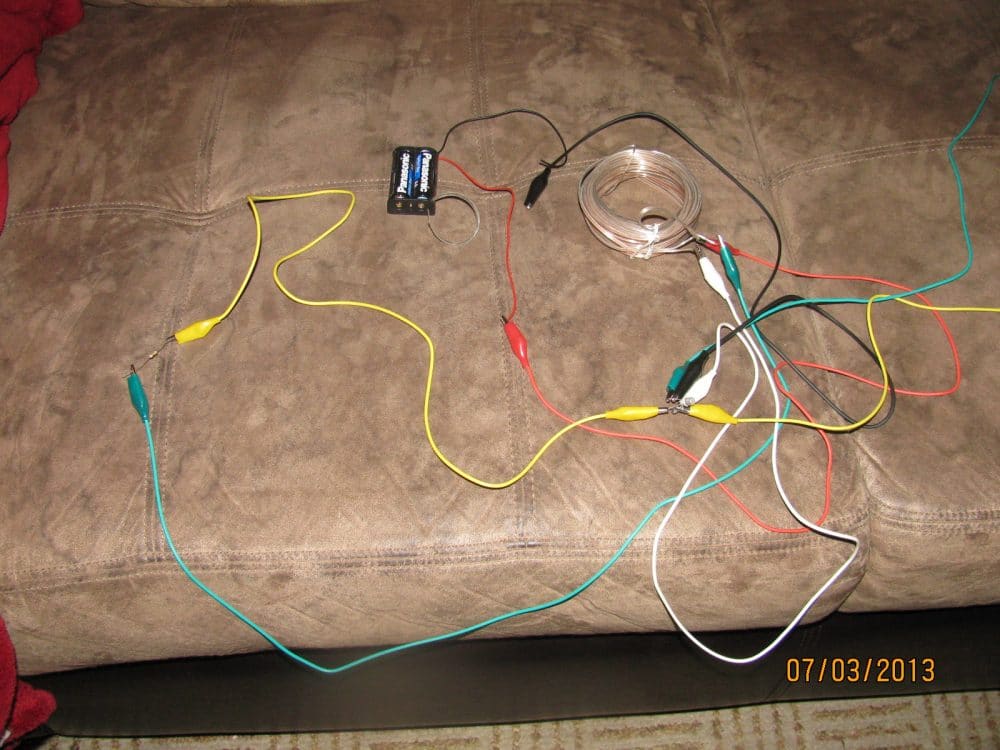
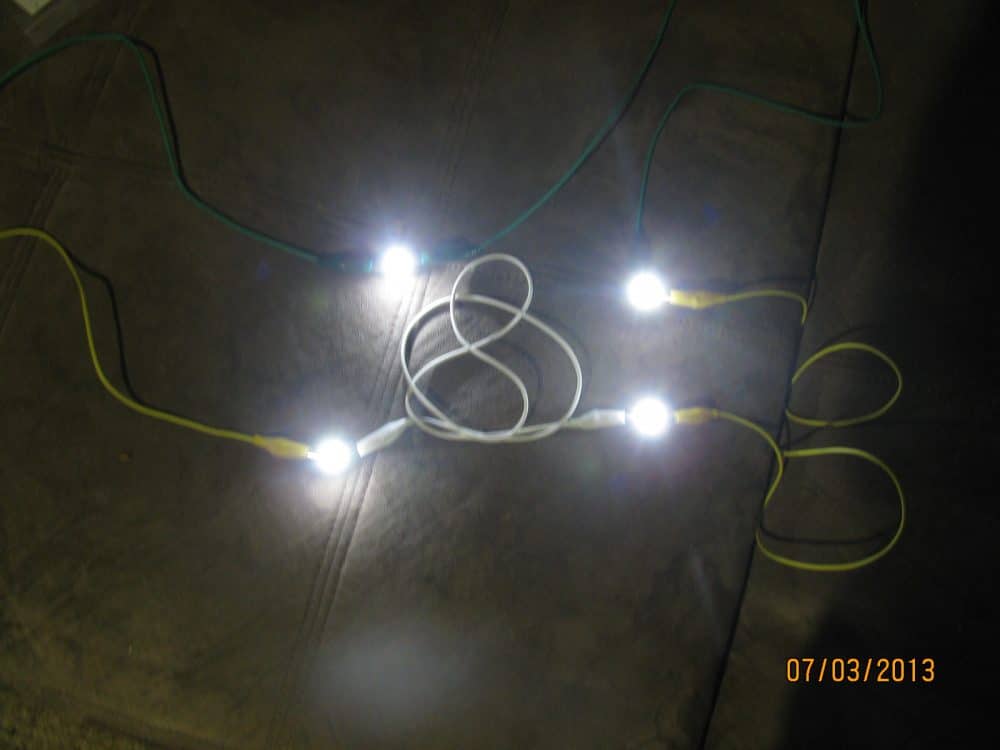
Feedback from MayaB
Hi Swagatam, Though it is long known Joule Thief circuit, not something new I discovered but thank you for posting a new article on behalf of me, I appreciated it.
Regards, MayaB
How to Improve Brightness of the LEDs
Ps. Over the weekend I hybridized your circuit with the circuit I sent you here and it turned out to be dazzling bright (warning: may blind your eyesight, hehe).
I used the same speaker wire (mentioned above), a 8050SL transistor, 2.2K resistor (paralled with a 470pf capacitor), one 1W high power LED, a 100uH choke (connected from collector of the transistor to the positive rail of power supply), and 1 diode (1N5822 connected at base of the transitor to the positive rail of the power supply).
I used two 1.5V (total of 3V) AA batteries for power supply. And btw, a LDR between 2.2K resistor and the negative rail can be added to turn the LED off during the daylight. Unfortunately, could not light more than one 1W LED with 8050SL transistor in this configuration.
Another Design for Illuminating High Power LEDs
The concept discusses yet another popular joule thief circuit, this time using power BJT 2n3055, improvised by my old friend steven in his own unique way. Let's get to the core of the developments with the following article:
In a few earlier article we covered some interesting theories summarized as given below:
- Stevens radiant joule thief battery charger circuit tests and results sunday may 9th 2010.
- The radiant joule thief circuit I built From a circuit schematic featured on a youtube video and here are the results So far
- With a aa size energizer battery, with a Measure voltage of only 1.029 volts left in it I got an output from the radiant Joule thief battery charger of 12.16 volts @14.7 milli amps.
- Test 2 using a small a23 energizer battery With a measured voltage of 9.72 volts in it I got 10.96 volts out from the circuit @0.325 milli amps.
- Test 3 I used a fully charged nimh rechargeable 9 volts battery with a measured charge of 9.19 volts dc in it and I Got 51.4 volts @137.3 milli amps output from the radiant joule thief battery Charger circuit.
- Test 4 I used a 3575a button cell battery With a measured charge of 1.36 volts in it and I got 12.59 volts out @8.30 milli amps.
- Test 5 I used an l1154 button cell battery With 1.31 volts measured in it and I got an output of 12.90 volts @7.50 milli amps.
- With an slr battery with a voltage of 12 Volts left in it I got 54.9 volts output @0.15 amps.
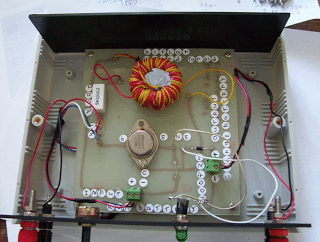
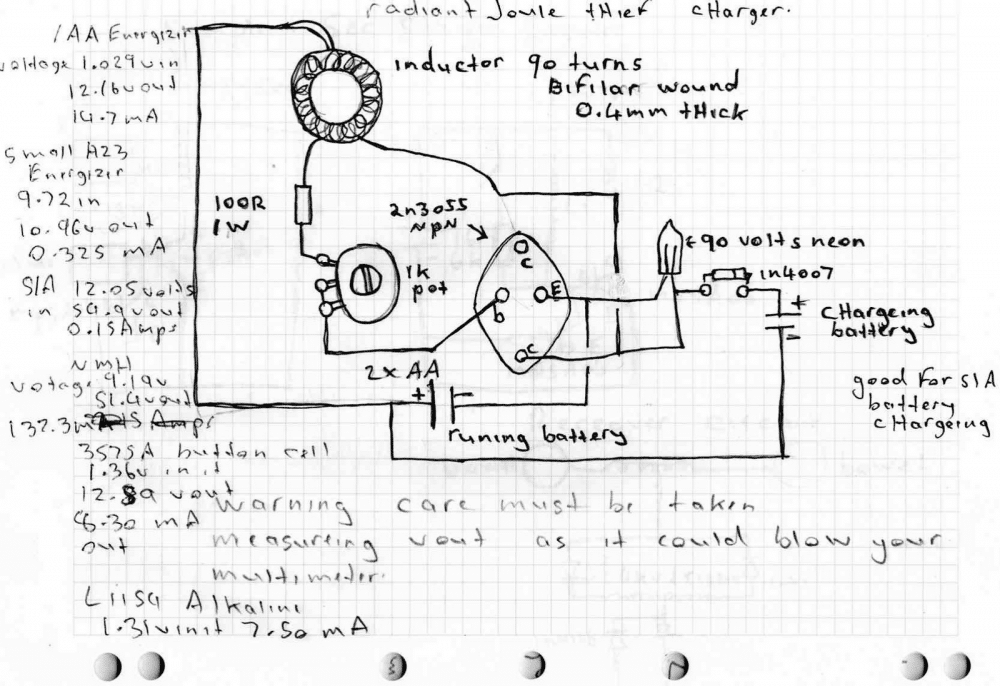
Here is the simplified drawing I built the Radiant joule thief battery charger by. The inductor I wound so many turns till It was to full to wind anymore.
But I brought 2x 5 or 6 meter lengths of Stranded copper wire unknown gauge from dicksmiths electronics insulated wire, and I wound most of it on except I think a few feet left over.
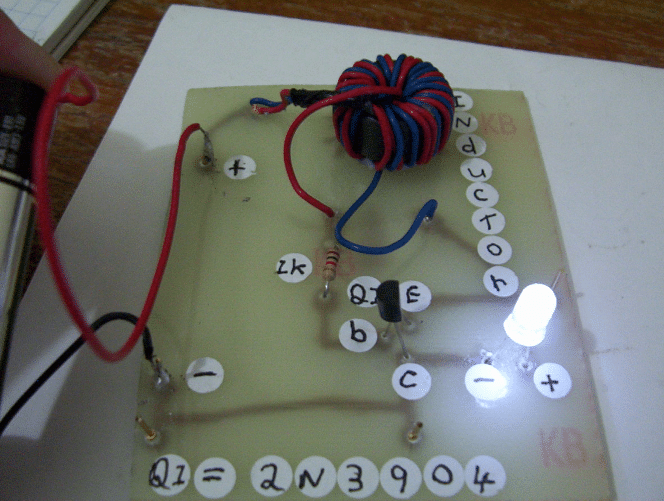
The latest test I used my pencil energizer Battery but I didn't remeasure the volts in it.
I powered the radiant energy Joule thief with it and at the outputs I put a 2200uf electrolytic capacitor Rated at 50 volts.
I ran my multimeter leads from it and got up to before I Stopped 35.8 volts , and that’s the charge being fed into the capacitor to ,
Before that I was getting 27.8 volts but as the capacitor was charging past the half way mark the voltage climb was slowing down, maybe due to the voltage from the battery getting low.
I'll have to remeasure it and do the test again in more detail.
Shorting the capacitor gave a snap noise And sparks. I tried it again charging it so far but This time I dumped the capacitor charge back into the input and this illuminated the neon for a second before the cap charge went down
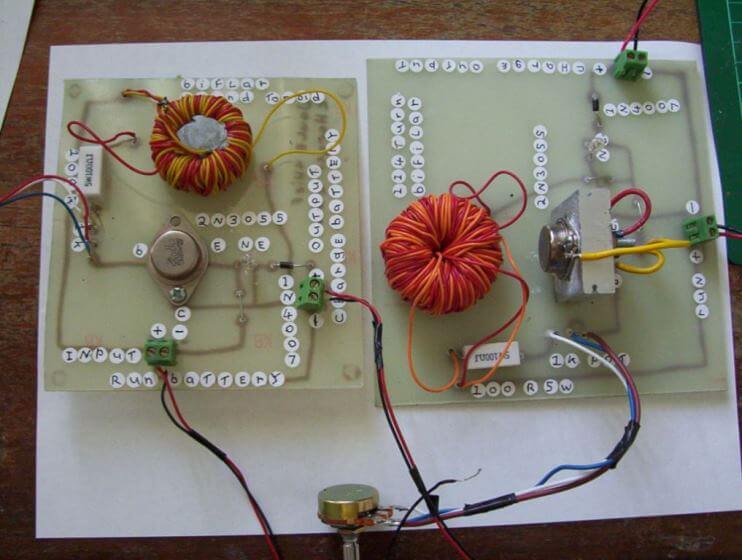
Next experiment was different I had the Outputs to my meter set to 200 millivolts range and the negative input I had my A23 energizer negative sitting on the negative input and the top positive well
My finger was on it only as for the positive input it was run to a rectangle peace of circuit Board on the end of a wire held in the air By an aligater clip.
The reading was climbing at a Faster rate I got o 47.2 millivolts before I stopped it I was getting power at
A good rate from no where with an open circuit here but I was also holding the Battery case to while doing the experiment. I just repeated these tests and got much improved results now.....
My tests will go on, and I'll keep you all updated with the latest, until then keep DIYing.
Well, these were 3 best circuits using the joule thief concept that I presented for you, if you have any more such examples please feel free to post the info through your valuable comments.
Reference: https://en.wikipedia.org/wiki/Joule_thief




Comments
Hi dear Swagatam,
Your efforts to develop electronics science are commendable
Joule Thief’s circuits were very interesting. I suggest you design one of them with a germanium transistor, I made one myself and it worked even with less than 0.5 volts
Thank you Dear Amirsaraf, you are absolutely correct!! Germanium BJTs are more efficient than the silicon counterparts….however silicon BJTs are mores easily available than the Germanium ones…thanks for your interesting feedback.
I have created a jewel thief circuit using BC547 and torroid 0.5mm coil 20:20 turns,1K resistor and a 5mm LED. Everything seems to be alright with the circuit. But it does not work with 1.5v. When i use 2.4 v the LED lights on. Of course with 3.7 v the LED is brighter . I have a 1.5-2v solar cell for this circuit. I do not understand the reason for not lighting of the LED with 1.5v. Is there any solution for this problem.
No .It was connecting the common to Vcc and the other two ends, one to 1k resister andother to collector.
In that case I would suggest you to please try the first circuit from the above article, and check the results..
Did you build the first circuit from top? That circuit is tested by me and it worked perfectly well with a 1.5V cell for me, and I could illuminate a watt LED nicely. You can see the results in the first video.
Which ferrite toroid ring did you use, use the T10 or T13 toroid.
Good morning swagatam,
it’s a privilege to people like you still alive. please I need to construct a joule that does not use battery just like that of YouTuber lasersaber so I can further use the output for my generator. where my family live back in our village there’s no light. Lasersaber did put the details or better still maybe I didn’t understand it well please help me with the details. I am new in electronics and everyone in the house is looking up to me
Thank you so much Donald, I appreciate your kind words!
Can you please elaborate on what is your exact requirement, with specifications, for example how do you want the joule thief circuit to work for your specific application? The power output spec needed, and what should be the input supply to the joule thief circuit? I will try to figure it out for you….
Dear Mr. Swagatam, thanks a lot for this useful and worthy job about the “Joule Thief” circuits!
In “How the Circuit Functions” you wrote, “T1 switches ON and pulls the entire supply voltage to ground and in the course chokes the current across the primary winding of the coil so that the biasing to T2 dries up, shutting off T1 instantaneously”.
Which is in the circuit “T2”? Where is T2 located on the circuit?
This circuit could be used with a bridge rectifier, using, for example, 4 UF4007 and an electrolytic capacitor?
I want to build an LED tester, like one used to test the LED lamps or the backlight LED TV.
Thanks a lot in advance for your attention!
Greetings from Argentina!
Thank you Alejandro, for pointing the typo mistake.
Actually there’s no T2 in the circuit, there’s only one transistor T1, it was probably a typing mistake which I have corrected now.
Yes, you can connect a bridge rectifier at the output with a filter capacitor, and use the boosted DC to test backlight LED strings.
Let me know if you have any further questions, I am always happy to help!
Hi sir , I want a circuit that inputs 0.7v and outputs 1.2v, 1.8v, 3.3v and 5v. How should I design it?
Hi Song,
For that you can specifically use a joule thief circuit and then get those specific supplies through respective zener diodes.
I have another question on the capacitor for the fan circuit. The C1 in the circuit is 470microf, 25V. The capacitors I have on hand are 4700microf, 50V and 2700microf, 10V. Are any of these capacitors suitable ? Why ? Thanks.
You can use 4700uF/50V, it will do the job nicely.
Hi, I am trying to understand the circuit better. You can assume that I am new to circuits. In the circuit with the fan design. The diodes have polarities pointing upwards and the capacitor has polarities pointing downwards. What if the 4 diodes are (a) removed i.e. purely leaving the battery to power the fan and charge the capacitor ?
(b) preserved as in the original setup, but we reverse the polarities i.e. of the diodes and at the same time, connect the fan terminals to the negative ends of the bottom most 2 diodes ?
Please do not feel obliged, but is there a video/ youtube channel on a working prototype of this circuit ?
Thanks.
Hi, In the joule thief circuit with a motor, the motor is used as a generator for charging the battery. Here, the fan (motor) is powering the battery, not the other way round.
If we connect the motor directly without the bridge rectifier, the battery will start getting discharged quickly through the motor winding.
I have added a video just below the diagram for your reference.
Hi every one. How many turns do we need to make the circuit with the 1w, and a 12V dc motor.
Hi, the number of turns will be 20. Just make sure to use bifilar type of wire for the winding. Bifilar means making a thicker wire using many thin wires together. So the wire thickness can be 1mm, built using many thin wires, for example by using 5nos of 0.2mm wires together.
Hi,
“Bifilar winding” means winding with two wires at the same time (bi-filar = 2-“threads”).
What you describe is named “Litze wire”.
Regards,
Sum
Thanks for the info, Yes you are absolutely right….
In your diagram with the cell phone connection above, there is a C2. Is the white portion (plate) of the capacitor C2 supposed to indicate the positive or negative end of the capacitor ?
What about the white portion of C1 found in the diagram with the small dc motor 12V above ? Thanks
The white portion indicates the positive terminal of the capacitor.
Can you please share a simple circuit for a solar light of 1watt LED using the IC QX5252F, AA battery and solar cells. Thanks.
Here’s the circuit which you can try, but I am not sure whether this IC is designed to charge the cell or not through the solar panel. Nothing is specified regarding this in the datasheet of the IC:
https://www.homemade-circuits.com/wp-content/uploads/2022/12/QX5252-solar-garden-light-circuit.jpg
Datasheet of the IC:
https://www.mikroshop.ch/pdf/QF5252F.pdf
Hi what happens if we connect the output to a COCKCROFT WALTON MULTIPLIER Circuit im planning to try charge a 60 volt lithium-ion battery …..any one tried this please advise…
It might work to generate the intended high voltage but that simply won’t charge a 60 V li-ion battery due to lack of current.
At least 0.6 volts is needed to trigger a transistor.
I wonder what effect would have adding permanent magnet to toroid. There should be some additional magnetic flux to harvest.
The circuits just shuts off (I just tried). When you add a permanent magnet next to the coil, you are saturating the nucleus and that affects the working of the circuit.
Sounds interesting! That needs to be investigated practically.
I can ask how to calculate the switching frequency. Thank you
I do not have the exact formula for this!
Hi sir, I want to appreciate your efforts, you’ve really done well in helping us expanding our horizon of electrical and electronics knowledge and your circuits works well!!! My question is:- Can the first schematic of the circuit be somehow modified to a buck converter?? Thanks in anticipation
Thank you 2DO, the joule thief circuits are actually boost converters, and there’s isn’t any option to transform them into buck converters.
Alrt, thanks. Can you please give recommendations on how to increase the output current?
Output current can be increased, by using thicker wires for the transformer, and also by using higher current transistor.
Hi Swagatam;
I tried the one of the above circuits which is proper for the small DC motor. The led is ok that lights but there is no voltage between the diodes to the Motor. I also used voltmeter but voltmeter shows zero Volt. Please advise where would be the mistake.
Hi Suat, a motor can consume a significantly high current which can cause massive drop in the joule thief output current. You may have to try some other high current boost converter such as this:
https://www.homemade-circuits.com/wp-content/uploads/2021/05/boost-charger-compressed.jpg
And make sure your input DC has sufficient current to handle the motor load optimally.
Thanks Swagatam. I mean the measurement while there was no load. Although there was no load and there was no output voltage too. On the other hand I also tried the circuit to cellphone there is output voltage measurable. I will try your new offer
Suat, You can try measuring the voltage with an LED connected. If the LED is illuminating then naturally there will be a voltage at the output. Unless the transistor and the coil and the input current are sufficiently upgraded, the circuit will not be able to charge a cellphone or drive a motor.
Hello Swagatam,
I’m planning to make the first circuit you gave above with a suitable mosfet. The input will be 5VDC, and the output will be a battery that will be kept in drop charge. You answered this before. However, I would like to draw a sample circuit and share it on my blog. No matter how inefficient the circuit is, isn’t it also possible to at least be used in trickle charging? Actually, what I want to learn is, could I not use a mosfet instead of a transistor in the circuit?
Hi Shampuan, you can try a mosfet…. however mosfets don’t work with 1.5V or 3V inputs.
Thank you. The input will be 5V and I will apply it to the Gate leg of the mosfet with a 220R resistor. At the output, I will connect a 12V battery for trickle charging. If I give up on this, I might decide to use the TIP41 transistor. The toroid transformer will be a large type that I can get from PC power supplies. Hey! Someone warn me if I talk too much 🙂
With 5V a MOSFET might not conduct well…so a BJT is the right choice…
Can you build a joule thief using a H-Bridge?
Hello Mr. Swagatam,
Using the same principle, I want to make a charging circuit for 12V lead batteries with 12Volt DC voltage. Do you think this would be efficient? I would like to develop the same idea for 5V USB adapters. If achievable, the user will be able to charge his motorcycle battery or a 7Ah UPS battery with an inexpensive 5V USB adapter. My only problem is the coil calculation for inductors. What do you say?
Thanks.
Hello Shampuan, a 5V USB is normally rated at 200 to 500mA current. If you use a joule thief circuit to boost the USB output 14V will cause the current to drop to around 100 mA, which cannot be used for any battery charging purpose
Thanks so much.
yes, you can, the core should be ferrite
Can I use small transformer with 3 terminl instead of torroid.