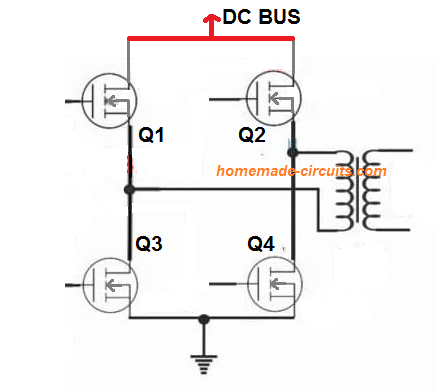
Bootstrapping is a crucial aspect that you will find in all H-bridge or full bridge networks with N-channel mosfets. It is a process in which the gate/source terminals of the high side mosfets are switched with a voltage that’s at least 10V higher than its drain voltage. Meaning, if the drain voltage is 100V, then […]
Newly Updated Circuit Projects:
P-Channel MOSFET in H-Bridge Applications
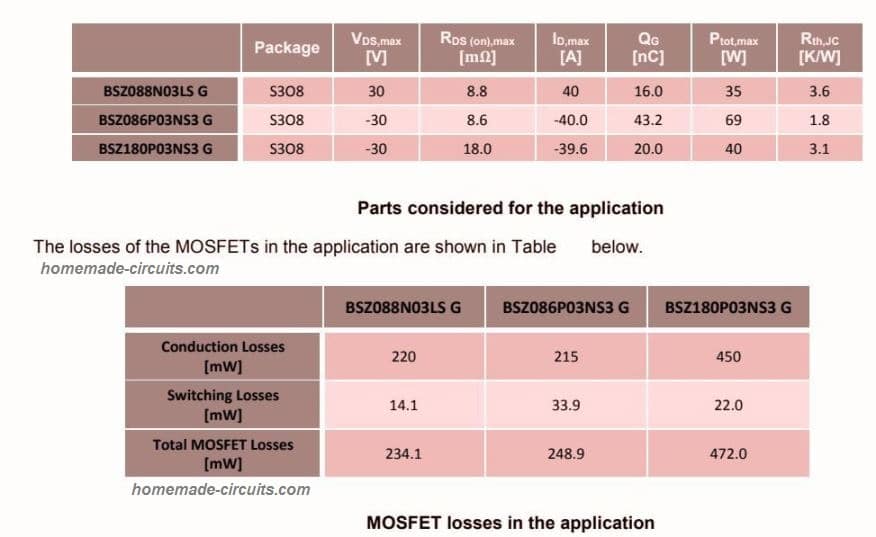
Implementing P-channel MOSFETs in an H-bridge circuit may look easy and enticing, however it may require some stringent calculations and parameters for achieving an optimal response. P-channel MOSFETs are usually implemented for load ON/OFF switching. The ease-of-use of P-channel options on the high side allows them to be very convenient for applications like Low-Voltage Drives […]
Capacitor Inductor Calculations
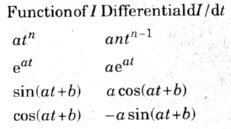
Inductors can be imagined as the opposite of capacitors. The main difference between a capacitor and an inductor is that a capacitor carries a protective dielectric between its plates, which inhibits the conduction of current across its terminals. Here it acts like an open circuit. On the other hand the inductance of an inductor is […]
Learning Basics of Semiconductors
In this post I will comprehensively explain regarding the fundamental working principles of semiconductor devices, and how the internal structure of semiconductors function under the influence of electricity. The resistivity value between these semiconductor materials neither has a complete conductor characteristic nor a complete insulator, it is in between these two limits. This feature may […]
How to Connect Transistors (BJT) and MOSFET with Arduino
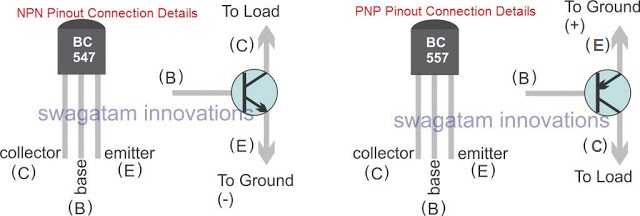
The interfacing of power devices like BJTs, and MOSFETs with Arduino output is a crucial configuration which allows switching high power loads through low power outputs of an Arduino. In this article we elaborately discuss the correct methods of using or connecting transistors like BJTs and mosfets with any microcontroller or an Arduino. Such stages […]
DC Biasing in Transistors – BJTs
In simple terms, biasing in BJTs may be defined as a process in which a BJT is activated or switched ON by applying a smaller magnitude of DC is across its base/emitter terminals so that its is able to conduct a relatively larger magnitude of DC across its collector emitter terminals. The working of a […]