• Skip to main content
  • Skip to primary sidebar

Homemade Circuit Projects

Need circuit help? Post them in the comments! I've answered over 50,000!

Blog | Categories | About | Contact | Calculators-online
You are here: Home / Automobile Electronics / Motorcycle Regulator, Rectifier Tester Circuit

DIY Circuits | Learn Basics | Arduino Coding

Motorcycle Regulator, Rectifier Tester Circuit

Last Updated on December 30, 2019 by Swagatam 1 Comment

The motorcycle regulator, rectifier tester circuit presented here can be used to test a 6-wire shunt type regulator-rectifiers for a 3-phase charging system of motorcycles. These reg./rectifiers (RR-units) are usually sealed with epoxy and it is considered difficult to find out if the unit is faulty or not.

Designed and Written by: Abu-Hafss

As the name suggests, the unit consists of 2 circuits i.e. the Regulator and the Rectifier. Usually, the wires are coded as below:

Red = BATTERY +

Green = EARTH (Chassis or Battery -)

Black/Yellow = IGNITION

3 Yellow or 3 Pink = 3 PHASES
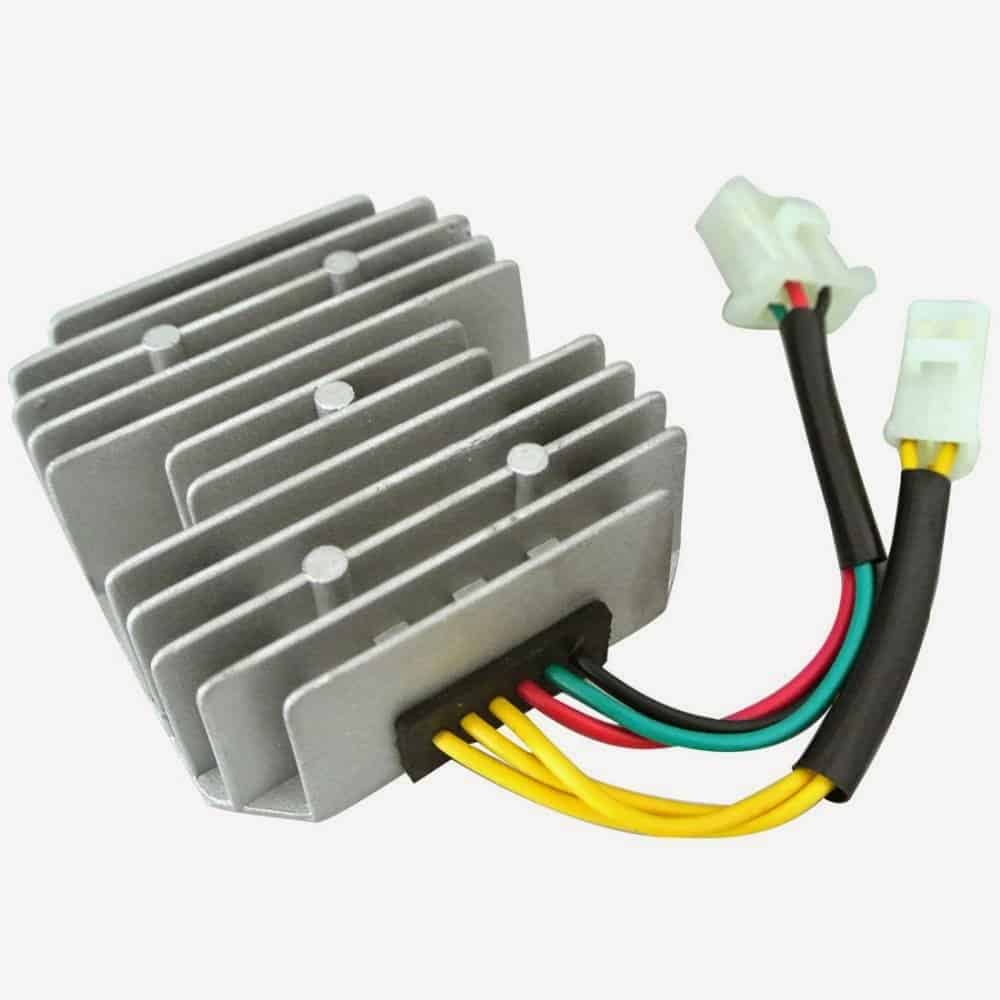
readymade motorcycle rectifier regulator

To test those 2 circuits, the tester circuit is also divided accordingly.

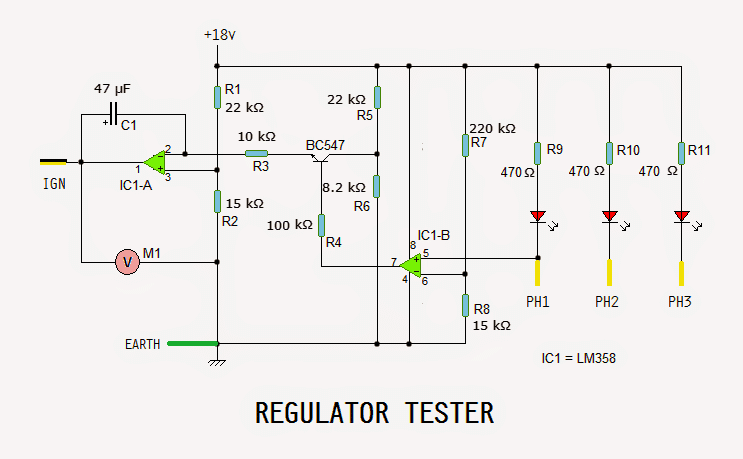
REGULATOR TESTER:

To test the Regulator, its wires are connected to the test circuit as shown. The red wire is not used.
Motorcycle Regulator, Rectifier Tester Circuit

The op-amp IC1-A (along with C1, R1, R2, R3, R5 and R6) is configured as an integrator. R1 & R2 forms a voltage divider, which provides about 7V as reference voltage to the op-amp. R5 & R6 forms another voltage divider to provide ramp-triggering voltage (lower than 7V) thru Q1 BC547 which act as a switch.

Initially Q1 is on, hence a ramp voltage is generated from about 7V to about 16.5V. This ramp is fed into the RR-unit via its IGNITION wire (BLACK/YELLOW).

If the RR-unit is good, its regulator circuit will trip at 14.4-15V (and supply gate voltages to the 3 SCRs inside the RR-unit). The anodes of those SCRs are connected to 3 phases, i.e. the 3 YELLOW wires. The three red LEDs will find path to ground via yellow wires & SCRs hence, they light up.

At the same time, voltage from one of the phases is fed into pin# 5 of IC1-B which is configured as voltage comparator. It compares it with the reference voltage assigned by voltage divider R7 & R8. Since the voltage at pin#5 is lower than the ref. voltage at pin# 6, the output at pin# 7 becomes low.

This switches off Q1 thereby cutting off the ramp-triggering voltage. The ramp voltage comes to a halt. This regulated voltage (14.4 - 15V) can be read with voltmeter M1.

If any of the LEDs does not light up or none of the LEDs light up, it indicates that one or more SCRs are bad. If the voltmeter reads around 16.5V, it indicates the regulator circuit is not working.

RECTIFIER TESTER:

The rectifier section of RR-unit consists of only 6 rectifier diodes as shown. The wires are connected as shown. The Black/Yellow wire is not used.
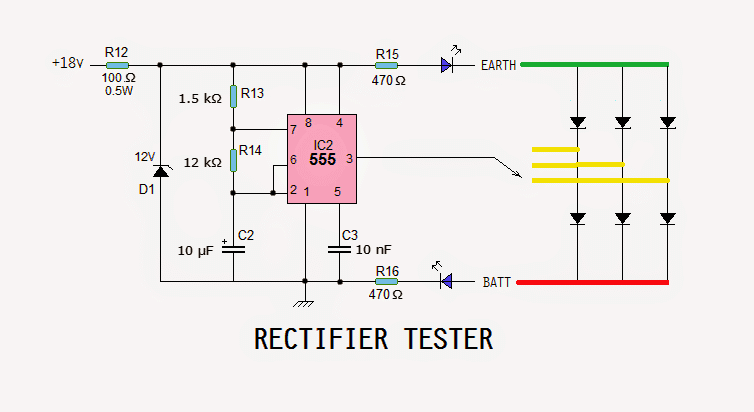
IC2 is a 555 which is configured as an astable vibrator. Since the supply voltage is 18V and max voltage for 555 is 15V, a zener diode D2 is introduced to protect the IC.

The output is connected to 1 yellow wire at a time. Both the LEDs should blink, indicating that the corresponding rectifiers are good. If only one LED or no LED blinks, it indicates one or both rectifiers are bad.

Now, the connections of red and green wires are interchanged. If one or both LEDs blink, it indicates that the rectifiers are short (bad).

p.s. I have tested the above explained motorcycle regulator, rectifier tester circuit
-Abu Hafss

You'll also like:

  • windshield washer fluid indicator circuitWindshield Washer Fluid Indicator Circuit
  • carturnsignalindicatorcircuitCar Turn Signal Flasher Circuit with Lamp Malfunction Indicator
  • bicyclesafetylightsCyclist’s Safety Light Circuit – Nighttime Visibility for Cyclists, Walkers, Joggers
  • pwm 3Adding a PWM Multi-spark to Automobile Ignition Circuit

Filed Under: Automobile Electronics Tagged With: Motorcycle, Rectifier, Regulator, Tester

About Swagatam

I am an electronics engineer and doing practical hands-on work from more than 15 years now. Building real circuits, testing them and also making PCB layouts by myself. I really love doing all these things like inventing something new, designing electronics and also helping other people like hobby guys who want to make their own cool circuits at home.

And that is the main reason why I started this website homemade-circuits.com, to share different types of circuit ideas..

If you are having any kind of doubt or question related to circuits then just write down your question in the comment box below, I am like always checking, so I guarantee I will reply you for sure!

Previous Post: « Remote Controlled Fish Feeder Circuit – Solenoid Controlled
Next Post: Submersible Pump Start/Stop Circuit »

Reader Interactions

Comments

salman says:
December 29, 2020 at 12:06 pm

i want this i have renegade commando bike

Reply

Need Help? Please Leave a Comment! We value your input—Kindly keep it relevant to the above topic! Cancel reply

Your email address will not be published. Required fields are marked *

Primary Sidebar

circuit simulator image

Subscribe to get New Circuits in your Email

Categories

  • Arduino Projects (95)
  • Audio and Amplifier Projects (133)
  • Automation Projects (18)
  • Automobile Electronics (103)
  • Battery Charger Circuits (87)
  • Datasheets and Components (109)
  • Electronics Theory (149)
  • Energy from Magnets (27)
  • Games and Sports Projects (11)
  • Grid and 3-Phase (20)
  • Health related Projects (27)
  • Home Electrical Circuits (13)
  • Indicator Circuits (16)
  • Inverter Circuits (95)
  • Lamps and Lights (159)
  • Meters and Testers (71)
  • Mini Projects (28)
  • Motor Controller (68)
  • Oscillator Circuits (28)
  • Pets and Pests (15)
  • Power Supply Circuits (91)
  • Remote Control Circuits (50)
  • Renewable Energy (12)
  • Security and Alarm (64)
  • Sensors and Detectors (106)
  • SMPS and Converters (34)
  • Solar Controller Circuits (60)
  • Temperature Controllers (43)
  • Timer and Delay Relay (49)
  • Voltage Control and Protection (42)
  • Water Controller (37)
  • Wireless Circuits (31)

Other Links

  • Privacy Policy
  • Cookie Policy
  • Disclaimer
  • Copyright
  • Videos
  • Sitemap

People also Search

555 Circuits | 741 Circuits | LM324 Circuits | LM338 Circuits | 4017 Circuits | Ultrasonic Projects | SMPS Projects | Christmas Projects | MOSFETs | Radio Circuits | Laser Circuits | PIR Projects |

Social Profiles

  • Twitter
  • YouTube
  • Instagram
  • Pinterest
  • My Facebook-Page
  • Stack Exchange
  • Linkedin

Recent Comments

  • Swagatam on How to Configure Resistors, Capacitors and Transistors in Electronic Circuits
  • Win Myat Han on How to Configure Resistors, Capacitors and Transistors in Electronic Circuits
  • Swagatam on Making a Thermoelectric Generator (TEG) Circuit
  • Swagatam on EGS002 Datasheet, Circuit Diagram Explained
  • Swagatam on About Me

© 2026 · Swagatam Innovations