• Skip to main content
  • Skip to primary sidebar

Homemade Circuit Projects

Need circuit help? Post them in the comments! I've answered over 50,000!

Blog | Categories | About | Contact | Calculators-online
You are here: Home / Audio and Amplifier Projects / Extended Telephone Ring Amplifier/Repeater Circuit

DIY Circuits | Learn Basics | Arduino Coding


Extended Telephone Ring Amplifier/Repeater Circuit

Last Updated on May 5, 2022 by Swagatam 2 Comments

The discussed phone repeater circuit can extend the range of your land line ring sound from the phone such that one is able to make a call heard in another room or even in another house.

By: R.K. Singh

Circuit Operation

The circuit can be connected with an attached buzzer, the buzzer with a driving circuit is then further used to expand the range of it. Even a warning light (a light bulb / bulb for example) when be connected in case a person with hearing impairment was to use the device. To achieve multiple units one may connect more than relay output contacts for the respective loads.

How the phone repeater works:

The signal is derived directly from the telephone lines. The current from the lines passes through a set of capacitor C1 and resistors R1, R2, R3 and a rectifier bridge formed by diodes D1, D2, D3, D4. Thus a filtered DC signal is achieved which is then applied to the base of transistor Q1 in the form of a positive pulse signal.

The transistor Q1 responds to the rhythmic pattern of the signal received at its base, resulting in an inverted and amplified signal across its collector resistor.

This amplified collector signal is restricted by the set of resistor R5 and capacitor C2 network making sure that the signal is not pulsed rather direct and straight.

This modified DC is then applied to the set of Q2 and Q3 transistors connected in Darlington configuration for further amplification so that the final output is able to actuate the relay to activate the buzzer. D5 is used to protect transistors Q2 and Q3 for reverse relay coil back EMFs.

Circuit Diagram
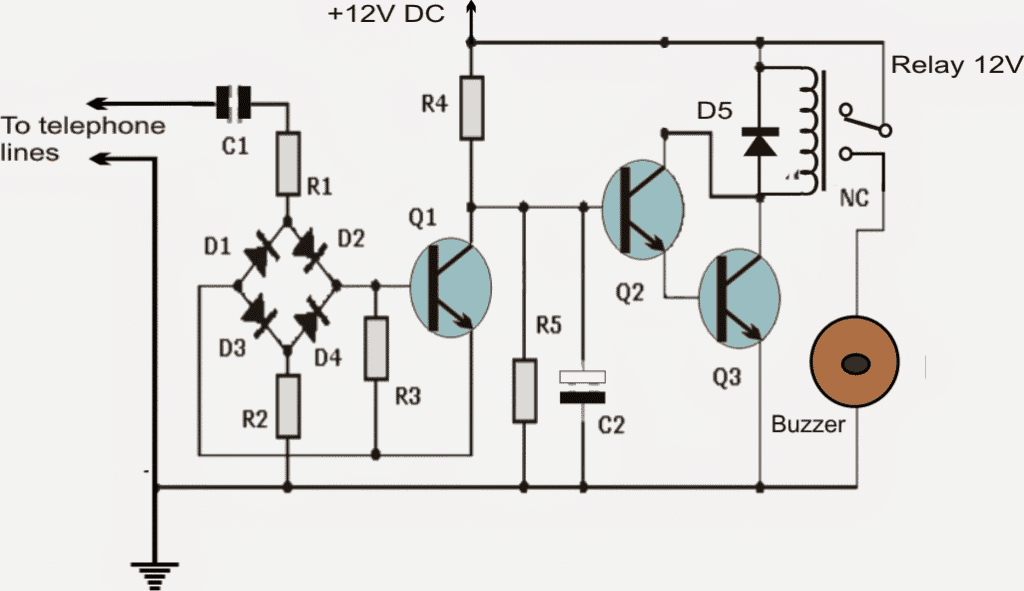
List of components for the proposed Telephone repeater circuit

- 2 transistors Q1, Q2: BC547B
- One transistor: Q3: BC337
- Five diodes D1, D2, D3, D4, D5 1N4148
- One capacitor C1: 0.033uF
- 1 electrolytic capacitor: C2: 1uF, 50V
- Two resistors R1, R2: 100K
- 1 resistor R3: 8.2K
- 1 resistor: R4: 180K
- 1 resistor: R5: 39K
- 1 relay (relay) 12V
- 1 12V loud buzzer

Caution: Do not reverse the polarity of the telephone wires to the repeater.

You'll also like:

  • ampmutecircuitsoundoperatedSound Activated Automatic Amplifier Mute Circuit
  • 49060Selecting Power Supply for Car Amplifiers
  • balanced 4Balanced Microphone Preamplifier Circuit
  • ISD1820 Voice Recording IC Datasheet, Circuit Diagram

Filed Under: Audio and Amplifier Projects Tagged With: Amplifier, Extended, Repeater, Ring, Telephone

About Swagatam

I am an electronics engineer and doing practical hands-on work from more than 15 years now. Building real circuits, testing them and also making PCB layouts by myself. I really love doing all these things like inventing something new, designing electronics and also helping other people like hobby guys who want to make their own cool circuits at home.

And that is the main reason why I started this website homemade-circuits.com, to share different types of circuit ideas..

If you are having any kind of doubt or question related to circuits then just write down your question in the comment box below, I am like always checking, so I guarantee I will reply you for sure!

Previous Post: « Simple Thermostat Circuit Using Transistors
Next Post: Make this Simple Music Box Circuit »

Reader Interactions

Comments

STEFAN says:
July 10, 2022 at 1:30 am

Good evening,
I have been following you for a long time and I especially appreciate your activity, which opened my appetite for electronics, but especially for multiples and extremely useful applications even for self-taught beginners like me.
But, related to the circuit described above, it reminded me that I have several electronic landlines, from which I would like to use parts of the assemblies (keyboard, amplifier, bell, etc.); can you help me with schemes of such devices?
Thanks

Reply
Swagatam says:
July 10, 2022 at 10:44 am

Hi, sure, I can help you with common electronic circuits which can be built using common spare parts from electronic devices like telephones etc. If you can tell me which parts you have gathered I will try to figure out which small circuits could be built using those parts.

Reply

Need Help? Please Leave a Comment! We value your input—Kindly keep it relevant to the above topic! Cancel reply

Your email address will not be published. Required fields are marked *

Primary Sidebar

circuit simulator image


Subscribe to get New Circuits in your Email


Categories

  • Arduino Projects (93)
  • Audio and Amplifier Projects (133)
  • Automation Projects (17)
  • Automobile Electronics (101)
  • Battery Charger Circuits (85)
  • Datasheets and Components (109)
  • Electronics Theory (149)
  • Energy from Magnets (27)
  • Games and Sports Projects (11)
  • Grid and 3-Phase (20)
  • Health related Projects (27)
  • Home Electrical Circuits (13)
  • Indicator Circuits (16)
  • Inverter Circuits (95)
  • Lamps and Lights (159)
  • Meters and Testers (71)
  • Mini Projects (28)
  • Motor Controller (68)
  • Oscillator Circuits (28)
  • Pets and Pests (15)
  • Power Supply Circuits (91)
  • Remote Control Circuits (50)
  • Renewable Energy (12)
  • Security and Alarm (64)
  • Sensors and Detectors (106)
  • SMPS and Converters (34)
  • Solar Controller Circuits (60)
  • Temperature Controllers (43)
  • Timer and Delay Relay (49)
  • Voltage Control and Protection (42)
  • Water Controller (36)
  • Wireless Circuits (30)


Other Links

  • Privacy Policy
  • Cookie Policy
  • Disclaimer
  • Copyright
  • Videos
  • Sitemap


People also Search

555 Circuits | 741 Circuits | LM324 Circuits | LM338 Circuits | 4017 Circuits | Ultrasonic Projects | SMPS Projects | Christmas Projects | MOSFETs | Radio Circuits | Laser Circuits | PIR Projects |

Social Profiles

  • Twitter
  • YouTube
  • Instagram
  • Pinterest
  • My Facebook-Page
  • Stack Exchange
  • Linkedin


Recent Comments

  • Swagatam on 9 Simple Solar Battery Charger Circuits
  • Gagana on 9 Simple Solar Battery Charger Circuits
  • Swagatam on Arduino 2-Step Programmable Timer Circuit
  • Swagatam on Simple Buck-Boost Converter Circuits Explained
  • Swagatam on IC IR2111 H-Bridge MOSFET, IGBT Driver IC: Full Datasheet, Circuit Diagram

© 2026 · Swagatam Innovations