In this post we investigate how to connect popular voltage regulator ICs such as 7812, 7805 in parallel for acquiring high current output from the ICs.
Voltage regulator chips mostly have their maximum current output specs fixed to some predetermined levels. Increasing them to a higher level would normally call for external out board transistors and complicated associated circuitry which might be difficult to configure for the new hobbyists. Connecting a few of them in parallel, possibly solves the problem.
The idea was requested by Mr.Raja.
Technical Specifications
Sir,
could i use three L 7815 voltage regulator ic in parallel, to get 15 volt 4 amps dc current from about 20 volt 5 amp dc source?
Sir, as LM 338 and their equivalent ic s ( which gives 5 amps ) are not available in my town. I planned to use three 7815 in parallel. Is my idea works? If so please help me.
How can i connect them in parallel ? Could i connect input of all three 7815 ic by a common wire or i should separate mutually by a diode of 2 amp? And what about out put, should i separate them or use
a common wire? And i think, i can connect the negative terminal of ic with a common wire. Is it? Please guide me.
Solving the Circuit Request
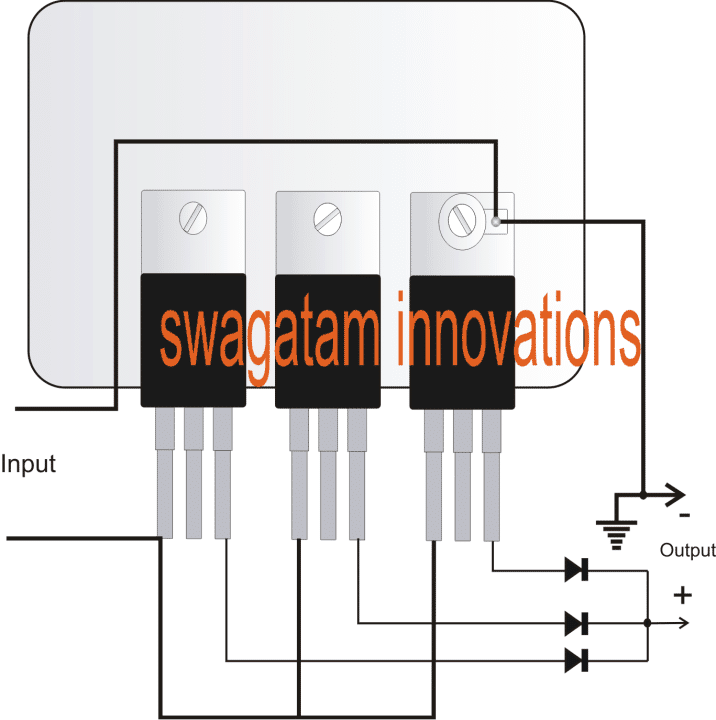
Although not recommended by many, the issue can be handled simply by connecting the regulators in parallel, as shown in the following diagram.
Here we can see the terminals of the all the three ICs connected in parallel except the output pins which are terminated with individual diodes.
However the above connection might face a crucial drawback. Since all the ICs wouldn't have precisely identical characteristics and specs could vary with their current limits, and ultimately lead to one of them supplying greater amount of current than the other, and overheating in the course.
Although this won't pose a threat to the ICs as these are always thermally protected from inside, it's never a good idea to have a semiconductor device sizzle unnecessarily.
The issue can be very easily tackled by connecting the counterparts over a common heatsink, as shown in the diagram below.
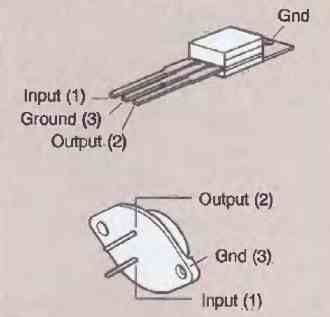
Since the tab for the ICs connect with their identical common leads (ground lead), doesn't need any sort of isolation in the form of mica isolation kit etc.
Just make sure to put them over a common aluminium plate, and then you can relax as the heat dissipation across the plate would result in correct transition of heat enabling each one with an equal share of current at their respective outputs which in return would result in an optimally combined higher current outputs, as required.
Circuit Diagram
High Current from IC 7805 using 2N3055 External Transistor
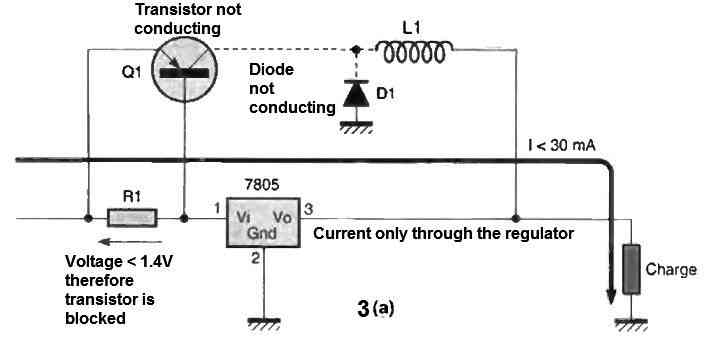
Although using 7805 or 7812 ICs in parallel is a good way of getting an enhanced current output from these chips, a better alternative is perhaps by using an external power transistor, as indicated in the following diagram:
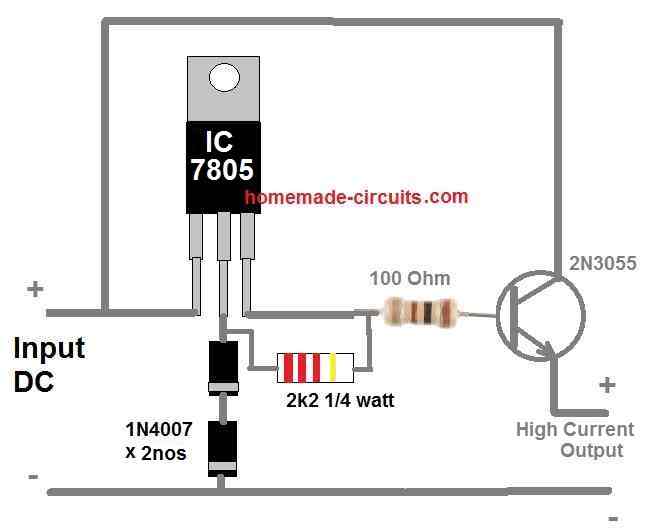
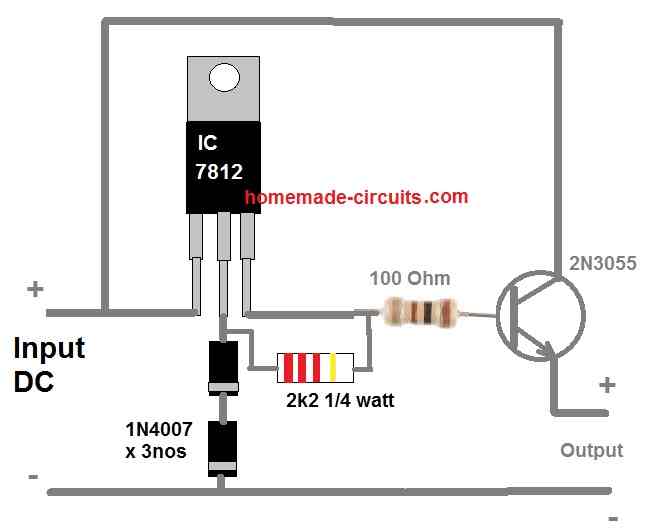
You can get as high as 5 amps from the above setup using a single 7805 IC and a 2N3055 transistor. The output will as regulated as a 78XX IC can provide. The output will be around 5 V 5 amps or 12 V 5 amps depending on which 78XX IC is used.
You can tweak the output voltage slightly by manipulating the number of 1N4007 diodes at the GND terminal of the IC.
The current output can be further adjusted by adjusting the value of the 100 ohm base resistor.

Comments
I'm curious to know if the spacing of, or rather the space between, the devices is crucial? Also, what's the draw of the devices themselves? By that I mean, Is there substantial current draw with not no load on the regulated volatge?
Sir, is it possible to regulate a 12v 65Ah car battery to 6v dc and still have close to the 56Ah at the output by connecting 7806 regulators in parallel. If yes, then how many pieces of the regulators will be used. Thanks.
Yes it would be possible but you will have to use as many as 60 nos of them, instead you can use 10nos LM196 and connect then in parallel by following the conditions provided in the above article.
sir
here i am looking for solar inverter,but without battery for day time purposes ,no back up required, kindly give me some idea about this circuit
Hi Vijay,
I'll try to design it and post it soon in this blog.
thank u sir
here i am asking about residential need purposes ,like fan,light,tv.
kind regards
vijay
Hi Vijayakumar,
What kind of load do you want to operate? please specify the load type and power, I'll try to help you with the right circuit.
It may be done for 7812, but for 7815 as proposed above the issue won't matter much.
current can be increased by increasing the thickness of the secondary winding.
To decrease voltage reduce the number of turns, and to increase current use thicker wire.
Please is it possible to produce a joule thief circuit that can use a 4×1.5v battery in parallel to produce 1.5v and 6amp and upconvert it to 12v? Please if possible how can i get the circuit?
Yes it is possible but it won't produce 6amps.
Rather its capacity will increase to 6 AH, AH refers to charge or discharge rate in terms of current in an hours time, it's does not suggest the current delivering capacity.