A tap water heater circuit can be simply built by attaching an iron tube on the mouth of the tap or the faucet, and allow the iron pipe to pass through an induction heater coil. The induction heater will heat up the iron pipe and hence water passing through the the pipe will also heat up and provide a warm water for the user from the other end of the pipe.
Materials Needed
To build this project you will need the following basic materials:
A ready made induction heater circuit that can be powered from a 12V 10 amp SMPS DC power supply.
An appropriately fabricated metal pipe with Bakelite holder at one end which can be clamped to the tap mouth.
An appropriately dimensioned Bakelite box for enclosing the induction heater, the induction coil, and the metal pipe.
The Set Up
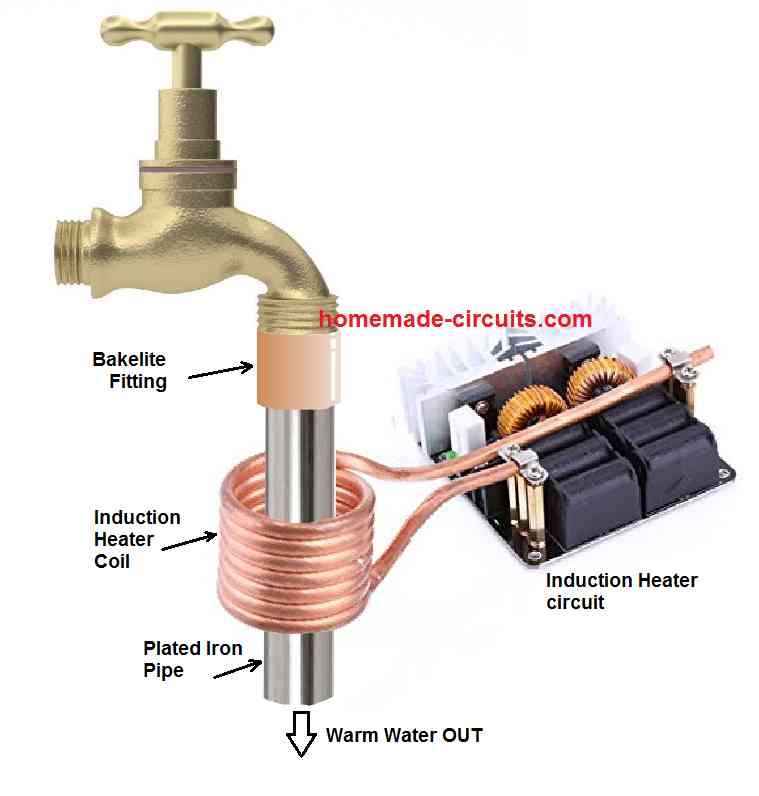
The complete set up for the induction tap water heater circuit can be witnessed in the following set up diagram:
In this set up we can see a plated iron pipe or a galvnized iron pipe is clamped to the mouth of the tap via a bakelite adapter cap. The bakelite cap ensures that the heat from the iron is not able to disperse to the tap metal, and remains instact within the iron pipe.
The iron pipe can be seen encircled by the induction heater coil, or in other words the iron pipe is allowed to pass through the induction heater coil.
The metal pipe diameter must be selected to ensure that the amount of water passing through it is not too large, and the water is able to get warm enough while passing through the pipe. The water coming out from the pipe must be at least 35 degrees Celsius warm.
How to Enclose the Whole Set up
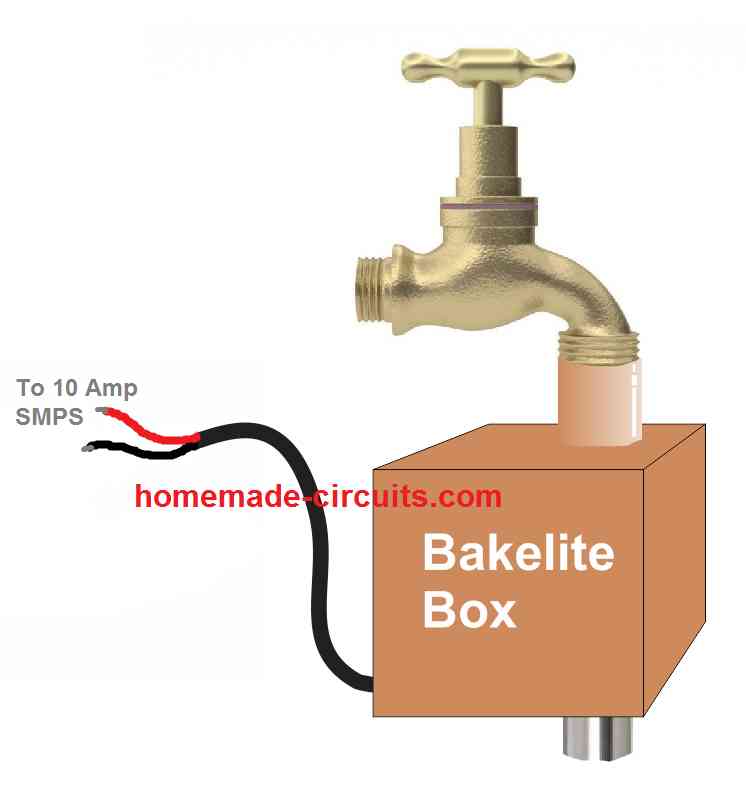
The above explained induction tap water heater circuit set up will need an appropriate enclosure which must be light, sturdy, water proof, heat proof, and could be attached to the tap system along with the iron pipe.
An example format of the enclosure can be seen in the following image.
The enclosure should have ample ventilation from the bottom side, so that the parts of the induction heater can dissipate the heat comfortably without getting too warm.
The power to the induction heater circuit enclosed inside must be supplied from an external SMPS unit, which may be rated at 12 V 10 amps.
Using the SMPS unit externally provides the user with an advantage of using the SMPS for some other desired purpose, when the heater is not being used.
Cheaper than Commercial Water Heater
If you compare the above induction based tap water heater circuit with commercially available geysers and water heaters you will find that the above set up is much cheaper and cost effective than the commercial units.
The complete set up can be built in less than $20, which is 50% less compared to the commercial units.
Also, the electricity consumption can be 50% less for the above explained concept, compared to the commercial heater units, which depend on heater coils rather than induction heating system.
Moreover, you get a free SMPS device which you can use for lighting LEDs, driving a power amplifier or a subwoofer amplifier, a benefit you can never get with the commercial heater units.


Questions & Answers
I’m looking at this to maintain the 180 degree temperature in my hydronic boiler return line that is 1 1/4″ copper pipe attached to the boiler via an iron pipe inlet.
Could this simple circuit be used and temperature controlled to do that? I know there are plate exchangers that can be used to do this, but I have solar panels that can provide 12v DC via an EcoFlow Pro 3 battery system to this induction circuit.
Yes, it can be customized for your specific application, by appropriately upgrading the work coil dimension and the input current capacity.
Great and respectful ideas. I have an idea and we need to cooperate in it to get out for everyone well and effectively, which is to convert the steam tank to the average steam iron about 3 liters of water or a little less to use the house or small projects so that we dispense with the traditional heater and replace it with a heated heater.I know that the project is not simple, but I also know that it is not very difficult, what do you think, dear engineer
Yes that’s possible using an induction heater, rated appropriately…
This could also be used to heat the water for a central heating radiator. Either a whole system or just a standalone radiator, set with a water temperature thermostat to keep the water at the ideal temperature. This would be a very economical way to heat your room or home.
Thank you for your useful suggestion!! I completely agree with you.
Hi, thank you.
I very much woud like a heater to warm shower water to maybe 50 or 60°C, not even 9l/min which is my gas unit now never on full.
Ac or Dc…? Inverter or battery? 24vdc or 240vac?
Regards
Hi, the induction heater shown in the above article usually works with a 12V 20 amps or a 24V 10 amp DC power supply.
Archie again; Lets approach heating water with electromagnets. If we set up electromagnets out side this 10 inch water line wrapped with copper tubing to conduct electricity and used the water flow in the 10 inch pipe to spin the electromagnets. We would then connect the copper tubing up to the flowing water in the 10 inch pipe to transport the hot water into the 10 inch pipe. Hope this is not to confusing Archie.
That would make the setup greatly complex, which is not required according to me.
Will one of these heaters keep heating 24/7 under full load if you keep the water cool for the circulating coil lines. I was thinking we could just build a small copper cooling coil in the main water line to control the temperature of those lines.
Yes that may be possible. If the water does not heat correctly then the power of the induction circuit will need to be increased appropriately.
sorry for repeating myself I had another issue on my mind
Sure, please feel free to ask.
If I used a pipe with fliting welded to the inside to make the water swirl this would probably be a better heat conductor.
Yes, that sounds a very good idea. However this has to be maintained within the internal diameter of the induction coil
The water that I want to heat is a continua’s flow. I am hooking up to a larger pipe with water flowing under pressure, [they call this slipstreaming] with a ten inch stainless steel 3/16 side wall pipe. This pipe will be approximately 8ft. long it will hook up to the heating area. Lets say the heating area is a 20ft stainless steel 3/16 side wall by 4ft. diameter vessel with stainless steel auger type center coil welded all the way around for heat transfer. This auger will run the full length of the heating area. The flow and desired heat transfer will be the same. This water will then be pumped back into the line under pressure. The water does not stop it’s a continuous flow that just slows down in the heating area. Does this still work? I’m trying to make it more efficient for heat transfer and smaller generator. Archie
Yes, the water just needs to run slowly while passing through the heating col, this will ensure that the water is able to heat up properly while passing through the heating coil.
However, how much the water gets heated will ultimately depend on the power output of the induction heater.
thanks for the feed back. If you or any one else out there knows how to build this heater I would be very interested in talking to you. Archie
If I find someone who is willing to do it, I will let you know.
I want to build a water heating system that will heat 1000 gal. per min. to a differential of 30 degrees C. I realize I will need a 600 Kw. generator to produce the power to to achieve that much heat in the water. Is this possible with an Induction geyer heating system or what do you advise. Archie
It can be achieved through induction heating, but the required setup will be quite huge.
I under stand that this is not a small project I just want to know if this project will work 100%. I see no reason if I supply enough heat to the heating area and the heating area is big enough to transfer the heat it should work unless it some how interfered with the electrical circuit.
The concept will work 100% if it is built as explained in the article or with some other more efficient technique. The induction heater power must be also selected appropriately depending on how much water from the tap is released per second.
You have 1full set with smps, total cost ?
Rs.1200/-
I need one full set with smps, message me in detail with your account gpay details for amt transfer.
by next month 1st week i will send you the amount by the mean time mail me all the details to roananth@gmail.com, 9740078871.
Send me your contact number also.
Best Regards
Ananth
Sorry Ananth, I won’t be able to build the unit for you due to work load and lack of time. If you need any other help please let me know.
OR If you have no time you can send me the pcb and spare parts also, i will assemble it my self.
You cam easily purchase the 1000 watt induction heater from Amazon . com
Atleast can you send my the backlite fitting pipe tube remaining i will see.
If so send me the cost of it, i can gpay you. by Aug 1st week.
roananth@gmail.com
9740078871
Ananth
Hi, I have only designed the circuit, I do not have the materials with me. The bakelite box is made-to-order type, it is not available ready made from the market.
You will have to ask a bakelite dealer to build the box for you.
Yo quisiera fabricar uno para la ducha… ¿cual me recomiendan?
You can try the concept explained in the above article. There’s only one circuit concept explained above.
My brother is an engineer
I Watch all your respected engineering activity ; And your living conscience
And love to help others.. I respect you with all my heart and I wish you were my brother.
Egyptian radio officer
Naguib sawy
Thank you Naguib, I appreciate your thoughts, and I wish you all the best