In this post I have explained a simple transformerless SMD 5630 type LED tube light circuit which can be built by anybody for illuminating home interior cheaply. The idea was requested by Mr. Smeet.
Technical Specifications
I am a very big fan of your website and it has been much helpful to me in my college projects i wanted to design a driver to drive 1 to 50 SMD 5630 LE and input voltage 110 to 235 v , forward voltage of LED is 3.3v and i need a very efficient circuit i.e all LED should be maximum brigh would u please help us with this circuitlooking forward to your reply soon
thank you
The Design
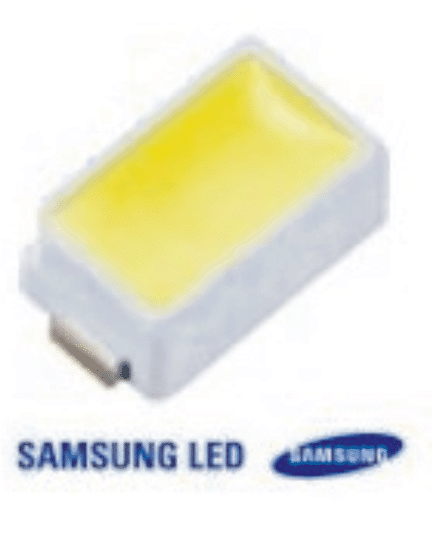
The LED model shown below is the 5630 type surface mount LED from Samsung which has the following typical voltage and current specifications:
Forward voltage: 3.3V
Optimal Current: Between 50 and 150mA
Power dissipation: 0.5 watts approximate.
Although it is recommended to operate any LED via a current controlled SMPS, for simplicity sake the following compact transformerless power supply may be tried and could prove as good as it's other counterparts.
The present design is based on my previous variable transformerless power supply design, which enjoys a novel crowbar network concept for safeguarding the involved sophisticated devices.
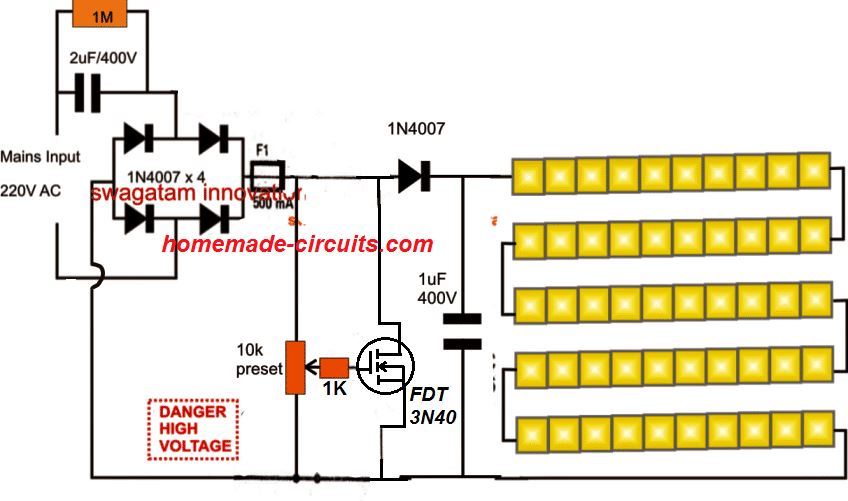
The proposed 5630 SMD LED driver or compact tube light circuit may be understood with the help of the following discussion:
Circuit Operation
The input capacitor which is a high voltage metalized polyester 2uF/400V rated capacitor drops the mains 220v to desirable limits and feeds the connected the bridge rectifier stage.
The bridge rectifier in conjunction with the 1uF/400V rectifies the AC into a 330V DC.
This high DC is applied across the crowbar network comprising the zener, MOSFET and the preset in the stage.
The preset is appropriately set such that the the output matches the total forward drop of the connected LEDs.
If 50 LEDs are connected in series at the output the above preset must be selected to produce precisely a voltage of around 50 x 3.3 = 165V
Once set, this voltage gets clamped and never exceeds even under worse conditions.
The LEDs thus stay safeguarded from all possible high voltage and surge current hazards.
This happens owing to the fact that the mosfet tends to conduct and ground the output voltage whenever the voltage across its drain/source tries to rise above the set value which may be 165V as assumed here.
Other different number of LEDs may be opted for at the output as per individual preferences, and the preset set up as per the calculations discussed above.
In the shown circuit diagram all the LEDs are connected in series to form a chain of 50 LEDs connected one behind the other with anode of one LED connected to the cathode of the other, and so on.
NOTE: Please connect a 50 Ohm / 1 watt resistor in series with the LED chain for better safety of the LEDs
Circuit Diagram
THE WHOLE CIRCUIT WOULD BE FLOATING WITH LETHAL MAINS AC, EXTREME CAUTION IS EXPECTED FROM THE USER WHILE TESTING THE CIRCUIT IN AN UNCOVERED POSITION.
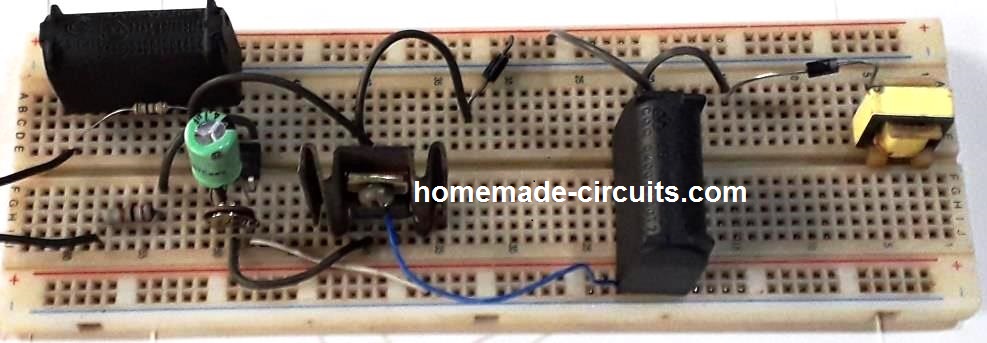
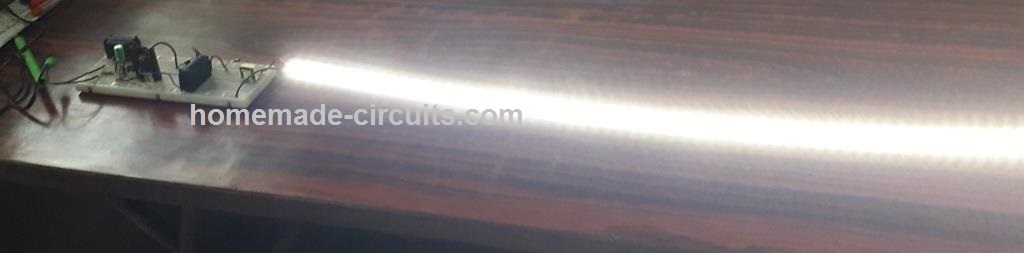
Feedback from one of the dedicated readers of this blog, Mr. Raghavendra Kolkar:
Hello sir good evening, thanks a lot for sending the circuit diagram of led driver. After 5 failures finally the circuit was successful.
I am sending you the picture of the driver and working.
Thanks a lot, so far all your circuits are working well and nice.




Comments
Hi sr, firts of all, sorry for my bad english u.u.
Second, i have 8 lamps with 14 leds 5630, it means that i have to use 46.2 volts, how i can drop the voltage to that? because in your diagram its 165 volts
I make it, and before the zener give me 330v, after the zener only 7 volts, any idea? im using 1N4756A
thanks, another question, the capacitors are electrolitic or ceramic?
Hi carlos, you may simply remove the triac and the resistors and connect a 50V 1watt zener right across the output capacitor…this will hold the voltage to around 50V….
Hi…Swagatham Ji,
Please give me the name of transformerless led driver IC ( like MBI6001 ). I want to run 2,3,4 watt led lamps.
Nikhil V G
nikhilkbd@gmail.com
Hi Nikhil,
there's no specific name for this IC, and it's not rated for high watt operations, only 20mA LEDs can be used with it
I'll try to update the article soon in my blog. thanks!
earlier there was a thyristor instead of a triac which I later replaced with a triac, the markings are for the SCR which was previously present in that position….
Hi Sir,
Nice to meet you after a long…my new request is on driving 5630 led at120mA which is rated at 150mA max with 12v 5-8amps dc power supply…..for example 5630 led strip module( 3 led in series with a resistor).
for 12V, the resistor should be 14 ohms/ 1 watt or 2 watt
I have calculated the above for 14V input max… for better safety…
use 3 in series with a 27 ohm 1 watt resistor
want to run those 5630 leds at its full output at 150mA max will it be possible and if so let me know the resistor value.
can i drive 5630 led above 120mA which has Max.150mA. if so let me know the resistor value for using in car parking plug…power supply 12-14v 3.5-5amps….or more
hi sir
i tried the setup what u mentioned me…it works but the resistor is getting hot…can i connect the entire series arranged leds connected in parallel with one 17ohm 2watt resistor..??? if so when i use such setup what will happen…???
Vinu, Use LM338 if the total current requirement is beyond 2 amps,
if a sufficiently large heatsink is employed then the current regulator stage can be eliminated, furthermore a fan cooling could be employed for better safety of the LEDs
Sir,
1.Should i use LM317 or LM338 for 5630 leds and also for 1watt leds….
2.Is there any possibilities without using current regulator for this leds….
Vinu, you can use the first circuit from the following link:
https://www.homemade-circuits.com/2013/06/universal-high-watt-led-current-limiter.html
Calculate R1 as per the given formula.
Sir,
1.Should i use LM317 Voltage regulator for 5630 leds powering from automobile 12v dc….???
2. Give me a LM317 regulator setup diagram for this 5630 leds and also for high power 1 watt*3 leds in series…
…it should not be less than 17 ohms.
Vinu, for 120mA use any value near 17 ohms (2 watt) for each 3 LED string.
sir kindly tell me the nearest value resistor and setup with its max output….which can easily sourceable from electronic shops….
if suppose i want the above setup which i asked you as a query to use it in car dc supply what should i do to get the 5630 led at its full brightness without over heating the leds…..(making a DIY led strip using 5630 led)
Hi Vinu, you will need to assemble three LEDs in series with a 17 ohms 2 watt resistor, you can add more such assemblies in parallel for getting as many LED strings as you want.
sorry I forgot to mention. the board is live and when you design a board you should make sure that you have enough clearance between any led or copper the earth or mounting holes of your enclosure. at least 3mm.
hi guys. I was busy with research into the smd 5630 led when I stumbled on this post. I looked at the drawing and there is some short falls to it. I also use long strings(81 leds) connected to mains power230v ac rectified to dc . what we found with lots of research is that you can not use any light string with out a current controller. let me explain. when leds start to heat up then the voltage drop over the led decreases, this cause a increase in current which again cause more heat. at the end you will have a dead circuit. we use a basic circuit, sorry I don't know hoe to upload a picture . upload.wikimedia.org/wikipedia/commons/thumb/f/f7/Const_cur_src_111.svg/220px-Const_cur_src_111.svg.png . en.wikipedia.org/wiki/Current_source
we use MJE340 for the transistor, dz1= 2.7v 1watt,R1=100K 1Watt. R2 needs to be calculated. easy way is r=v/I v is 2v I is the current of your led. for example I need 60ma through my string then R2= 2/0.06 =33ohm. note do not try to use your led at maximum data sheet power because they always produce too much heat rather go for 60% rated current.
Thanks! you are right, the fact pretty known though, and I am sure most of the hobbyists already know about this.
I have covered comprehensively about this cricatility and many more in my other relevant posts, with calculations.
The above article design was meant for tackling four fundamental things:
the circuit needed to be cheap, transformerless, surge protected, and easy to assemble.
The heat factor could be rather solved by using an aluminum base PCB or the LEDs could be itself mounted over an aluminum plate.
The above circuit attempts to include all these features in one and therefore the current control was ignored.
However the above the design is already too inefficient as far as amp spec is concerned.
The triac would dump a lot many amps and I am afraid we would have rather an under illuminated LED string.
Furthermore the triac network woulds also make sure that the voltage across the array stays close to the rated voltage spec of the LEDs.
Together, the above circuit is pretty much within the safe boundaries of the devices used and could be considered safe.
Hi sir. I made this circuit.when i switch on leds are blinking very fast.why like this? Can i remove triac?
Hi Mohammed, you can remove the triac and connect a 100 ohm relay coil in series with the LEDs, this will protect the LEDs from sudden voltage surge….or alternatively keep the triac as given and increase the 1uF/400V to 50uF/400V for getting rid of the fluctuations.
Hi sir,
I 'm going to make your circuit, I have 50 pcs of LED SMD white 0.5 watt and 150ma. can i use your circuit? what is the triac number?
Hi Mohammed,
yes you can use the above circuit, the triac number is BT136 but an easier alternative is given in the following article which you can also try:
https://www.homemade-circuits.com/2012/04/how-to-make-led-bulb-circuit.html
if to take only half of that is 30 leds, what would be the modification of circuit ??? I hope your answer thanks
no modifications would be required, any desired led quantity would work here.
Dear Sir,
Can you suggest any transformerless power supply to run 50 or 60 led in series.
I have some 5mm white leds laying with me. the forward voltage of the led is 3.7v and current arround 30ma
Dear Thejus,
You can try this design:
https://www.homemade-circuits.com/2012/04/how-to-make-led-bulb-circuit.html
Dear Sir,
I have built the 2nd circuit with the separate low value capacitor stage for the gate trigger as in the drawing but im not getting any voltage in the 100uf 50v capacitor. DMM shows only 0.5 volts
Dear Thejus,
The circuit diagram needs a little fixing, I'll do it soon, in the meantime you can try the following design:
https://www.homemade-circuits.com/2012/08/high-current-transformerless-power.html
hi sir for the above circuit. i am going to connect 10 5630 leds in series can i able to get 150mA of current constantley to the leds so that my leds will give maximum light.
Hi Unknown,
No with 10 leds the current would also drop with votage, so according to me you will have to use a least 50 to 60 leds for acquiring or sustaining 100mA current with any capacitive transformerless circuit
thankk u sir and b lated happy vijayadashmi
Thanks very much Vaibhav.
hi sir can i connect 20nos of 1w power led with this circuit and what is max output current of this circuit
thanks
hi Vaibhav,
yes you can use them, connect them in series, max current is not known to me because i haven't checked it practically.
you can use them, but the illumination may not be optimal.
yes…
Hello Shail,
Yes you can use the above circuit for types of low current LED driver application.
According to me nothing would overheat in the above discussed circuits.
Hello sir,
I think zeener should be removed to drive 50 led to get 165v out put
for lower voltage requirements, it would be better to include the zener as it would keep the output within the zener voltage under all conditions.
Is above mentioned issue also persists if we use the above circuit in low voltage output as it is in schematics(say 12v or 24v)for less no of led's
Helo Avijeet,
You are correct the zener does not have any relevance here.
Another issue could be the heating up of the preset and the resistor….the values should be either carefully selected or the gate of the SCR should be attached with the separate capacitive power supply stage. I'll try to update it here soon.