This article will illustrate a simple procedure to devise an unregulated 50V switching SMPS symmetric power supply of 350W. This unit can be substituted with the standard audio amplifier power supply to reduce expense and also the weight. The proposed power supply works as a half-bridge with no regulation.
Written and Submitted by: Dhrubajyoti Biswas
Mosfets as Power Devices
My power supply relies on two N MOSFET and run by IR2153 integrated circuit. The IR2153 is powered by a power resistor of 27K 6W. The ripple at full load is recorded below 2V.
The use of Zener diode (15V) ensures voltage stabilization and the operating frequency is set to 50 kHz (approx.).
At the point of the input, I have placed a thermistor to force a check on the peak current when the capacitor is getting charged.
This same phenomenon can be found in AT/ATX power supply unit of a computer. Moreover, to ensure low leakage inductance and full voltage output, the first half of the primary is wounded in 20 turns followed by the secondary wound.
Also to assure safety in the system, do be sure to connect the output (center tap 0V) to the earth.
Chokes for Filtering RF
The chokes used in the design will facilitate removal of RF output ripple. The number of turns and the core which is found in PC supply is not a critical factor.
Additionally, the 6k8 resistors at the output section is used to discharge capacitors after it is switched off and this way it helps to prevent the voltage increase during no load.
The proposed Switched power supply 2x 50V 350W operates in single switch forward topology. It has an operating frequency of 80-90 kHz and has IRF2153 control circuit which is very much similar to that of US3842. However, the duty cycle is lesser and is limited to 50%.
Rewinding an ATX Trafo
The Tr1 transformer was devised by rewinding the SMPS ATX transformer and its primary inductance is 6.4 mH (approx.).
The core of the system has no air gap and the primary inductance is further broken in two parts: The first half is the wind and the second is the winding.
Moreover, it is also feasible to deploy the original primary bottom half without rewinding. This type of power supply aptly suits for power amplifier applications.
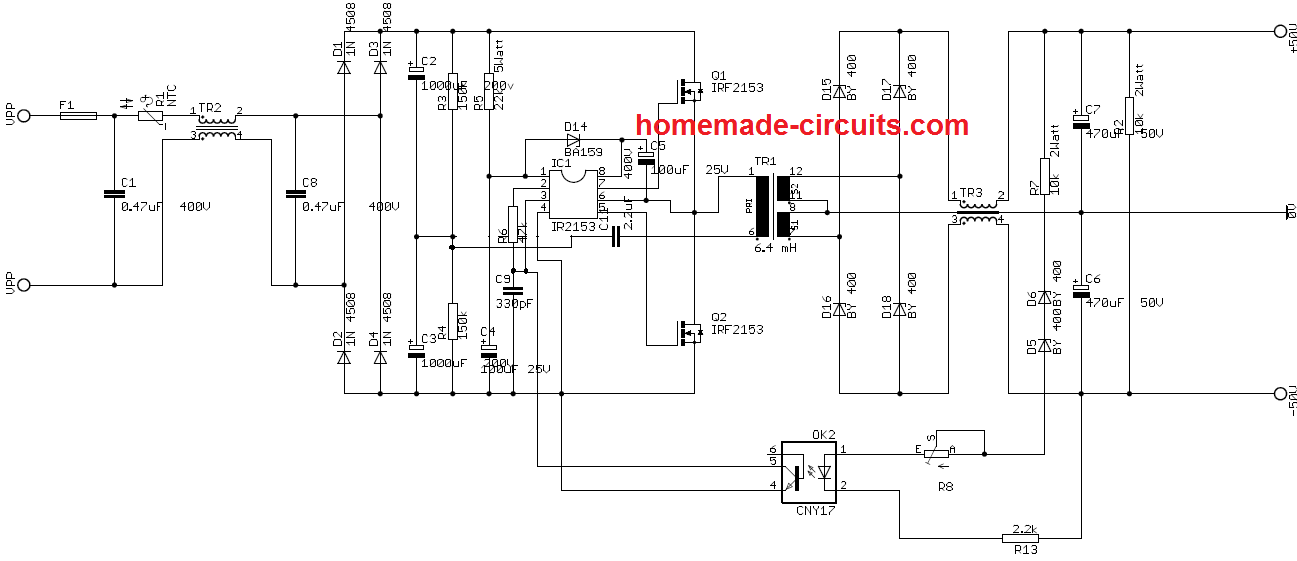
If required it may be also safeguarded against overload or short circuit and the voltage of the output could be stabilized. The Feedback of the system may be enabled through the help of optocoupler.
It is important to note that in regard to 350W power, care should be taken that in the conductive state the typical resistance should not cross more than 0.8R. MOSFET can also be used to lower the point of resistance.
Interestingly, the smaller the resistance better is with the system.
The voltage tolerance is in the range of 900-1000V. In the worst case scenario 800V can be used. Considering this, the best MOSFET I found was SPP17N80C3 or 900V IGBTs.
Circuit Diagram
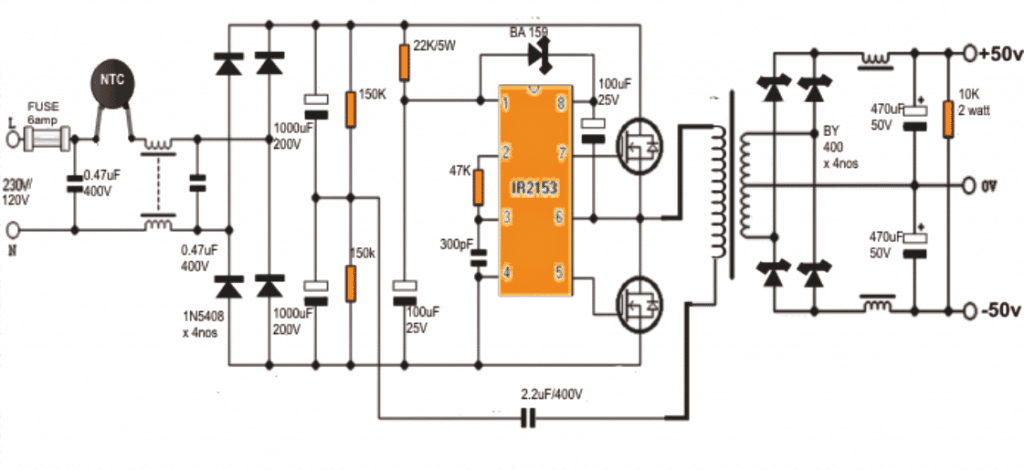
Coil Winding Details:
- The main SMPS transformer which can be seen integrated with the MOSFETs may be wound on a standard 90 by 140 square mm ferrite bobbin core assembly.
- The primary side winding consists of 40 turns of 0.6mm super enameled copper wire.
- Remember to stop after 20 turns, put an insulation layer with an insulation tape and wind the secondary winding, once the secondary is wound, insulate it again and continue with the remaining 20 turns over it.
- Meaning the secondary winding gets sandwiched between the primary 20 + 20 turns.
- The center tap of this 20+20 may be connected with the body of the SMPS for an improved stabilization and cleaner outputs in terms of ripples or buzzing interference.
- The secondary consists of a center tapped 14 x 2nos turns made by winding 0.6mm super enameled copper wire.
- The input and output filter coils may be wound on ferrite torroidal cores. The paired winding must be wound on the same individual torroidal cores using 0.6mm super enameled copper wire with 25 turns on each arm of the relevant supply terminals.
Update:
The above design 350 watt SMPS circuit was further improved by one of the dedicated members of this website Mr. Ike Mhlanga. The complete schematic of the same can be witnessed in the following figure:


Questions & Answers
Hi,
Can anyone explain how the second circuit by Mr. Ike Mhlanga does voltage regulation. The optocoupler is put across +50 and -50 output, so it regulates both the rails together, not each rail. In audio, there is load on one rail only at any given time so this regulation is not ideal, am I missing something?
Hi, the opto is only detecting the over voltage situation and regulating the secondary side overvoltage situation.
When a load is operating at the output, the overall voltage will drop, so the opto will remain inactive most of the time…so it has nothing to do with dual nature of the output DC…
Swagatam,
The Transformer calculator is relatively easy to understand than the wire current calculator. To deliver 850Watts@55 volts, the current max capacity should be 15.45A per rail (+ve & -ve). I am thinking of putting two separate SMPS per channel that is expected to deliver 100W into 8 ohms, 200W into 4 ohms and 400W into 2 Ohms. Adding 26W idle power consumption
to it I need the SMPS of 450W per channel. I am aware that the entire value chain should comply with the increased power capacity – right from input mains rectifiers to output rectifiers with the transformer and the IGBTs/MOSFETs in between. What type of ferrite core (dimensions) would you suggest with the Np/Ns ratio with the wire diameters for primary and secondary. Apologies for bothering you.
Hi Prasanna,
The wire current calculator page has another calculator at the bottom section of the page, which directly calculates the approximate thickness of the wire, depending on the current spec flowing through it. However, estimating the bobbin size and E-core could be a matter of experimentation through some trial and error.
Alternatively, as explained in the SMPS calculator page, you can customize the E core/bobbin size simply by adjusting the frequency value such that the number of turns just fit inside the desired E core/bobbin setup. Because, as we know, as the frequency is increased, the number of turn decrease and vice versa. Let me know if you have any further doubts.
Agree. Increase the frequency or the number of turns to get higher voltage. But we have to make apt choice between the two to keep losses and hence the ambient temperature minimal.
My amp mandates peak current of 21.2A/rail for 1V rms input when driven with 2 Ohm load (worst case scenario). When put in the wire diameter calculator on the page suggested by you it gives me 3mm wire diameter. (I assume it’s for secondary). To accommodate such a thick wire, I should go for ETD22 ferrite bobbin which is proposed on some other site for 400W. I really need to obtain the core and give a try.
Yes, you are correct regarding the losses and noise.
It can be for the secondary or primary, it solely depends on which side current (I) is being measured. But yes, since 21 amps looks too big, and cannot be on the 220V side, so it has to be on the secondary side.
You can use Litz wire which can further help to keep the transformer dimensions compact and yet fulfil the high current requirements efficiently.
Thanks Swagatam, I will give a try and revert.
No problem Prasanna, all the best to you!
Swagatam, I need 55V Symmetrical output with max 850W output. I have a couple of questions 1) What should be the dimensions of the Ferrite bobbin. Should it be square only or the ring will also work. 2) What should be the diameters of the coper wires for primary and secondary windings.
Hi Prasanna, You can go through the following articles to get an idea of all the basic parameters required for designing a customized SMPS circuit. For the output voltage you can select 55 + 55 = 110V. Let me know if you have any further doubts or questions.
https://www.homemade-circuits.com/56492-2/
https://www.homemade-circuits.com/smps-transformer-calculator-2/
Thanks Swagatam.
sorry the above comment was a mistake, feedback already provided in the subsequent circuit. thanks.
No problem Imsayuba…glad you found the design you wanted.
Sir, can we add a Feedback circuit for voltage regulation? if yes, could you please show in the schematic?
good 👍
Hi Swagatam can a similar power supply be designed using TL494 as I have a few if these ICs ..
Hi Andrew, I am not sure how a TL494 can be configured like a half bridge inverter using a bootsrapping network, so i think it may not be easy to replicate the same above design using the TL494.
Hello Sir,
I need 2x45v,15 Ampere power supply for audio amplifier.
Also is it possible to rewind a transformer in place of an SMPS bobbin with keeping in mind primary for 25 volt.
Hello Ajay,
I would suggest you to first build and try the above circuit, if you succeed then we can adjust the transformer specifications to suit your requirements.
Sorry i did not understand your second question? Do you mean using an iron core transformer in the above circuit, no that’s not possible.
Thank you so much, Sir. Can you please provide the specifications of the SMPS bobbin?
Or can I rewind it on the computer supply SMPS?
You can use any ferrite bobbin which accommodates the complete winding, as specified in the article.
However, as per the article, 90 by 140 square mm ferrite bobbin is the exact specifications of the bobbin
Hello. I intent to make this SMPS Power Supply. I am doing it for the first time.
How I see there is work with high voltage and it should be dangerous for a beginner.
Is it possible to use this kind of filter as change for the first part of this circuit diagram?
It should be better for me to buy finished ones?
FILTER Type 2470
mgelectronic.rs/filter-za-rso-tip-2470
FILTER Type YB10T1
mgelectronic.rs/filter-za-rso-tip-fyb10t1
yunpen.com.tw/en/product/IEC-Inlet-Filters_YB-T1.html
Hi, yes those filters can be used at the input side of any SMPS circuit.
Thank you.
90by 140 Sq mm BOBBIN means. I don’t understand
It is the dimensions of the ferrite core bobbin, 90 sq mm is the vertical side height x width dimension, and 140 mm is the length and breadth of the top side dimension.
Hello swagatam first of all thank you for this circuit I was looking for something like that suit my project and i have founded on your website I have maded this circuit and got 48.3v at the output but when i connected some load there’s no voltage at all however I think that for the constant voltage i should have to connect an output coupler and after that i should connect the load !
Thank you Salman, The above circuit was not designed by me, and I do not have sufficient information regarding this circuit, therefore it can be difficult for me to help you with this design.
optocoupler is important for the feedback without it SMPS will do switching first and after that it will not switch optocoupler will give the SMPS feedback and after that it will do switching continuously and it will make real voltage am i right sir ? Do you know how to integrate optocoupler in this circuit?
Optocoupler feedback is important only for regulating the output voltage to a fixed level. It has nothing to do with the generation of the output voltage. Even without the optocoupler the output should be able to handle a connected load.
Yes it means your problem is not solved yet.
360mV is too low, that could be a leakage voltage also, it does not indicate your IGBTs are switching the transformer.
Please confirm it with the diagram, if it matches the circuit diagram then it is correct.
Thanks alot. The circuit works very well . But sensitive to short circuit. It would be good if it’s modified to have short circuit protection
Thank you Aluda, Glad you could build it successfully. Yes the circuit is not protected from an output short circuit, which must be corrected.
Hi engineer. How can I get additional 12 0 12 from this circuit ?
For powering preamplifier
Hi Aluda, you can use a 7812 and 7912 IC circuit for getting the +12V and -12v outputs from the 50 V outputs.
Okay thank you
Any PCB for the circuit?
Sorry, PCB is not available for this project.
Kindly share PCB for this circuit. I will appreciate
The first, top diagram.
Please read the point number 7 under “Coil winding details”.
You can use a bridge rectifier but it should be rated to handle at least 3 amp current and have a PIV of 1000 V, just like the diodes 1N5408.
MOSFETs are SPP17N80C3, the diode numbers are given in the diagram, the NTC is 5D-11