• Skip to main content
  • Skip to primary sidebar

Homemade Circuit Projects

Need circuit help? Post them in the comments! I've answered over 50,000!

Blog | Categories | About | Contact | Calculators-online
You are here: Home / Electronics Theory / Transistor Stray pickup False Triggering Problem

DIY Circuits | Learn Basics | Arduino Coding


Transistor Stray pickup False Triggering Problem

Last Updated on March 19, 2019 by Swagatam 4 Comments

In this article I have explained how to make any BJT or mosfet based circuit free from stray signal pickup and false triggering by simply attaching a filter resistor or a capacitor across their base/emitter or gate/source terminals. The problem was raised by Mr.Henrik.

Solving a Circuit Problem

I have an issue I don’t understand. please check out the following diagram.
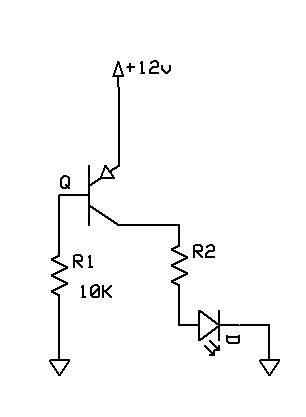
If I connect the Base of a PNP transistor through a 10K resistor to ground the LED lite up. If I disconnect the Base from ground the LED light up weakly. I would have expected the LED to be completely off.Can you explain me why this is the case. I have tried with other transistors also.
If I use a NPN transistor to switch a PNP transistor (Darlington) do I need a resistor from the Base of the PNP to Collector of the NPN transistor?
Thank you,Henrik

 The Reason behind the Fault:

The mentioned problem of false transistor triggering while its base was unconnected to a triggering source may be due to stray signal pickup by the transistor base causing the slight illumination on the LED.

Because as we know that when a small current flows through base emitter of a BJT, forces a relatively more stronger current to pass through collector/emitter of the device. Here too the stray signal at the base of the BJT could be forcing the device to trigger albeit fractionally, but enough to cause a faint illumination on the LED.

The Solution:

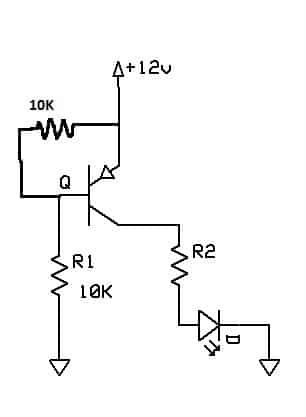
The problem could be easily remedied by adding a compensating resistor across the base emitter of the BJT, the value could be anything which allows a 1V across the base emitter when the actual trigger is connected with the base. This value could be evaluated using a resistor potential divider network calculation.

Or simply a matching value resistor could be included similar to the existing base resistor value, as done below.
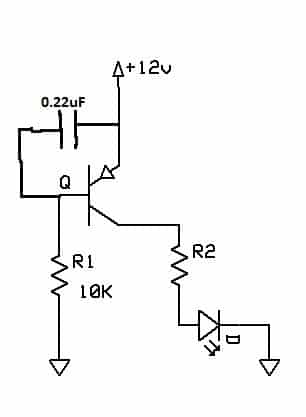
Another simple way to eliminate stray pick up while its base was not associated with any form of input logic or trigger is to add a small value capacitor across its base and emitter, which would help the BJT to effectively ground any possible stray input signal and prevent it from causing the device to conduct spuriously.
You'll also like:

  • transformer workingHow Transformers Work
  • Diac bidirectional breakover charactericticsDiac – Working and Application Circuits
  • IC4060PinOutIC 4060 Pinouts Explained
  • How to Connect a TSOP1738 IR Sensor

Filed Under: Electronics Theory Tagged With: False, pickup, Problem, Stray, Transistor, Triggering

About Swagatam

I am an electronics engineer and doing practical hands-on work from more than 15 years now. Building real circuits, testing them and also making PCB layouts by myself. I really love doing all these things like inventing something new, designing electronics and also helping other people like hobby guys who want to make their own cool circuits at home.

And that is the main reason why I started this website homemade-circuits.com, to share different types of circuit ideas..

If you are having any kind of doubt or question related to circuits then just write down your question in the comment box below, I am like always checking, so I guarantee I will reply you for sure!

Previous Post: « 3 phase Solar Submersible Pump Inverter Circuit
Next Post: Controlling LED Strip Light ON/OFF and Brightness with any Remote Control »

Reader Interactions

Comments

Krishen Gopal Kathel says:
July 17, 2024 at 11:26 pm

please give difference of pull up and pull down resistance and above theory.
I want theory to prevent false LED indication of
any circuit diagram. So circuit would be work proper ON and OFF.

Reply
Swagatam says:
July 18, 2024 at 9:04 am

Pull-up resistor is connected from positive supply to base of a BJT, when the base of this BJT is connected to a sinking source via the collector of another BJT or through a diode from a logic IC output.
Pull-down resistor is connected between base of the BJT and its emitter supply. It’s basically to add a potential divider network at the BJT base.
Please provide your LED application details, if possible I will try to solve it for you….

Reply
Liju says:
March 15, 2019 at 1:00 am

Can i connect 220v AC line to base of BC546 through a 5M ohm resistor to trigger the transistor ON/OFF.

The main question is: since the C, E and load is going to b on a DC circuit with a 9V battery, will the domestic line which will not have common ground with this DC circuit trigger the transistor?

Thanks for your advice in advance

Reply
Swagatam says:
March 15, 2019 at 9:08 am

You must have the other unused line of the mains connected with the common (-) of the 9V DC otherwise the transistor will not switch. You will have to use a 1N4007 diode in series with the base resistor so that only +DC is able to reach the base.

5M is too high, you can safely use 100K.

This design will be non-isolated from mains so extremely dangerous to touch.

Reply

Need Help? Please Leave a Comment! We value your input—Kindly keep it relevant to the above topic! Cancel reply

Your email address will not be published. Required fields are marked *

Primary Sidebar

circuit simulator image


Subscribe to get New Circuits in your Email


Categories

  • Arduino Projects (93)
  • Audio and Amplifier Projects (133)
  • Automation Projects (17)
  • Automobile Electronics (101)
  • Battery Charger Circuits (87)
  • Datasheets and Components (109)
  • Electronics Theory (149)
  • Energy from Magnets (27)
  • Games and Sports Projects (11)
  • Grid and 3-Phase (20)
  • Health related Projects (27)
  • Home Electrical Circuits (13)
  • Indicator Circuits (16)
  • Inverter Circuits (95)
  • Lamps and Lights (159)
  • Meters and Testers (71)
  • Mini Projects (28)
  • Motor Controller (68)
  • Oscillator Circuits (28)
  • Pets and Pests (15)
  • Power Supply Circuits (91)
  • Remote Control Circuits (50)
  • Renewable Energy (12)
  • Security and Alarm (64)
  • Sensors and Detectors (106)
  • SMPS and Converters (34)
  • Solar Controller Circuits (60)
  • Temperature Controllers (43)
  • Timer and Delay Relay (49)
  • Voltage Control and Protection (42)
  • Water Controller (36)
  • Wireless Circuits (30)


Other Links

  • Privacy Policy
  • Cookie Policy
  • Disclaimer
  • Copyright
  • Videos
  • Sitemap


People also Search

555 Circuits | 741 Circuits | LM324 Circuits | LM338 Circuits | 4017 Circuits | Ultrasonic Projects | SMPS Projects | Christmas Projects | MOSFETs | Radio Circuits | Laser Circuits | PIR Projects |

Social Profiles

  • Twitter
  • YouTube
  • Instagram
  • Pinterest
  • My Facebook-Page
  • Stack Exchange
  • Linkedin


Recent Comments

  • Swagatam on 9 Simple Solar Battery Charger Circuits
  • Swagatam on BLDC Ceiling Fan Circuit for Power Saving
  • DANIYA on BLDC Ceiling Fan Circuit for Power Saving
  • Johnny on IC 723 Voltage Regulator – Working, Application Circuit
  • Swagatam on 9 Simple Solar Battery Charger Circuits

© 2026 · Swagatam Innovations