In the following post I have explained a pure sine wave inverter circuit using the IC 556 which forms the main sine wave processor device in the circuit.
How it Works
The presented design actually produces a modified sine wave output, but the waveform is highly processed and constitutes an exact equivalent of a sinusoidal waveform.
A single IC 556 forms the heart of the circuit and is responsible for manufacturing the required PWM controlled modified sine output waveform.
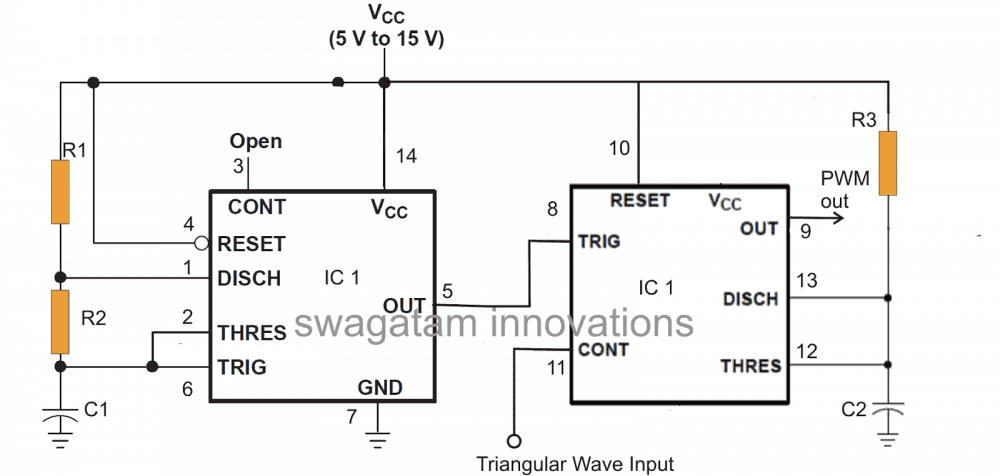
One half of the IC on the left is configured as a 200Hz frequency generator, this frequency is used for providing the required square wave clocks to the preceding monostable which is formed by wiring up the other half of the 556 IC.
The clocks are received from pin#5 and applied to pin#8 of the IC. The right hand side section of the IC does the actual processing of the above square wave by comparing it to the triangular waves applied at its pin#11.
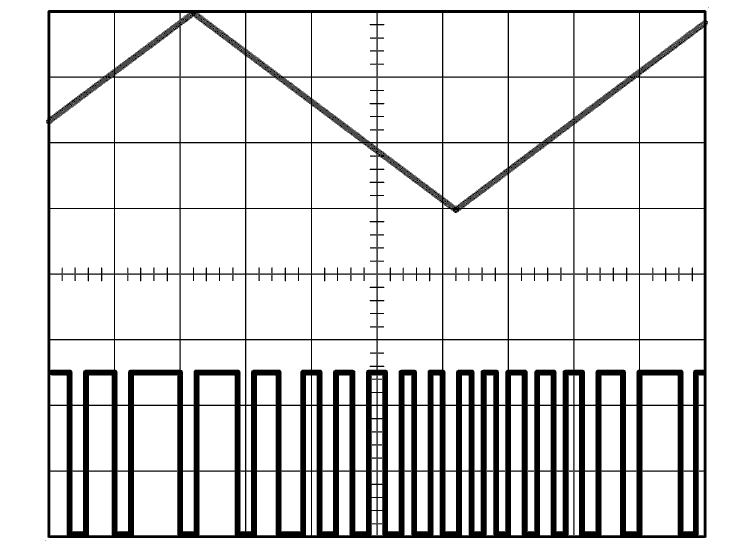
The result is an output at pin#9 which is a PWM, varying in accordance with the amplitude of the triangular waveform.
Ideally the triangular waves can be replaced with a sine waveform, however since triangular waves are easier to generate, and also appropriately replaces the sine counterpart, its been employed here.
R1, R2, C1 should be appropriately selected so that pin#5 produces a 50% duty cycle, 200 Hz frequency.
The 200 Hz is not critical here, however it becomes critical for the IC 4017 stage and that's why it's been selected to that value.
The modified sine wave PWM generated by the IC556 is next applied to the switching stage comprising the IC 4017 and the relevant output mosfet devices. Let's see how it's done.
Parts List
IC1 = 556
R1,R2,C1 = select to generate 50% duty cycle
R3 = 1K
C2 = 10pF.
The output stage
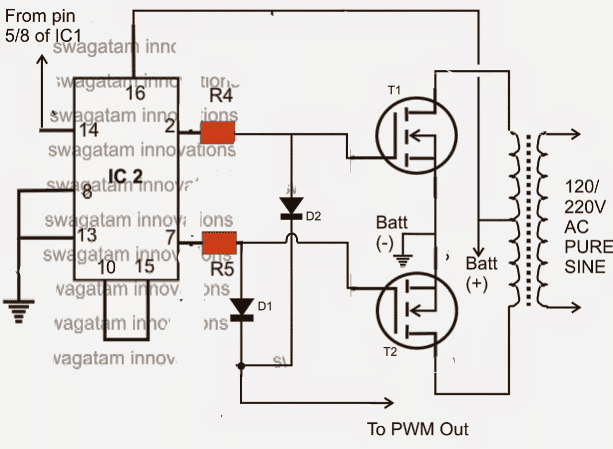
The diagram given below shows the output stage configuration where the IC 4017 takes the center stage. Basically its function is to switch the driver transistors alternately so that the connected mosfets also conduct in tandem for inducing the required mains AC output into the transformer.
The IC receives the clock pulses from the above explained 556 circuit (pin#5/8) and its outputs sequence across the connected transistors alternately as discussed above.
Until here the circuit behaves like an ordinary square wave inverter, however the introduction of D1/D2 with the pin#9 of the 556 transforms the circuit into a full fledged pure sine wave inverter.
As can be seen, the common cathodes of D1/D2 are integrated with the processed PWM pulses from the above 556 stage, this forces D/D2 to conduct only during the negative pulses from the generated PWM blocks.
It simply means that when D1/D2 are forward biased, T1 and T2 are inhibited from conducting since their gates become grounded through D1/D2 into pin#9 of the IC 556, which make the mosfets respond exactly to the PWM pattern.
The above process generates an output across the transformer secondary that's perfectly chopped and processed and equivalent to a sine waveform.
Parts List
IC2 = 4017
all resistors are 1K
D1,D2 = 1N4148
T1,T2 = IRF540n
Transformer should be also appropriately rated as per the requirement.
The Triangular Wave Generator Circuit
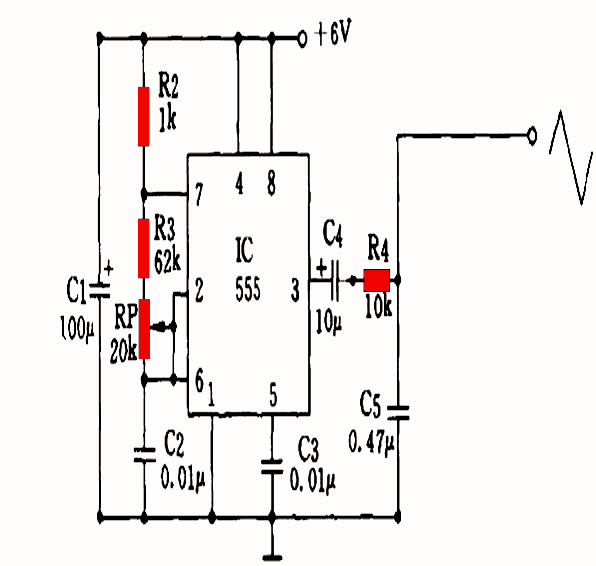
The entire modified sine PWM waveform construction and implementation is dependent on the fed triangular waves at pin#11 of the IC556, therefore a triangle wave generator circuit becomes crucial and imperative.
However there are many types circuits that will provide you with the required waveform inputs, the following is one of them which incorporates yet another IC555 and is pretty simple to configure.
The output from the below given circuit must be fed to pin#11 of the IC556 for enabling the proposed sine wave inverter functioning.
DESIGNED BY "SWAGATAM"
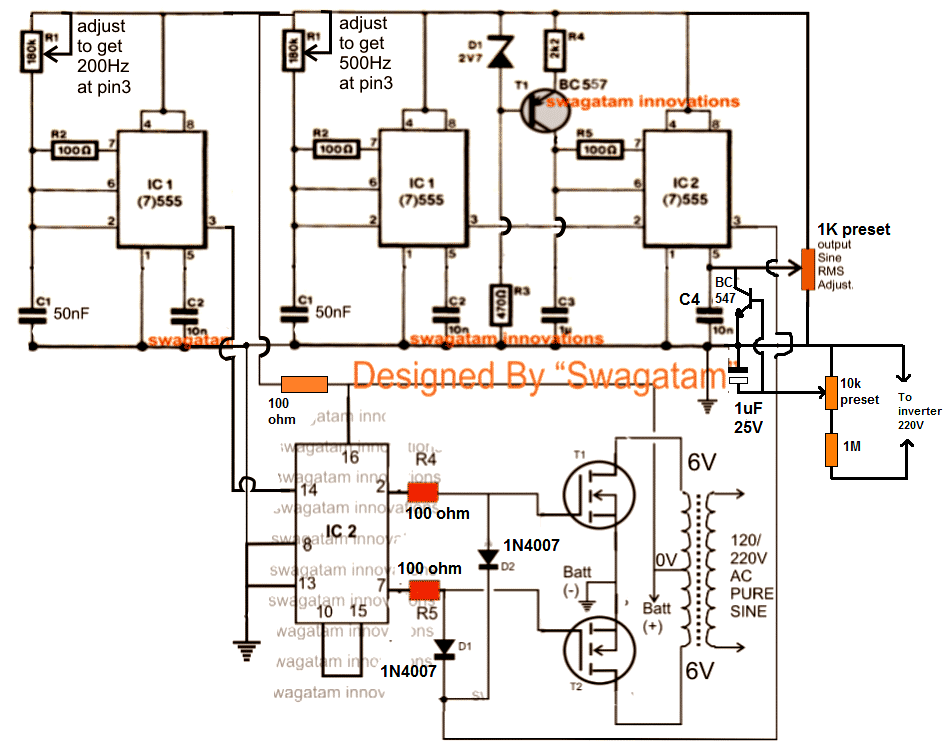
A simpler alternative to the above design is shown below, the configuration would produce same results as explained above:



Comments
hi Swagatam,
pls sir, i would like to know the type of capacitors used in various point of your design, also to asks why standard operating frequency{50hz} is not so important that you did not consider it in the cct, and also to know why battery voltage is not regulated for the cct
thanks sir
Hi dele,
the output will be a 50 Hz, I have made sure that it gives 50 Hz by recommending 200Hz at the 4017 input. I have a feedback included in the lat diagram which will probably take care of a discharging battery and help to keep the output constant
Hello sir, i asked some questions in one of ur post and i see no reply, let me ask u the same questions here:
1. In choosing or selecting MOSFETs, what must i consider, is it the volt or the amp of the MOSFETs?
2. Can i use stabilizer transformer to connect with my inverter circuit?, or does a stabilizer and inverter has different pattern of winding
Gud job boss
Hi,I want to convert 310 VDC to pure sine wave 220 VAC using 4 N-channel mosfet IRF740 or IRF830,I already made it with AVR and IR2110,but now I want to use no microcontroller,Would you please help me doing this job?Regards.
you can try the following circuit:
https://www.homemade-circuits.com/2014/01/simplest-full-bridge-inverter-circuit.html
THANKU SIR FOR YOUR REPLY… HERE I USED A 12-0-12/ 230V, 5A TRANSFORMER.. AND I AM GETTING ONLY 120V OUTPUT. FROM THE ABOVE COMMENTS I HAD UNDERSTOOD THAT I SHOULD USE 6-0-6/ 230V 5A TRANSFORMER. I WILL REPLACE THE TRANSFORMER SOON.. THANKU…. I WILL BE BACT IF THEIR ANY DOUTS ARISES….. THANKU
am getting an outputvoltage of 120v. i had used irfp55 as mosfet.i need 220 volt out put. in the circuit diagram u had given in the output that it will give 120 v or 220v.what change to be done to get 220v output
remove the PWM diode connection from the mosfet gate and check the voltage, if you see it to be 220V … connect back the PWM and adjust the pin5 preset of IC2 until the voltage settles to 220V,
if you are using a 12V battery then make sure the transformer is either 6-0-6V or 9-0-9V
i had wired up the circuit.. i had used irfp55 as the mosfet,.. am getting only 120v output…….
sir please i build this circuit and got 6.8v at output of ne555 and i got 5.8v at ne556 output cd 4017 i got 2.3v at pin2 and pin7 how can do to raise up pin2 and pin7 lik 4v to maybe 5v cos the circuit don't start i think it the out put of 4017 is too small to open the gat of the mosfet, sir i found 4017 circuit its the same as this one but the different is you added transistors at pin2 and pin7 but you did not put value of the component thank you.
you are seeing the average voltage in your meter…the peak voltage should be well close to the supply voltage…so it's perfectly OK for triggering the mosfets
Hello sir,
I want to make a circuit for 8kHz sine wave. Can you plz post a suitable circuit with correct component values?
thanks!
hi sir
you received my picture
No, did not receive any new pictures??
hi sir
i will sending you any my picture. this is results
It output not pure sin. I'm wrong in area ?
specifiction tranfo 12-0-12 =>220v ,i'm supply 24vdc,output 20vac – 30vac,
i'm supply 21.9vdc, output 204vac
output tranfo i connect a 0.33uf/400 but it not pure sin
hi khang, did you put a load at the output? please put a load and then check.
anyway you won't get a pure sine wave rather only as shown in this article:
https://www.homemade-circuits.com/2013/10/modified-sine-wave-inverter-circuit.html
you can also try connecting an inductor after the capacitor as shown in the above article….
After using the link "www.royalrife.com/555_calculator.html" I've come up with the following values: R1=100 OHMS, R2=10K, C1=330nF which gives a frequency of 217Hz and a duty cycle of 50.2%. Will this work? Am trying as much as possible to work with parts i already have. Thanks.
At IC1 pin3 it should be around 500Hz, at 4017 pin 14, it should be 200Hz
hi sir
you received my picture.can you help me
thanks
hi sir
i'm check again and let you know the results.
thanks
hi khang, yes i saw them, please check it after connecting a load and also connect a 0.22uF/400V capacitor across the output terminals of the transformer.
please check the response with the above.
hi sir
yes .i will sending to you
thanks very much
hi sir
im tweak them perfect. i use 12-0-12 out 220vac tranfo.
DC input 12v .but output tranfo give me 120vac 50hz it's not pure sine, it's give me spikes pulse
can i connect RC filter for output tranfo sine pulse . it's is value
thanks
Hi khang,
you must use a 6-0-6 trafo for a 12V battery.
anyway how did you check the spikes, I guess you checked them on a scope, can you please send the images for verification??
yes filters can be used but that will make the fets hot.
hi sir
thanks .im check again . i try tweak them
hi sir
i have a question
pins rest not use (IC 4017) is open or connected to each other
the remaining outputs are all unused and open.
hi sir
I have followed the guide but circuit operation not good. output 80Vac and 200hz, i can't control accurate frequency in circuit . i adjust frequency IC1, IC2 frequency change too,
can you help me
Hi Khang,
the above circuits are perfect, may be you are not able to tweak them rightly.
you can try the following design instead:
https://www.homemade-circuits.com/2013/10/pure-sine-wave-inverter-circuit-using.html
hi sir
i have a idea
can you use wien or pubda bridge circuit to generator true sine . sine pulse input pin 14 ic 4017
thanks
hi khang, it's not pubda, it's bubba oscillator.
pwm sine is more efficient than bubba sine concept
my previous simple sine wave inverter was based on the same principle (bubba)
https://www.homemade-circuits.com/2013/04/simple-pure-sine-wave-inverter-circuit.html
hi sir
thanks for relay.im check again.
frequency in ic 1 and ic 2 (7555) not stabilize.
pulse in ic1 and ic 2(7555) is spike pulse and very noise
output 2-7 ic 4017 is square pulse not sine pulse
ic ne555 Specifications not good i think so
Hi Khang,
everything is perfect in the circuit, it's done as per the datasheet info of the IC 555, for the waveform images you can refer to the following article:
https://www.homemade-circuits.com/2013/10/modified-sine-wave-inverter-circuit.html
hi sir
can you tell me out put pin 3 ic 7555(1) what is pulse? spuare or triangle…
out put Ic7555(2)is pulse ?
help me. thanks
it will be a square or a rectangle pulse
hi Swagatam majumdar
im construction your design (three ic 555) but i can't control frequency 200hz and 500hz . your design in generator frequency have problem , can you update for me ?. can you help me ?
Hi khang, I don't think so, the 555 section was published in elektor electronics magazine so it can't be wrong moreover i have tested it for a motor control design, it worked perfectly…the same has been applied here.
try using a lower value for the 50nF, make it 22nF or lower and check the response.
yes definitely
can i use three ic 555
hi Swagatam Majumdar
image not risk
c3 in ic2 7555 is val?
is 1mF?
Hi khang, yes it's 1uF
Hi Swagatam. Have you tested this circuit and confirmed it to be working? Is this circuit suitable for digital electronics (PC, Led TV)?
Not yet Peter, but I am sure about its results, it will work if done correctly. It's suitable for all sophisticated equipment.
Hi Swagatam Majumdar
sorry i have a question stupid
output is true sine or square pulse
Hi khang, it's a true sine.
your circuits are really innovative
thank you!
dear Swagatam Majumdar,
in the explanation of the circuit comes to T3 but I can not find it on the diagram.
you can tell me where it is?
thanks
greetings andrea
…by TR2 I mean the transformer shown in the diagram:)
Dear Andrea, goo observation, thanks.
Actually T3 has been removed in the above updated diagram.
In the previous design T3 was connected with the common cathodes of D1, D2, however later I realized that T3 was in-fact inverting the PWMs which would cause incorrect results at the output of TR2.
Therefore I did the necessary corrections and removed it from the diagram.
……..I'll remove it from the article too, shortly.
sir please in the last circuit ca i use 4n35 opto?
sir please it this a pure sine and ca it be use for long period i mean always without switching off?
sir can ne555 replace this ic (7)555? if i use ne555 can it produce same as (7)555?
please sir .
sir please the link you gave don't work please resend again thank you
the links is perfect and works, copy it correctly.
sir thank you sir please this circuit, from ic556,ic4017 and NE555 it work but the problem is the two fets got hot,sir im asking you that i use (1k for R1) i use (10k for R2) and (104 for C1) in NE555 i did not get 62k so replace it with 68k so sir it becos of that im experiences all the problem? sir my question is it 20k preset use for 220v output or for frequency? please i need your assistance sir its this pure sine wave?
biannz, the parets used are approximately correct.
I will recommed you to use te following circuit for the triangle wave generation:
http://www.next.gr/uploads/544-18813c9c29.gif
C = 0.1uF
the mosfets should not become hot without any load at the trafo output
ok sir but please in the ic 556 where is pin3 of 556 connect to?
it's unused
sir please i want to ask you that in this circuit Make this IC 556 Pure Sine Wave Inverter circuit from firs circuit to third circuit should be connect together?
yes, these three stages will integrate with each other as per the given instructions.
sir please im going for the 556 and 555 sir you said pin 11 of 556 should connect to 555 out put in the 555 it need to be power so im asking 555 can be power by 12v BATT or it need 6v supply? sir please im talking about this circuit The triangular Wave Generator Circuit
biannz, you can use 12V for the triangular wave generator circuit.
sir please im going for the 556 and 555 sir you said pin 11 of 556 should connect to 555 out put in the 555 it need to be power so im asking 555 can be power by 12v BATT or it need 6v supply?
I did not understand your question….which circuit are you referring to?
555 wii work with 12V
sir why me i did it exactly as you said but still heating and blowing the transistors i chick every pats of the circuit nothing seem to be wrong sir i even build it Sevres times and it have cost me a lots cos our electronic pats are not chip at all sir have you ever build this circuit before do you have it pcb? sir i use 250k preset in place of 180k cos i did not get 220k preset,in my country we only have 10k pot,2kpot,2.2k pot 4.7k pot 50k pot 100k pot 500k pot we don't sell 180kpot or 220kpot no.sir please i dont care how much it going to cost me i still want to survive help me sir cos im going mad sir thank you looking forward to hear from you.
bianzz, don't depend on me, i advised this to you once before…ask the questions to yourself why you are not succeeding. If you are not able to troubleshoot the problems yourself means you have not understood the circuit, or may be this circuit is not for you.
If you are having difficulty in making this design, there are many simper circuits in this blog you can try those and learn from the scratch..
All components indicated in the diagram will need to be as given, the parts values cannot be compromised.
ok thank you im very appreciate of it the way you responds my quotations but sir in the last circuit i finally build but the transistor got hots without plugin any load sir i need your help thank you looking forward to hear from you son.
Biannz, that can never happen as long as your 4017 IC is sequencing correctly in response to the clocks at it's pin14. Or alternatively you can try connecting TIP122 transistors and a smaller trafo initially for confirming all the circuit functioning as per the explained specs. If the TIP122 also becomes hot would indicate some other issue with your circuit design
you can also try using 3V zener diodes in between the mosfet gate resistors and IC4017 pinouts, this will ensure complete switch OFF of the mosfets when the pinouts are at zero potential.
sir please i want to ask you that is it compulsory to use opto i mean to put there the ldr and led? its the circuit going to work if i did not ues LDR AND LED? thank you.
You can use it only if you want to get an automatic voltage regulation.
sir please the last circuit what is the per pose of the opto? can i use opto 4n35 or LDR and LED combination? thank you sir hope to hear from you son.
only led/ldr combination will work, 4n35 will not work
sir the lats circuit that use 3 ics (555) can i replace 47nf in place of 50nf? and also the two preset 180k can be remove and use 180 resister? sir is not that i am not follow your circuit but some of the pats lists or component are very difficult to find it that's why so forgive me for bordering you thank you sir im looking forward to hear from you son.
I think we have already discussed this question earlier, 47nF can be used for 50nF and 180k can be replaced with 220K preset.
how can you use 180k fixed resistor when it's clearly shown as a preset and is crucial for setting the frequencies??
Hi, could I expand this circuit to include as many transistors as necessary, in parallel, to get a higher wattage?
yes surely you can do it.
hi sir please sorry for the question ok cos i really like your skills of creating circuits especially the inverters circuit,my question is in this circuit Make this IC 556 Pure Sine Wave Inverter circuit can i replace NE555 in place of 556? its this a real pure sine wave as its named? thank you sir.
Hi bianzz,
please see the last diagram, you can do it in that way. It's a modified sine wave, equivalent to a pure sine wave.
Great circuit, however I read somewhere that it's always good practice to put a rather large capacitor on the primary transformer stage so as to avoid "dirty" AC. But you didn't include it ? Also, you don't explain, really, how a PWM waveform is somehow coverted into sine wave at the secundary stage
Thanks! I have included only the crucial things in the designs, ofcourse it can be enhanced in many different ways, I leave it upto the readers to do them as per their own preferences and knowledge levels.
The PWM is manufactured inside the opamp of the 555 IC by comparing the external square waves and the triangle waves across the 555 capacitor.
swagatam you are great i love every page of your articles
thank you ibitoye!
thank u very much i was tooo much confused that how to design inverter bt nw i got idea
bt which transformer to be use ???
transformer should be ideally a 9-0-9V and wattage as per load requirements.
Hi Swagatam,
I have gone through several inverter circuits in this blog and i wish to make one of my own. I have tried to make inverter in the past but i faced one major problem of the output transformer. I have confusion regarding this matter. Is there anything called "Inverter Transformer" of particular rating? I asked many but none of them gave me a suitable answer. Can i get it readymade ? Do i have to manufacture of my own? It will be extremely helpful for me if you kindly clear my confusion.
6-0-6 is a matching transformer when a PWM is used, otherwise 9-0-9 is a matching spec,
here matching does not mean that it should be exactly the same.
sir,u are saying that one side of the transformer should match with the battery voltage.then how can one use 6 0 6 /230v or 9 0 9/230v for a 12v battery supply…?
Hi Arnab,
There's nothing called "inverter transformer" you can use any ordinary transformer having one side winding matching the battery voltage while the other side winding corresponding to 220V, that's all is required….current rating of the transformer will correspond to the load that needs to be operated, higher rating would allow higher loads and vice versa.
…it is not necessary if the supply is constant.
Hi Robin,
It just a constant current configuration so that the IC2 does not get affected with supply voltage variations and current up-downs.
It is not necessary, you can remove the zener, the 470 resistor, and the transistor and just connect the positive resistor to the IC pins directly
yes it can be done by using input voltages upto 60/100v and by using transformer/mosfets capable of handling 2000 watts of power
hi dear swagatam can you please tell us which type of capacitiors used in all digram whether they are porcelain or ceramic.since while buying componenet they ask me which type capacitior you want.is there major change in result if i buy wrong type capacitior.
I answered this in G+
I have simplified the circuit to a great extent in the last diagram, you can try it.
NO two or more gates of mosfets can be directly connected , if we do so mosfet gets blow off, we must connect each through 47ohm resistor..
we can istall visual analyser softeware in pc , den we can use pc as oscillocsope (20hz to 20khz) .. input is mic input in sound card , appropriate strobe must prepared , use o.1u capacitor , 1M ohm resistor in serias with phase for 220 v ..
ok.. sir can u try the above circuit practically in small scale(in your free time) ??
you can use single mosfets IRf540 for each channel as shown
You have made a good point, the last circuit is actually not set for producing 50Hz, IC1 parts will need to be changed for setting up this frequency. I'll do it soon.
Also I have added a RMS correction preset to the last circuit, I hope you have seen it.
Thanks for ur reply sir
At last ,there is no any Preset used in above circuit so this circuit is fixed to produce 50hz 220v at output(approx).
which mosfet i had to use and how much on each channel for 750watt trafo
(I had couple of irfp250, urfz44,irf540,irf54n06)
Thanks
both types will work, you can use 555 or 7(555) doesn't make any difference.
473 = 47000pF = 47nF, so that's fine, you can use it.
3V zener will be ok!
Thanks for ur reply sir
So will u suggest me to use ic555 instead of ic7555 for above circuit u had discussed at end of above article.
Some more doubt i want to clear it with u
#can i use 473 instead of 50 nf capacitor.
#can 2.7v zenner will replaced with 3 v zenner
Hi Sir,
first I want to express my respect to you, answering all the questions here.
My Name is Michael. I only want to ask a Special question……is it possible to immitate a tapped tranformer, with 2 equal resistors connected in series, which to connect both parallel to trafo to get a middle Point ? Only a thought….might be a weired one 🙂
Hi Michael,
no that will not work, because the voltage has to pass through the winding in a push pull manner in order to generate the output voltage.
7555 consumes less current and its output is more accurate than the analogue IC555, but IC555 is able to output 200mA current which the cmos counterpart cannot….so according to me IC555 is much better than (7)555, however it largely depends on the specific application, which one suits it better.
Thanks for ur reply sir,
At the last in above article u had posted a circuit having two (7)555ic and one 4017ic.
Is 555ic and (7)555ic has some difference in their working.
I had read some where that 7555ic has a diffrent packaging (cmos) type.can i use normal ne555 ic for above circuit
Thanks
Thanks for ur reply sir,
At the last in above article u had posted a circuit having two (7)555ic and one 4017ic.
Is 555ic and (7)555ic has some difference in their working.
I had read some where that 7555ic has a diffrent packaging (cmos) type.can i use normal ne555 ic for above circuit
Thanks
you will have to try it practically for confirming!
thanks! this circuit will work only with center tapped trafos.