Are you a beginner to electronics? Then here are few guidelines which might help you to buy some really useful components, so that you are always for an electronic and are never short of some crucial component..
OBJECTIVE:
Not only for beginners, this will also help other hobbyists to buy some most commonly used components.
Keeping a spare of some components will prevent us going to the market for every circuit we make. It will also enable us to repair any previously made circuits easily without going to the market.
Please note that the components marked ‘*’ are very important to buy. Others can be bought or left according to your budget.
LIST OF COMPONENTS:
RESISTORS:
These are most commonly seen and basic component for electronics. You may buy these values of resistors to help you.
10ohm* – 3 ;
100 ohm* – 5 ;
470 ohm – 5 ;
1.0K* – 20 ;
3.3K – 3 ;
4.7K – 3 ;
8.2K – 3 ;
10K* – 20 ;
22K* – 5 ;
47k – 5 ;
100K* – 15 ;
150K -3 ;
220K – 5 ;
470K* – 5,
1 meg* – 10 ;
2.2 meg* – 5 ;
4.7 meg* ; .
You can obtain the desired value resistance by connecting two resistors in series.
For example, if you want 330K resistance, then you can connect a 220K resistor and 100K resistor and a 10K resistor in series which would be equal to 330K.
DIODES:
Diodes occupy an important place in electronics. The 1N4007 diodes are required to rectify the low voltage AC from step down transformers to DC. Buy these diodes which are good enough for novices:
1N4007 *– 20 , 1N4148* – 5 .
VARIABLE RESISTORS (or) PRESET RESISTORS:
Variable resistors are required to adjust timing in timing circuits and for adjusting sensitivity in sensor circuits. These values are useful: 10K , 100K , 1meg linear potentiometers are useful values. Buy 2 of each.
CAPACITORS:
Capacitors are useful in timing circuits. Most importantly for getting smooth DC.
Buy these capacitors which are commonly used in circuits.....
NON – POLARIZED: 0.01uf* - 20 ; 0.1*uf - 5 ; 0.047uf – 5 ; 0.022uf – 5 , POLARIZED: 1uf, 50V – 2 ; 4.7uf*, 50V – 3 ; 10uf*, 25V – 5; 47uf*, 25V – 3 ; 100uf*, 25V – 5 ; 470uf, 35V ; 1000uf*, 35V – 10 . Note: “uf” stands for “micro farads”.
TRANSISTORS:
NPN:
BC107 – 4; BC108 – 4 ; BC547 *– 8; BC548* – 4; 2N2222* – 2; 2N3904 – 2.
PNP:
BC557* - 8 ; 2N4403 – 2.
These transistors are quite enough for novices....to try small basic circuits.
INTEGRATED CIRCUITS (IC’s):
NE555 – 5 (IF you plan to do permanent circuits by soldering, its better to buy 10) The NE555 IC is pretty enough for now, you may buy other IC’s when you are doing specific circuits. Don’t forget to buy DIL IC holders if you do soldering, as the IC’s are sensitive and are easily damaged by heat.
LED’s:
Red led’s – 10 , green led’s – 10 , white led’s – 5.
OTHER COMPONENTS TO CONSIDER:
LDR – 2,
Piezo Buzzer – 2,
Condenser microphone – 1 or 2,
Relays ; 6V relay – 1, 12V relay – 1.
A 12V relay efficiently replaces a 9V relay. So there is no need to buy a 9V relay.
Switches – SPST, SPDT switches. Two of each.
VOLTAGE REGULATOR IC’S:
In most of the cases, you may need to derive a lower DC voltage from the high volt DC source. In such cases, the voltage regulators are very useful. For example if you want to derive 5V from a 12 V battery, a 7805 voltage regulator would be useful. Buy these regulators:
7805, 7809, 7812, 7815. Buy 2 of each.
You can also buy aluminium heat sinks which are connected to the Voltage regulator using screw, so that the heat generated would be dissipated to surroundings. But they are not necessary until the IC is converting high DC voltages..
PCB’s & BREADBOARDS:
You should buy a bread board to make circuits and some single cored connecting wires too. If you can do soldering, then buy general purpose PCB’s of dimensions 95/127 mm.
The above components are enough for beginners to start with small basic circuits.
But please remember that there are still many components that are used in complex circuits. You may buy those components when attempting those circuits.
STORAGE INSTRUCTIONS:
The components are to be stored very carefully and in a particular manner so that there will be easy access to any component without searching much for it.
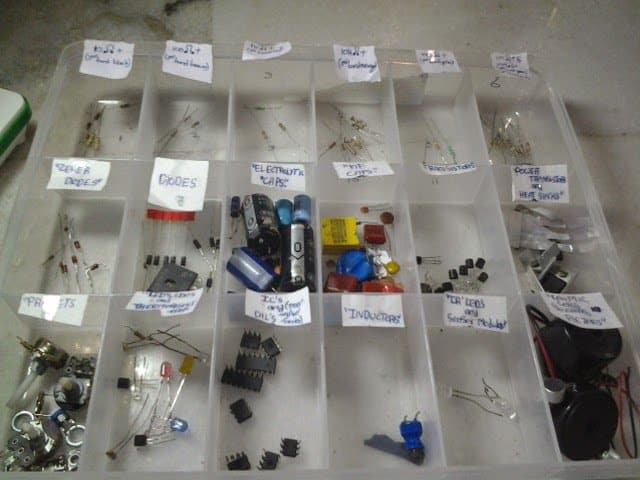
Here are the instructions how to store components: First you’ll need a plastic container with 18 divisions in it. It will look like this:
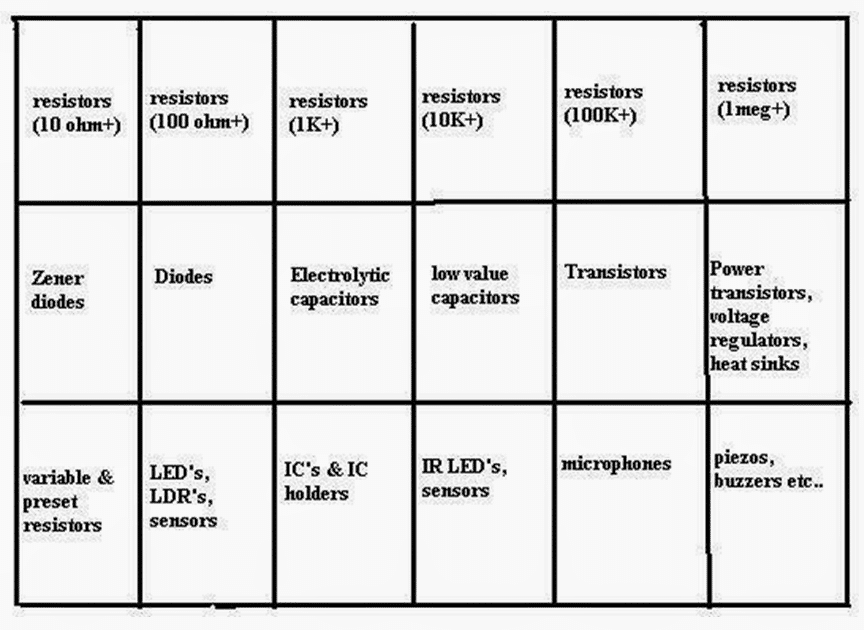
Next keep all the components in the box in this manner:
After filling the box, with all the components, take another plastic container and use it for storing relays, switches and other bigger components which you may have to get in future for making bigger circuits.
After completing the procedures it will look like this:
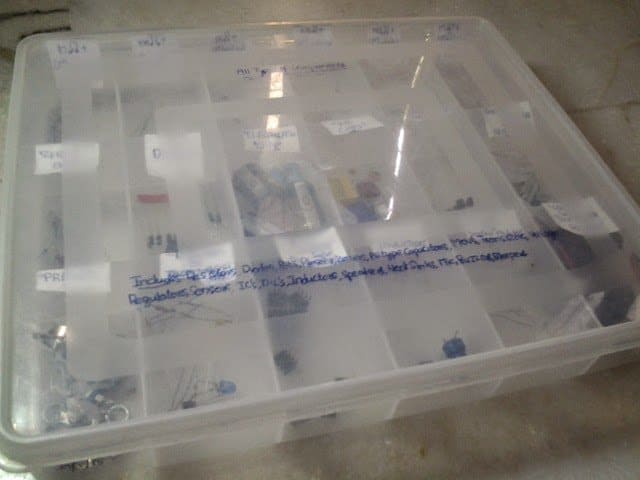
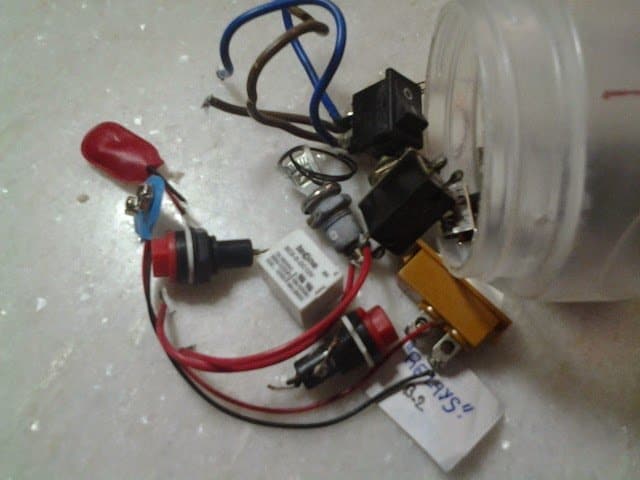
You can write the name of components present in a box and stick the paper to the respective box using sticky tape as shown in the above picture.
Now you are ready to start with basic circuits. You can find plenty of easy circuits from this blog. Good Luck!
Written and Submitted by: SS Kopparthy

Comments
we want to make one bicycle that produces our home electricity through peddling.
can you help us to choose which rating dc battery and generator is best?
The battery and generator rating will depend on the max electrical load of your home.
Dear sir ,
Whats is the best Laser Printer to buy to make DIY PCB'S?
Dear Satheesh, sorry I have no idea about it….
great.. 🙂
Hi swagatam!
I have started with electronics not too long ago, I always have been fascinated of how electronic components worked, I started with one container with the basic components, now i am up to 4, i collect broken tv's radio's etc,etc salvaging parts that i may need for any future projects, I have been a constant reader since the day i found your blog!
Thanks for everything!
Hi, thats really a good way to get components…….in beginning stages, in the above pictures, I too collected most of the components from damaged power supplies of desktop, damaged printers, UPS etc. Good luck.
Hi Vasilis, I too started in the same manner by salvaging parts from old radios, tape-recorders etc way back in my school days….
I very much appreciate your interest and thank you for being a dedicated visitor to my blog.