• Skip to main content
  • Skip to primary sidebar

Homemade Circuit Projects

Need circuit help? Post them in the comments! I've answered over 50,000!

Blog | Categories | About | Contact | Calculators-online
You are here: Home / Energy from Magnets / Make a Football Electricity Generator Circuit

DIY Circuits | Learn Basics | Arduino Coding

Make a Football Electricity Generator Circuit

Last Updated on January 3, 2024 by Swagatam 5 Comments

The explained football electricity generator circuit was developed by me in response to the request sent by one of the readers Mr.Bright.

Though I am not sure if the explained concept would actually give the intended results, it's worth trying as it's quite easy to understand and build.

Designing the Generator

There were three things that I had to consider while designing the circuit, firstly the circuit should be easy and cheap to build, second, should be reasonably efficient and thirdly it should be well aligned such that it does not disturb the ball dynamics while playing.

We are all familiar with Faraday's law of electromagnetism which says that when a when a conductor is subjected to a varying magnetic field, a flow of current is initiated in te conductor.

The above principle has been exploited here for generating electricity inside a football where the process starts when the ball is kicked or while the ball is rolling on the ground.

How the Coils and Magnets are Assembled inside the Ball

As shown in the figure, a magnet and a copper wire coil arrangement has been neatly assembled inside a polished plastic tube.
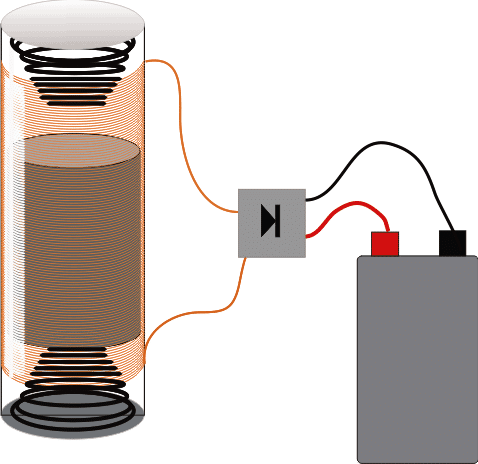
The tube encloses a cylindrical magnet having a north (N) and south (S) pole over its ends. The magnet diameter and the internal tube diameter are chosen such that the magnet just slides inside the tube freely without wobbling sideways much.

The tube top and bottom portions are sealed with lids having a low tension spring fixed inward for facilitating a bouncy effect to the jumping magnet.

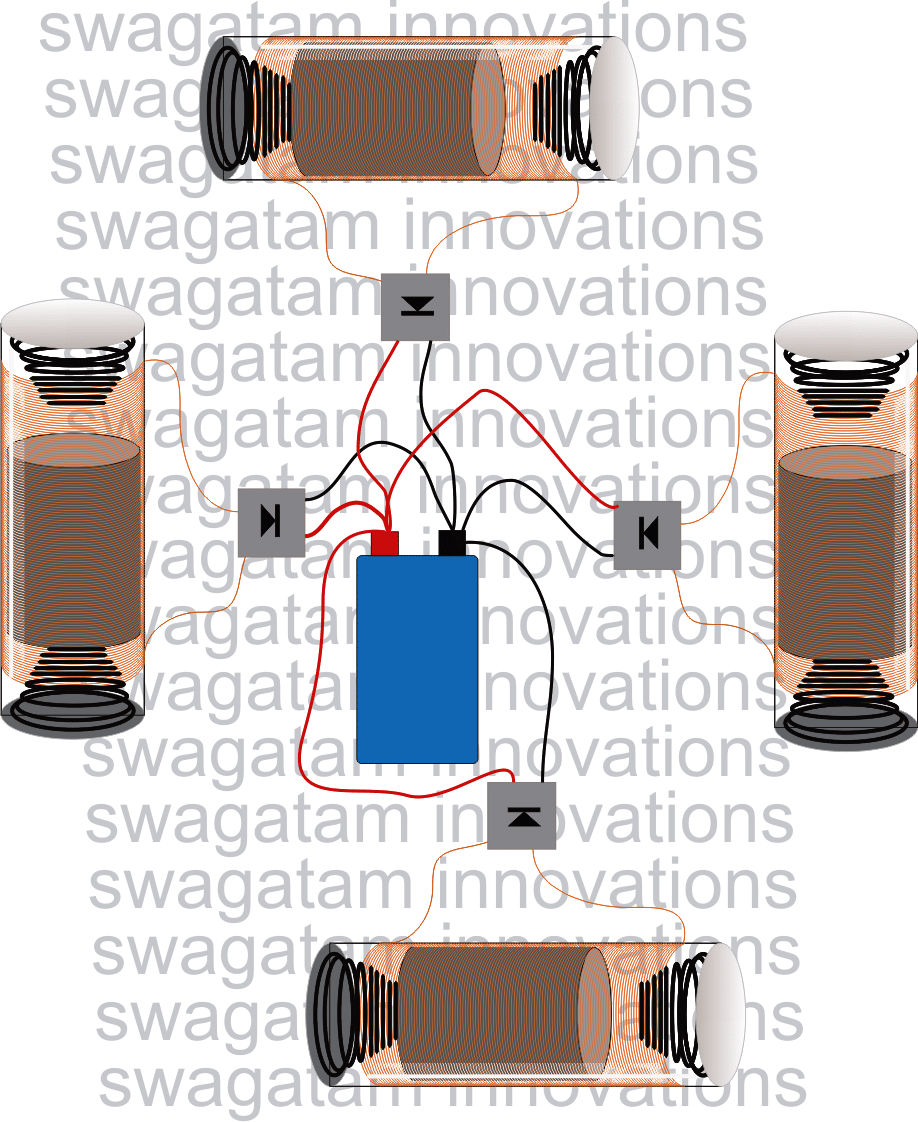
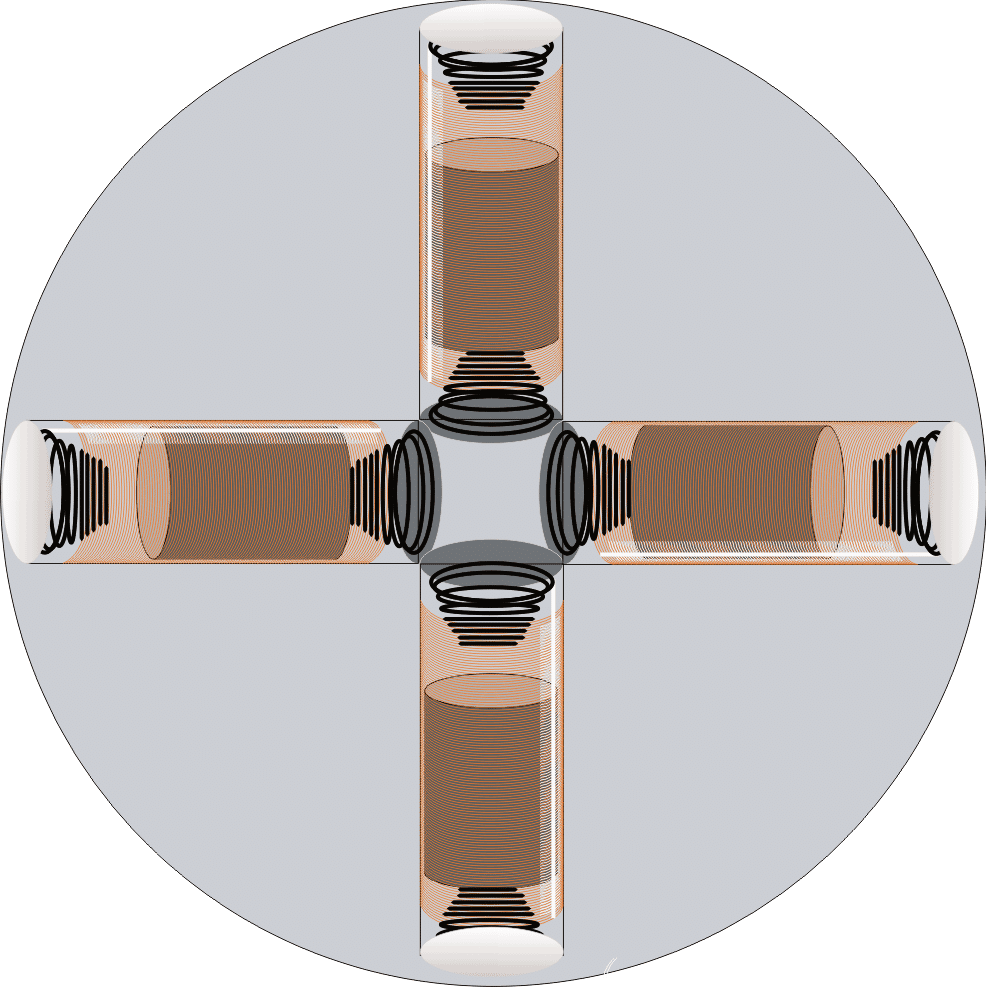
Four such assemblies are positioned perpendicular to each other inside the football for keeping a uniform alignment to the ball and its dynamics.

The coil wire terminals from each assembly is connected to individual bridge rectifiers and the outputs from all the bridge rectifiers are appropriately connected to a correctly rated battery, either a Li-Ion or Ni-Cd.

The whole assembly along with the battery is then neatly framed and securely fixed inside a football.
What Happens when the Football is Kicked

Now if the ball is kicked, a strong vibrational motion is delivered to all the magnets inside the tubes which start oscillating to and fro, giving rise to the Faraday's effect, inducing electricity across all the coils.

The above process would continue even while the ball roles over the ground.

The generated voltage across all theses coils is finally applied to the battery which hopefully starst getting charged as per the expectations.

The battery output is terminated out from the ball through some sort of plug-in arrangement made over the ball itself which cleanly merges with the ball diametric curve without distorting it's shape.

A small LED lamp would then light up using the charge from the football battery, once it gets charged after a good play session.

You'll also like:

  • tenns ball throwing machine circuit compressedTennis Ball Throwing Machine Circuit
  • another close up of sec tower 1Building a Sec Exciter – By Steven Chiverton
  • test2BcircuitMotionless Electromagnetic Generator (MEG)
  • 2Making an Inductive Generator Using two Motors

Filed Under: Energy from Magnets, Games and Sports Projects Tagged With: Electricity, Football, Generator

About Swagatam

I am an electronics engineer and doing practical hands-on work from more than 15 years now. Building real circuits, testing them and also making PCB layouts by myself. I really love doing all these things like inventing something new, designing electronics and also helping other people like hobby guys who want to make their own cool circuits at home.

And that is the main reason why I started this website homemade-circuits.com, to share different types of circuit ideas..

If you are having any kind of doubt or question related to circuits then just write down your question in the comment box below, I am like always checking, so I guarantee I will reply you for sure!

Previous Post: « 5 Best 6V 4Ah Automatic Battery Charger Circuits Using Relay and MOSFET
Next Post: Battery Charger Problems Troubleshooting Discussed »

Reader Interactions

Comments

Vibin Vijay says:
April 8, 2017 at 9:36 am

Can I go ahead with this project for my exam?

Reply
Swagatam says:
April 8, 2017 at 11:08 am

Vibin, you can go ahead with this project there's nothing critical about the design, you can first build the following and then implement it in the ball

https://www.homemade-circuits.com/2016/11/shake-powered-flashlight-circuit.html

Reply
Vibin Vijay says:
April 8, 2017 at 9:05 am

Sir, what is the length of the magnet used?

Reply
Unknown says:
April 8, 2017 at 9:03 am

Do anybody got the result?

Reply
Unknown says:
April 8, 2017 at 9:03 am

Do anybody got the result?

Reply

Need Help? Please Leave a Comment! We value your input—Kindly keep it relevant to the above topic! Cancel reply

Your email address will not be published. Required fields are marked *

Primary Sidebar

circuit simulator image

Subscribe to get New Circuits in your Email

Categories

  • Arduino Projects (95)
  • Audio and Amplifier Projects (133)
  • Automation Projects (18)
  • Automobile Electronics (103)
  • Battery Charger Circuits (87)
  • Datasheets and Components (109)
  • Electronics Theory (149)
  • Energy from Magnets (27)
  • Games and Sports Projects (11)
  • Grid and 3-Phase (20)
  • Health related Projects (27)
  • Home Electrical Circuits (13)
  • Indicator Circuits (16)
  • Inverter Circuits (95)
  • Lamps and Lights (159)
  • Meters and Testers (71)
  • Mini Projects (28)
  • Motor Controller (68)
  • Oscillator Circuits (28)
  • Pets and Pests (15)
  • Power Supply Circuits (91)
  • Remote Control Circuits (50)
  • Renewable Energy (12)
  • Security and Alarm (64)
  • Sensors and Detectors (106)
  • SMPS and Converters (34)
  • Solar Controller Circuits (60)
  • Temperature Controllers (43)
  • Timer and Delay Relay (49)
  • Voltage Control and Protection (42)
  • Water Controller (37)
  • Wireless Circuits (31)

Other Links

  • Privacy Policy
  • Cookie Policy
  • Disclaimer
  • Copyright
  • Videos
  • Sitemap

People also Search

555 Circuits | 741 Circuits | LM324 Circuits | LM338 Circuits | 4017 Circuits | Ultrasonic Projects | SMPS Projects | Christmas Projects | MOSFETs | Radio Circuits | Laser Circuits | PIR Projects |

Social Profiles

  • Twitter
  • YouTube
  • Instagram
  • Pinterest
  • My Facebook-Page
  • Stack Exchange
  • Linkedin

Recent Comments

  • Swagatam on HX710B Air Pressure Sensor Datasheet, How to Connect
  • Swagatam on Boost Converter Calculator (Non-Isolated)
  • Swagatam on How to Make Dog Barking Preventer Circuit using High Frequency Deterrence
  • NgPark on Boost Converter Calculator (Non-Isolated)
  • Yogesh on How to Make Dog Barking Preventer Circuit using High Frequency Deterrence

© 2026 · Swagatam Innovations