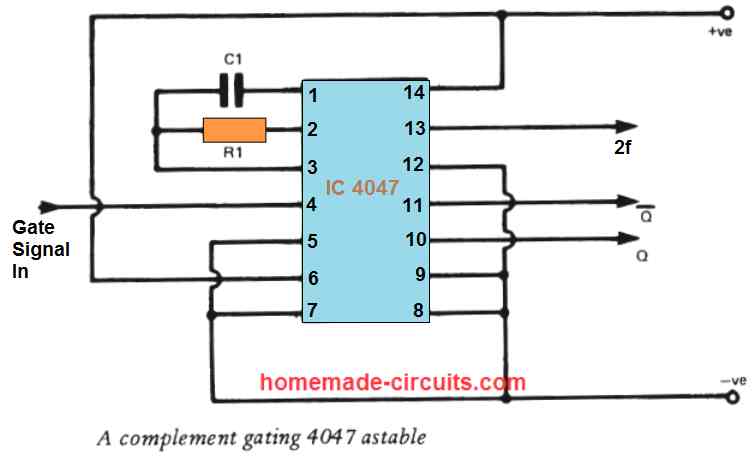
In an IC 4047 astable oscillator circuit, the output of the IC continuously generates a switching ON/OFF signal. Since the output is never in a stable state and constantly switches between and low and high, it is called an astable multivibrator. The astable ON/OFF switching frequency is adjustable and can be varied by changing the […]
Astable
Transistor Multivibrator Circuits [Astable, Bistable, Monostable]
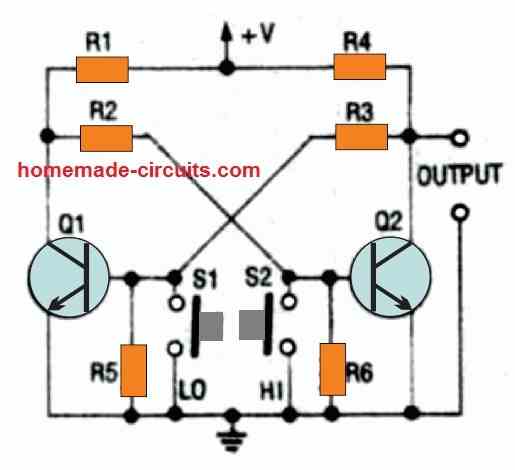
A transistor or BJT multivibrator is a two-stage switching circuit that is configured in a cross-coupled manner. This allows each of the active BJT stages to be regeneratively cross-coupled with the other BJT stage, so that one switches ON when the other switches OFF, and vice versa. This cross-coupling may be set up to switch either a […]
CMOS Astable, Bistable, Monostable Circuits Explained
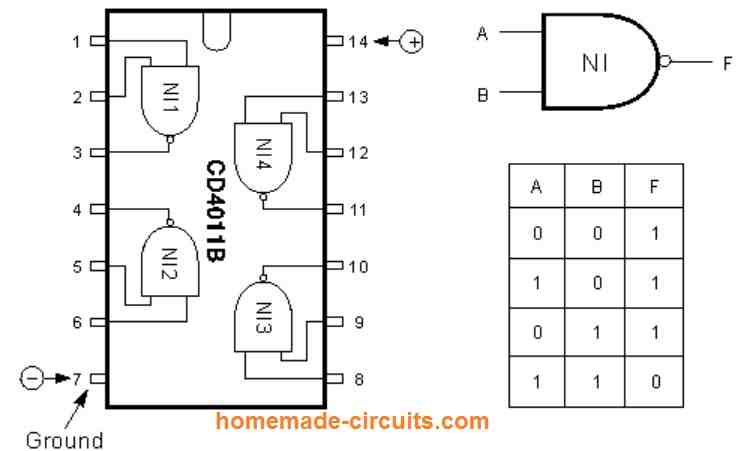
In this article I have explained how to use the low-cost CD4001 and CD4011 quad 2-input gate CMOS integrated circuits in bistable, astable, and monostable multivibrator applications through forty different manners. We also learn how to enhance and modify these configurations to produce highly improved outputs from these multivibrators. When CMOS logic gates are configured […]
IC 555 Astable Multivibrator Circuits
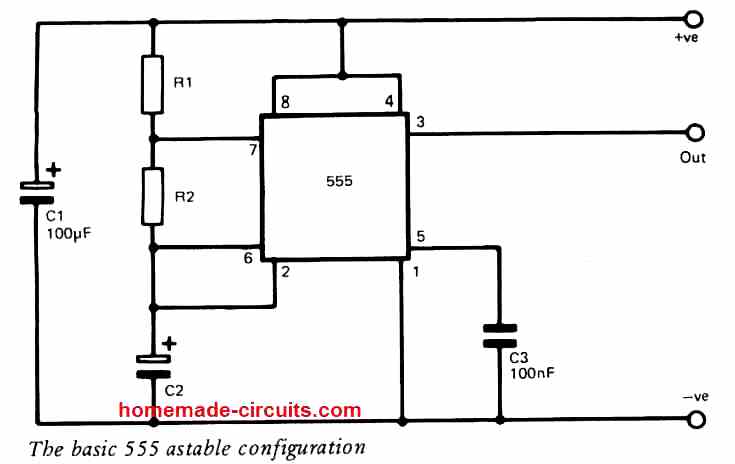
The IC 555 astable multivibrator is a configuration where the IC 555 output continuously switches between an ON state and an OFF state at a given frequency, determined by its RC timing components. Since in this configuration, the output of the IC 555 is never in a stable state, it is called an astable multivibrator. […]
Astable Multivibrator Circuit Using NAND Gates
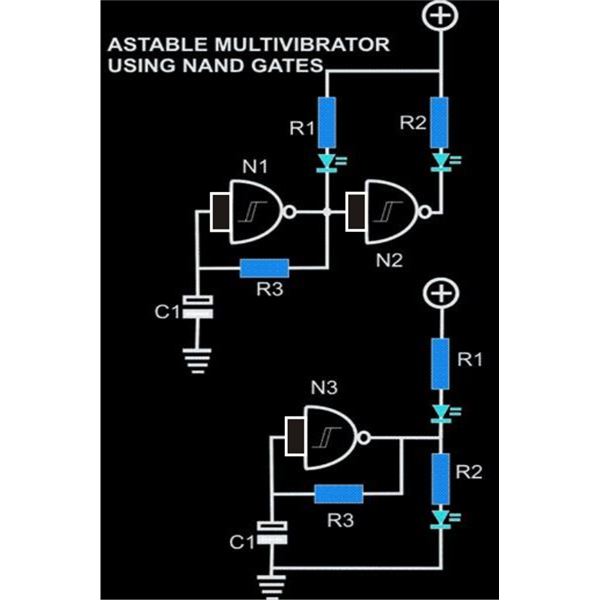
An astable multivibrator is referred to an electronic configuration which is able to generate continuous alternate high and low pulses from a couple of outputs, operating in tandem. Why IC 4093 You might have well come across such astable circuits using a couple of transistors, a couple of capacitors and a few resistors.However more simpler […]