This calculator helps us to:
- Find the resonant frequency if we know the capacitance and inductance values.
- Or find the capacitance if we know the frequency and inductance.
- Or find the inductance if we know the frequency and capacitance.
What is LC Resonance
So LC resonance happens when we connect a capacitor (C) and an inductor (L) together in a circuit either in series or in parallel. This thing starts to behave like a kind of natural oscillator. It keeps charging and discharging energy between the capacitor and coil, back and forth like a swinging pendulum.
That swinging frequency where this energy goes round and round perfectly, is called the resonant frequency.
At this point both C and L cancel out each other’s reactance and the circuit allows signals to pass super efficiently at that one special frequency.
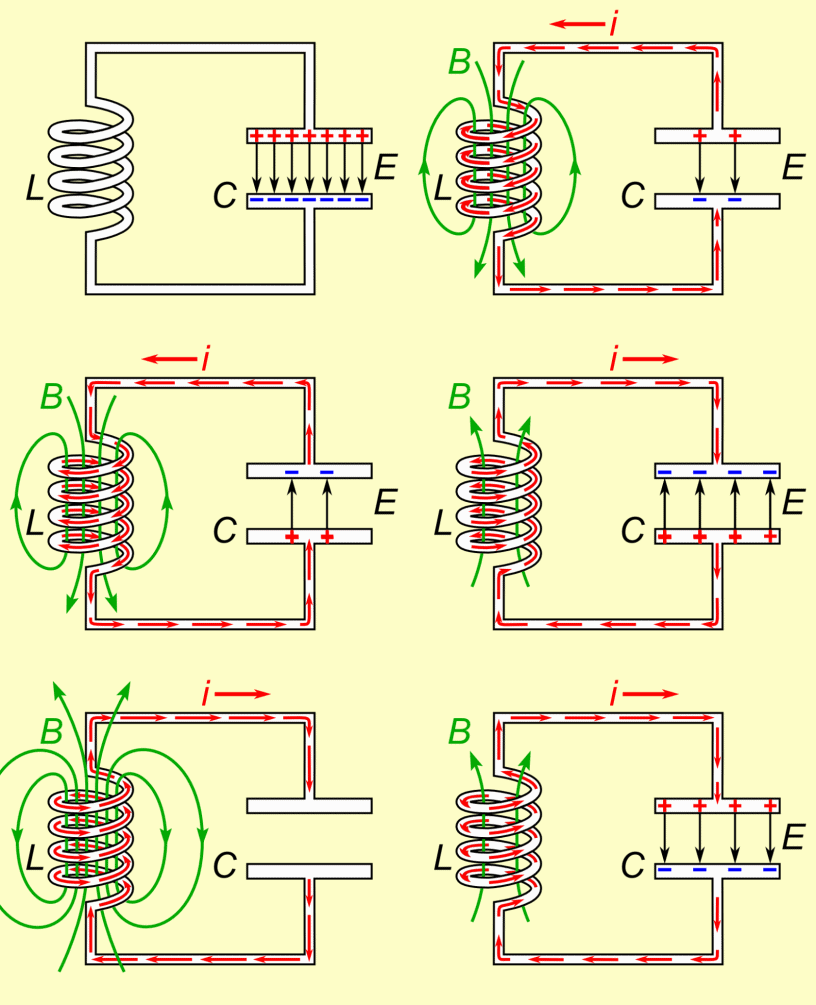
Breakdown:
- Capacitor stores energy as electric field.
- Inductor stores energy as magnetic field.
- When you connect them, one throws the energy to the other and back again.
- This creates a natural oscillation at one fixed frequency.
LC Resonance Calculator
How to Use This Calculator
So just do this step-by-step:
Step 1: Choose what you already know
Like:
Do you already have a capacitor and coil? Then pick:
- Value 1: 0.1
- Unit 1: Capacitance (µF)
- Value 2: 10
- Unit 2: Inductance (µH)
Or maybe:
You want a frequency of 100 kHz and you have a 0.01 µF cap? Then do:
- Value 1: 100000
- Unit 1: Frequency (Hz)
- Value 2: 0.01
- Unit 2: Capacitance (µF)
Step 2: Press "Calculate Unknown" button
Then it will show:
- If you gave L and C, it gives you Frequency.
- If you gave f and L, it gives you Capacitance.
- If you gave f and C, it gives you Inductance.
What Formula It Uses
Here is the main thing, this calculator uses this famous LC resonance formula:
f = 1 / (2π√(L × C))Where:
- f is frequency in Hertz.
- L is inductance in Henry.
- C is capacitance in Farad..
It rearranges this formula based on what values you give.
For example:
- If you want to find C then:
C = 1 / (4π²f²L)If you want to find L then:
L = 1 / (4π²f²C)Units Supported:
| Quantity | Supported Units |
|---|---|
| Frequency | Hz (default) |
| Capacitance | µF (default, auto to F) |
| Inductance | µH (default, auto to H) |
You can manually convert other units like nF or mH outside if needed.
Tips & Notes to Remember
- Always give only 2 inputs, so 3rd one will be calculated.
- Never give both inputs of the same type (like Cap and Cap)... it will show error.
- If your result comes in exponential (like 2.3e-7 F) then that means it is very small value, just multiply and convert:
- Example:
2.3e-7 F = 0.23 µF
- Example:
- Capacitance values usually go in µF, nF, or pF.
- Inductance values are in µH or mH for small coils.
- Use ceramic or film caps for high freq LC tanks.
- Avoid electrolytic caps in resonance circuits.
Comments
Hello Swagatam Sir,
Thanks for such a nicely explained concepts with necessary formulae and calculation. I am looking for a design of induction cookware suitable for restaurants. These are of the order of 15KW, 3 phase system. Do you already have such a working control system HW/SW that you can help me with please.
Thank you Satish, Glad you liked the above calculator.
However, unfortunately I do not have a 15 kW 3 phase induction heater circuit because that will require a lot of calculations and i do not have the necessary information for all those calculations.
Proszę o konverter SWG-mm
Pozdrawiam
Sorry, I do not have a SWG-mm converter software with me at this time.
PS. caps size is 4700 mf for power supply.
I am curious as to the resonant frequencies of a 120/100 volt power supply rectified to DC then using an CLC filter. is a resonant frequency of 4.238 a good frequency to have as i am trying to attain a very flat dc output at under 2 amps. L is a laminated silicon iron core 6″ L x 2.25 W x .75 H @ ruffly 300 to 500 mh.
Thank you in advance.
Please use the above software to calculate it…
Hello Swagadam
Please help, I want to make my Inductor to be installed on my generator (my output is square wave at Ic555, i need a formula
Of how to compute the henry in order to achieved Sine Wave.
Thank you
Romeo
Hello Romeo, I have not yet investigated inductor filters so I do not have the formulas with me right now, but I think you can use RC networks instead for the same results.
By the way for what application do you need this?
Hi Swagatam,
Thank you for promt reply
This application for a 12-0-12/240 AC volts transformer.
Can you send me diagram of RC networks for ic555 or 4017
Supply volts 12 to 15 volts for ic555 output pin 3 im using 2n3055 and 2n2222.
Thank you very much.
Romeo
study ic 8038 wave form generator .
Hi Romeo, you can try the following RC filter circuit for converting square wave into sine wavform. But please remember that the RC values will need to be adjusted as per the input frequency:
https://www.homemade-circuits.com/wp-content/uploads/2019/04/square-wave-to-sinewave.jpg
Hi Swagatam,
Many Thanks
My frequency range would be 60hz/65 on 220/240 vac
Lastly is this diagram you uploads is for left and right output connection of 12-0-12 transformer.
Best Regards,
Romeo
Hi Swagatam,
Yes it is inverter and i used ic555 and a transformer 12-0-12/230 vac
Thanks
Romeo
I am sorry Romeo, a sine wave input cannot be used from the DC side for an inverter…you will have to use an SPWM at the DC side and then refine the output on the AC side with LC filter or simply with capacitors.
Hi Romeo,
Can you please tell what exactly are you trying to make, is it an inverter? If it’s an inverter then this concept will not work.
I provided this for converting your IC 555 square wave into sine wave!
Hi swagadam,
i am moha, i really appriciated to you doing very good guidence upcoming engineers inspriation.
i need some information about transformers core max saturated frequency like Iron core, ferite core
pls reply and thankful to you
Thank you Moha,
I am not sure about the exact frequency range for these variants, but it seems 20 to 200 Hz is suitable for iron core coils and 10kHz to 100kHz for ferrite based coils.