
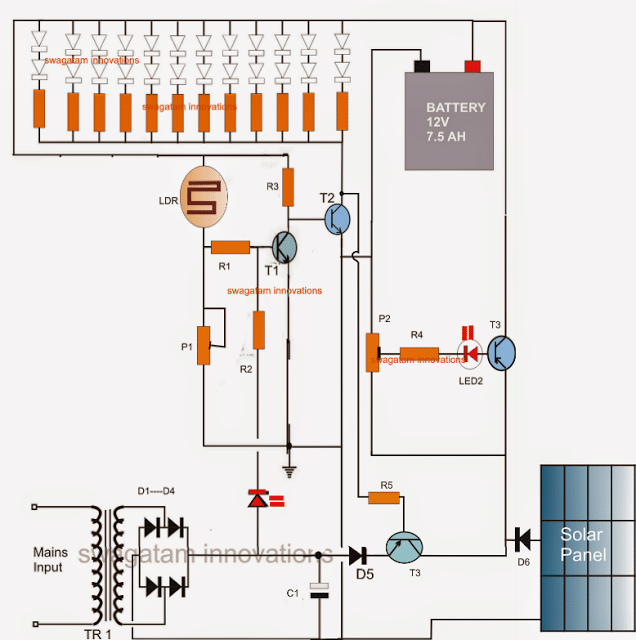
The following LED emergency light with battery over charge protection feature circuit was designed by me in response to the request sent by PP.
Main Features
In this article I have explained an LED emergency light circuit with advanced features such as,
- over charge battery cut off,
- day time auto-disable,
- and need less to say that the circuit switches ON the LEDs automatically when AC mains fails and reverts to charging mode when power is restored.
- The good thing about this circuit is that it incorporates ordinary, cheap components which can be easily procured from the local market.
Using Transistors only
The following design of the proposed day/night automatic emergency LED lamp circuit with battery overcharging protection uses only BJTs and looks indeed very simple. Let's understand how it works:

How it Works
Mains AC To DC Power Supply
We first see that the circuit starts with a small 0-12V transformer. We take the 220V AC and we let the transformer drop it to around 12V AC, then we send this AC through four 1N4007 diodes which make a full bridge rectifier.
So the AC becomes DC here, then the 1000uF capacitor smooths the DC and removes the ripples. So now we get around 14V to 16V DC during no load.
This DC is used for battery charging and also used as the signal which tells the circuit that mains is present.
LDR Light Sensor Section
We also see an LDR with a 10k resistor and a BC547 transistor, so this part senses darkness.
When the LDR receives light then the LDR resistance becomes low and that pulls the BC547 base high so the BC547 switches ON.
Conversely when it is night then the LDR resistance becomes high and that allows the BC547 base potential to fall, so BC547 turns OFF.
This OFF allows a positive biasing signal towards the TIP122 base and turns it ON, so that the LED panel can switch ON, but only when the mains is also absent.
Mains-Fail Detector Section
Now the BC547 transistor with one small LED near the base, this part also tells the circuit that mains is present or not.
So when mains is present then this BC547 becomes ON and it grounds the base of the TIP122, so that means TIP122 cannot turn ON.
So even in full darkness the LED panel will remain OFF as long as mains is present.
When the mains fails then this BC547 becomes OFF and it frees the base of TIP122, so now TIP122 will respond only to the LDR signal, as explained above...
TIP122 LED Driver
We see the TIP122 connected to all the LED strings through 1k at its base, so this is the main battery power switch.
When the LDR section says it is dark and when the mains section says mains is absent then the TIP122 receives base current.
So TIP122 turns ON and it allows the battery voltage to reach the LED panel, and the LEDs glow from the battery. But as soon as light returns or mains returns then the TIP122 switches OFF.
LED Panel
We see many 5mm white LED groups each with 680 ohm resistor. All of them are connected in parallel and all of them get the supply from TIP122. So the brightness is good and stable.
Battery Charging Section
We see the battery being charged through the TIP127 PNP transistor, so the DC from the transformer enters the TIP127 and then reaches the battery.
As long as the battery voltage is low the charging current flows. The BC547 with the preset in the lower right corner senses the battery voltage and controls the corresponding BC5547/TIP127 switch.
Battery Overcharge Cutoff
We see a 10k preset, a BC547 and some 10k resistors, so the preset is adjusted to pick a small sample of the battery voltage.
When the battery voltage reaches the full charge level then the bottom left side BC547 turns ON. When this BC547 turns ON then it pulls the adjoining BC547 base low, turning it OFF, which in turn switches OFF the TIP127 also.
This disconnects the supply to the battery and the battery stops charging.
The small LED near this bottom section shows the charging condition. When charging is happening the LED remains ON, and when the battery becomes full the LED switches off, but this ON/OFF illumination process is gradual and slow.
Complete Summary
Now we can summarize the behavior in simple crude steps.
Day + Mains
When it is day then LDR keeps top BC547 ON, grounding the TIP122 base. Similarly, when mains is present then this same BC547 is ON, grounding the TIP122 base. So in these both conditions TIP122 stays OFF. LEDs are OFF. Battery charges until full.
Daytime light + No Mains
When it is day then LDR keeps the BC547 ON. When mains fails then mains BC547 also becomes OFF. But still TIP122 gets no drive, because of the LDR and day light...So LEDs remain OFF.
Night + Mains
When it is dark then LDR turns the top BC547 OFF. But since mains is present then the mains BC547 has to be ON, so TIP122 base is again grounded. LEDs remain OFF.
Night + No Mains (This is the only time LEDs turn ON)
When it is dark then LDR resistance is high and the top BC547 turns OFF. When mains fails then mains BC547 is OFF. In these two conditions TIP122 gets proper base current. So LED panel turns ON from the battery.
Using IC 555
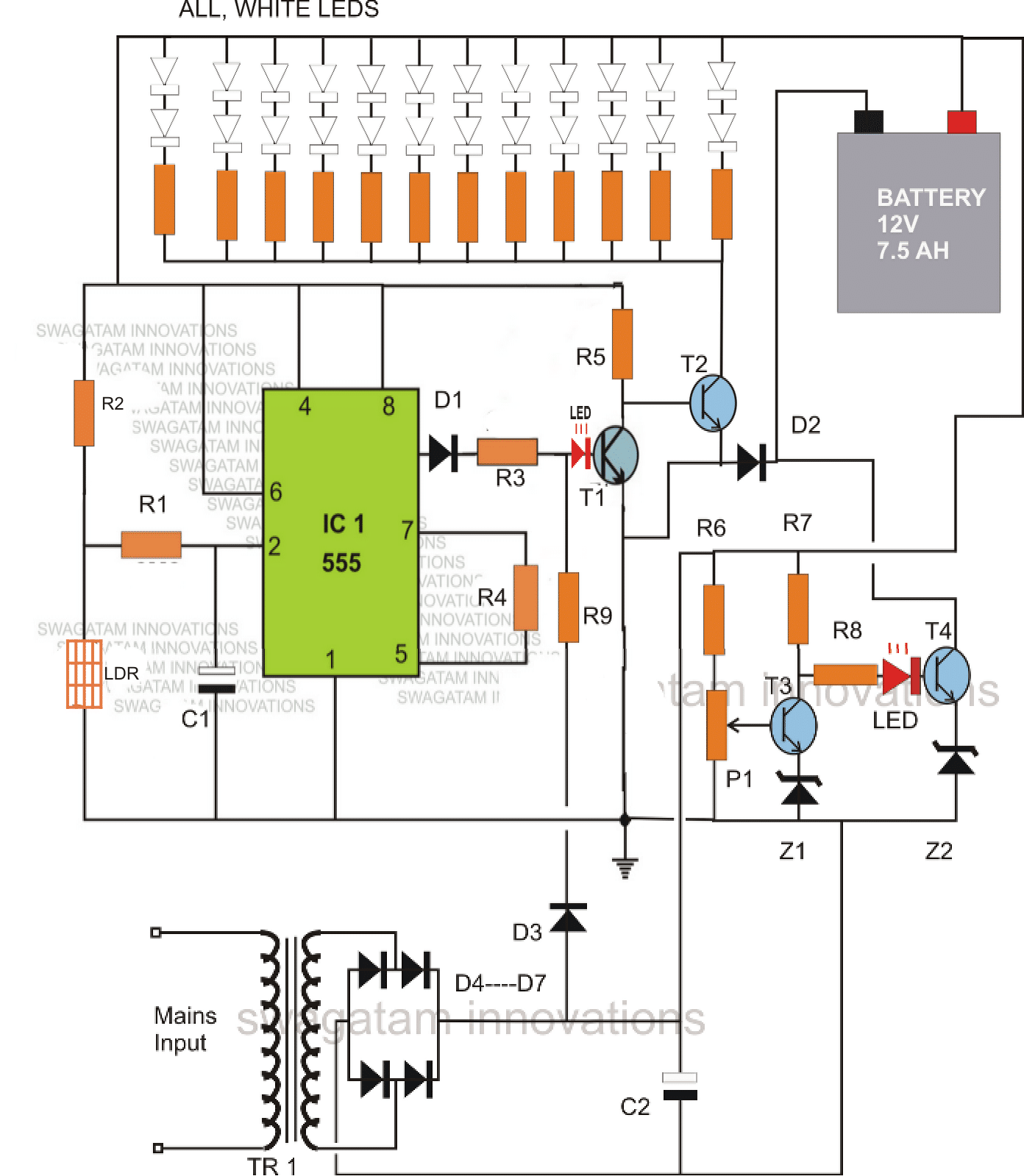
The above circuit can be also built using a 555 IC comparator circuit for sensing the day/night conditions and LED turn ON/OFF switching.
Circuit Operation
Let's try to understand the circuit functioning with the help of the following points:
IC1 which is our very own IC555 has been set as a comparator. During day time, the light over LDR keeps the LDR resistance low such that the potential at pin #2 of the IC is kept well over 1/3Vcc. This situation ensures that the output of the IC at pin #3 stays at logic high.
The logic high at pin#3 of the IC keeps T1 switched ON, which consequently keeps T2 switched OFF.
With T2 switched OFF, the LED array remains inhibited from the ground connection and therefore the whole white LED array also stays shut off.
Another factor that keeps T1 switched ON and T2 switched OFF, is the voltage from the transformer power supply stage.
This function is implemented via the resistor R9. This also means that as long as mains AC is available, T2 is restricted from conducting and therefore the LEDs cannot light up.
Now suppose the mains power to the transformer fails, and assume that this happens during night or complete darkness, pin#3 of IC555 reverts to zero and also there's no voltage from the power supply, means T1 has absolutely no base bias and therefore has to switch OFF.
This instantly prompts T2 to switch ON and consequently the entire LED array also switches ON, providing the required emergency illumination to the surrounding.
MAKE SURE THAT THE LIGHT FROM THE LED DOES NOT FALL OVER THE LDR, WHICH MIGHT TRIGGER A RAPID UNDESIRABLE SWITCHING OF THE LEDS.
The battery charging section consists of T3, T4 and the associated parts. P1 is set such that it switches ON T3 when the battery voltage reaches just above 14 volts.
The moment this happens, T4 switches OFF, cutting of the negative supply to the battery and restricting any further charging of the battery.
Diode D2 ensures that the battery receives the negative supply during the charging process only through T4 and also provides a normal negative path to to T2 and the LED array when they conduct.
The left side LED indicates, mains power ON or presence of day light.
The LED at the right side indicates, battery is charging.
Parts List
- R1 = 2M2
- R2 = 1M
- R3, R4, R5, R9, R6, R7, R8 = 4K7
- ALL LED RESISTORS = 330 OHMS
- D1, D2, D3 = 1N4007
- D4----D7 = 1N5402
- C1 = 1000uF/25V
- C2 = 1uF/25V
- T1, T3 = BC547
- T4, T2 = BD139
- Z1, Z2 = 3V/400mW
- P1 = 10K PRESET
- IC1 = IC 555
- TRANSFORMER = 12V, CURRENT = 1/10 OF BATTERY AH
- LEDS = WHITE 5mm, OR AS PER CHOICE.
- BATTERY = 12V, AH = AS PER LED POWER AND BACK-UP REQUIREMENTS.
Using a Single PNP BJT
The above circuit can be much simplified by eliminating the IC555, and by using just a single PNP transistor instead of two NPN in the battery auto-battery cut of section.
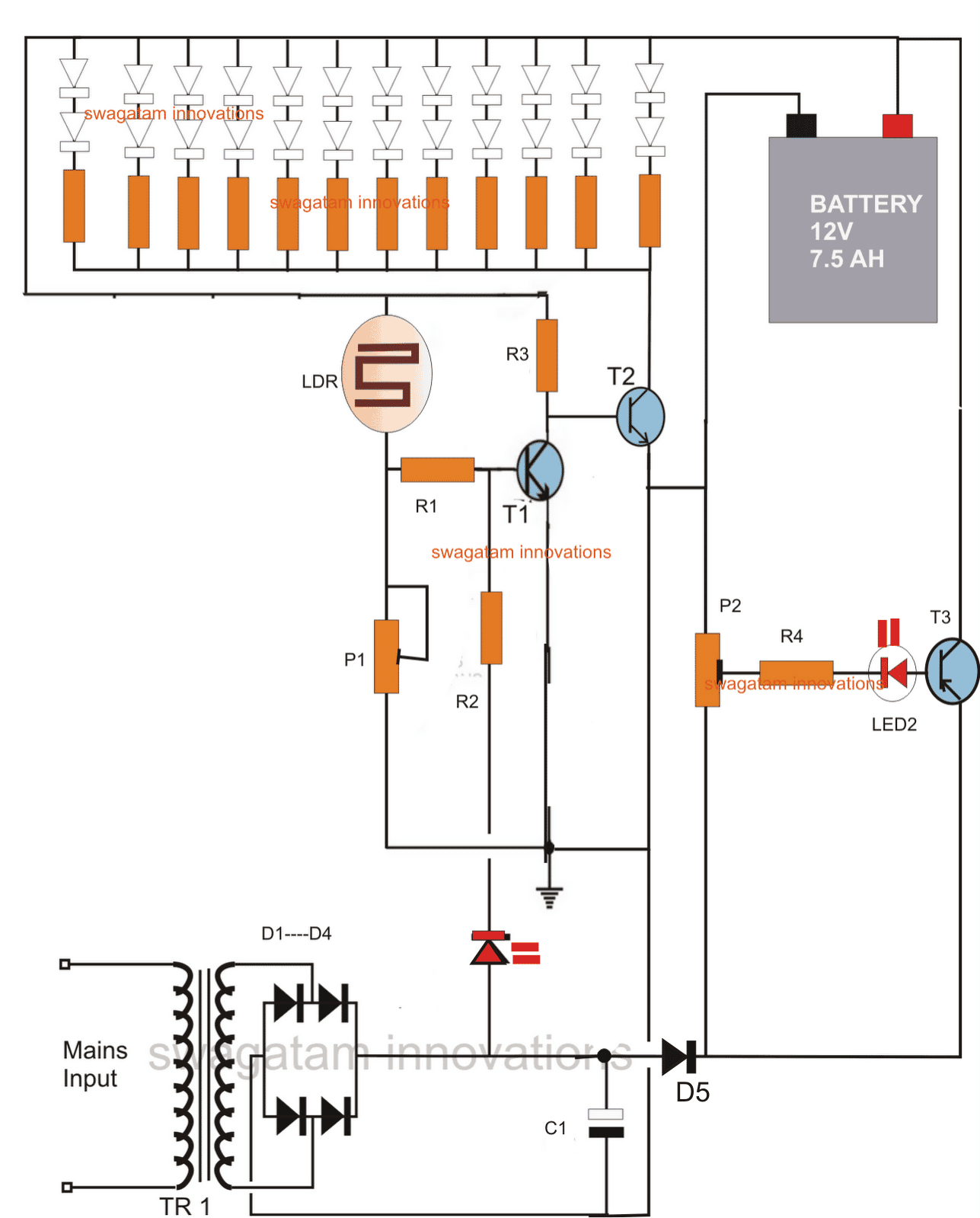
P1 is used for adjusting the ambient light threshold at which the LEDs stop illuminating.
P2 is set such that at 14.6V (across the battery terminals) the base LED becomes very dim, hardly visible, and at 12.5V it's brightly lit.
Adding a Solar Panel
The above circuit can be also coupled with a solar panel for getting an automatic charging facility from both the sources that is from the panel during day time and from mains after the sun sets.
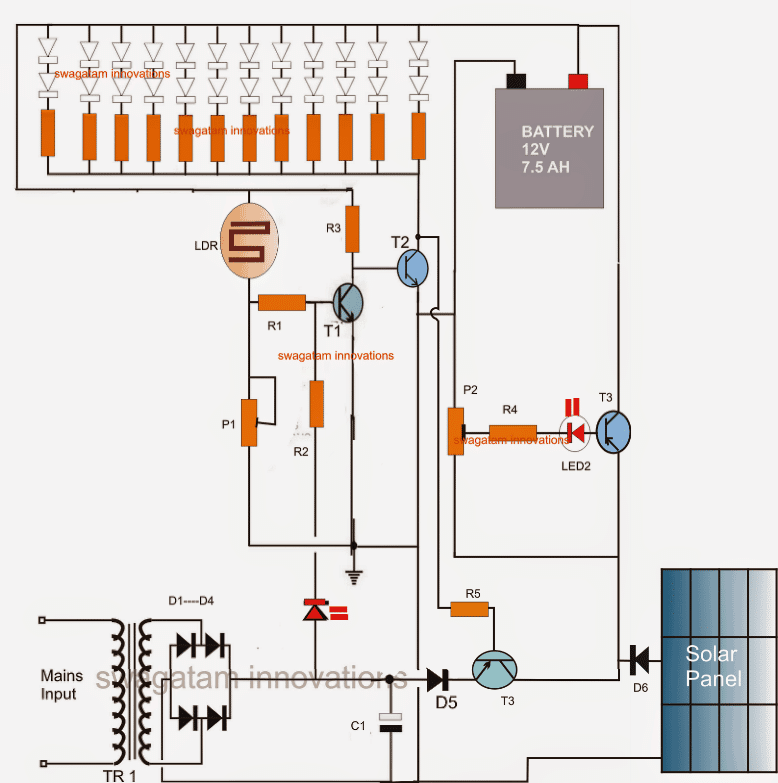
Parts List
R1,R2,R3, R4, R5 = 1K
P1 = 470K
P2 = 1K
C1 = 1000uF/25V
D1---D5 = 1N4007
T1 = BC547
T2 = 8050
T3 = TIP127
ALL LED RESISTORS = 330 OHMS
LEDS = WHITE, 5MM
LDR = ANY STANDARD TYPE
TRANSFORMER = 0-12/1AMP